
Marque Down
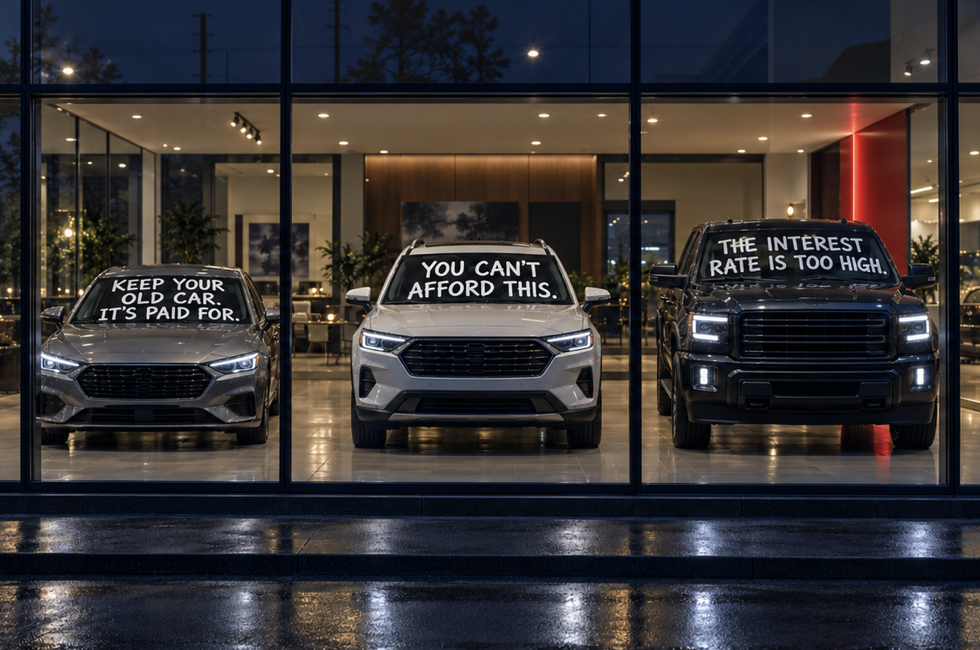
The warning signs are already there. What happens when the forces reshaping the car business reach motorsport?
Paul Pfanner has watched an energy shock rewrite the car business before, and watched the old order fall once from a hotel window in Detroit. He sees the pattern forming again. The first in a run of columns on what the paddock would rather not discuss, starting with why a bond market, a Porsche balance sheet, and the price of a barrel are one story.
You didn't want to read about this when I posted a Shift Happens essay titled "Instrument Failure" in the spring of this year. The truth is, I didn't especially want to write it. But the same market signals are stacking up that I saw in early 1974 when I was a shaggy haired kid helping to launch FORMULA magazine out of a race shop during the first energy crisis that led to a deep recession. Since then, I have paid attention to the frequency of the hum in markets beyond racing.
Short version: The car brands you grew up with are being repriced all at once, and the sport that depends on those brands has not gotten the invoice yet.
The first time the fire came through
The 1973 embargo and the 1979 shock did more than cause long lines at the pump and sharply raise the price of a fill-up. They handed the American market to the small, efficient imports and began a slow erosion of Detroit's marques that ran for the better part of two decades. Nobody rang a bell the day it turned. The Big Three looked healthy on paper for years. I was inside the sport while it happened on both occasions, so I know through bitter experience the opening of that story when I see it. I should also point out that I have an uncanny knack for being involved in launches that are perfectly aligned with global economic disruption. That is a bug in my personal destiny programming, not a feature.
The night the old order filed
I have also watched it from up close, and that time I did not read it in time.
OnCars was Bill Sparks's idea, and we built it together, backed by Jay Penske's Mail.com Media (MMC), the company he would grow into today's Penske Media Corp, and by my own money. It was a bet on web video about cars and racing before that was a normal thing to do, mini-documentaries for the carmakers included. That is what I was fighting to keep alive when the financial crisis hit.
This Week On Cars, the weekly news show we produced at OnCars. Our pioneering web video news-update about the car business.
I flew to Detroit to sell our OnCars Studios work to the carmakers. GM filed for bankruptcy that very day, and I landed into it, checking in that night at the hotel inside the Renaissance Center, GM's own headquarters. I could not sleep. Across from me the towers stood half lit past midnight. On the floor across from my room were people who had not gone home. In a conference room, half a dozen of them sat around a table, talking through the night. I have never forgotten it. The next morning I sat in meetings with people whose brands faced radically different futures: Pontiac was being wound down, and Hummer was being put up for sale. Roger Penske, the biggest name in American racing and owner of Penske Automotive Group, was trying to buy Saturn out of the same wreckage that month. Even he could not catch a falling brand.
We had just finished a short video series introducing the brand-new Tesla Model S prototype. Made fast and on a tight budget, it argued that an electric car could be a real-world, everyday car with style plus performance, and not a science project. In every meeting, the moment we mentioned it, no one wanted to see the rest of our work. They wanted to watch that one. The future, playing on a video loop at the old order's funeral.
The Tesla Model S launch video we produced at OnCars in the early 2009, (the original 3-episode series cut into one). This is the future that was playing on a loop at the old order's funeral.
I missed the biggest part until later. The day after GM filed, it announced a proposed sale of Hummer to China's Sichuan Tengzhong. That deal collapsed months later after Chinese regulatory approval was not secured. It is too neat to turn that into a single moment when China chose electric. But looking back, the contrast is hard to miss: we were trying to keep a company alive while carrying a glimpse of the industry's next chapter home on a hard drive. The Hummer deal's aftermath was more complicated than the headline.
What I do now
So now I watch for the shape of it with my teammates Bill Sparks and Bill Long in our Pfanner Advantage consultancy, and when it starts to form I say so early and out loud, to whoever can still act on it. For most of my career the reading was a means to an end, the instinct behind a product launch or a client's next move. Now it is the whole job.
The same fire, still burning
Energy is feeding this round too. I wrote in the spring that the fire had banked, not gone out. By September 21, Brent was above $100 a barrel. Reuters put the November contract at $101.18 at 12:54 GMT, down that day as hopes for talks and easing supply disruption offered some relief. Diplomacy can move the price. It has not removed the risk.
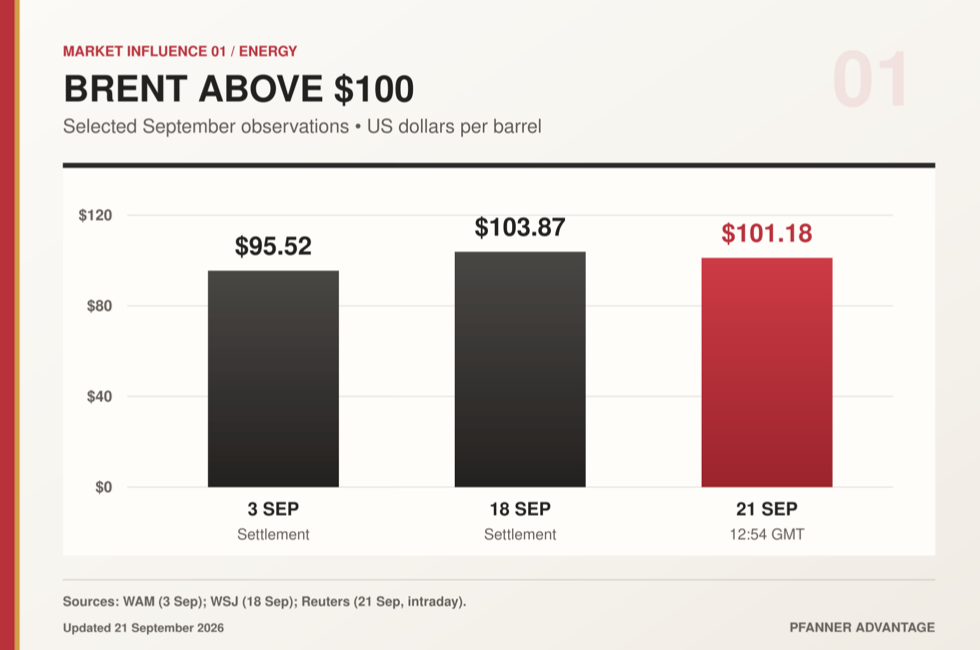
Brent crude: selected September observations. The first two are settlements; September 21 is an intraday quote at 12:54 GMT. These are dated snapshots, not monthly averages. Sources: WAM, The Wall Street Journal, and Reuters.
Look at Porsche. Its group operating profit fell from €5.637 billion in 2024 to €413 million in 2025, a drop of 92.7%. Those are full-year results, not a fresh quarterly collapse. They remain a measure of how much changed in twelve months. Porsche's financial figures.
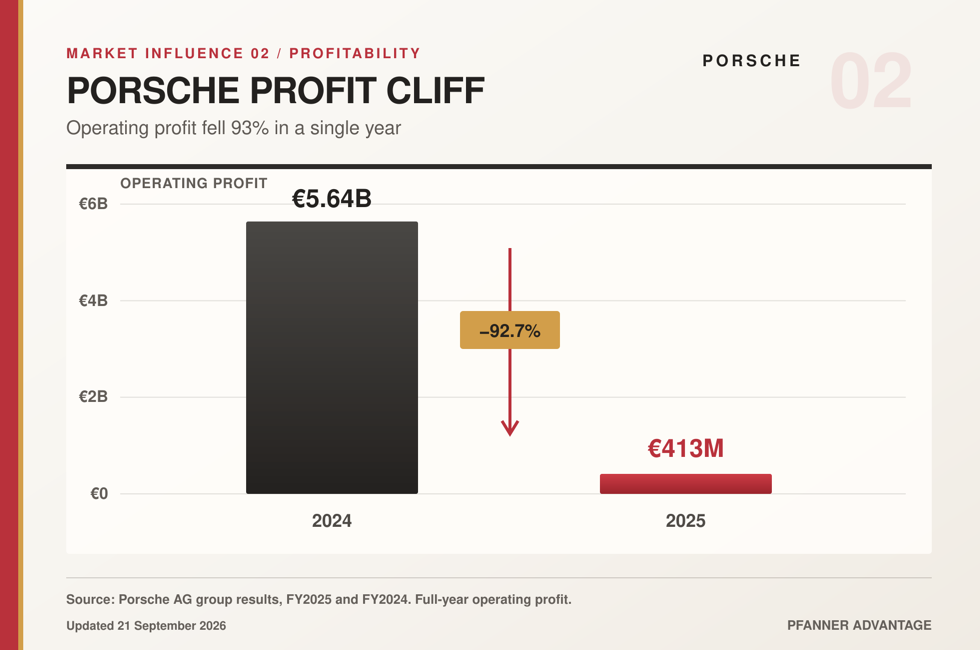
Porsche's group operating profit, 2024 versus 2025. The earlier year's value is rounded to €5.64 billion in the graphic.
China, once the market that carried so much of the brand's growth, has fallen far enough that Porsche delivered fewer cars there than at home in Germany in the first half of 2026: 14,501 against 14,938. China deliveries fell 32% from a year earlier; worldwide deliveries fell 16%. Porsche's first-half delivery report.
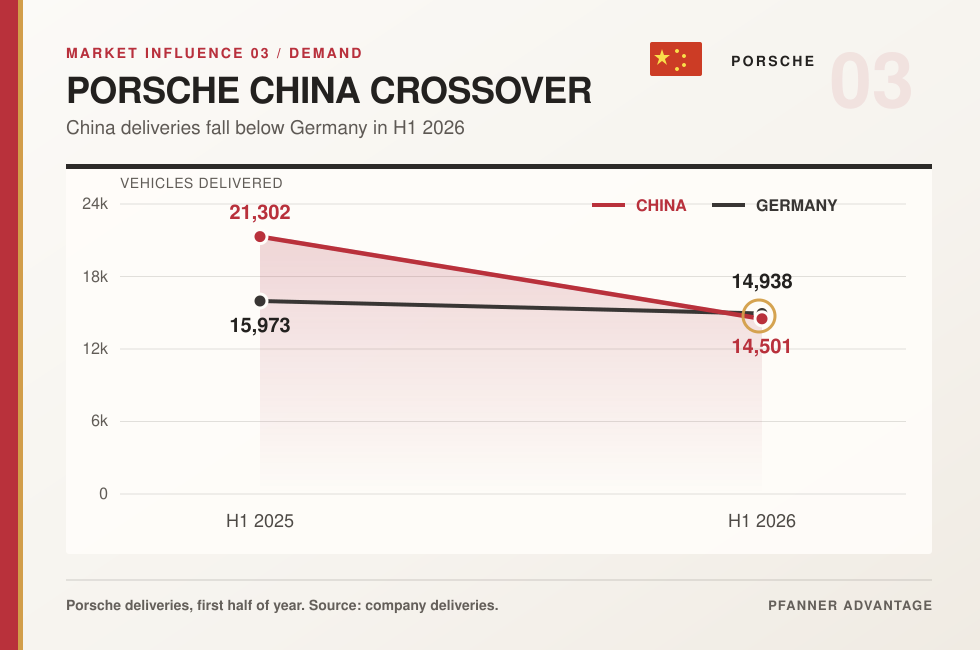
Porsche's first-half deliveries: China fell below Germany in 2026. North America remained the largest reported region.
The restructuring is substantial. Plans announced in July put total job reductions at roughly 9,000 through 2035. On September 21, the chief executive told staff that no further cuts were planned. The timing matters: this is a multiyear reduction, not 9,000 people leaving this week. Reuters, July 27 and September 21.
And the repricing has reached the parent. Volkswagen's September profit warning, tied to Porsche's reset, cut its expected 2026 operating margin to about 1%, from 4% to 5.5%. The Financial Times.
That does not mean Porsche has abandoned electric cars. Deliveries of the electric Cayenne began at the end of June. It means the transition is proving more expensive and less predictable than the original bet allowed for.
A brand rarely gets into trouble in one visible event. Margin, demand, and confidence can erode on different timetables until what looked temporary starts to feel structural. Porsche's recovery is not impossible. But neither is it something the badge guarantees.
Japan's quieter advantage
Toyota tells a different story, but the distinction matters. In April through June 2026, net profit attributable to Toyota rose 75.6% to ¥1.477 trillion. Operating profit fell 8.8% to ¥1.063 trillion, while consolidated vehicle sales declined 0.7% to 2.395 million. A much stronger bottom line and weaker operating earnings can happen in the same quarter. Toyota's quarterly financial summary.
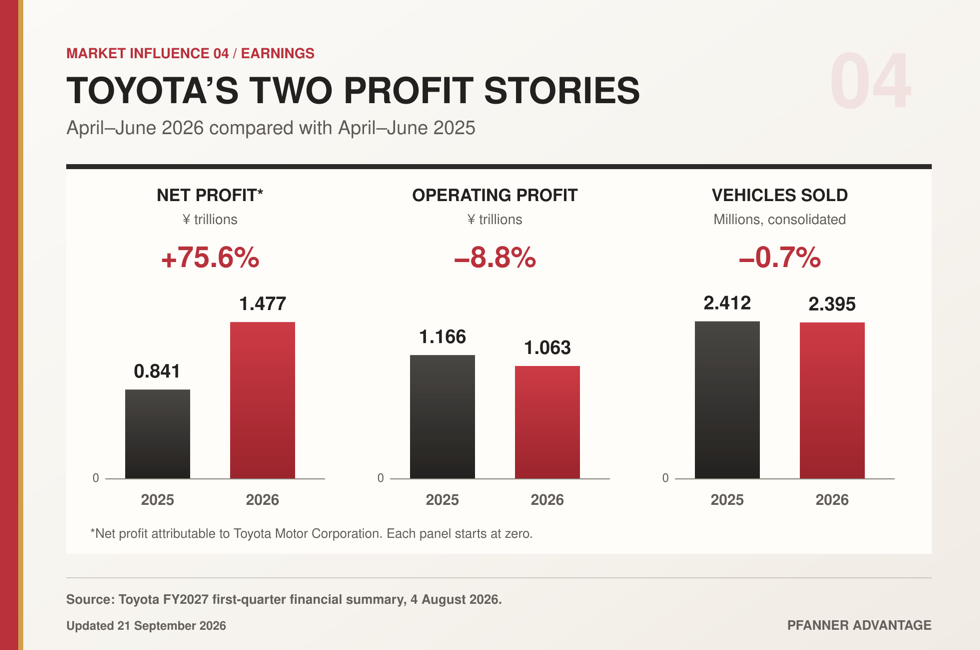
Three measures, one quarter. Net profit is attributable to Toyota Motor Corporation; vehicle sales use the consolidated reporting basis. The comparison is April–June in both years, on an as-reported basis; consolidated scope changed, including Hino’s exclusion.
Currency helped, but saying the weak yen did all the work would flatten the story. Toyota's filing shows a currency benefit to operating earnings alongside substantial cost pressures, while financial income also helped the bottom line. The profit measures are not interchangeable.
The patient hybrid strategy still gives Toyota options. Electrified vehicles represented 55.3% of its reported Toyota and Lexus sales in the quarter, with hybrids providing the great majority. That is a useful position when customers are weighing fuel costs, purchase prices, and charging access at the same time. Toyota's results discussion.
The advantage is flexibility. It is not immunity from costs, competition, or exchange rates. Even the company with more options does not fully control the conditions in which it has to use them.
The buyers are being priced out
Underneath the brand stories is a harder one, about who can still afford a new car. Cox Automotive's standing forecast is about 15.8 million US new-vehicle sales in 2026. A market can keep moving while the price of entry becomes uncomfortable. Cox Automotive's market snapshot.
The August average transaction price was $50,089, up 1.9% from a year earlier. The average sticker price was $51,852. Those are different measures, but neither describes an easy purchase for a household with little room left in the budget. Kelley Blue Book's August price report.
The Cox Automotive/Moody's Analytics affordability index put the typical monthly payment at $770. That was higher than a year earlier, but below the $795 peak in December 2022. Its estimated loan-rate input was 9.49%, modeled for a 72-month fixed-rate loan. Affordability worsened slightly from July but improved 1.2% from August 2025 as incomes rose. August affordability report.
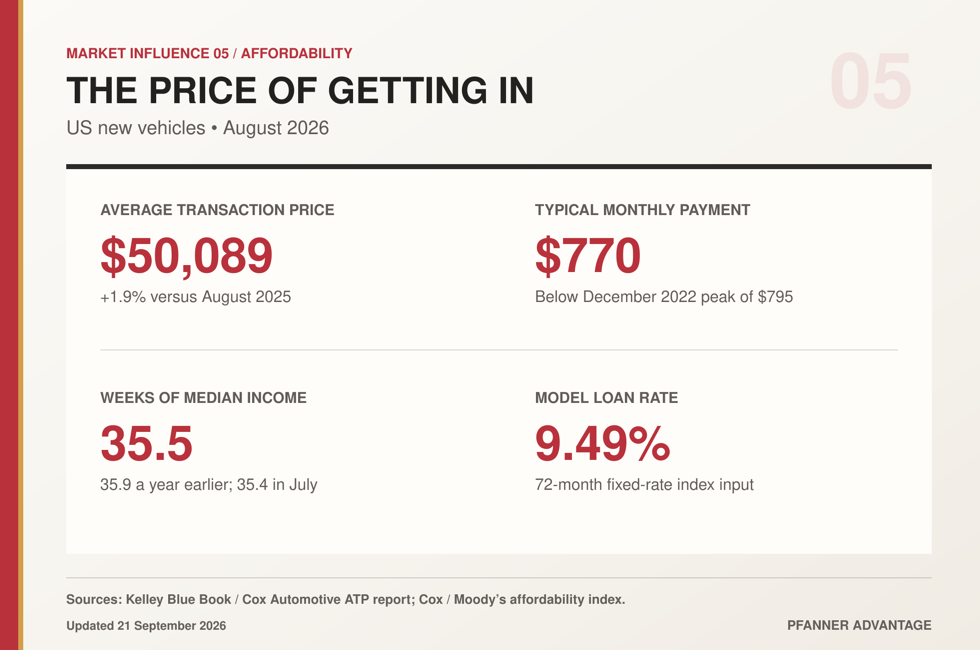
The price of getting into a new vehicle remains high, even with a modest improvement in affordability from a year earlier. The loan rate is an index input, not a universal showroom offer.
That qualification does not make the pressure disappear. A market can become a little more affordable on an index and still feel out of reach to a large part of its audience. My concern is what happens when manufacturers try to protect margins with prices their next generation of customers cannot comfortably pay.
Nor is China's huge market a simple story of uninterrupted growth. July domestic car sales fell 21.1% from a year earlier while exports rose sharply. That is one month's reading, not a full-year verdict, but it shows why competition increasingly travels across borders. Reuters, August 11.
Whoever wins from here will need to put a car the squeezed buyer can afford in the driveway. Prestige and technology will not make that requirement go away.
Who gets to change the rules
Above all of it sits the question of China. The industry that once attracted a proposed buyer for Hummer now produces companies challenging established marques far beyond their home market. BYD launched its Racco electric mini-car in Japan on July 28, taking its competition into a market with demanding customers and deeply established domestic brands. Reuters.
Scale, cost, and the ability to enter someone else's market are already changing the competitive terms. That is its own column, the one I am building toward next. For today, note where this is heading.
Why this is our problem too
During this remarkable period of growth and mainstream appeal, motorsport still has a reason to watch the car business closely. Works teams, engine programs, suppliers, and sponsorship budgets can all depend on decisions made inside manufacturers whose first responsibility is selling road vehicles profitably.
The sport has other sources of money, and the exposure differs by championship and team. But the manufacturer-funded part of the grid does not stand apart from the balance sheets behind it.
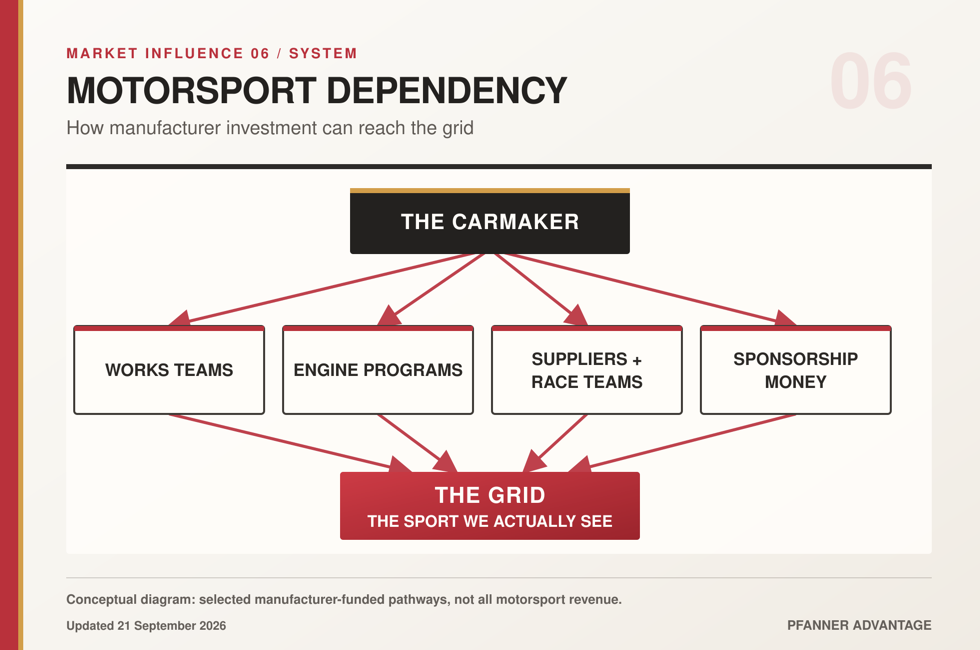
Motorsport sits downstream of the car business. When a carmaker weakens, the pressure runs down the line to the teams.
When a carmaker weakens, teams and suppliers can feel the pressure before fans see a change on the grid. A program does not have to disappear for a smaller budget, a delayed decision, or a reduced commitment to change what is possible. That is the invoice I am watching for.
What comes next
I have kept this on cars, pun intended, and the sport we love, because that is where I can read the signals most clearly. But there is a bigger story underneath all of it. Artificial intelligence is changing what companies invest in and what they expect to get back. How that connects to the cost of money deserves its own column. It is coming soon, because the pace of change can make everything else look like it is running behind the pace car under caution.
A word about why. It seems that I get the most attention when I write about what the next IndyCar ought to be, or good news out of the paddock, and I will keep writing those essays. But that is not all I see, so I am also going to write about the things that are harder to deal with, on a regular schedule, because spotting the uncomfortable subjects early is the only real edge any of us gets.
I do not see these as separate problems. Energy costs, competitive pressure, the buyer's monthly payment, and the budgets behind the grid meet in the same current. I would rather say so now than be proven right later.
Victory travels at the speed of thought. But only if you act decisively.
Publication note: This article was originally published on the Pfanner Communications website on September 6, 2026, and included in the Pfanner Advantage newsletter in the days that followed. For distribution through LinkedIn and social media channels, it has been updated with information available as of September 21, 2026. The original publication date remains unchanged.
Pfanner Advantage works with clients to turn change into advantage at the intersection of mobility, motorsport, media, technology, and marketing. Learn more or start a conversation: contact us today.
Paul Pfanner’s recent Shift Happens Insights:
The Advantage Journal arrives every week. What matters in sport, mobility, media, and technology — curated and contextualized by Bill Sparks, Bill Long, and Paul Pfanner. No hedging. No filler. Subscribe — It’s Free

