
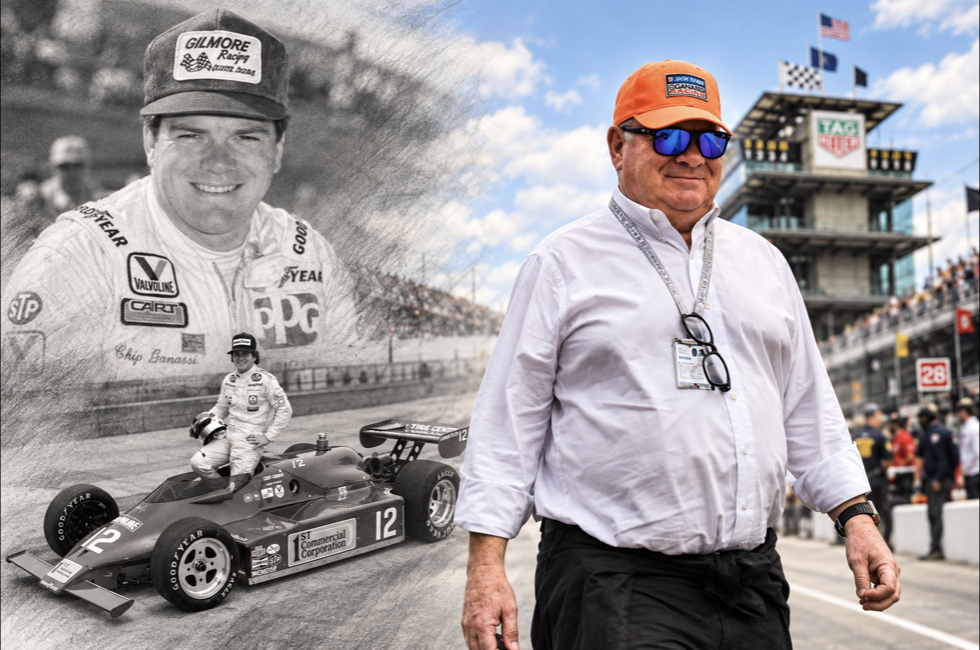
Then and now. Chip Ganassi came up a racer, brave and quick, and became the man who drives the whole team. The instinct never left him.
Chip Ganassi came up a racer, brave and quick, long before he built the winningest team IndyCar has known. As the season closed, Alex Palou's fifth title in six years carried Ganassi past his old friend Roger Penske for the most championships any team has ever won in the series. Pfanner Communications founder Paul Pfanner has known Ganassi since his Formula Ford days and watched him become the standard of the sport from close range. Here he looks past the record to the man behind it, the driver who steers the car, the team, and the ambition of everyone around him, and makes the case that the most telling thing about Chip Ganassi is that he is not finished.
Chip Ganassi is a racer
There is a video of him at the 1980 SCCA Runoffs that I go back to more than I should. Road Atlanta, Formula Ford, a young Chip in a narrow-track Crosslé 40F. Crosslé had built good cars for years, but the 40F was a handful, and you can watch him wrestle it around the place and finish third against some of the best people who ever ran the category. He was early in his time as a driver and he carried that difficult car on will as much as grip. I knew that field. Those were the people I'd been racing among a year or two before, so I know what I'm looking at when I watch it.
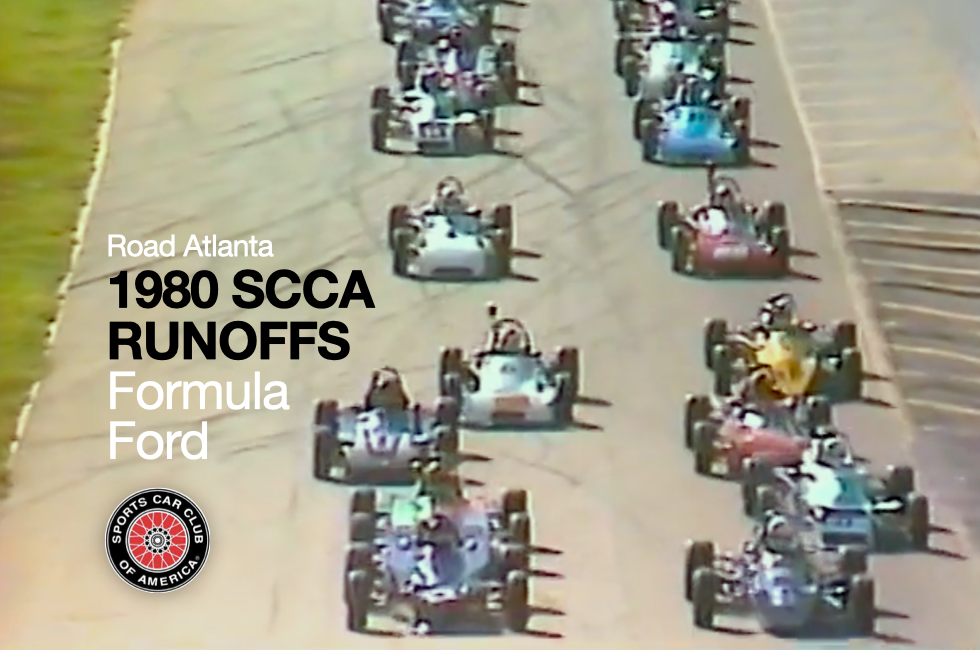
I keep going back because that race is the whole man in a few minutes. Everything he has built since grows out of a driver who learned the sport from the seat and decided the car would not get the last word.
A driver in every sense
You can drive the car. You can also drive the team, and the ambition of everyone in it. Chip does both. He has a racer's mind that does not break, and he takes the bad days as information instead of insult. He reads people fast, and once he sees what someone has, he knows how to make it bigger. That last part is rarer than raw speed, and it is why his teams last.
The will that would not break
It almost ended in July of 1984. At the Michigan 500 a cut tire pitched his car into Al Unser Jr. and then into the air, and it came apart against the inside wall. Steve Olvey, the CART doctor, reached him first and found him not breathing. He thought Chip was gone and was going for CPR when Chip drew a breath on his own. I was following the race and feared the same thing. He spent a night in a coma and a week in a hospital bed.
Then he got back in the car. He returned the next season and ran the Indianapolis 500 again, and once more the year after, and he took a class win in sports cars in 1986. The full-time driving never came back, but sit with what that took. A man who nearly died at Michigan strapped himself into a race car and went again. The will did not bend. It just needed somewhere bigger to go.
A different seat
He found it in ownership. He came in through Pat Patrick's operation, where I knew the crew from my own work on Alfa Romeo's IndyCar program, and by 1990 he had his own team. In 1992 he pulled Mike Hull across from Patrick to help build it, and to this day, if you ask Chip how his teams win, you get two words back. Mike Hull. That same spring I launched RACER at the Long Beach Grand Prix, and our two worlds started running alongside each other and never came apart.
I like winners
That is his line, and most people hear more swagger in it than is there. It is really a description of how he hires. He looks for people who want it as badly as he does, hands them what they need, and gets out of the way. The good ones stay for years, which is why you can feel the depth of the team from outside the fence, and why it keeps winning across decades and not just across good seasons.
I know the line from the inside, because he aimed it at me when I had proven nothing. The night we launched RACER at Long Beach, Chip found our whole team at dinner and quietly paid the bill. He believed in me before there was a reason to, and it is the same bet he has placed on every driver who ever climbed into one of his cars.
Stop and consider
Try to hold the whole of it at once. Chip Ganassi is the only team owner in history to have won the Indianapolis 500, the Daytona 500, the Brickyard 400, the Rolex 24 at Daytona, the 12 Hours of Sebring, and a class win at the 24 Hours of Le Mans. No one else has all six, and no one is close. In 2010 and 2011 he held the Daytona 500, the Indy 500, the Brickyard 400 and the Rolex 24 at the very same time, which no owner had ever managed. The race wins run more than 280, the championships to twenty-five, and if you sat down to count what all of that really took, you would be at it a while.
Then Sunday added the one they will argue about for years. Alex Palou won his fifth title in six seasons, and it gave Chip his eighteenth championship in American open-wheel racing, one past his old friend Roger Penske. When Chip was starting out, nobody imagined Roger could be caught in the column Roger cares about most. It has happened now, and it happened clean, by building a better team and out-learning the field season after season. I am sure Roger respects him for it, because Roger knows better than anyone what it costs.
The one still out there
Look again at that Le Mans line. A class win, yes, with the four-car Ford GT program in 2016, fifty years to the race after Ford's famous run. But Chip drove Le Mans himself back in 1987, and the gearbox broke before he could finish. The overall win is the trophy that has never come. That is not a closed account. Knowing him, he'll be back for it.
He is not done
That is the part people skip while they add up the hardware. There is more in him. He is a driver with laps left and a team he still believes in, and he will keep pushing the whole thing forward because that is what he is and what he has always been.
Congratulations, Chip. Now go win the next one.
Pfanner Advantage works with clients to turn change into advantage at the intersection of mobility, motorsport, media, technology, and marketing. Learn more or start a conversation: contact us today.
Paul Pfanner’s recent Shift Happens Insights:
The Advantage Journal arrives every week. What matters in sport, mobility, media, and technology — curated and contextualized by Bill Sparks, Bill Long, and Paul Pfanner. No hedging. No filler. Subscribe — It’s Free

