
Everything Matters
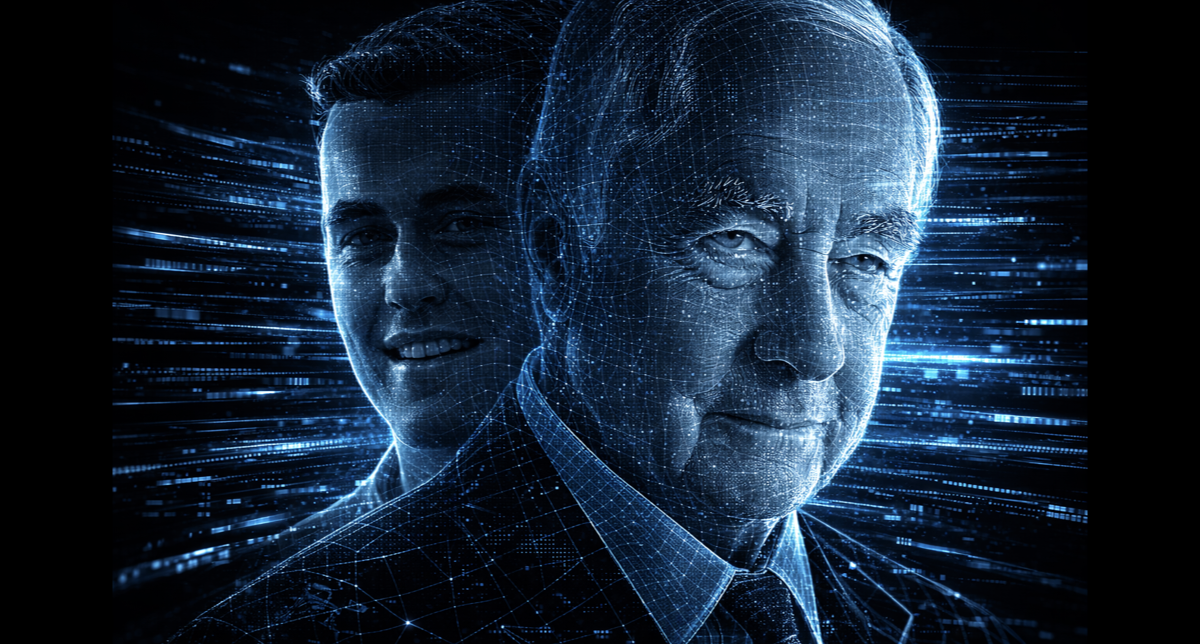
Since the 1960s Roger Penske has defined competitive advantage — and winning.
For sixty years Roger Penske has built one of the most formidable organizations in sport and business. The results are visible in trophies, championships, and companies that move the machinery of the global economy. RACER Brand, and Pfanner Advantage Founder, Paul Pfanner reveals that the real advantage behind the Penske system is something simpler — and harder to sustain.
Roger Penske’s Unfair Advantage
My first close look at the Penske operating system came in 1996.
Pfanner Communications had been retained by Roger Penske and Penske Motorsports, Inc. to assist with the launch of California Speedway. At the time, I thought we were working on a racetrack brand and a set of creative materials that would introduce a new venue to the motorsports world.
What I didn’t fully appreciate yet was that I was getting a close view of how Roger Penske actually builds things.
The lesson, as it turned out, was simple.
Everything matters.
Roger often repeats a phrase his father taught him: “Effort equals results.” It is a powerful idea and an honest one. Anyone who has watched Roger operate knows that he believes it. But spending time around him reveals that the equation runs deeper than the slogan suggests. Roger once summarized it even more directly: “The key to winning is preparation.”
The real driver of outcomes in Roger’s world is the belief that everything matters — not ceremonially, but operationally. The condition of the trucks matters. The uniforms matter. The shop floor matters. The timing of a meeting matters. Even the order of a presentation slide matters. Small details send signals about expectations, and expectations shape behavior. Brand is behavior.
Roger leads by example in the most literal sense. He does not impose standards from a distance. He embodies them. When the leader operates with that level of discipline, the organization calibrates around it. Over time the mindset becomes an attractor — people who value preparation and precision move toward the environment, and those who don’t tend to move on. Eventually the culture becomes self-selecting. That is how culture compounds into advantage.
A Racer First
Roger’s authority to build that culture did not come from theory. It came from experience.
Before he built companies and race teams, he was a competitor. In the early 1960s Roger Penske was one of the most promising young drivers in American motorsports — winning races in sports cars and stock cars, earning Sports Illustrated’s Sports Car Driver of the Year in 1961. His driving career was successful but brief by design. Roger recognized early that building the organization interested him more than driving the cars.
But the instincts of a racer never leave. Preparation, observation, and judgment under pressure remain part of the operating system — and they shaped the company he built when Team Penske was founded in 1966, now celebrating its 60th anniversary.
Over six decades the team has produced 20 Indianapolis 500 victories, multiple IndyCar and NASCAR Cup championships, and victories in endurance classics including the 24 Hours of Daytona and 12 Hours of Sebring. Few organizations in any sport have sustained that level of excellence across six decades.
The Larger System
Part of the reason Roger still operates at racing speed is that motorsports has always been only one dimension of the Penske enterprise.
Behind the race teams sits one of the most sophisticated transportation and mobility organizations in the world. Through Penske Corporation and its related companies, the enterprise spans automotive retail, truck leasing, logistics, commercial vehicle distribution, and professional motorsports — generating more than $40 billion in annual revenue and employing tens of thousands of people worldwide.
But numbers alone don’t explain it. What drives the Penske companies is the same operating discipline that drives the race teams. The trucks are clean. The equipment is maintained. The people know the standards. The expectations are clear. Execution is the system. The race teams are simply its most visible expression.
The larger enterprise operates quietly inside the infrastructure of global commerce — moving freight, supporting supply chains, delivering vehicles, maintaining transportation systems most people never see. The same mindset drives all of it.
Everything matters.
A Small Story That Explains a Big Idea
One moment during the California Speedway project still makes me smile.
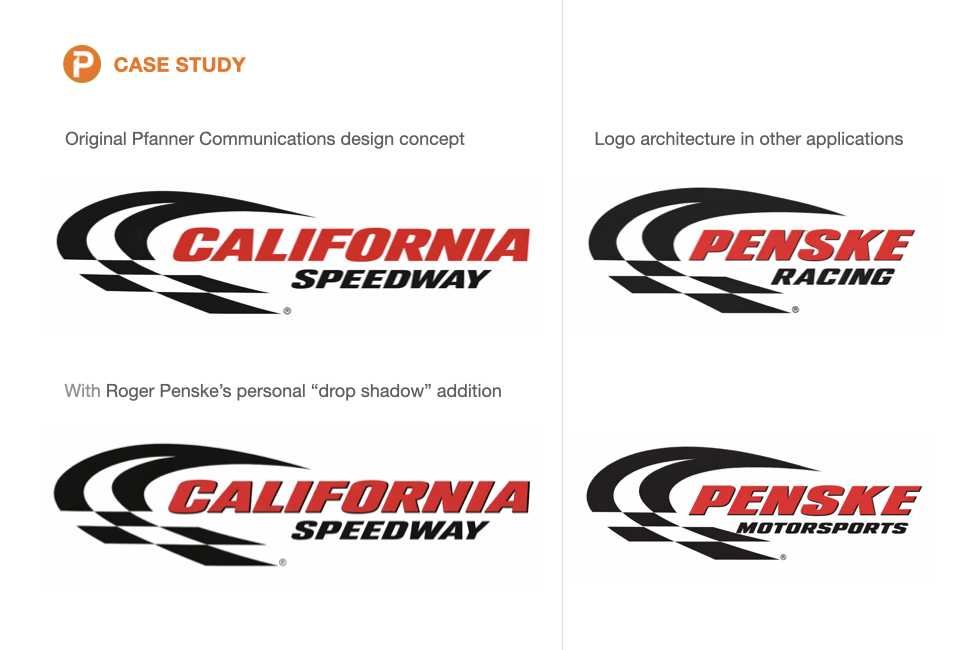
When we were finalizing the speedway logo, Roger and I found ourselves on opposite sides of a design decision. I wanted the wordmark to remain a clean single red color. Roger believed the lettering should include a subtle solid black shadow to give it greater definition and presence.
The conversation was friendly but serious — the kind where Roger listens carefully and then asks a direct question.
At one point he said: “I want to change this, but why is it I get the feeling that everybody here, who doesn’t agree with me, is using you to argue against it?”
Without missing a beat, I replied: “Because if you fire me, I still have a job.”
Roger chuckled.
And in the end, I saw his point.
My concern was execution — I was thinking about how the logo would reproduce across thousands of applications: print, television, merchandise, signage, and what was then the emerging world of digital media. Roger was thinking about impact. The black shadow gave the mark presence. It made it stronger, more visible, and unmistakably Penske.
Roger has always understood that identity matters. The organization even developed its own distinctive typeface — the recognizable PENSKE font seen across trucks, race cars, and buildings.
Looking back, I realized I had briefly forgotten who I was dealing with. Roger Penske is the Obi-Wan Kenobi of Everything Matters. Execution is what Roger Penske and his teams do better than 99.9999 percent of the 8.3 billion humans sharing this moment on Earth.
The Fastest Human Learning Machine I Know
Long before artificial intelligence became part of everyday conversation, I occasionally described Roger this way: he is the fastest and best human learning machine I know.
Roger does “now” exceptionally well. What makes him unique is that he is always translating the present moment into a better next. Every race produces information. Every mistake produces information. Every result becomes another input into the system. Roger processes it quickly, adjusts, and moves forward. Over time that habit compounds into advantage.
The System at Full Speed
That operating system continues to perform — on the track and off it simultaneously.
Porsche Penske Motorsport opened the team’s 60th anniversary season by winning the Rolex 24 at Daytona, marking Team Penske’s third consecutive overall victory in one of the sport’s most demanding endurance races — a fitting echo of history, given that Penske first won the Rolex 24 in 1969, only three years after the team was founded. The proof continued at Phoenix, where Team Penske swept the double-header with Josef Newgarden winning the INDYCAR event and Ryan Blaney finishing the job in the NASCAR Cup race the following day.
For an organization celebrating its 60th season, it was less a surprise than a reminder. The standard still operates at full speed.
What makes the current moment distinctive is that competitive excellence and platform expansion are running in parallel. The Acura Grand Prix of Long Beach — long a cornerstone of the IndyCar calendar under Penske stewardship — anchors the established portfolio. The Java House Grand Prix of Arlington brought IndyCar racing to a new street circuit in the entertainment district surrounding AT&T Stadium and Globe Life Field. The Detroit Grand Prix aligns the series to one of the world’s great automotive cities. And the Freedom 200 in Washington DC places IndyCar at the symbolic center of the nation — a statement of ambition that goes well beyond a race weekend.
Taken together, these events reveal the same operating logic at work. Roger isn’t simply preserving what exists. He is expanding what’s possible — finding new markets, new audiences, and new platforms while the competitive standard remains unbroken.
That is the system at full speed.
The Unfair Advantage
Watching Roger operate over the years helped crystallize something I often summarize in a simple phrase:
Victory travels at the speed of thought.
Success rarely begins with the machinery. It begins with the clarity of the mind guiding the effort. Over time that discipline becomes visible. The trucks are clean. The garages are precise. The teams execute. Culture reveals itself in the smallest details.
In the end, brand is behavior.
After watching Roger operate for three decades, the formula reveals itself.
Clarity. Judgment. Execution. Advantage.
And behind all of it sits the belief that has guided the Penske organization for sixty years.
Everything matters.
