

What if the Market Doesn't Want What You're Selling?
Technological or cultural changes can obsolete business models. And new ideas can be rejected straight out of the gate. When these things happen, it's time to pivot. Bill Sparks examines the tricky art of reinvention.

The Finite Growth Paradox: Why "More" Is No Longer a Strategy
An uncomfortable reality is that the pursuit of volume has started to generate diminishing returns. Bill Sparks observes that in many sectors, it's actively destroying value.
Inside Mythos: The AI Too Dangerous to Release
Bill Sparks examines Claude Mythos Preview — Anthropic's most powerful AI model, withheld over cybersecurity fears — and what its six-to-eighteen-month window means for every organization connected to the internet.
The New Sovereignty: Mastering Algorithmic Meta-Capital
Bill Sparks introduces Algorithmic Meta-Capital — the strategic asset class that determines whether your organization exists in the AI decision-making loop or has already been written out of it.
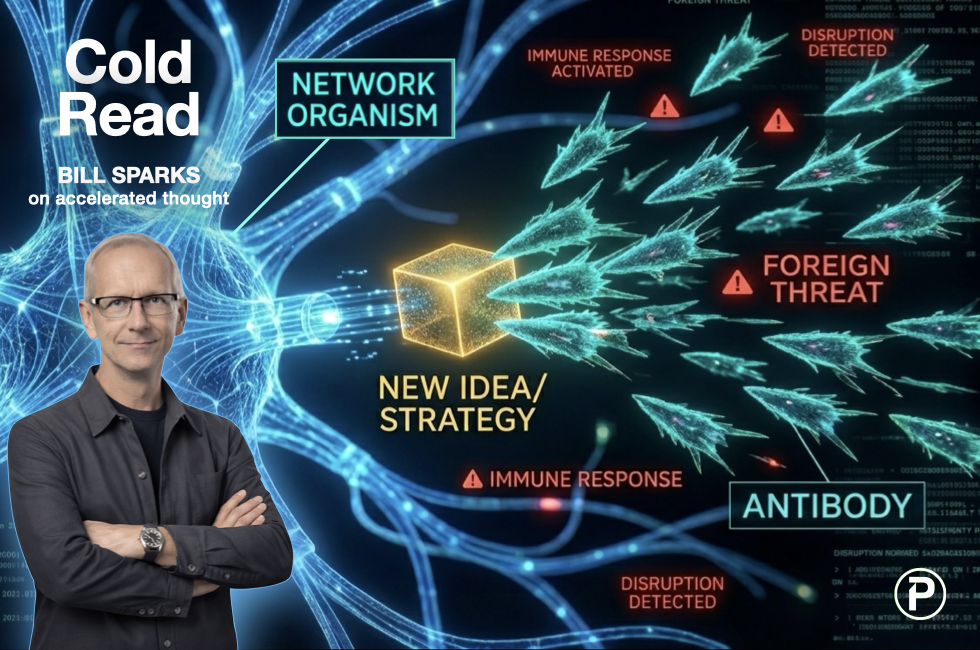
The Organizational Immune System
Bill Sparks diagnoses the invisible force that defeats most transformation initiatives — and gives you the framework to work with it instead of against it.
Am I Irrelevant?
Paul Pfanner asks the question every leader eventually faces in the dark — and reframes it from fear into the only competitive posture that actually works.
The Hardest Thing a Leader Can Do
Paul Pfanner watched Jim Michaelian tend the Long Beach Grand Prix for fifty-one years — and never once make himself the story. When Michaelian died at 83, he had already done the hardest thing a leader can do.
Check Engine Light
Every business tracks performance indicators. Few have warning lights for their brand awareness, relevance, and trust. The diagnostics exist. The question is whether you're reading them before the light comes on.
2031: Racing Isn’t the Business
The economics are strong and the audience is growing. But the systems now controlling distribution, behavior, and value are reshaping what the sport actually is. The most important asset may be the one no spreadsheet captures.
Now. Five Years From Now.
One truth stands out from a lifetime of decisions made under pressure with immediate consequences. The future isn't something you wait for. The leaders who know that are already moving.
Why Your CEO Isn’t a Robot (Yet)
Companies are already experimenting with algorithmic leadership and the results are more complicated than the headlines suggest. There is still something the machine cannot do. It matters most when things go wrong.
Relevance is a Moving Target
Stability once signaled strength — in periods of rapid change, it can be a warning sign. The organizations that endure don't just survive disruption. They learn what to do with it before everyone else does.
Everything Matters
For sixty years one organization has dominated sport and business with a consistency no one has fully explained. The results are visible to everyone. The source of the advantage is something most organizations walk right past.
What is Really Powering F1?
Melbourne opened Formula 1's new regulatory era with record attendance and genuine excitement. Beneath that, a harder question is already forming. The real power unit has never been mechanical.
The Need for Speed
Speed has always been a defining force in business. But moving faster without clarity doesn't create advantage. It creates fragility — and in today's environment, fragile organizations don't get a second chance.
The AI Era Has a Thinking Problem
AI is getting better at answering questions at a pace no human can match. The harder question is what's happening to our ability to ask them. That gap has consequences no algorithm will flag.
The Speed Trap
Everyone says the future belongs to whoever moves fastest. Racing has always known something different. In the AI era, confidence is outrunning understanding — and that gap has a cost.
The Ghost in the Machine
The ghost in the machine is no longer hidden — and that changes the equation for every organization running on complex systems. The discomfort isn't the problem. It's the signal.