
The Hardest Thing a Leader Can Do
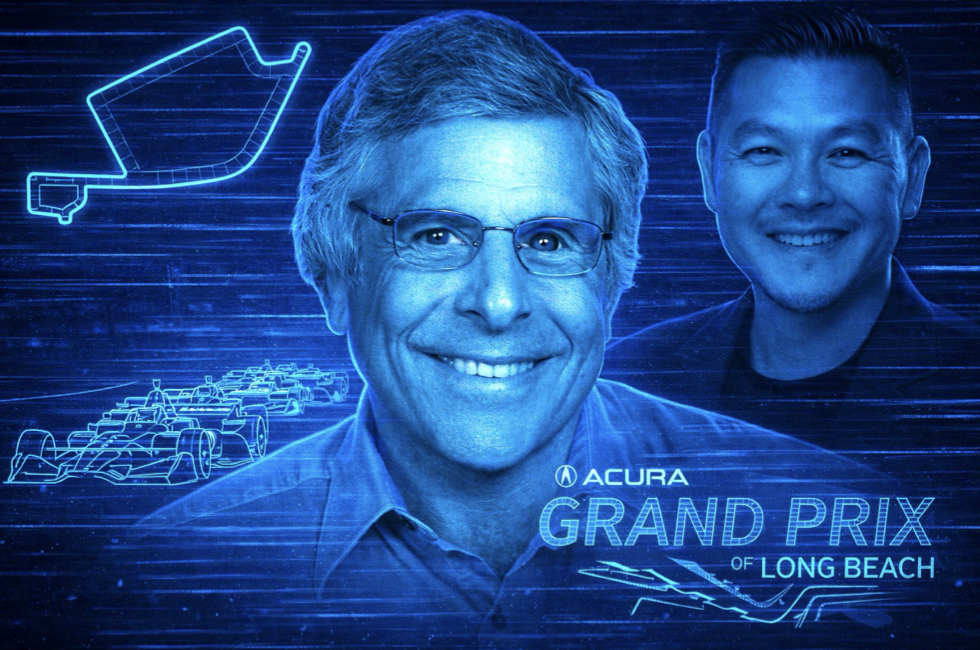
Jim Michaelian and Jim Liaw — the passing of a standard, fifty-one years in the making.
Jim Michaelian built the Acura Grand Prix of Long Beach into America's premier street race over fifty-one years. Then he did the hardest thing a leader can do. RACER Brand and Pfanner Advantage founder, Paul Pfanner, traces a thread that runs from a Riverside souvenir stand in 1972 to a question Bill France Jr. once asked Les Richter — and finds in Jim's life the clearest answer he has ever seen.
It took me a week to write this.
That's not my usual pace, and Jim Michaelian would have noticed. He noticed everything. But when someone who has been a fixture of your professional life for more than five decades is suddenly gone, the instinct to reach for language too quickly feels like a betrayal. So I waited. I sat with it. And what came back, slowly, was not a eulogy — it was a question I had first heard answered in a diner in Fontana, California, in 1999.
Where It Starts
In October 1972, my partner Mike Vannatter and I launched Brazewood Graphics at Riverside International Raceway. We were eighteen years old. We had created original illustrations of the top Can-Am cars of that era and drove to Riverside to sell prints of them. It was not a sophisticated business plan. It was belief — in the sport, in what we had made, and in the idea that someone at a race track might pay for art that captured what they were feeling in the grandstands.
NFL legend Les Richter ran Riverside International Raceway. His colleague and number two was Roy Hord Jr. — a former NFL lineman who had traded blocking assignments for the logistics of running one of America's great road courses. Between them, they had seen every kind of ambition walk through those gates. Somehow, they saw something in two teenagers selling artwork out of a box, and they gave us a spot in the souvenir area next to the main grandstand and press room.
That weekend, George Follmer won the Can-Am race in the Penske Porsche 917/10, clinching the championship for Roger Penske. It was the first weekend of my professional journey.
Three months later, in January 1973, I was back at Riverside — this time working inside the souvenir stand rather than selling my own work beside it. Mark Donohue won in the AMC Matador that weekend, giving Penske Racing its first NASCAR victory. I watched, I worked, and I reached a conclusion about myself that has held for more than fifty years: I was unemployable. The stand wasn't for me. Creating something of my own always would be.
I did not know it then, but I was also watching the early chapters of a dynasty being written. And the men who let me watch from close range were Les Richter and Roy Hord.
A Question Worth Carrying
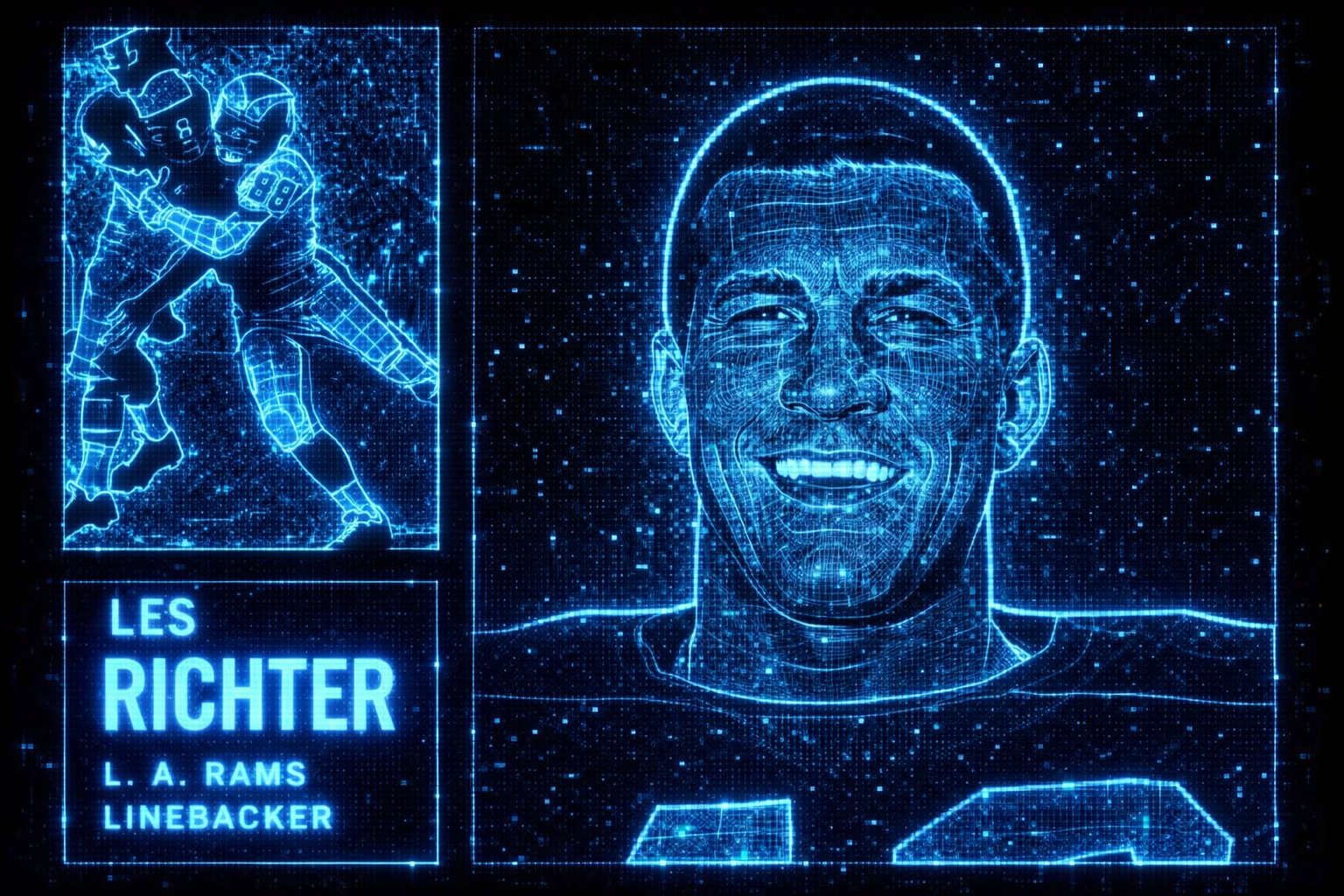
Les Richter, also affectionately known as “Coach”, was one of the great elder mentors of my professional life — a Pro Football Hall of Famer whose second act was building Riverside into a world-class facility, and whose third act brought him to a senior role at NASCAR. The relationship that began in 1972 deepened over the years, and by the mid-1990s, through my work with Penske Motorsports at Pfanner Communications, I had the privilege of his time and counsel in ways I still draw on today.
In 1999, we had lunch together at a small diner in Fontana — the kind of place that still felt like the 1960s, which suited Les perfectly. The conversation had been warm and wide-ranging. Then Les shifted to a somber register. He told me that Bill France Jr. had been diagnosed with cancer, that it would soon be public, and that the sport would have to reckon with what came next.
Then Les told me something France had said to him years earlier, when Les first came to NASCAR in a senior role after his long run at Riverside.
France had asked him a question: "What is your most important job?"
Les had answered the way most executives would answer: to grow NASCAR.
France shot back without hesitation. "No. Your most important job is to identify your replacement. That is how we continue to grow NASCAR."
I have carried that exchange for twenty-six years. I have watched leaders confirm it and contradict it in roughly equal measure. And when Jim Michaelian died on March 21st at the age of 83, I understood — with the clarity that only loss can produce — that he had spent his entire career proving Bill France Jr. right.
Fifty-One Years of Witness
I was at the first Long Beach Grand Prix in 1975. I was there for the Formula 5000 race that Chris Pook conjured from equal parts audacity and instinct — a street race on a California waterfront that had no business working and proceeded to work spectacularly. I was there in 1992 when we launched RACER magazine on those same streets, turning a motorsport event into a platform for something we believed in. I was there in 2012 when I came back to RACER, and Jim was there too, as he always was — riding his scooter through the paddock, fixing something, checking something, making sure the standard held. I was even there in 2020, when the pandemic emptied the city and the streets sat silent, the circuit still painted on the pavement with nowhere to go. Jim felt that absence as personally as anyone.
Fifty-one years. Every race. I watched Jim Michaelian tend this institution through six decades of American open-wheel racing, three series identities, two pandemics of threat — one viral, one political — and more hostile mayors and rival series than anyone bothered to count. He did it without making himself the story. He did it from a scooter, at eye level, attending to what needed attending to.
That is a rarer form of leadership than most organizations will ever see.
Founding and Sustaining Are Different
Chris Pook founded the Long Beach Grand Prix. That fact is accurate and important, and Jim never disputed it. What Jim understood, with the clarity of someone who had earned his perspective over five decades, was that founding and sustaining require entirely different gifts. Pook's was vision — the audacious belief that a Monaco-style street race could take root in a depressed California port city. That belief was correct, and it was extraordinary.
But Pook left twenty-four years ago.
Jim stayed. And in staying, he transformed the original vision into something more durable than vision: an institution. Under his stewardship, the Acura Grand Prix of Long Beach became the longest-running major street circuit race in North America. It survived the CART-to-IndyCar split that destroyed other events. It survived COVID. It survived the revolving door of city administrations, each with its own agenda. It survived the constant temptation to sell, redevelop, or hand the streets back to ordinary commerce.
The event survived because Jim Michaelian treated its survival as a personal obligation.
He was everywhere at once during race week — not performing leadership, practicing it. He monitored the crowd by walking among it. He tracked what fans were experiencing, not what the operational reports said they were experiencing. When something was wrong, he fixed it. When something was right, he redirected the credit to his staff. Marshall Pruett, writing for RACER last week, captured it precisely: pay Jim a compliment about Long Beach and he would deflect it, always, toward the people who actually ran the event.
That is not modesty as personality trait. That is an understanding of what sustains organizations across time: teams, not individuals.
The Hardest Thing
The leadership lesson that Jim Michaelian's life teaches is not complicated. It is, however, extraordinarily difficult to execute.
Great leaders make themselves replaceable — on purpose.
Not because they have run out of energy or ambition. Not because they have been pushed out. But because they understand that the measure of their leadership is what survives them, not what depends on them. Jim was 83 years old and still present, still engaged, still fixing things from his scooter, when he announced in January that he would transition out of the Grand Prix Association presidency at the end of June. He had already selected his successor. He had already been working alongside him.
Jim Liaw — co-founder of Formula Drift, former General Manager of Performance Racing Industry — was not an accident of succession. He was a choice, and a long-considered one. I have believed in Jim Liaw and his Formula Drift co-founding partner Ryan Sage since we were first introduced in 2003. From the beginning, they understood the intersection of now and next better than almost anyone else in the motorsport world — they took a discipline no one in North America had heard of, imported it from Japan, and built the most influential drifting series on the planet. That is not luck. That is vision combined with execution, which is the rarest combination there is.
On race morning at Indianapolis in 2024, I ran into Jim Liaw and his wife Angela in the pitlane. I told them directly: I believed Jim was a key future leader of this sport. That conversation happened before any succession announcement, before any formal process. It reflected twenty years of watching him build things that lasted.
When the time came, I was honored to serve as a reference for Jim Liaw to Penske Entertainment. I said yes without hesitation — because Jim Michaelian had already done the most important part of the evaluation. And credit belongs squarely to Roger Penske for trusting Jim Michaelian's judgment and having the confidence to go with his recommendation. That chain of trust — from Michaelian to Penske to Liaw — is itself a leadership lesson. Succession only works when every person in the decision is operating from earned credibility rather than institutional convenience.
Bill France Jr. understood this. Les Richter understood it. Jim Michaelian lived it.
What Endures
I will be at the Acura Grand Prix of Long Beach in three weeks. I will walk those streets, and the paddock, the way I have walked them for fifty-one years, and Jim will not be there. The scooter will be still. The champagne toasts will carry a weight they haven't carried before.
What will be there is the event. The institution. The standard.
That is not a consolation. It is a confirmation. Jim Michaelian spent five decades building something that could outlast him — and then, with characteristic precision, made sure it would.
In racing, we talk about learning as the only sustainable competitive advantage. Jim Michaelian learned something most leaders never grasp: the goal is not to be indispensable. The goal is to build something so well, so consistently, and with such fidelity to what matters, that the people who come after you have something worth protecting.
He gave that to Long Beach. He gave it to Jim Liaw. He gave it to all of us who have been watching since 1975.
Brand is behavior. Fifty-one years of it.
Rest well, Jim.
Paul Pfanner launched RACER magazine in 1992 at the Long Beach Grand Prix and has attended every running of the event since 1975.
