
Check Engine Light
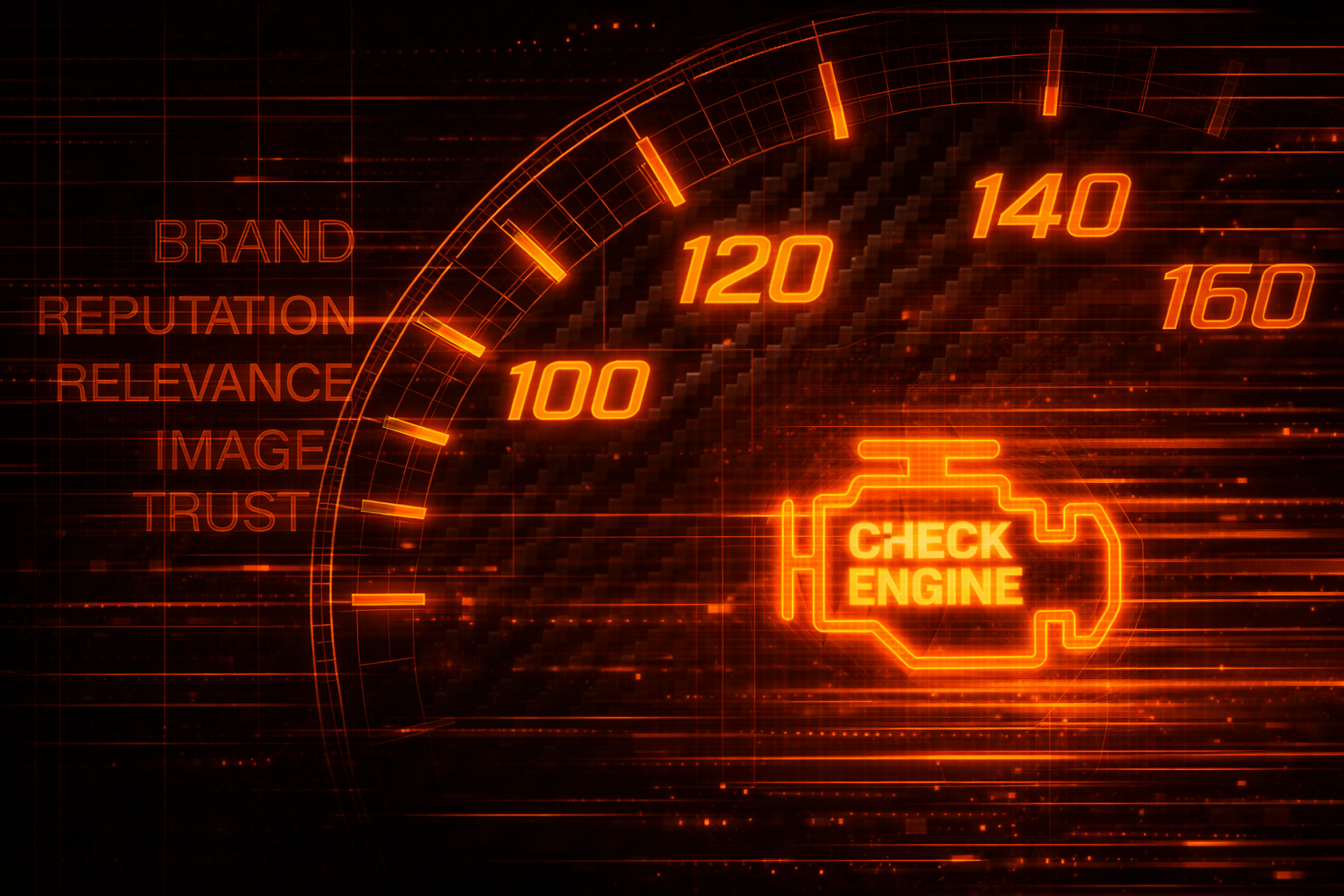
This warning is a constant for your business amid change and uncertainty.
Pfanner Advantage Change Agent, former MEMA CEO, Bill Long, has spent a career inside the systems that determine whether brands endure or disappear—across manufacturing, mobility, and the complex networks that connect product, perception, and performance. In this edition of The Long View, Bill reframes a familiar signal as something far more consequential.
Warning… it’s not just your Engine
A bit of history:
The check engine light first appeared in vehicles in the 1930s with the introduction of the idiot light by the Hudson Motor Car Company. This early version only alerted drivers to major engine issues and did not provide advance warning. By the 1980s, most automakers phased out the idiot light in favor of more sophisticated diagnostic systems that activated the check engine light when a problem was detected. The standardized check engine light system was established in 1996 with the introduction of the On-Board Diagnostics (OBD2) system, which required all vehicles sold in the United States to have this on-board diagnostics system.
When OBD2 and the check engine light became required, many in the aftermarket feared it was an attempt to seal the hoods of vehicles, forcing motorists back to car dealerships, as they would be the only ones able to access the diagnostic codes for repairs. The fear or threat to the industry was averted as part of the Clean Air Act Amendment that gave independent repair technicians access to vehicle calibration diagnostic codes.
The Problem –
Despite this access, if the check engine light came on, motorists’ immediate reaction was “only my car dealer can fix it.”
The solution – Top-of-Mind Awareness
Using a cocktail napkin during an industry cocktail reception, I drew up the concept of placing an illuminated check engine light in every independent repair shop with a simple message: Ask Us!The approach being to create top-of-mind awareness as motorists drove to and from work or shopping, often stopping at the same traffic corner repair shop, seeing a simple image with a simple call to action… Check Engine – Ask Us! So that if the warning light in their vehicle appeared, motorist top-of-mind recall would connect with that repair location. It also helped reconnect the dialogue between motorists and repair locations that had been lost as a result of self-service, gas-n-go stations.
And yes, the campaign rolled out thousands of Check Engine – Ask Us!kits, achieving the desired outcome…but it made me think.
The need for another Check Engine Warning Light
In business, there are several key performance indicators (monthly financials, cash flow, quality, scrap, efficiency, etc.). But what are the warning indicators you use for your brand—for top-of-mind share, for relevance, image, for trust? What turns your warning light on? What diagnostics determine your brand is still performing as it was designed?
In the past decade, markets, behaviors, attitudes, and even needs have changed. Most businesses have made significant adjustments to position their operations for opportunity, and in some cases, survival. Yet amongst these changes, what considerations have you applied equally to your brand? Yes, brand reputation, legacy, and brand stability mean something…or maybe meant something. And making changes to a brand can be risky…take New Coke as an example.
But not knowing the state of your brand in today’s market (and tomorrow’s) is even more risky.
What now? What Next?
Two problems to solve:
People don’t know about you or your brand, and
People don’t care.
Some of you may know I spent five seasons as Vice President of Marketing with the Indy Racing League - now rebranded to the IndyCar Series. These were the same two problems the League faced when I first joined. People didn’t know who or what the Indy Racing League was, and even worse, people didn’t care, especially fans of open-wheel racing’s Championship Auto Racing Teams (CART). Despite the brand-positioning of great racing, defined as the most lead changes, close finishes, and 200 mph speeds, it was not enough to fill the stands or attract viewers. It wasn’t enough to make people care. The strategy and tactics we used then, I’ll save for another time.
These apply to almost every brand, product, and business.
“People don’t know” — the strategy and process of capturing top-of-mind awareness is the easy part. If you don’t have one, let’s talk.
“People don’t care” is the greater challenge—addressing the why versus the what, establishing meaning or eliciting an emotional connection that is sustainable over time. Is your marketing strategy, brand positioning, and messaging the real reason why people engage or buy your product?
I’ve found that often products and/or services are bought for the wrong reasons…not for the quality or the features and benefits that are part of “the value proposition” of the brand. It may be for convenience or availability or other factors like price, or the experience and big-event atmosphere. Said differently, you may be experiencing growth—but not for the reasons you thought.
What to do?
Some simple steps—begin with the end in mind:
Ask the question:
When you think of us (insert brand, company, product, etc.), you think of what?Write down the responses you want to be known for.
Align your vocabulary, messaging, and actions.
Know your customer…trends, shifts, behaviors.
Anticipate what’s next.
Build the performance indicators that will trigger your Check Engine warning light for awareness, engagement, and relevance.
In business and racing, one never assumes all systems are performing as intended—they are tested, measured, and improved. The same applies to brand. Awareness, relevance, and engagement require the same level of discipline and control. Without it, you’re left reacting instead of leading. The brands that endure are the ones that know what their warning lights are telling them—and act before it’s too late.
More Long View Insights on Relevant Change from Bill Long:
Relevance is a Moving Target — Stability May Be a Warning Sign
The Advantage Journal arrives every week. What matters in sport, mobility, media, and technology — curated and contextualized by Bill Sparks, Bill Long, and Paul Pfanner. No hedging. No filler. Subscribe — It’s Free