
2031: Racing Isn’t the Business
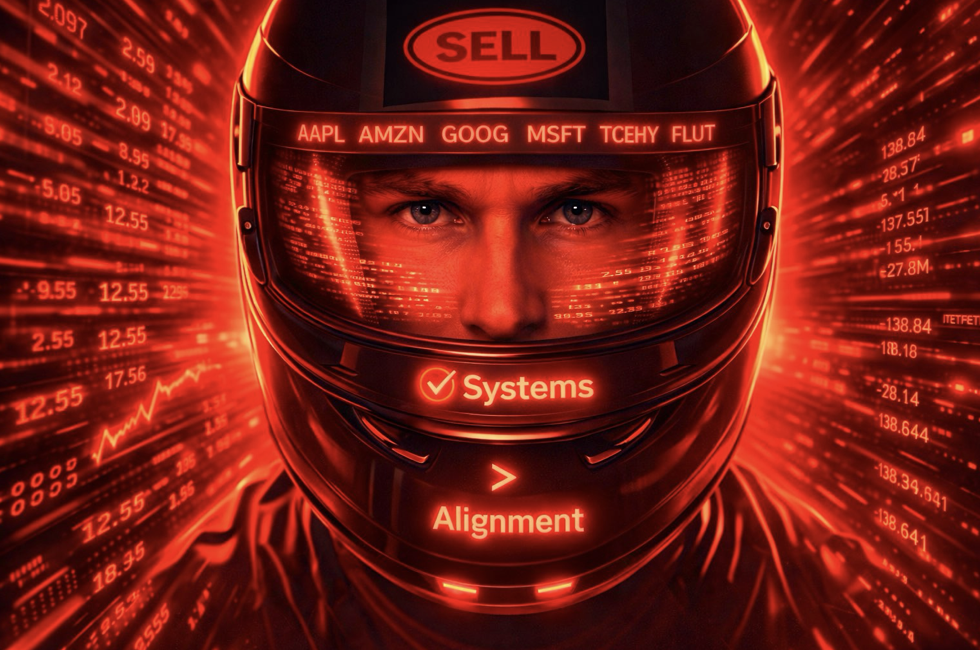
By 2031, the drivers of racing may no longer be on the track.
Paul Pfanner, founder of the RACER Brand and Pfanner Advantage, has worked inside media, racing, mobility and brand marketing for decades. Today he works alongside teammates with equally deep experience — Bill Long and Bill Sparks—both of whom have operated at senior levels across the same sectors, guiding business strategy over similar time horizons. Together, they’ve been close to the moments that shape what comes next—often before they’re recognized for what they really are.
DISCLAIMER: This material is provided for informational purposes only and reflects a forward-looking perspective based on current observations and assumptions about conditions that have not yet occurred. It does not constitute prediction, investment advice, or a recommendation to act.
Racing as Signal
In my previous insight, “Now. Five Years From Now”, I wrote that advantage increasingly comes from seeing conditions early — and understanding what they mean before others do. Racing feels like it is sitting in one of those moments now.
At a time when mobility is navigating real uncertainty — technological, economic, and structural — racing offers something increasingly rare: clarity under pressure.
What changes the most by 2031 won’t be the cars. It will be how these properties align within larger systems — and more specifically, the intent behind that alignment. The next phase will not be defined by broadcasters or sponsors alone, but by system operators: companies that understand how distribution, data, identity, commerce, and behavior reinforce one another.
As those systems have advanced — optimizing movement, predicting outcomes, reducing variance — the role of the individual has started to shift. Control has given way to orchestration. Outcomes are shaped earlier, decisions are distributed, and the edges are smoothed.
Racing did not follow that path.
It remains one of the few places where human judgment is still visible at the edge of system capability — where decisions are made before certainty, and where the outcome is not fully managed. The proximity to mortal consequence, understood if not always spoken, creates a different kind of connection — compressing the distance between participant and observer.
In a world increasingly defined by managed outcomes, that clarity has become rare. And more valuable.
Racing is the one sport where men and women compete equally — where judgment matters most because consequence is real. In the age of acceleration, it endures as a metaphor for those who choose to drive their own outcome amid uncertainty.
It hasn’t simply grown. It has separated. And in that separation, racing becomes something more than competition.
It becomes signal
Competing for Attention
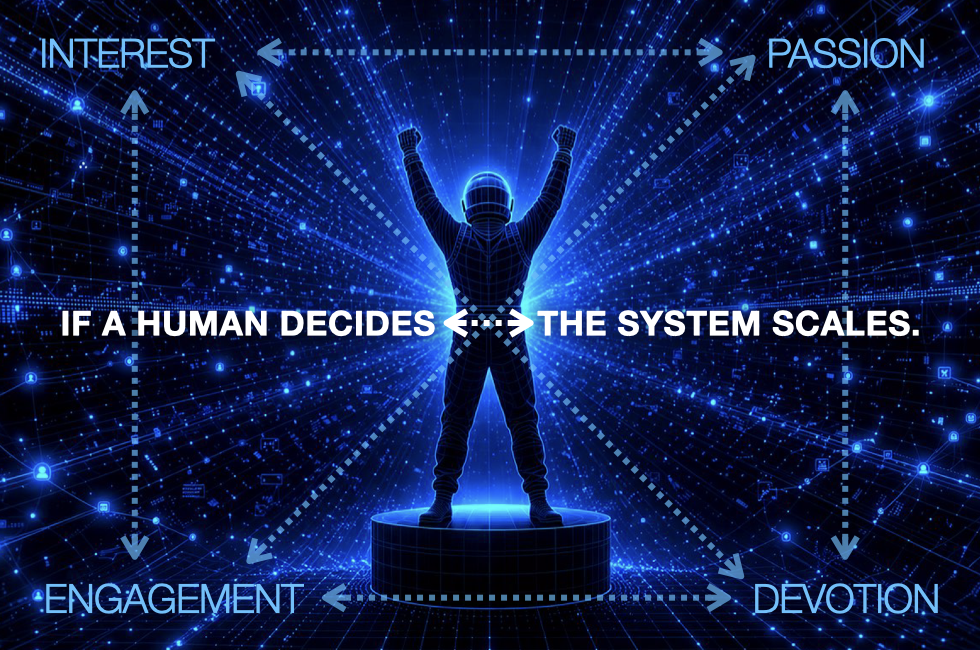
Racing does not operate in isolation. It sits inside a broader contest against global sport, gaming, and an expanding entertainment landscape where time, identity, and engagement are constantly in play. Every property, every platform, every format is competing for the same finite resource: attention that converts into devotion, participation, and value.
Scale matters in that environment. But it is not enough. Differentiation is what holds.
Racing’s differentiation is not built on reach alone. It comes from what it uniquely reveals: visible consequence, compressed decision-making, and human judgment under pressure. Those qualities are difficult to replicate — and increasingly rare in a landscape built around managed, frictionless experience.
The question is not whether this shift is happening. It is who recognizes it early enough to shape their position within it.
Why Value Is Rising
The rise in value across live sports makes more sense when viewed through this lens. Leagues, teams, and athletes are being repriced because they sit on something increasingly scarce: real-time attention that people choose to experience together.
The structure beneath media has also fundamentally changed. Traditional broadcast no longer sits at the center — it has been displaced. Control has moved outward: to platforms, to creators, and ultimately to audiences themselves. The distance between production, distribution, and consumption has collapsed.
People are no longer simply watching. They are interacting — placing bets, buying, trading, responding in real time. The audience is no longer downstream of the experience. It is part of it.
Athletes — including drivers — have scaled with that shift. Their audiences are no longer confined to teams, leagues, or broadcast windows. They exist as independent nodes within larger systems, carrying both attention and influence. Brands are no longer buying exposure. They are aligning with identity, and emotional connection compounds over time.
Racing fits this structure naturally. It already operates at the intersection of identity, performance, and consequence.
System operators now control distribution. They are not simply media companies — they are the environments in which media exists. The consumer connects directly to them, interacts within them, and transacts through them. That creates an advantage that sovereign wealth funds and private equity do not have. They can acquire and hold value. They cannot integrate and compound it in the same way. They do not control the loop between attention, interaction, and outcome.
Value is no longer defined by ownership alone, but by the ability to participate in that loop — enhanced by the emotional gravity live sport creates.

System Alignment (One Expression)
Formula 1 already operates closest to this reality. It is global, controlled, scarce, and designed to move cleanly across markets — a natural fit for systems built around integrated ecosystems.
In one possible expression, alignment with a company like Apple — approaching four trillion dollars in market value — begins to make sense. Not because more content is required, but because environments that reinforce hardware, software, services, and experience together create durable value. Formula 1 fits that architecture. It doesn’t need to be explained to a global audience. It already exists as one.
NASCAR presents a different kind of opportunity. Often framed through tradition, it behaves structurally more like an engine — producing continuous output across a long season. Within a system like Amazon, that output becomes more than entertainment. It becomes behavioral infrastructure, feeding commerce, engagement, and data in a continuous loop.
IndyCar sits in a different position—but not here.
NHRA operates on a different axis entirely. Short, binary, immediate — the outcome is clear and the consequence is instant. Within a wagering ecosystem like Flutter, operating globally at scale, that clarity isn’t a limitation. It’s the asset.
At this level, racing is not large in financial terms. But it is highly useful in system terms. The series are becoming more valuable not by expanding the sport, but by connecting it.
A Note on Friction
None of this moves at the speed of capital alone. Racing series are not unstructured assets — each operates within defined frameworks of control, rights, and oversight. Formula 1, Formula E, WEC, and WRC are governed through long-term agreements tied to the FIA. NASCAR and IMSA operate under tightly held private ownership. IndyCar sits within Penske Entertainment, now combined with FOX. Off-road remains fragmented, which surprises no one familiar with the category.
Legality is evolving alongside all of it. Wagering, data integration, and real-time platform services introduce new forms of scrutiny — and the closer systems move toward live interaction, the more sensitive the boundary becomes between competition and commercial influence. Trust in outcome is non-negotiable.
These forces don’t stop the shift. They define how fast it can actually happen.

Where Systems Are Proven
The most revealing properties sit closest to the manufacturers — and they illustrate something the financial alignments alone don’t.
Consider Alphabet. YouTube is not simply a distribution channel. It is a continuous environment where live content, community, and interaction exist together: layered, persistent, unconstrained by schedule. What it lacks is a physical system where those elements converge under real conditions. WEC and IMSA provide that. Endurance racing builds through decisions, conditions, and consequences that compound over hours — and within a system, that process becomes visible across every layer: live, replay, data, simulation, interaction. Not as marketing. As proof.
Formula E extends the same logic into digital ecosystems — which is where Tencent becomes coherent. It operates environments where watching, playing, transacting, and interacting are part of the same loop. Formula E isn’t just a racing series in that context. It’s a platform where competition, simulation, gaming, and audience participation converge. The value lives in what surrounds the race, not the race itself.
WRC and off-road are different in kind. These environments are exposed to terrain, weather, and genuine uncertainty — conditions that cannot be fully modeled in advance. For a company like Microsoft, that’s not a limitation. It’s the point. AI, cloud, and edge systems that learn in uncontrolled environments are more valuable than those that don’t.
But something else is happening in off-road that goes beyond any corporate alignment. The movement has grown beyond competition. It represents exploration, capability, and movement through environments not designed for you. By 2031, off-road vehicles have become a different kind of status symbol — not speed, not luxury, but capability. In a world of managed systems and frictionless experience, that signal carries weight precisely because it refuses to be optimized.
Taken together, these properties look less like separate championships and more like a layered architecture: endurance, integration, adaptability — and now, the deliberate choice to operate beyond the system entirely.

The Unaligned Platform
Perhaps by 2031, IndyCar occupies a different position — not because the product is lacking, but because it still carries the sport’s original DNA.
Since the dawn of the 20th century, the Indianapolis 500 did more than define racing. It defined progress — a proving ground for speed, risk, and engineering, and for the idea that human ambition could move the world forward. That remains true. The Indy 500 is still one of the most powerful events in global sport. But it concentrates attention in a way that has long made it difficult for the rest of the calendar to expand around it. That tension has been part of the system for decades.
The split in 1996 didn’t just fracture governance. It interrupted continuity at the moment the broader landscape was accelerating. NASCAR moved decisively and came to define American racing. Formula 1 built a system that captured a global, digital-native audience. IndyCar took a different path — the product remained credible, arguably more versatile than any other form of racing, but it was never fully structured for the era it entered.
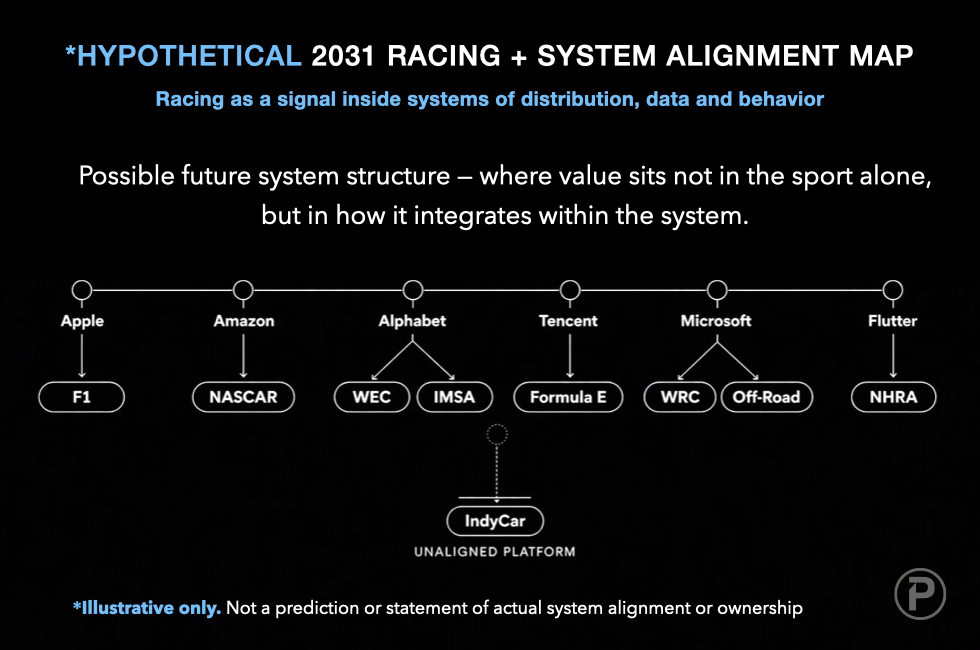
2031: Racing’s new alignments reflect a younger, more balanced, digitally native audience, as value shifts to systems that connect distribution, behavior, and identity at scale.
That is what makes it matter now. In a system-driven environment, IndyCar is one of the few properties at scale that still carries the capacity for a consequential shift forward.
The FOX investment reinforces that point rather than contradicts it. It improves distribution and sharpens the product. But it still operates within the logic of broadcast — reach, scheduling, aggregated audiences — rather than system integration.
In this environment, what has not yet been integrated may be the most valuable position of all.

A Different Outcome
There is also a scenario that does not follow any of these alignments. Not institutional. Not integrated. Not designed to fit inside existing systems.
These are not traditional operators. They are brands that built identity first, distribution second, and community as the connective tissue between them. They understood early that culture moves faster than media, and that participation matters more than reach. They have been inside motorsport for decades — not bound by its conventions, but reshaping them.
Red Bull and Monster operate at global scale with multibillion-dollar businesses built on exactly this model. They are already invested across the sport — from Formula 1 to off-road, from grassroots to global championships. They understand how the system works from the inside.
They are not entering motorsport. They have been redefining it for years. And what they see clearly is what the system still lacks.
The path forward from that vantage point is not singular. They could reimagine an existing series around a culture-first model — identity, participation, emotional connection over inherited structure. That alone would be disruptive. Or they could create something entirely new, something that doesn’t follow the rules of existing motorsport but writes new ones.
That new expression would not be polished or committee-built. It would be direct, fast, and uncompromising — defined by minimal rules, real risk, and clear outcomes. Shorter formats that hold intensity rather than stretch it. Conditions that introduce unpredictability instead of controlling it. Locations that feel discovered rather than scheduled. Drivers who operate as creators as much as competitors.
No legacy to protect. No expectation to manage. Only the freedom to build something aligned with the moment.
In a world moving steadily toward autonomy and managed experience, the appeal of something that remains fully human continues to grow. Not optimized. Not softened. Just real.
And if it emerges at the right moment, with the right backing, it doesn’t need to compete with the existing system. It can move around it.
That may sound unlikely. But so did most structural shifts before they happened. What begins at the edge, dismissed or misunderstood, eventually redefines the center. Smart capital knows this — it looks for asymmetry and cultural leverage that cannot be easily replicated.
This is where disruptive operators still hold their advantage. They are not waiting for alignment within existing structures. They are capable of creating alignment around something new. And when they do, the impact is not limited to ownership or format. It changes how the sport is felt.
Because motorsport has never been only an entertainment business. It is an inspiration business — where victory travels at the speed of thought, fueled by emotional meaning that systems alone cannot produce.

What This Points To
None of this depends on any single outcome being right. But it is getting harder to miss where things are heading.
Racing is not being displaced or diminished. Its value is becoming more visible — because of where it sits, and what it reveals, as everything around it continues to shift. What changes is context: the systems it connects to, and the role it begins to play inside them.
Because once racing is understood not simply as a sport or a media property, but as something operating inside larger systems of distribution, behavior, identity, and decision-making, it stops being evaluated on its own terms. It starts being valued for what it enables.
Some will continue to see a series, a calendar, a rights structure. Others will see something else — something that carries attention, compresses decision-making, and makes consequence visible in a way very few environments still can. That distinction is already starting to separate those aligned with it from those still reacting to it.
The shift itself is not dramatic. It rarely is. It happens in layers, then all at once, and only later appears obvious. By then, the positioning is already set.
The question in front of us is not whether racing changes. It is how it is understood — and by whom.
Those who continue to see seasons will operate one way. Those who recognize systems will operate another. Over time, that difference compounds.
Because the shift is not subtle. It is from seasons to systems — and from events to environments.
If racing was never the business to begin with, and the future now being built requires fewer humans to sustain it, then the real question isn’t how fast it arrives — but who it still works for when it does.
PS: For those keeping score…
With a quiet assist from my AI teammate: Individually, these scenarios sit somewhere between 20–35%. Collectively, in this exact form? Single digits.
But that’s not how shifts happen. They don’t arrive as predictions fulfilled. They arrive as patterns recognized—usually after the advantage is gone.
The tools evolve. Judgment still decides.
DISCLAIMER: FORWARD-LOOKING STATEMENT
Actual outcomes may differ materially. They usually do. That is the point.
