
The Speed Trap
From the cockpit, speed feels like the ultimate advantage.
Data streams in real time. Simulations run in milliseconds. Artificial intelligence is compressing learning cycles across motorsport and business alike. But when every competitor has access to the same acceleration, something strange happens. Speed stops being the edge. RACER Brand and Pfanner Advantage founder Paul Pfanner explores why — and when many teams drive straight into the speed trap.
I’ve spent my life at the intersection of racing, media, and brand behavior — shaped by mentors who believed competition was a discipline, not a performance. They raised me inside the competitive cauldron of motorsport, where excuses are exposed quickly and performance is the only measure. That environment taught me to respect speed — but never mistake it for advantage.
The Diner in Daytona
A pivotal scene in the opening minutes of the Apple-produced F1® The Movie — directed by Joseph Kosinski — is set in a busy old-school diner in Daytona Beach, just hours after the film’s hero demonstrates his undaunted spirit helping his team win the GT class at IMSA’s Rolex 24.
Aging racer Sonny Hayes (Brad Pitt) sits with Ruben Cervantes (Javier Bardem), his former Formula One teammate, now an F1 team owner. Ruben has a promising rookie driver but has gone through several veterans trying to find the right experienced racer to lift his Apex F1 Team from the back of the grid — and avoid a forced sale to manipulative investors.
On the table between them sits a first-class ticket back to Formula One.
A second chance.
Ruben slides a 1990s RACER magazine — the brand I created and built — across the table. The cover features both men as young prospects. He asks Sonny what that younger version of himself would want him to do.
Sonny deflects. Jokes. Minimizes. Because that’s safer.
“I’m offering you an open seat in Formula One. The only place you could say for one day — if you win — you are the absolute best in the world.”
Sonny studies the ticket and asks: “Ever seen a miracle?”
Ruben answers quietly: “Not yet.”
Later, alone, Sonny studies the ticket again. Then the RACER magazine cover. Something shifts — not nostalgia, but recognition of possibility. With a wry smile he silently accepts the challenge.
The film soared to $693.3 million in global box office, earning four Academy Award nominations including Best Picture. It also redefined the fast-evolving relationship between sports, media, and today’s younger, digital-native audience.
But that scripted encounter between two mid-life men in a diner isn’t really about age or second chances. It’s about whether someone still believes they can learn faster than younger competition — even when the nature of competition has changed.
That’s the same question artificial intelligence is now forcing on many of us.
The Age of Acceleration
We are living through the fastest acceleration cycle of our professional lives.
Artificial intelligence now sits inside motorsport — informing tire strategy, simulation modeling, stewarding review, driver development, sponsorship analytics, and the content ecosystem surrounding the sport. Across Formula 1, IndyCar, NASCAR, IMSA, WEC, WRC, and Formula E, learning cycles have compressed dramatically.
That’s genuinely exciting. But here’s the uncomfortable part: when everyone has access to the same acceleration, speed stops being the advantage. What replaces it is something harder to manufacture — trust, judgment, and the discipline to know what the data actually means.
AI accelerates the race. But the race itself hasn’t changed.
We live in a world where access to information is nearly universal and analysis arrives instantly. That creates a dangerous illusion — that faster answers mean deeper understanding. In motorsport, we know better. Data has never driven the car. Judgment does.
Telemetry reveals patterns. Simulation tests possibilities. AI processes millions of scenarios in seconds. None of it replaces the human capacity to interpret context, recognize weak signals, and decide what actually matters. Learning takes friction — mistakes, reflection, and the humility to sit inside uncertainty long enough to develop judgment. AI can accelerate exposure and surface patterns, but it cannot internalize consequence for us. That part remains human.
When we stop doing that work — when we substitute instant answers for disciplined learning — the risk isn’t that machines become too intelligent. It’s that we become less thoughtful.
In racing, that mindset doesn’t last long. Electronic timing systems don’t reward explanation. They reward performance.
Three Words
In 1979 I was racing a new Van Diemen Formula Ford under the guidance of my mentor and team manager Mike Hull. After a qualifying session debrief filled with explanation rather than performance, Mike stopped me mid-excuse.
“I thought you wanted to be a racing driver… but you’re showing real potential as an excuse maker.”
Then he delivered three words that have shaped nearly everything I’ve built since: Racing is learning.
Four years earlier Mike had written something both humorous and impactful in my SCCA driver’s school logbook: “Nice job on the straights.”
Translation: you’re comfortable when things are easy. The real work happens in the corners — especially the fast ones where visibility is limited and exit speed determines everything that follows.
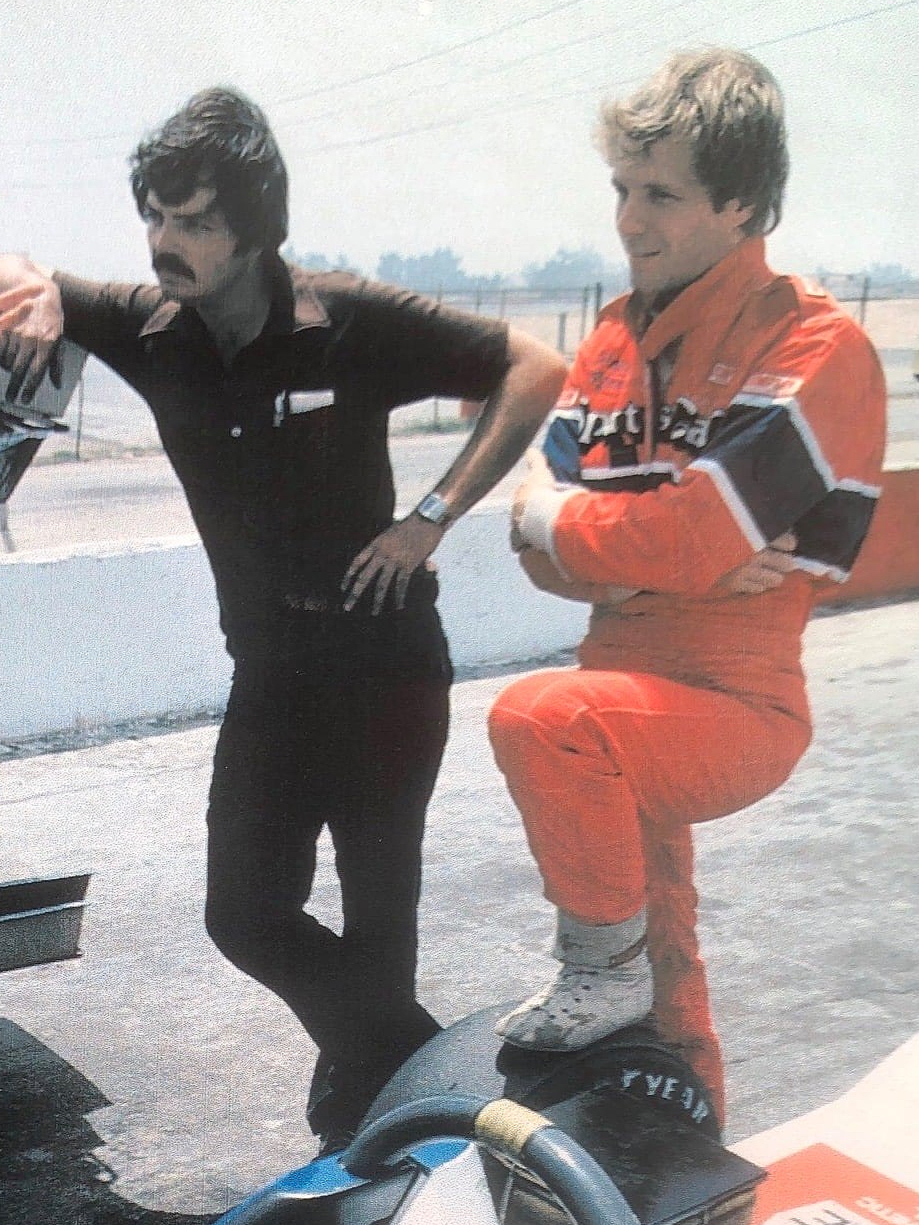
Learning faster: Racing Zen master, Mike Hull (left) and his young pupil.
After that season I redirected my competitive instincts into something else that demanded the same commitment to learning. I left the publishing company where I worked and started what is now Pfanner Communications, Inc., and our Pfanner Advantage consulting practice.
A mentor gives you the words. Life teaches you what they meant.
Mike went on to become Managing Director of Chip Ganassi Racing. Watch how he operates and you’ll see it immediately — he lives in now. No nostalgia. No ego. Just disciplined reflection and faster learning. That behavior is advantage.
That philosophy echoes the thinking of the late Mark Donohue — the brilliant driver-engineer who helped define the Penske era and co-authored The Unfair Advantage. Donohue understood something that still holds true today: speed matters, but intelligence determines the outcome. Not raw speed. Not innovation alone. Performance powered by disciplined learning — the kind that compounds over time inside organizations that trust the people doing the work.
This is the real unfair advantage that has defined Team Penske and Chip Ganassi Racing for decades. In racing’s most competitive environments — Indianapolis, Daytona, Le Mans — success rarely comes from raw speed alone. It comes from teams that learn faster than everyone else while maintaining trust inside the system.
Racing is learning. Business is learning. Survival is learning.
