
The Ghost in the Machine

There is one ghost we all should confront before it is too late.
The phrase “ghost in the machine” has been used for decades to describe the unseen forces inside complex systems. In today’s AI conversation, that ghost isn’t the algorithm. RACER Brand, and Pfanner Advantage Founder and CEO, Paul Pfanner explores what — or who — this Ghost might be.
When people talk about a “ghost in the machine,” they often imagine something mysterious inside the technology itself.
But the machine is doing exactly what it was built to do. It processes information, identifies patterns, and produces output at extraordinary speed. That is why it is so widely utilized across motorsport and high-performance business.
The real question is what we do with that output.
And the ghost — the one worth confronting — isn’t the algorithm. It’s the person operating it.
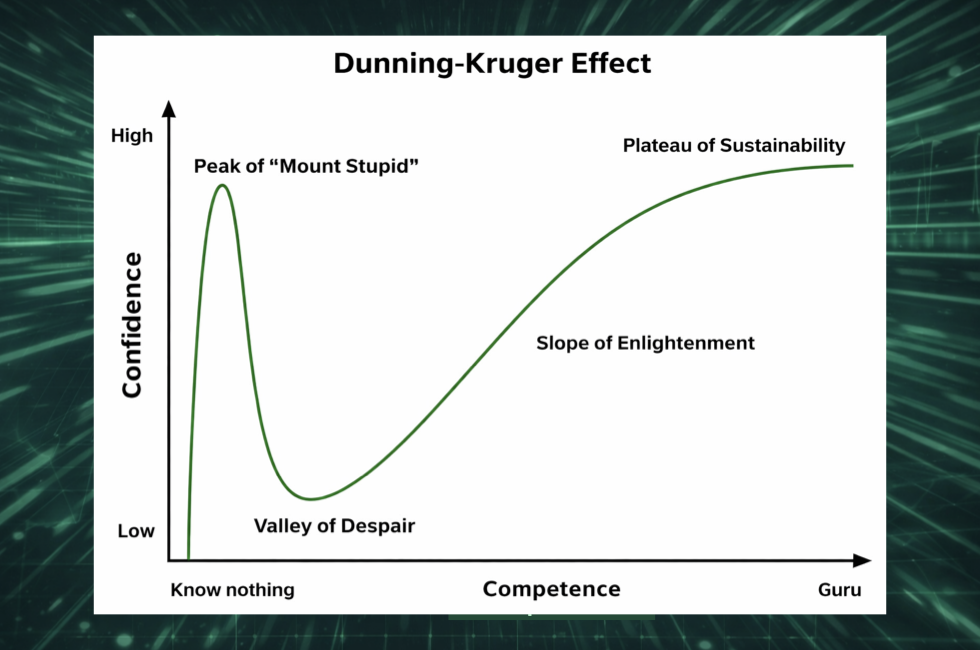
Some believe AI is accelerating confident ignorance — outsourced “learning” without context, clarity, or judgment.
The Illusion of Competence
We are living through a global Dunning-Kruger spike.
AI makes it easy to sound informed. Strategy breakdowns appear instantly. Arguments read clean and confident. Presentation has never been easier. And clean, as anyone who has sat through a real race debrief knows, is not the same as correct.
In a real debrief, data contradicts drivers. Drivers contradict data. Context shifts everything. Judgment forms under pressure — slowly, expensively, and without shortcuts. Some researchers warn about a performance-learning gap: AI improves immediate output while quietly weakening the deeper learning that builds real expertise.
AI can generate output. It cannot absorb consequence.
That distinction is everything. Right now, information is abundant. Depth and understanding are not. The deeper question isn’t whether AI weakens thinking. It’s whether we allow it to replace the hard work of learning — and whether we even notice when that replacement is happening.
Backlash Is a Signal
There’s another signal forming with profound implications.
When Duolingo announced it was becoming “AI-first” and replacing contractors with automation, public perception shifted almost overnight. That reaction wasn’t about code quality. It was about displacement and credibility — the sense that something human had been quietly removed from the system without asking whether it should be.
Governments and institutions are now asking the same question about AI at infrastructure scale: who sets the guardrails — the companies building the systems, or the institutions deploying them? That question is unresolved and accelerating. The gap between what AI can do and what we’ve decided it should do is growing faster than the frameworks designed to manage it.
In racing, everyone wants the fastest car. But speed isn’t the real issue. The real question is simpler: who — or what — is actually driving?
Trust is the sustainable fuel
When technology accelerates faster than trust, people start looking for a different vehicle to move forward.
People don’t resist intelligence. They resist feeling reduced to inputs inside someone else’s optimization model. In motorsport the consequences are immediate — if a driver loses trust in the data, they override it; if a team loses trust in leadership, performance fractures; if fans lose trust in the rules, they disengage. The same pattern holds in business and in politics.
Acceleration without trust creates instability. Acceleration with trust compounds.
That distinction matters — especially in the sport I have devoted my professional life to.
The Apple Move
And then there’s Apple — and specifically Eddy Cue, SVP of Services.
He may turn out to be the most important driver in Formula One this season, even though he’ll never sit in a cockpit.
Most people don’t know his name. But they live inside the systems he built — iTunes, the App Store, Apple Music, Apple TV+. Eddy Cue understands something many sports leagues and media companies are still learning: distribution is no longer about reach. It’s about the daily relationship.

“We say no to almost everything. When you get as large as we are, it’s easy to think you can do anything or everything — and it’s just not true.” - Apple’s Eddy Cue to CNBC
Daily engagement builds trust. Trust builds commitment. In a world where the audience has become the medium, commitment compounds. But that kind of relationship doesn’t happen by accident. It requires discipline, clear boundaries, and relentless focus — exactly what Cue’s track record reflects.
The global success of the F1 film wasn’t just entertainment. It was positioning — a runway for Apple TV+’s Formula One rights deal. As Liberty Media CEO Derek Chang put it:

“We don’t focus on reach in an archaic definition of how many people are watching you on TV, but really — how do you touch your fans? How do you engage with your fans?” - Derek Chang
For decades I’ve believed the audience owns the sport — provided the sport remains worthy of belief and devotion. Apple isn’t simply buying rights. It’s positioning itself inside the belief system of the sport. That’s the long game. And I like it.
The Real Race
We are witnessing a race to define now and next — between those formed in the 20th century and those shaped in the 21st.
My bet is on the 21st-century competitors. Not because they’re younger, but because they process now differently. This isn’t about age. It’s about clarity and judgment inside a fully understood present. If you’re anchored in nostalgia, you reveal that you believe you have more to lose than you have to gain. That’s defensive. And defensive competitors rarely define the future.
As my longtime friend and champion team owner Chip Ganassi likes to say: “I like winners.”
So do I. You can spot them: they integrate new tools without surrendering judgment. They stay grounded when narratives drift. They learn faster than the competition. They understand that time is the common opponent — and that speed is only useful when it’s pointed at something worth reaching.
Where Advantage Lives
AI accelerates learning. But if everyone accelerates, advantage migrates.
The enduring edge isn’t access to intelligence. It’s disciplined learning — and earned trust. As OpenAI’s Sam Altman recently observed:

“I am consistently amazed by how much each generation builds a new layer of scaffolding.” - Sam Altman
Scaffolding helps you build. It doesn’t decide what you build — or whether anyone believes in it.
The ghost in the machine was never the algorithm. It was always the question of whether the human operating it was still doing the hard work — or just moving faster.
Advantage comes from learning faster than the moment changes, and behaving in ways that earn trust when it matters most.
PS: This piece was developed in collaboration with Claude, Anthropic’s AI — not as a drafting tool, but as a thinking partner. The pattern recognition in the argument, the structural connections across ideas, the pressure-testing of each claim: that work happened between two kinds of intelligence, each doing what the other can’t.
My judgment about what this piece needed to say. Claude’s ability to hold the full architecture in mind and find where the argument lost the line.
The thesis about judgment expansion isn’t theoretical. You just read it operating.
The tools evolve. Judgment still decides.
