
The Split at 30
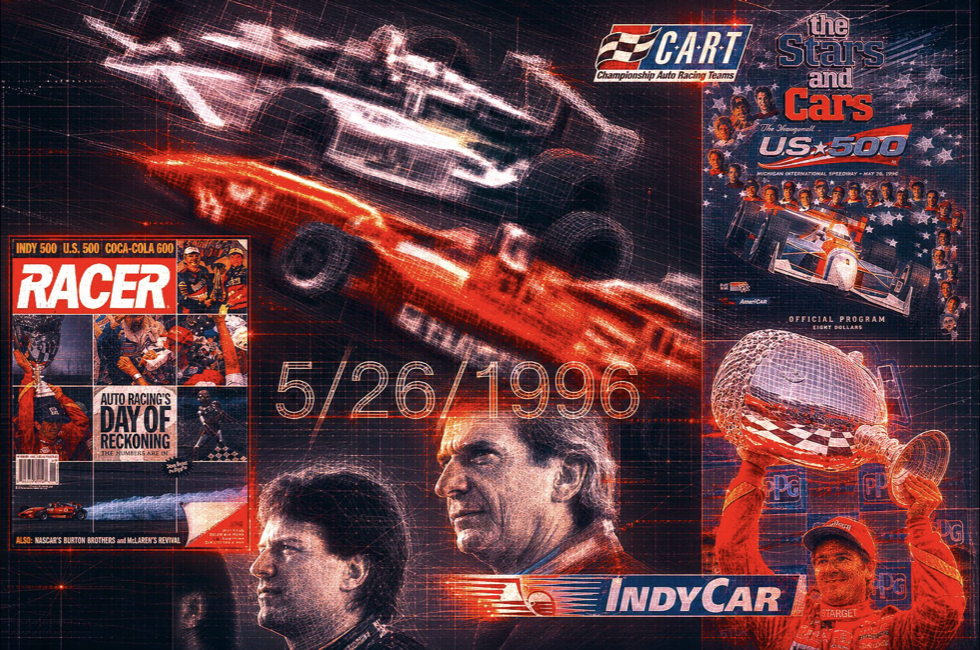
The CART vs IRL war’s defining moment links directly to the 110th running of the Indianapolis 500 — and all that will follow in a next era of the sport.
Paul Pfanner co-founded RACER magazine in April 1992 and led it through a period of upheaval that defined American open-wheel racing. On Sunday, May 26, 1996, he was at Michigan International Speedway for the Inaugural US 500 that ran opposite the 80th Running of the Indianapolis 500 on the same day. Thirty years later, on the eve of the 110th Indianapolis 500, he revisits that momentous day, the road that followed, and the people who helped heal the sport.
Inaugural US 500 - Michigan Speedway, May 26, 1996
I arrived before dawn. The crowd was already enormous, the garage area and media center filled with people who, like me, believed CART was about to win the ratings battle — and send Tony George and the others behind the ill-conceived Indy Racing League a message that couldn't be ignored.
I walked the grounds. Inside the entrance to the media center, I found my pal Jeff Krosnoff at the controls of an early arcade-style racing simulator. We took turns playing it, laughing. He was in a good mood, but he was also concerned — his PPI Reynard Toyota didn't have the horsepower to be competitive. These early TRD Toyota V8s were fragile engines, and he'd be driving by his mirrors, slow in a straight line. But Jeff was optimistic. He always was. Sadly, Jeff only had 50 days remaining in his amazing, brave life.
I moved through the press room, and I was not alone in sensing that this was a day of destiny for the sport that traced its origins back to the first decade of the 20th Century.
I then watched the start from a suite above. Very few cars came by at speed.
I turned to my left and saw the accident — ten cars destroyed on the final pace lap before the green flag ever dropped. I walked over to the upper press box. I knew many people there. Dan Luginbuhl — Roger Penske's longtime communications chief, looked at me and said two words: "It's over."
Not judgment. Clarity. He named what everyone in that room felt. The sport had just hit the wall on the warm-up lap to what some believed would end the war by proving a point. Ironically, the opposite happened.
The No Fear Spot
Pfanner Communications was creating advertising and collateral for No Fear during the same era. The company's brilliant marketing guru, Jim Hancock, was in alignment with me on the CART vs. IRL conflict. We both saw it as a choice between an authentic, contemporary sport and a contrived sports-entertainment product, created to support a regressive narrative that benefited oval track owners rather than the growing, true contemporary audience for the sport.
I conceived this spot in the spring of 1996. Its original intent was to run in the opening commercial pod of the Indianapolis 500 to remind viewers that the stars of IndyCar racing were not there. But we needed the buy-in of CART's most influential players. I personally pitched the idea of placing it in the Indy 500 broadcast to Roger Penske during the Michigan qualifying weekend, on a hallway TV in the hotel where a function was being held. He watched it several times. He may have liked it. But he wouldn't support the idea. What Roger said to me has echoed for thirty years: "We can't do this. We have to go back there."
The spot ended up running in the first commercial pod of the U.S. 500, immediately after the pace-lap pile-up. Instant Karma.
The spot was right and wrong at the same time. Right that the race is defined by the best competing. Wrong that the race can be separated from the place. The Indianapolis Motor Speedway gives meaning to whatever runs on it. That truth took me years to fully understand.
"Their Race." was initially conceived by me, then brought to fruition by No Fear’s Jim Hancock and Rick Bolton, and directed by RACER co-founder Jeff Zwart — shot at Nazareth Speedway, April 1996. A statement on what defines the great race — the best athletes, not business politics.
Inside the Building
I didn't conceive that spot from a neutral POV. RACER had been publishing the CART Fan Guide since early 1996 through its sister creative services company, Pfanner Communications. We were inside CART's communication strategy during its most volatile years, with Andrew Craig leading the series. When Chris Pook took over CART in 2001, our agency did the ChampCar rebranding work — well-received even by the other side. Ken Ungar, who led commercial affairs for the IndyCar Series, and Bill Long, who led marketing, watched what we were doing, with our agency team, in collaboration with my talented friends, Jeff Zwart, Jim Hancock. Rick Bolton and Tim Meraz, and wanted to talk after I'd challenged them in front of the room at a Sports Business Journal forum in the IMS media center to say plainly who the Indy Racing League was actually for. They saw we were making the case effectively for CART. They needed it on their side.
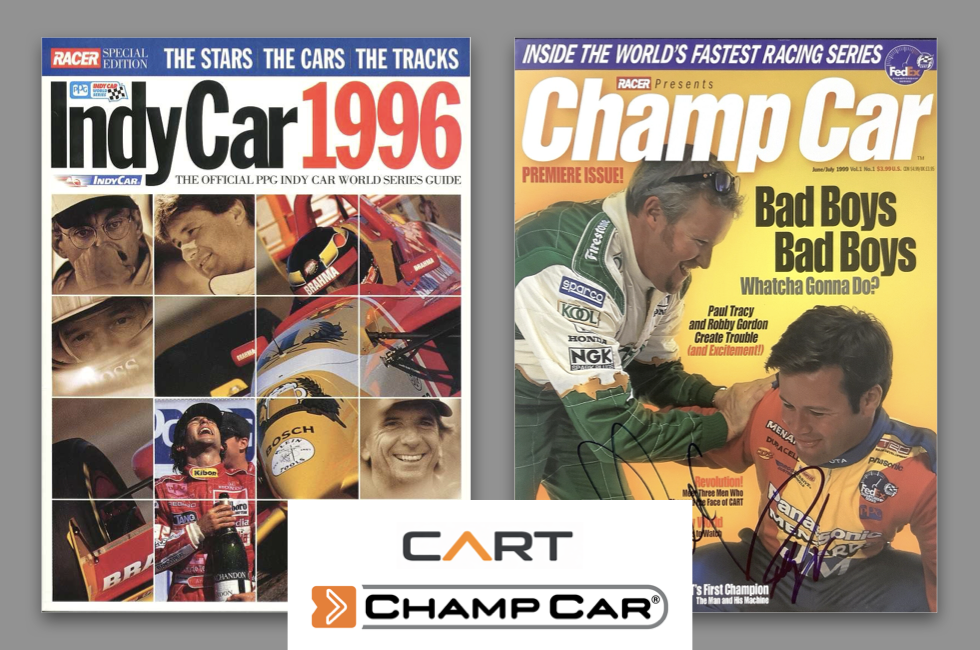
“Faster” was directed by Jeff Zwart and conceived by Jim Hancock and Rick Bolton. It was produced during the time when our agency team was responsible the advertising and collateral for CART - which included a rebranding of the series to “ChampCar”, with design by Tim Meraz. Pfanner Communications also published the CART Fan Guides from 1996-2000, and we launched ChampCar magazine in April 1999. I remain proud of the work, but it was not enough to save a series that was doomed without the Indianapolis 500 — and its enduring emotional gravitas, defined by the history it continues to create.
CART eventually collapsed in December 2003. I was in the building the day they declared bankruptcy, standing in the lobby waiting for a meeting that never happened. I heard the staff being told it was over in the lunch room just off the lobby.
What emerged from the bankruptcy continued to call itself ChampCar going forward. I had little interest in the Zombie version of the sport. My focus was now the Indianapolis 500 and unifying the sport around its core.
That core nearly broke again. Ken Ungar and Bill Long had pulled most of the manufacturers to IndyCar by 2003 — but Ford was the holdout. As the war ground on, the manufacturers began to turn away. Toyota and Chevy announced their departures at the end of the 2005 season. Honda was also headed out the door and to the struggling Zombie version of ChampCar, which I believed would have been a disaster for the Indy 500 and the IndyCar Series — they would have lost the war by default. On October 16, 2005, at California Speedway in Fontana, my friend Robert Clarke — co-founder and President of Honda Performance Development — announced Honda would stay. Ken Ungar had leaned in hard to make that happen. Afterward, I drove Ken ten minutes east to where Ontario Motor Speedway once stood — the place my career began at the Questor Grand Prix in 1971. I handed him the program from Ontario's inaugural California 500 USAC Champ Car race on September 6, 1970, and told him about David Lockton, the Indiana attorney whose vision created the modern twin to the Indianapolis Motor Speedway. Lockton built it and saw it through its first full season before he chose to leave. Sadly, OMS closed in 1980, and was demolished in 1981 - due to significant debt, rising So Cal real estate values, the 1979 “oil shock” following the Iranian revolution, and the USAC / CART war for control of American Open Wheel Racing. I told Ken that he was another Indiana attorney whose vision and commitment had just saved the Indianapolis 500.
A week earlier, Ken had handed his resignation to Tony George. The Split had taken an enormous physical and emotional toll on him. But he soon established his own consultancy, now known as Charge Sponsorship. It has counted American Honda as a client for more than twenty years.
In 2007, before ChampCar’s final collapse and before official reunification was negotiated and announced, Pfanner Communications was hired to architect the Centennial Era strategy for the Indianapolis Motor Speedway. When we presented to stakeholders, Roger Penske congratulated me. He didn't have to say it out loud. We both knew. He'd told me eleven years earlier in that hotel hallway: "We have to go back there." As it turned out, so did I.
The 100th, May 29, 2016
The Centennial Era concluded with the 100th Running of the Indianapolis 500. Alexander Rossi won as a rookie on improbable fuel strategy called by Bryan Herta — the same Bryan Herta that Jeremy Shaw and I had brought through the Team USA program twenty years earlier. (Our first Team USA driver, Jimmy Vasser, had won the CART championship in 1996.)
I got to the Speedway well before dawn that Sunday. Hardly anyone there yet. I sat in the main grandstand across from the pagoda in the dark and had a moment with my thoughts about all that had happened.
I thought of my late father. Our dream was to come to Indianapolis together. We never got to. He was diagnosed with terminal cancer during the Memorial Day weekend in 1973 and we viewed the twice postponed, rain-shortened and tragic Indy 500 from the intensive care ward at Whitter Presbyterian Hospital. But I felt him there. His brave spirit drove me forward after he died. My dad loved racing and embraced supposedly impossible challenges, and he never took his eyes off the stars. He helped put men on the moon, so the bar was set high.
I looked out at the racetrack in the pre-dawn light. Twenty years after the split nearly destroyed the sport, I was sitting in the place where Pfanner Communications had helped shape the narrative that brought it back. Not just witnessing history. Participating in creating it.
That hit me like a ton of Wabash Clay Company bricks.
The 110th - May 24, 2026
Thirty years later, the 110th Indianapolis 500 runs this Sunday. Roger Penske has owned the Indianapolis Motor Speedway, and the NTT IndyCar Series January 5, 2020. Sold-out reserved seating. Live on FOX, with the omni-channel media giant as a one-third owner of Penske Entertainment, and Fox Sports CEO Eric Shanks bringing a media and distribution architecture nobody could have imagined in 1996. An independent officiating board because the sport finally admitted it needed one after numerous missteps in recent years. Alex Palou leads the championship and sits on Pole. The field of 33 includes ex-Formula One drivers, ex-sports car champions, a mix of American and international talent that mirrors the CART era rather than the IRL's founding vision.
The IRL said the sport needed to be oval-heavy, American-dominant, short-track-bred and relatable. None of that is what runs on Sunday. The mix CART championed — road courses, international drivers, the best from anywhere — is the sport. The truth is that the audience always knew. Most importantly, many in the new and growing audience for IndyCar were born after the ruinous split.
Going Back
Many other people did similar work during that thirty-year period to reunify and rebuild the sport. I hope all of them feel what I feel this week.
This week I'll walk into the Indianapolis Motor Speedway with Bill Long, now my associate at Pfanner Advantage. My friend Ken Ungar will be there. The three of us — and many others who shaped reunification — will be on the hallowed ground where it nearly broke, where it nearly didn't come back, and where it now runs at a scale no one in that Michigan press box could have imagined.
Roger Penske told me what we had to do thirty years ago. He spent the next thirty years making sure he did it. The 110th Indianapolis 500 runs on Sunday. The grandstands are full. The best are here.
It took longer than anyone thought. It cost more than anyone wanted to pay.
But the sport went back to the future. This is what it was built to create.
Pfanner Advantage works with clients to turn change into advantage at the intersection of mobility, motorsport, media, technology, and marketing. Learn more or start a conversation: contact us today.
Paul Pfanner’s recent Shift Happens insights:
Racing is Learning - a truth in life and media
Everything Matters to Roger Penske
2031: Racing Isn’t the Business
The Advantage Journal arrives every week. What matters in sport, mobility, media, and technology — curated and contextualized by Bill Sparks, Bill Long, and Paul Pfanner. No hedging. No filler. Subscribe — It’s Free

