
The Electric Air Taxi Is Almost Here

In the not too distant future, air taxis could become a common sight in the skies above New York City.
JoeBen Bevirt started an electric aircraft company on a California ranch in 2009, self-financed, with almost no press coverage. He now holds 160 patents, has Toyota, Delta, and Uber as partners, and is months away from launching the first FAA-certified air taxi in U.S. history. Bill Sparks looks at this new entrant in the mobility space.
On April 27th, a small electric aircraft lifted off from John F. Kennedy International Airport, crossed New York Harbor, and landed at a heliport in Midtown Manhattan. The flight took seven minutes. The same trip by car, on a good day, takes around 45 minutes. On a bad day, considerably longer.
There was no jet fuel involved, no thunderous rotor noise. The aircraft is the Joby S4, and the company behind it has spent the better part of 15 years working toward this moment in near-total obscurity.
The Man on the Ranch
JoeBen Bevirt started Joby Aviation in 2009 on his ranch in the Santa Cruz Mountains, financed with the proceeds from previous companies he had built and sold. One of those was GorillaPod, the flexible camera tripod that most photographers have owned at some point. Another was Velocity11, a robotic laboratory systems company acquired by Agilent Technologies.
Bevirt holds over 160 U.S. patents. He has a mechanical engineering degree from UC Davis and a master's from Stanford. He is not, by most accounts, a media-savvy Silicon Valley founder who's good at getting on the cover of Wired. What he appears to be is an obsessive engineer who decided that building a quiet, electric aircraft capable of vertical takeoff and landing was the most important thing he could spend his working life on.
For most of its first decade, Joby barely registered in the press. Other startups in the emerging eVTOL space were louder, better funded, and more visible. Several of them are now bankrupt.
What Makes the Joby Different
The S4 carries four passengers and a pilot. Six tilting rotors handle vertical takeoff and then pivot for forward flight, like a hybrid between a helicopter and a propeller plane. It cruises at around 200 miles per hour with a range of roughly 150 miles per charge. These are respectable numbers. But the specification that matters most for city operations is noise output.

Helicopters are loud and annoying by nature. A quiet eVTOL could make mass-scale flying taxis politically viable.
A conventional helicopter is brutally loud. The characteristic thumping comes from rotor blades passing through their own turbulent wake, a phenomenon called blade-vortex interaction, and it is essentially unavoidable in traditional rotor designs. It is also one of the main reasons helicopter commuting never scaled in cities, despite the infrastructure existing for decades. New York has had heliports for 70 years. Wealthy people have been using them occasionally for almost as long. What hasn't been possible is operating them at anything close to mass scale, because helicopters are deeply antisocial. They rattle windows, disrupt neighborhoods, and generate political opposition, which politicians hate because it means they have to do something.
Joby's published acoustic data puts the S4 at around 45 decibels overhead during cruise, roughly the sound level of a quiet library. A typical light helicopter at a similar altitude registers in the 85 to 90 decibel range. Joby has claimed that during flight its sound footprint covers about 0.004 square miles. A helicopter on the same route covers approximately 45 square miles. If those numbers hold up in real-world commercial operations at scale, the aircraft represents something genuinely new: urban air transport that doesn't make everyone under the flight path hate people who can afford to fly in helicopters.
The S4 achieves this partly through rotor design. Multiple smaller, faster-spinning rotors operating at higher frequencies push their acoustic signature into ranges that dissipate more quickly with distance and that people find less intrusive than the low-frequency thumping of large helicopter blades.
The safety architecture is also meaningfully different from a conventional helicopter. A traditional rotorcraft has one main rotor and one tail rotor. Lose either, and you have a serious problem. The S4 has six independent propulsion motors, four separate battery packs, and a triple-redundant flight control computer. The design intent is that losing one or two rotors is survivable without heroic piloting. That is a fundamentally different philosophy than traditional rotorcraft safety.
The Long Road to Certification
Joby began its FAA type certification process in 2018. The agency essentially had to build the regulatory framework from scratch, since no electric vertical takeoff and landing aircraft had ever been certified for commercial passenger service in the United States. The FAA issued its first formal powered-lift certification standards in October 2023, which gives a sense of how long the groundwork took.
Certification involves five stages. Joby completed Stage 4 in late March 2026. This stage required the FAA to physically inspect production aircraft and confirm that the hardware rolling off the assembly line precisely matches the certified design. It's where many aerospace programs stumble, because there is often a real gap between what engineers designed and what the factory actually builds. Joby passed.
One stage remains. If the company clears it by the end of 2026, it will receive the first type certificate ever issued to a commercial eVTOL aircraft in U.S. history.
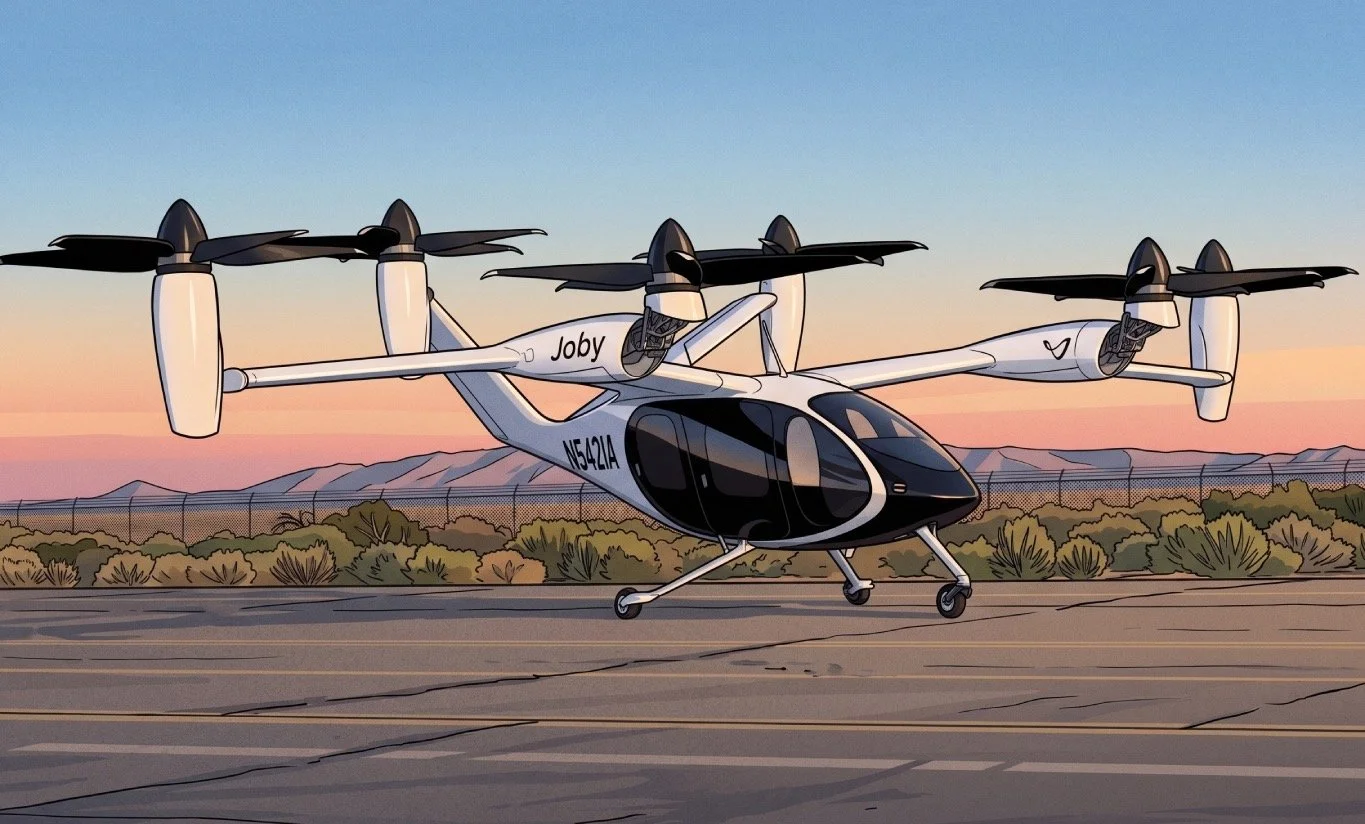
Joby eVTOLs are already being tested by the U.S. military for personnel transport and casualty evacuation.
The First Partners
Toyota has invested close to $900 million in Joby. More importantly, Toyota engineers are physically embedded at Joby's California facility, applying Toyota Production System discipline to aircraft manufacturing. Toyota also has a long-term agreement to supply key powertrain and actuation components. Getting the money mattered. Getting Toyota's manufacturing knowledge may have mattered more.
Delta Air Lines invested $60 million and has a commercial agreement for Joby to serve airport connections for Delta passengers. The obvious initial use case is exactly the trip that was demonstrated in New York: between the airport and the city center, where road congestion causes the most predictable, repeatable frustration.
Uber's involvement has a more interesting history. In 2020, Joby acquired Uber Elevate, Uber's entire urban air mobility division, along with a $75 million investment from Uber. Uber Elevate had spent years building the software infrastructure, market simulation models, and operations platforms for running an urban air network. Joby absorbed all of it. The booking integration with the Uber app that exists today is a direct inheritance of that acquisition.
The U.S. military is also in the picture. Joby has a contract with the U.S. Air Force worth up to $163 million, the largest eVTOL contract in the industry. Aircraft have already been delivered to Edwards Air Force Base in California and MacDill Air Force Base in Florida, where military units are testing them for personnel transport and casualty evacuation. It generates revenue, provides real operational experience before commercial launch, and subjects the aircraft to demanding conditions that most aerospace programs don't face until after they're already carrying paying passengers.
The Competition Has Thinned
The eVTOL space attracted considerable attention and investment over the past decade. It has also produced a significant graveyard. Lilium, a German company once considered one of Joby's most serious rivals, went bankrupt. Volocopter encountered severe financial difficulties. The companies still standing are a much shorter list than five years ago.
Boeing's Wisk is the most interesting remaining competitor, and it's taking a different strategic bet. Wisk is building only autonomous aircraft, skipping the piloted phase entirely, on the theory that eliminating the pilot is where the real unit economics of the business actually live. That's probably correct as a long-term proposition. The practical problem is that the FAA is nowhere near approving fully autonomous passenger aircraft at commercial scale. Joby's approach is to launch with pilots now and migrate toward autonomy gradually through its Superpilot platform. One strategy optimizes for near-term launch; the other for long-term margins. It's not obvious which bet will win.
The Financial Picture
Joby burned through approximately $510 million in 2025 and is on pace for $340 to $370 million in just the first half of 2026. Analysts don't project profitability until 2032. The company's Q1 2026 earnings, reported this month, actually beat expectations on both revenue and loss per share, and the stock moved up in the days following. But investors remain focused on a more fundamental question: when do paying passengers actually board, and will the business model hold up when they do.
Every delay costs real money. Joby ended Q1 with approximately $2.5 billion in cash, boosted partly by a $1.3 billion equity raise during the quarter, which provides substantial runway. Even so, the company still has to prove that enough people will use the service regularly and pay enough to support the business, and that the aircraft can be manufactured consistently at scale. None of those things are demonstrated yet.
Initial pricing is expected to be in the range of Uber Black, around $200 for the JFK-to-Manhattan route. That's not a mass-market product, at least not at launch. The path to something closer to mass transit pricing depends on the cost reductions that come with manufacturing scale, and manufacturing scale depends on commercial success. It's the classic chicken-and-egg problem that faces every new transportation technology.
What It All Means
JoeBen Bevirt started building electric aircraft on a ranch in 2009, quietly accumulated 160-plus patents, watched better-funded competitors fold, and is now seven minutes from JFK to Midtown. The threshold that the industry has been talking about for a long time — an FAA-certified, commercially operating electric air taxi in a major American city — is now measurable in months rather than years.
Whether this becomes a meaningful new layer of urban transportation or a technically impressive niche for business travelers depends on factors that are still genuinely uncertain: real-world noise performance, regulatory pace, manufacturing execution, and consumer behavior. The skeptical case is not unreasonable. But neither is the case that a patient founder with good engineering and unusually good partners has done something that a lot of people assumed was still a long way off.
The seven-minute flight happened. What comes next is the harder part.
Pfanner Advantage works with clients to turn change into advantage at the intersection of mobility, motorsport, media, technology, and marketing. Learn more or start a conversation: contact us today.
The Advantage Journal arrives every week. What matters in sport, mobility, media, and technology — curated and contextualized by Bill Sparks, Bill Long, and Paul Pfanner. No hedging. No filler. Subscribe — It’s Free