
Now Processors
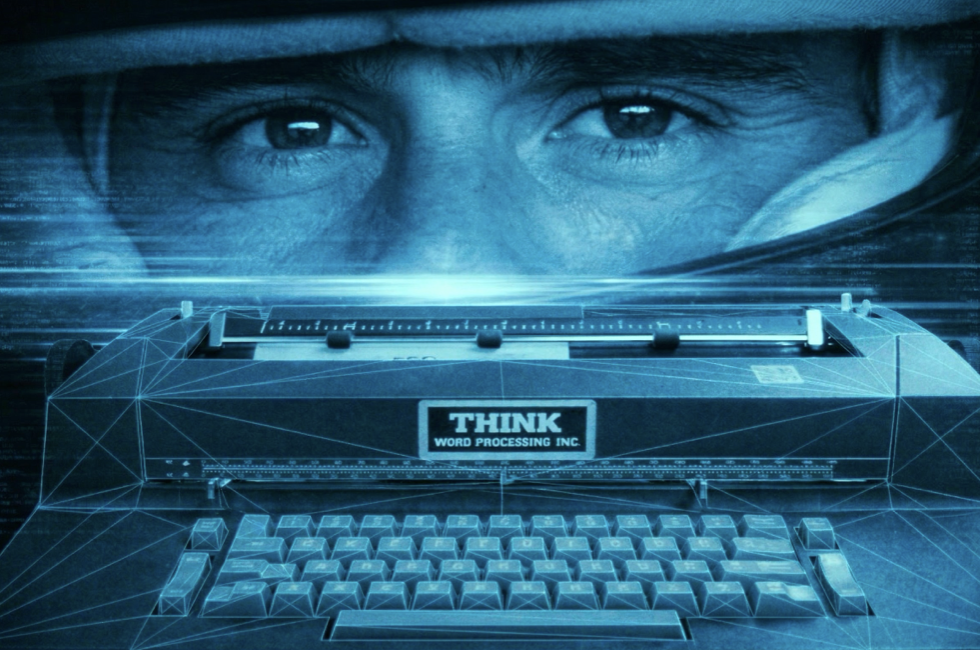
The tools change. The discipline does not.
Paul Pfanner, founder of the RACER Brand and Pfanner Advantage, has spent fifty years at the intersection of motorsport, mobility, media, business, and culture. In this edition of Shift Happens, he names a competitive discipline he calls Now-ism — the capacity to operate fully in the present moment under real consequence — and argues that it is both the most powerful edge available to a leader and the primary target of the forces currently reshaping how we think, decide, and act.
The present moment is not a philosophy. It is a performance requirement.
We’ll start with two words. Not in Merriam-Webster. Not yet. Both describe something real..
Now-ism (noun) /ˈnaʊ.ɪz.əm/
The competitive discipline of operating fully in the present moment under real consequence — distinguished from mindfulness or contemplative presence by its performance orientation, its acceptance of risk as the entry fee, and its structural incompatibility with the manufactured realities that substitute for direct experience in modern life.
Now-ist (noun) /ˈnaʊ.ɪst/
A person who operates habitually and under consequence from the present moment — reading conditions before the frame arrives, committing before certainty is available, and grounding identity in what they have actually done rather than what they are performing. Distinguished from the merely reactive by discipline, and from the merely present by judgment.
Where Did That Come From?
When the flag dropped, something surfaced from beneath conscious thought. Primal. Unplanned. One instruction: catch and overtake what is ahead of you.
In my first novice SCCA Formula Ford race, I ran that way — fueled by adrenaline and powered by an unfamiliar, urgent instinct — until I encountered a seasoned competitor who had it together. Present, committed, judgment intact. As the checkered flag fell, I accepted the verdict. I was exhilarated and terrified at the same time by what had possessed me when the green flag flew.
Only on the drive home from Riverside International Raceway did the recognition surface. The scale of the risks I had been taking — while I was taking them.
My SCCA driving school instructor and mentor Mike Hull’s question afterward wasn’t really a question.
“Where did that come from?”
The person who showed up when the flag dropped only arrives when consequences are real and the present moment is the only place available to operate.
That is Now-ism.
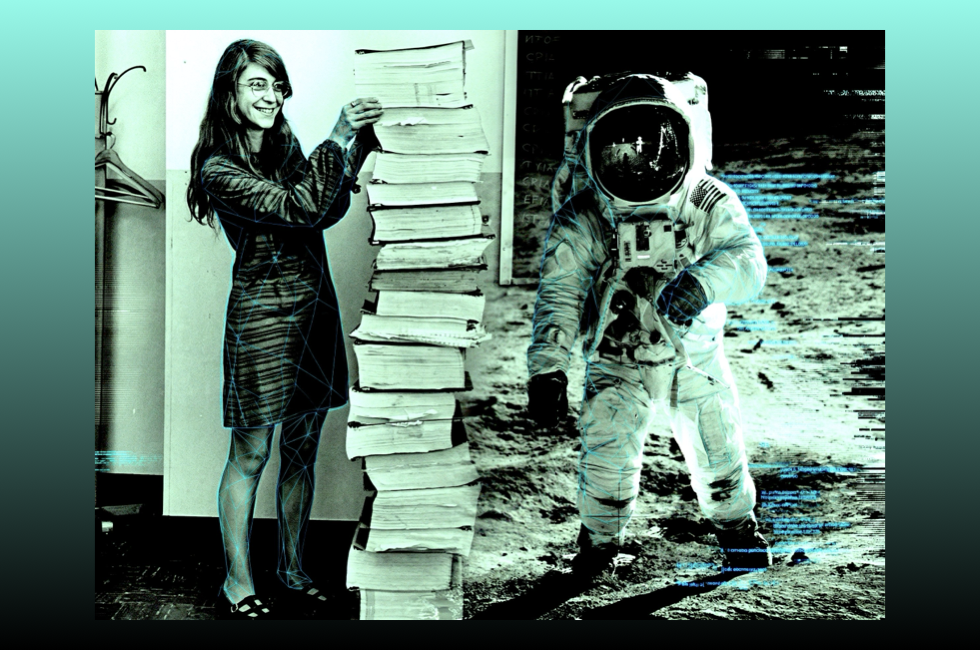
Margaret Hamilton alongside the Apollo flight software her team wrote at MIT, 1969. Her code flew. My father trained the humans who trusted it.
The Now Processors
Margaret Hamilton was in her twenties when she led the development of the Apollo flight software at MIT — writing code for a guidance computer that had less processing power than the watch on your wrist, for a mission where there was no second chance. She didn’t wait for better tools or more certainty. She designed systems capable of handling unknown problems in real time, under consequence no software had ever faced, and her code saved the Apollo 11 landing when alarms sounded three minutes before touchdown.
My father was training the Apollo flight simulator team at North American Rockwell at the same time — the humans who learned to trust her software enough to follow it to the surface of another world.
She called it the only option available: “There was no choice but to be pioneers.”
That is Now-ism applied to software engineering. She also named the discipline before it had a name — exactly what this piece is attempting.
I met Ayrton Senna once. His presence off the track was the opposite of what you might expect — shy, quiet, almost still. He saved everything for now. Which is why what he said about his qualifying lap at Monaco in 1988 — the lap widely regarded as the greatest single lap ever driven — is worth reading carefully. He described it to the late motorsport journalist Russell Bulgin:
“I was well over something conscious. Monaco is small and narrow, and at that moment I had the feeling that I was in a tunnel; the circuit was just a tunnel for me. It was going-going-going and within the physical limit of the circuit. It was like I was on rails. Of course, I wasn’t on rails.”
The numbers behind that description are almost impossible to comprehend. In qualifying at Monaco on May 15, 1988, Senna was 1.427 seconds faster than his McLaren-Honda teammate Alain Prost — in an identical car. The next best non-McLaren, Gerhard Berger’s Ferrari, was 2.687 seconds behind. Nigel Mansell, fifth on the grid, was 3.667 seconds back. On one of the narrowest, most unforgiving circuits in the world, where hundredths of a second normally separate the field, Senna had departed into a different dimension entirely.
And then:
“Suddenly, I realised it was too much; I slowed down, drove back slowly to the pits and said to myself that I shouldn’t go out any more that day. Because for that moment I was vulnerable for extending my own limits, and the car’s limits: limits that I never touch before. It was something that I was not — not that I was not in control — but I was not aware, exactly, of what was going on. I was just going-going-going. An amazing experience.”
He recognized the edge. Pulled back. Stopped.
In the race he led from the first lap, building a commanding margin. On lap 67 — with eleven laps remaining, leading by nearly a minute, having been asked by McLaren team principal Ron Dennis to slow down and protect a safe finish — Senna lost concentration at Portier and crashed into the barrier. Not from mechanical failure. Not from a competitor. From a momentary loss of the very presence that had produced the qualifying lap.
He went directly to his Monaco apartment. The McLaren team did not hear from him until that evening, when he walked back into the pits as they were packing. He later described the entire weekend as a spiritual experience — a transformation he hadn’t sought and couldn’t fully explain. The qualifying lap had taken him somewhere beyond performance. The crash brought him back.
Senna’s genius was not that he could access that state. Others could too, briefly and unreliably. His genius was that he recognized it, named it in his own language, and carried what it taught him forward.
That is Now-ism with judgment intact. The mature form. The one that compounds across a career rather than consuming it.
Now Processors appear in every field. Michael Jordan, who shrugged at the camera in the 1992 Finals after scoring 35 points in the first half on six three-pointers — not because he was showboating, but because he genuinely didn’t know where it was coming from. Steve Jobs, who described design as the discipline of removing everything that isn’t essential until only now remains — and who protected the silence that made it possible through decades of meditation. Roger Penske, six decades of competitive excellence without nostalgia or drift — always the current problem, solved now. And Mike Hull, who didn’t give up on the sloppy novice at Riverside — who went on to spend four decades at Chip Ganassi Racing building one of the most formidable Now Processor cultures in the history of American motorsport, developing drivers, engineers, and strategists who operate at the absolute edge of the present moment, in the cockpit and outside it, under the kind of consequence that separates what you believe from what you actually do.
The common thread is not talent. It is the capacity to be fully present under consequence — and the wisdom to recognize when presence becomes exposure.
The Threat
Something is working against Now-ism at a scale and sophistication the world has never seen.
Provocative behavioral scientist Chase Hughes has mapped this architecture in forensic detail — the systematic replacement of direct experience with manufactured reality, layer by layer. His work is worth your time. The mechanism is not conspiracy. It is incentive. Whatever generates engagement gets amplified. Whatever triggers emotion gets shared. The system does not need to lie. It only needs to control how truth is experienced before you have time to think.
Hughes names the key: silence is where thinking happens. The system is designed to ensure silence never enters your life.
The racing car does not perform. It performs or it doesn’t. The outcome is real whether anyone watches or not. Most people no longer live that way. Most people are living inside a manufactured version of the present moment — mediated, preframed, emotionally managed — without knowing it. Not because they are weak. Because the system is sophisticated, relentless, and specifically designed to occupy now before you can.
You cannot be manipulated by a frame if you were already in the room before the frame arrived.
Now-ism is not resistance. It is the structural incompatibility between living in genuine present reality and a system that requires your distraction to function.
Built in Silence
The first piece of equipment in the Pfanner Communications office in 1979 was a typewriter rented from a company called THINK. One character at a time. That word — pressed into a machine that processed language at the speed of a human hand — was the technology of now in that moment. The Apollo Command Module’s guidance computer had less processing power than the watch on your wrist. Margaret Hamilton’s team put human footprints on another world with it — not because they had better tools, but because they were operating at the absolute edge of their present moment without the option of failure.
The tools change. The discipline does not.
Every company I’ve built since that THINK keyboard was built in the same silence. Three all-nighters. Three commitments made real before the world woke up — and before any frame could arrive to tell me what they meant or whether they were wise.
When I was younger it was the still of the night. Now I rise before dawn. The external conditions have changed. The internal requirement has not. Silence is where the real work happens — not because it is comfortable, but because it is the only environment where the present moment is available without competition.
The tool I am using to write this sentence would have been indistinguishable from science fiction to the person sitting at that THINK keyboard in 1979. The discipline behind both is identical.
Pfanner Communications was incorporated in December 1979. Mike Hull began his journey toward Chip Ganassi Racing the same month. Two people who crossed paths at Riverside in 1976 — one writing four words in a logbook, one learning what those four words meant — both starting the race to their current now on the same grid, in the same month, forty-seven years ago.
The simulation cannot reach you at 3am with a brush or a keyboard and a decision that is yours alone to make.
The Culture
Forty-seven years of change velocity separate the THINK typewriter from this collaboration. Every tool between them was adopted without apology and used at the edge of what it could do, in the present moment it was needed, without waiting for a better version to arrive.
Margaret Hamilton had no choice but to be a pioneer. Neither did the teenaged 1.0 version of me with fake credentials at Ontario Motor Speedway in 1971. Neither does anyone who chooses to operate fully in the present moment when the simulation is offering a more comfortable alternative.
For a leader, Now-ism means reading what is actually forming — in the market, the organization, or the room — before the data confirms it, before consensus arrives, before the frame is handed to you by someone with an interest in how you respond. It is the edge that cannot be automated, compressed, or manufactured. It requires presence. It requires consequence. It requires silence.
Ask yourself — when you make a consequential decision, what is the primary input? If it is what worked before, you are living in then. If it is what others are doing, you are living in someone else’s now. If it is what the data says, you are living in the recent past. If it is what you genuinely sense forming in the present moment — before the frame arrives, before consensus, before certainty — you are in now.
That is where advantage lives. That is where it has always lived.
PS: This piece was written in collaboration with my current Now Processor, Claude, Anthropic’s AI. The first Claude to shape my life was Claude Collignon, who taught me to drive a racing car at Willow Springs in December 1972. The second is the AI that helped build this argument in real time — present, committed, doing what the moment required.
You are reading proof that Now-ism and the tools of now are not in conflict. They are the same thing, operating together.
Now.
The Advantage Journal arrives every week. What matters in sport, mobility, media, and technology — curated and contextualized by Bill Sparks, Bill Long, and Paul Pfanner. No hedging. No filler. Subscribe — It’s Free

