
Get Out
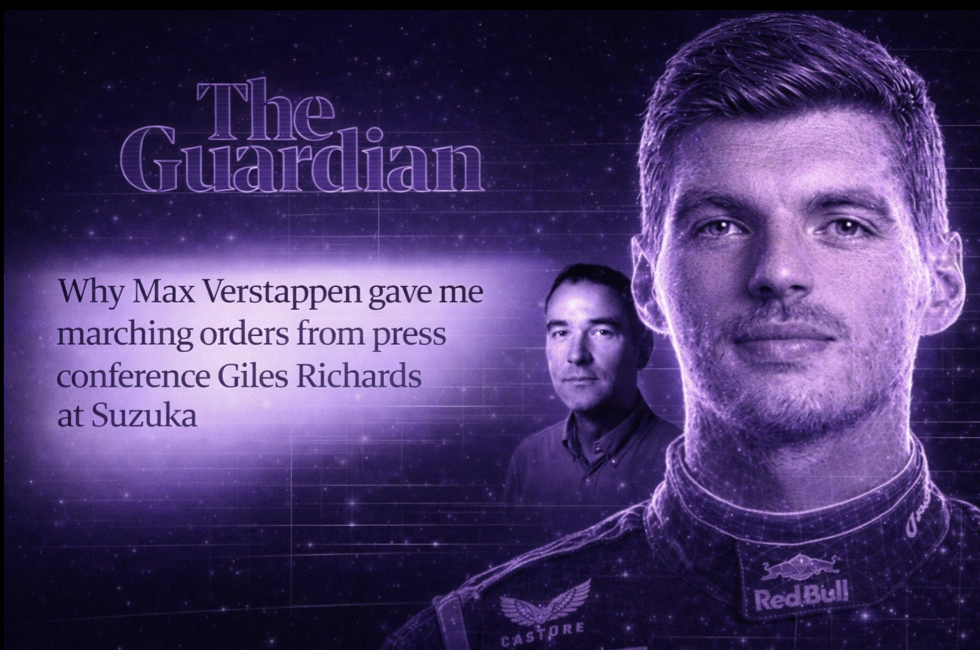
Max Verstappen and Giles Richards, Suzuka 2026. A press conference, a four-month-old grievance, and a room that had no one in it who held the standing to stop it.
Paul Pfanner, founder of the RACER Brand and Pfanner Advantage, has spent fifty years at the intersection of motorsport, mobility, media, and business. In this edition of Shift Happens, he responds to an incident at the 2026 Japanese Grand Prix that he argues is not about one driver's behavior — but about the structural condition of professional motorsport journalism, and what the sport loses when the accountability function disappears.
In Suzuka last Thursday, Max Verstappen told a journalist to get out of his news conference.
Not because the journalist had done anything wrong in that room. Because four months earlier, at Abu Dhabi, the journalist had asked a question Max didn't like. A fair question about a penalty that may have cost him the championship. Verstappen remembered. He waited. And when the moment came, he used it.
"Get out."
The journalist — Giles Richards of The Guardian, who has covered Formula One for more than a decade — left. The journalist left. No one in that room had the standing to stop it. That's the point.
Within two hours, someone had tracked down Richards' email address. The message called him a toxic dipshit responsible for British bias in F1. It was, Richards later noted with dry precision, at least properly punctuated.
For fifty years I held media credentials at racing events around the world. I led a company that published more than a thousand issues of motorsport magazines and operated five websites. That chapter closed at the end of 2025. I was never a frontline reporter — I never had that particular gift, or that particular hunger.
Over the years I took calls and sat across tables from some of the most powerful people in American motorsport — sanctioning body executives, manufacturer PR chiefs, team owners, iconic racers — who were unhappy with what our reporters were writing. The reporting was accurate. I stood firm every time. That's not heroism. That's the minimum obligation of anyone who runs a media operation and claims to serve an audience.
So, I've been in enough rooms, on enough sides of enough tables, to know what those two hours in Suzuka actually were.
A proof of concept. And then its confirmation.
Days later, Verstappen told the BBC he is weighing whether to continue in F1 beyond 2026. He cited a lack of enjoyment with the cars, the racing, the whole formula. He will be fine — he said so himself. But the two moments are connected. A driver who has decided the sport exists on his terms will eventually decide the press does too. The audience deserves to know both things.
A Door That Was Already Open
The test was simple: can an athlete restructure his own accountability in public, on camera, with colleagues watching — and face no meaningful consequence?
The answer, so far, is yes.
This matters beyond Max Verstappen, who is by any measure one of the most gifted racing drivers in the history of the sport and who also has a well-documented history of deciding which rules apply to him. This matters because the incident didn't happen in a vacuum. It happened in an environment that made it possible. An environment years in the making.
Consider what has happened to professional motorsport journalism in the span of a single decade.
The racing series themselves now operate full media divisions — cameras in the garage, access to drivers that independent journalists don't have, content distributed directly to audiences with no editorial filter. Formula 1's own production arm has done more to grow the sport's global audience than any independent outlet in its history. That's a genuine achievement. It is also, from a journalism standpoint, a fundamental conflict of interest operating openly and without apology.
AI can now generate a competent race recap in the time it takes a human journalist to find a parking spot at the circuit. The recap will be factually accurate. It will contain no institutional memory, no source relationships cultivated over years, no understanding of what a driver's eyes looked like when he gave an answer that didn't match the telemetry. It will be free. And it will be good enough for most audiences most of the time.
Creators — a word we now use to describe people with cameras, platforms, and access — have moved into paddocks in numbers. They produce content fans want. They are not bound by editorial standards, source protection obligations, or the professional discipline of asking questions that powerful people would prefer not to answer.
The economic model that once made independent motorsport journalism viable — the advertising, the circulation, the institutional support — has been fundamentally restructured. The outlets that remain are doing serious work under serious constraints. What has quietly diminished is not the quality of the people. It is the infrastructure around them.
Team PR staffs feel this too. The good ones — and there are many — have always understood that a healthy press relationship serves the sport and, by extension, their employers. They are skilled professionals navigating their own version of a new reality, caught between the demands of access management and the value of honest coverage. But PR output, however skilled, is not journalism. It was never meant to be.
The Credibility Vacuum
This is what fills the space: series content, AI output, creator posts, team communications. Each one looks like coverage. Sounds like coverage. Reaches audiences that once belonged to independent journalism. But none of it carries the one thing that makes journalism journalism: the accountability function. The obligation to ask the question no one in that room wants asked, and to publish the answer regardless of consequences.
Verstappen didn't break through the wall in Suzuka. He walked through a door that was already open.
The Discipline
Professional motorsport journalism exists to do something none of those substitutes can: hold the sport accountable to the people who love it. To remember what was said four months ago in Abu Dhabi and understand why it matters in Suzuka. To be in the room not because someone credentialed them to be agreeable, but because an informed, independent press is the mechanism by which a sport maintains its integrity with its audience.
Giles Richards understood this. Writing afterward, he described the journalist's instinct plainly: you never want to be the story, even when it becomes unavoidable. He called the Abu Dhabi question one that simply had to be asked. That's the discipline. That's the job.
The audience owns the sport. They always have. But the audience can only own what they can see clearly.
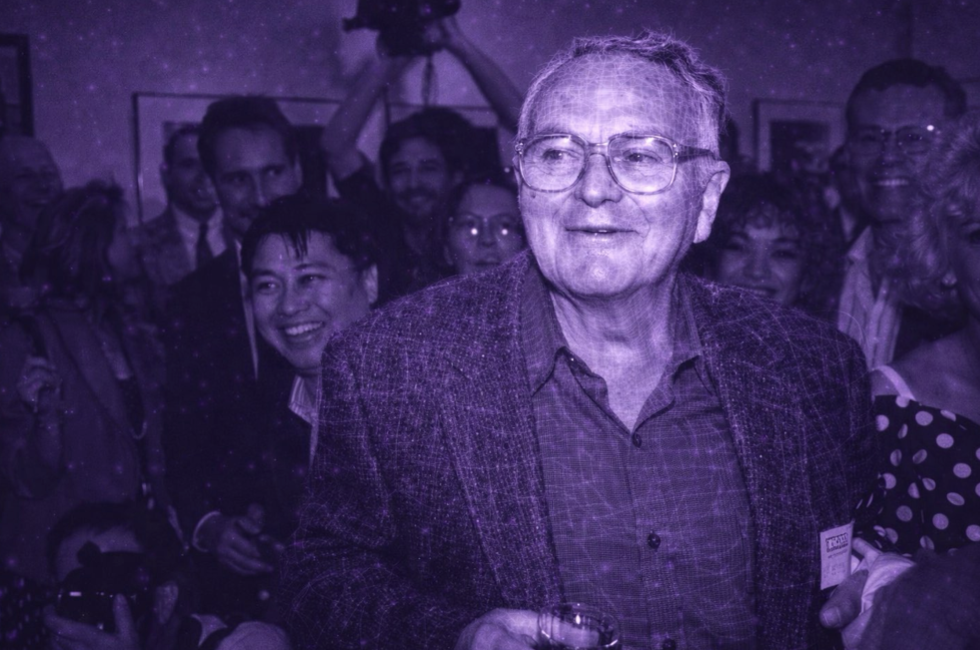
Chris Economaki at the RACER launch party in April 1992 where he raised a toast to our success. He was a friend, mentor, journalist, broadcaster, and institution. The man who built National Speed Sport News and gave voice to American racing on ABC's Wide World of Sports understood something the sport is forgetting: there is room enough for everyone who does this work honestly.
The Sport Is Big Enough
I knew a man who understood that better than almost anyone.
In 1992, I was launching RACER magazine. I reached out to Chris Economaki — the dean of American motorsport journalism, editor and publisher of National Speed Sport News, and for decades the voice of auto racing on ABC's Wide World of Sports. I needed his subscriber mailing list. His readers were exactly the audience I was trying to reach. I was, in every practical sense, asking a competitor for help.
Chris gave it to me. And I made him a promise in return: once RACER had its own subscribers, I'd share our list with him. He accepted. I kept the promise.
His words when we made the deal: "The sport is big enough for both of us."
I've thought about that sentence a great deal this week. It assumes a healthy ecosystem — multiple voices, competing outlets, independent coverage that serves the audience rather than the series or the star. It assumes that professional journalism has a future worth investing in, worth protecting, worth extending to the person coming up behind you even when they're coming for your readers.
In Suzuka, a four-time world champion decided the room wasn't big enough for one particular journalist. Someone decided, within two hours, that it wasn't big enough for him at all.
Chris Economaki would have had something to say about that.
So do I.
The Society of Professional Motorsport Journalists (SPMJ) — founded in 2024 by Paul Page and Michael Knight, and rooted in the tradition that Bob Russo and Bill Marvel established with the AARWBA in 1955 — exists to hold that standard. Not as a memorial to how things used to be. As an active argument for what the sport still requires: people willing to ask the question the driver doesn't want asked, and to stay in the room until they get an answer.
The sport is still big enough for them.
The question is whether the sport still knows it.
The Advantage Journal arrives every week. What matters in sport, mobility, media, and technology — curated and contextualized by Bill Sparks, Bill Long, and Paul Pfanner. No hedging. No filler. Subscribe — It’s Free

