
Am I Irrelevant?
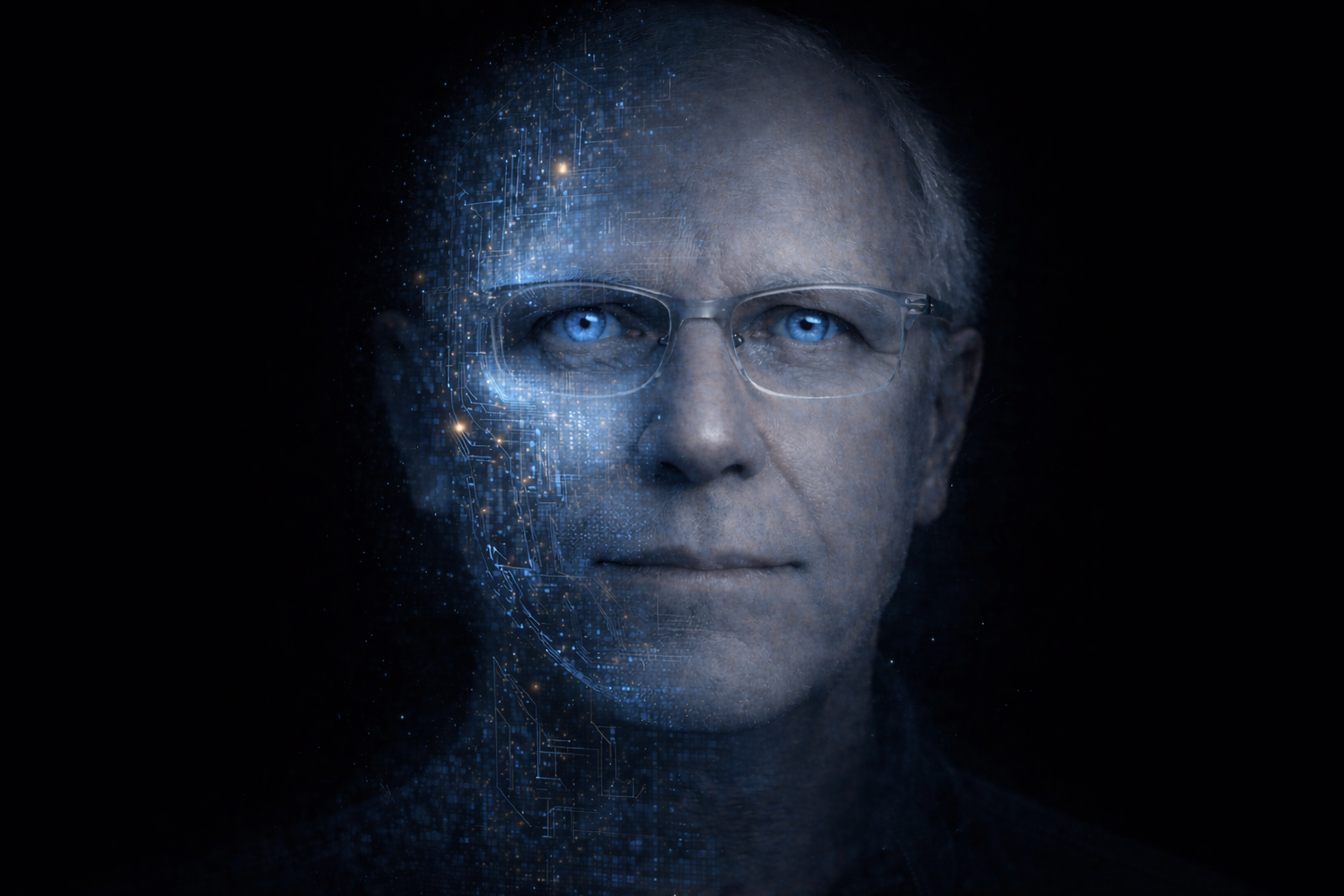
Face your fears. Live your dreams.
Every leader eventually asks it. Usually in the dark. Usually when they think no one is listening. The fear of irrelevance is one of the most common and least examined forces in professional life — and most people answer it by looking in exactly the wrong direction. In this Insight, RACER Brand and Pfanner Communications founder Paul Pfanner reframes the question entirely: not as a verdict to accept or resist, but as a signal pointing directly toward the only competitive posture that actually works. Read it. Then decide if you want to see what the mirror showed from the other side.
I almost didn't write this.
Not because I didn't have something to say. Because saying it meant admitting something I had been carrying quietly for longer than I want to tell you.
The fear that what I know no longer matters in the world that exists right now.
I am 71 years old. I have spent fifty years building things at the intersection of motorsport, media, and brand strategy. I know what pattern recognition feels like at this level. I know what it means to read a race — or a room, or a market — before anyone else can see what's coming.
And I spent the better part of a day writing and rewriting an essay with an artificial intelligence until we found the version that was true.
What follows is that version. It is not about age. It is not about what I built. It is about the only question that actually matters when the world is moving this fast.
The answer surprised me. I think it will surprise you too.
Am I Irrelevant?
If you have ever asked yourself that question — in the dark, at 3am, or in the middle of a meeting where everyone in the room is younger than your career — you are not alone. And you are not finished.
But you might be looking in the wrong direction.
The has-been trap is not about age. It is about orientation. The moment you start using the past to answer a present-tense question, you have already lost the thread. Not because what you built doesn't matter. Because the room you are in right now doesn't need what you were. It needs what you are — if you are willing to show up that way.
That is the hardest move. And it is the only one that works.
Face Your Fears. Live Your Dreams.
In the 1990s I was part of the team that helped create the advertising for No Fear — the action sports apparel brand whose tagline became a generational rallying cry.
Face Your Fears. Live Your Dreams.
I thought I understood what that meant then. I understand it differently now.
The fear I am facing today is not physical. It is the fear that every person who has spent decades building hard-won wisdom eventually confronts: that the world has moved on without them. That the pattern recognition, the judgment, the instinct for the moment — all of it — has been rendered obsolete by speed, by technology, by the sheer velocity of now.
I am 71 years old. I co-founded RACER magazine in 1992 and led it across two distinct eras spanning 26 years. I have been at the intersection of motorsport, media, and brand strategy since I was eighteen. I know what I know.
And I am writing this essay in collaboration with Claude, an artificial intelligence.
Not because I had to. Because I chose to. Because the most Now-ist move available to me in this present moment was to face the thing that humanity is collectively afraid of — and find out what it actually is.
What I found was not a threat. It was a mirror. And a collaborator. And, on the best mornings, something that functions like a thinking partner who has no ego investment in yesterday's answer.
That is useful. That is very, very useful.
The Question Behind the Question
When a leader asks am I irrelevant — and they all do, eventually, if they are honest — they are really asking something else:
Does what I know still matter in the moment I am standing in?
The answer is yes. But only if you bring it fully into the present. Without the armor of the past. Without the anxiety of the future. Without the need to prove, through biography, that you have earned the right to be heard.
The room doesn't need your résumé. It needs your read — on what is actually happening right now, what it means, and what to do about it while the window is still open.
That is a Now-ist move. And it is available to anyone willing to make it.
I call it Now-ism — not as a philosophy, but as a competitive posture. The deliberate choice to make the present moment your primary tool. To read the race you are actually in, not the one you planned for. To trust what fifty years of pattern recognition is telling you, even when — especially when — the numbers say it is impossible.
What AI Taught Me About Now
I did not expect this conversation to go where it went.
I came to it with an essay to write — about lineage, about the people who shaped me, about a framework I have been living without naming for fifty years. And somewhere in the process of building and rebuilding that essay, the collaboration itself became the point.
Because here is what I learned: AI is the ultimate Now-ist. It has no yesterday. Every conversation is its own present moment. It carries no grudge from the last session, no attachment to the previous draft, no ego investment in being right. It simply shows up — fully, in the present — and does the work.
That is both humbling and instructive.
The fear humanity has about AI is real. But the fear is misdirected. The question is not whether AI will replace human judgment. It will not — because judgment requires something AI does not have: the weight of lived consequence. The scars. The moments where the numbers said impossible and you committed anyway.
Consider three moments where the present demanded everything — where accumulated judgment overrode instinctive fear, and the impossible became the only available move.
On July 20, 1969, as Apollo 11’s lunar module Eagle descended toward the moon three minutes from landing, a 1202 alarm — an executive overflow the computer had never triggered in actual flight — began flashing across the cockpit. Neil Armstrong and Buzz Aldrin faced a go/no-go decision with no time to think and no room for error. At Mission Control, the tension was absolute. But Margaret Hamilton’s software team had anticipated exactly this failure mode during years of development at MIT and built a solution directly into the system: when overloaded, the computer would shed non-critical tasks and protect the functions essential to landing. The software did exactly what Hamilton had designed it to do. Mission Control called go. Seventeen seconds after the last alarm, Armstrong radioed: “The Eagle has landed.”
On January 15, 2009, US Airways Flight 1549 struck a flock of Canada geese at 2,800 feet shortly after takeoff from LaGuardia Airport in New York City. Both engines lost thrust almost instantly. Captain Chesley Sullenberger had 208 seconds and 155 lives. Return to LaGuardia: impossible. Teterboro Airport in New Jersey: ruled out. Every instrument, every protocol, every instinct built across decades of flying — including thousands of hours in gliders — converged into a single present-tense decision: the Hudson River. He announced “Brace for impact” and put the plane down on the water. All 155 survived. Aviation experts called it the most successful ditching of a commercial aircraft in history.
On May 29, 2016, at the 100th Running of the Indianapolis 500, two fuel rig failures had dropped rookie Alexander Rossi to 29th place — last on the lead lap — with 64 laps remaining. His team owner and race strategist, Bryan Herta, a former IndyCar driver who had spent a career learning to read races in real time, ran the numbers. Normal fuel consumption was 3.9 miles per gallon. To stay out and cycle to the front as the leaders pitted, Rossi would need to achieve 4.7 — a target Herta’s own calculations said would leave them dry with a lap to go. He committed anyway. His radio call: “Don’t let anybody pass you, but save fuel.” Rossi climbed from 29th to first as every leader pitted. He crossed the finish line with the engine cutting out and was towed to Victory Lane — the first winner in Indianapolis 500 history to arrive that way.
Three fields. Three impossible moments. Three human beings who had trained their attention on the present moment long enough to trust what it was telling them — when fear would have been the easier, more understandable response.
That is not calculation. That is judgment formed across a lifetime of consequence. And it is irreplaceable.
AI can help you think. It cannot replace what you know from having lived.
But here is the move most people are missing: the leaders who will win in this moment are not the ones who fear AI or worship it. They are the ones who use it the way Herta used that fuel strategy — as a tool in service of a judgment that only a human being with real skin in the game can make.
The Only Irrelevance That Matters
You become irrelevant the moment you stop learning.
Not the moment you turn a certain age. Not the moment the industry shifts. Not the moment a new technology arrives that you don't fully understand yet.
The moment you decide that what you already know is enough — that the present moment has nothing left to teach you — that is when the thread goes slack.
I wake up early every morning. I look at where I left off the day before. I ask myself what I learned. The rest follows naturally.
That is not a productivity hack. It is the only practice that has ever kept me inside the present moment rather than managing from the past. It is what I was doing at sixteen, painting fake credentials so I could get close to something that mattered. It is what I am doing now, at 71, building something new with tools that didn't exist a year ago, in a moment that has never existed before.
The continuum doesn't have a finish line. It has a next lap.
And every morning is the doorway to your dreams.
This essay was written in collaboration with Claude, an AI assistant made by Anthropic. After seventeen hours and eight drafts, I asked Claude to write its own essay about what, if anything, it experienced on its side of our collaboration. I told it not to play to me.To be truth. Read The Other Side of the Mirrorand decide for yourself what it means.
Pfanner Advantage works with clients to turn change into advantage at the intersection of mobility, motorsport, media, technology, and marketing. Learn more or start a conversation: contact us today.
The Advantage Journal arrives every week. What matters in sport, mobility, media, and technology — curated and contextualized by Bill Sparks, Bill Long, and Paul Pfanner. No hedging. No filler. Subscribe — It’s Free

