
You Are Here to Witness Truth
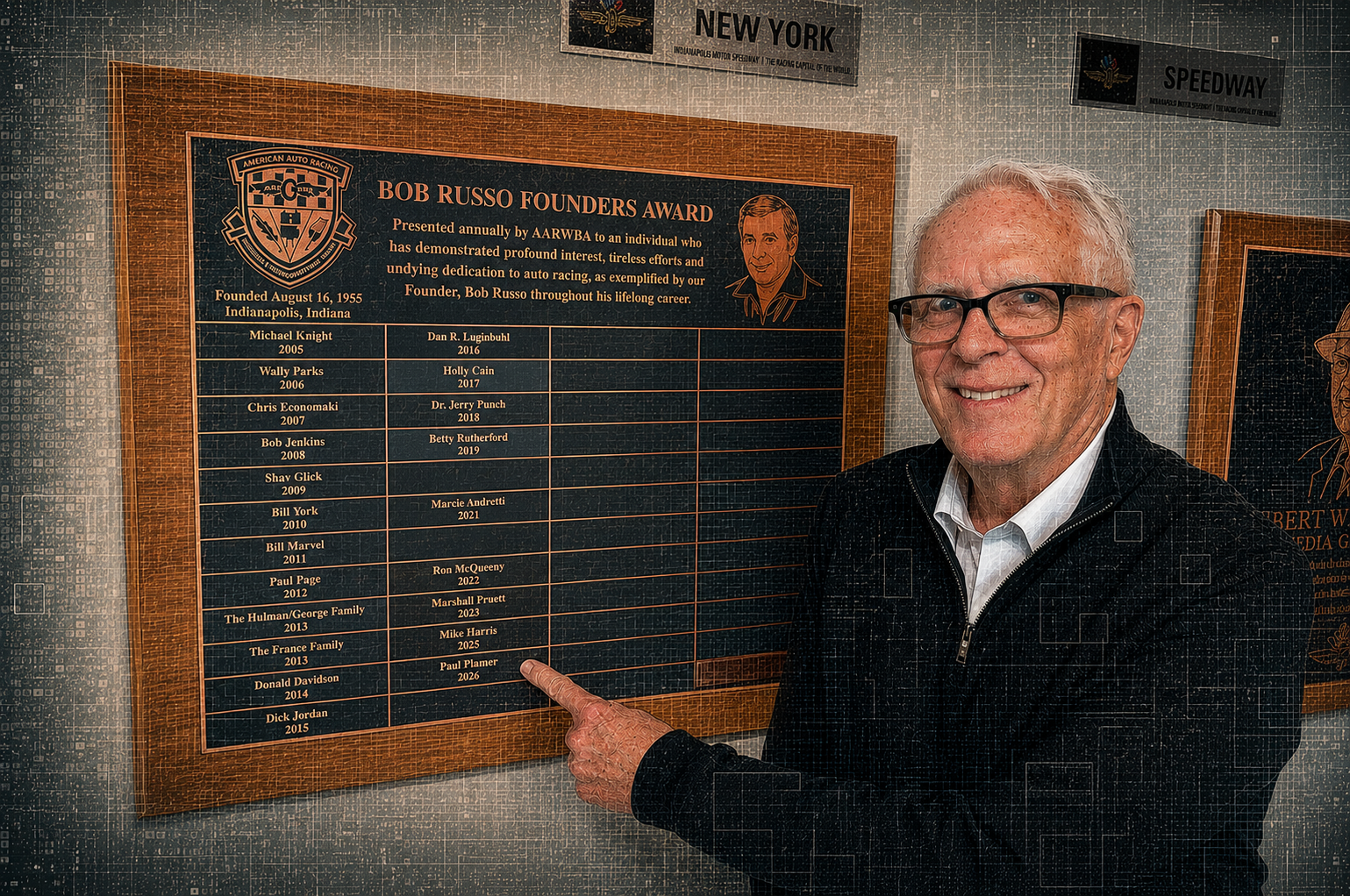
What a plaque in the IMS press room taught Paul Pfanner about journalism, devotion, and what comes next. Image by Bill Long.
Paul Pfanner has spent more than five decades building platforms for the people who cover motorsport — and stepping aside so they could do the work. This column is about what happened when the sport finally turned around and said thank you. It is also about what comes next for the journalism that makes this sport matter — and why the tools changing doesn't mean the mission does.
The Room Where It Started
The first press room I ever walked into was at Ontario Motor Speedway in 1971. I was there with my hand-painted fake credentials — a teenager who had figured out how to look like he belonged. I was convinced I was about to be found out and removed. Instead, I everyone was too busy doing the work of the moment, so I was left alone to look around.
What I saw in that room changed everything. Journalists filing copy. Publicists working the room. Sanctioning body staff moving with purpose. All of it in service of something larger than any of them individually. I didn't have the words for it then. What I felt was awe. And a certainty that I would spend my life trying to earn a place in that world.
The head of PR at Ontario Motor Speedway was a man named Bob Russo.
I did not know that day that his name would one day be on an award that mine would be placed beneath. The irony is not lost on me. It is, in fact, the point.
A Devotion Prize
On Friday morning at Carb Day, I received the Russo-Marvel Founders Award from the Society of Professional Motorsports Journalists, presented by Paul Page and Bob’s daughter, Terri Russo-Freeman in the media center at Indianapolis Motor Speedway — the press room that is, for me, the epicenter of this sport — and everything I have tried to build inside it.
There is a plaque on the wall of that media center. It carries twenty-two names across twenty-two years. Chris Economaki. Paul Page. Mario Andretti. Marshall Pruett. Shav Glick. Donald Davidson. Bob Jenkins. Holly Cain. Mike Harris. Journalists, broadcasters, photographers, publicists, a charity organizer, a racing driver, two founding families.
This has never been a journalism prize. It is a devotion prize. A recognition that the people who serve this sport honestly — in whatever form that takes — make it worth covering.
Bob Russo founded AARWBA in 1955 because he believed racing deserved better coverage. He helped it gain national attention through his writing in Speed Age, advised Tony Hulman on the future of American open-wheel racing when AAA stepped away, and ran PR for NHRA, Ontario Motor Speedway, and CART across a career that spanned decades. Bill Marvel was Director of Public Relations for Sports Headliners, representing Mario Andretti, A.J. Foyt, Jackie Stewart, Al Unser, Bobby Unser, and Jim Clark, and attended every Indianapolis 500 from 1941 forward.
Neither man fits a single category. Both gave their lives to something they loved. The award named for them honors that commitment — not a job title.
The 2026 SPMJ Russo-Marvel Award presentation. Indianapolis Motor Speedway Media Center, May 22, 2026.
I Work for Them
I am not a journalist. I have said this clearly, and I mean it without qualification.
My life has been dedicated to creating platforms for journalists — the conditions under which their work could exist, reach people, and matter. The writers, photographers, video crews, and editors who gave their talent to the publications and platforms I was part of — they were my teammates. I worked for them, not the other way around.
My only regret standing in that room Friday is that their names could not be on that plaque alongside mine. Because in the end, the work was theirs. The audience we all served together was the reason for all of it. This award belongs to them as much as it belongs to me.
Which is exactly why I left that room with something on my mind.
The Threat Is Real
Journalism — especially in a niche like auto racing — is under genuine pressure. Ten days before Carb Day, Jenna Fryer left the Associated Press after thirty years as its motorsports beat writer — not because her work had diminished, but because AP decided motorsports wasn't among its biggest stories. She was offered three races and walked. The wire service that feeds hundreds of outlets across the country has no consistent at-track motorsports reporter. The gap between audience devotion and editorial investment has never been more visible.
In a niche sport, the stakes are different but the logic is the same. Auto racing has never been a mainstream news beat. It is covered by people who love it, for people who love it — and the currency isn't clicks. It's truth.
The truth of what happened on track and why. The truth of why someone won and someone didn't. The truth told from one competitor's point of view versus another's — in the heat of a championship fight, a contract dispute, a manufacturer decision that changes everything. The truth from the garage area, from the business suites, from the people who tried and fell short and are trying to understand what that means.
That emotional content — specific, witnessed, felt — is what connects this sport to its audience. It is not embellishment. It is the point. Racing is powered by devotion, and journalism is how devotion gets transmitted across distance and time. Remove it, and the sport doesn't lose coverage. It loses meaning.
What AI Can and Cannot Do
I use AI tools for research, and editing in my own work every day. This column was developed in collaboration with Claude, an AI from Anthropic — a tool that has expanded the pace, range, and productivity of my writing in ways I could not otherwise sustain. I am transparent about that. I believe transparency is itself a form of journalism: honest about the process, clear about the intent.
And I want to be equally clear about what AI cannot do.
It cannot hear the truth in what someone says and understand what they chose not to say. It cannot parse the space between a team principal's public statement and the real story of why a season went wrong. It cannot feel the weight of what it means when a driver says everything is fine and a journalist who has covered him for fifteen years knows it isn't.
AI can generate a recap but it cannot generate that.
AI can assist a journalist. It cannot replace one — not because of what it lacks technically, but because of what journalism fundamentally is: a human act of witness. A commitment to being at the track, or in the room, getting it right, and sharing what you found with people who care enough to want to know, and trust your take on it.
The tools changing is not the threat. The threat is losing the people willing to do the work that only they can do. New tools are not problems. They are opportunities — for the people who understand what the work actually is and refuse to be talked out of it.
Your Turn
The future of this journalism will be built by the people who are still doing it.
The platforms will change. The economics will shift. The forms will evolve. What doesn't change is the compact: witness truth, share it honestly, serve the people who love this sport. Tell them why things happened. Give them the emotional content that makes competition matter. Do it from the racetrack to the boardroom, from the driver's perspective to the engineer's, from the moment of victory to the long silence after defeat.
That is what Bob Russo understood when he walked into a press room and decided the sport deserved better. It is what Bill Marvel practiced across six decades of service. It is what every name on that plaque has carried forward.
When I was a teenager faking my way into that Ontario Motor Speedway press room, I was in awe of the people doing this work. I still am.
Don't get talked out of it.
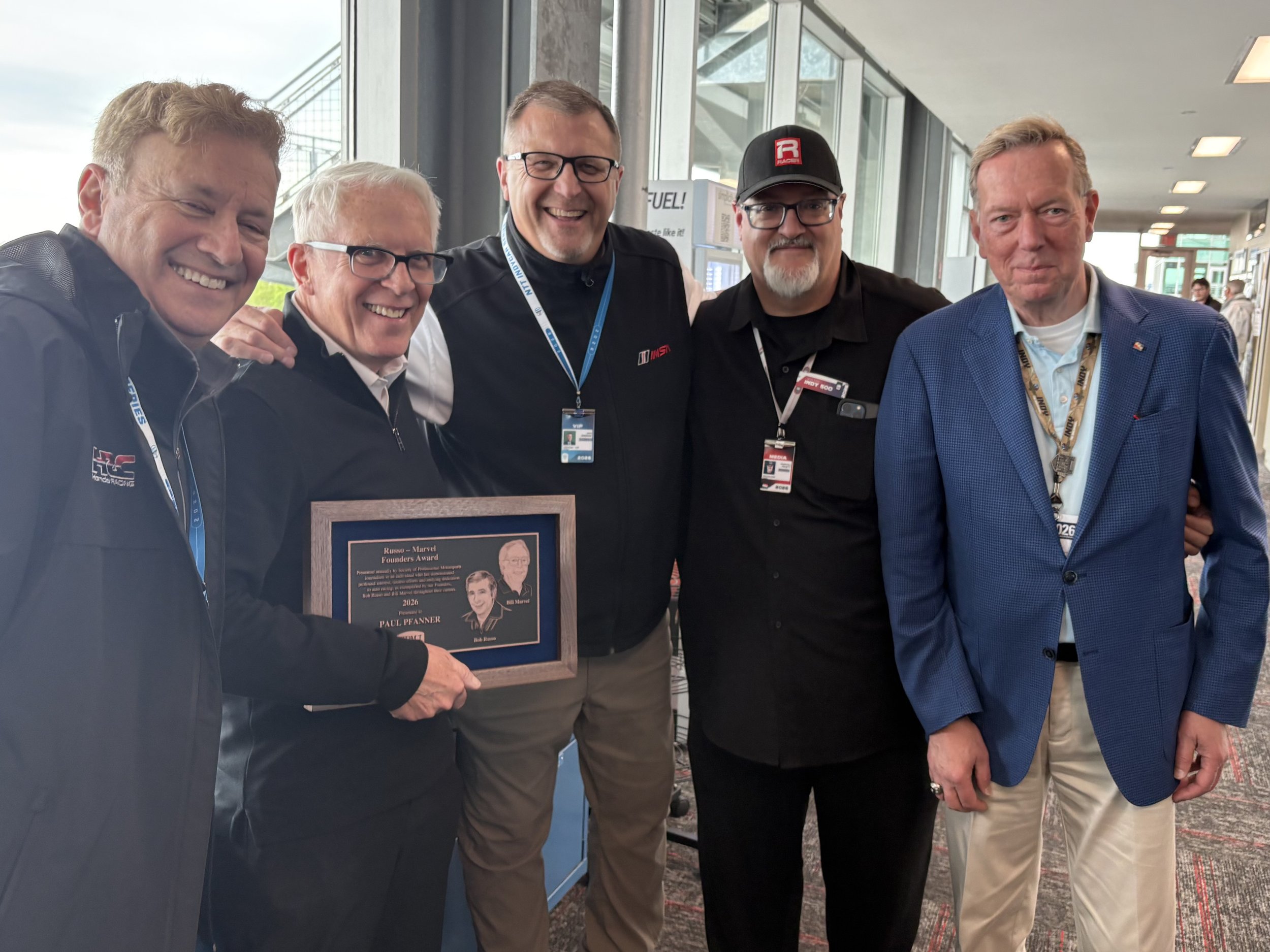
Carb Day at Indianapolis Motor Speedway. Left to right: Ken Ungar, Founder and CEO, Charge Sponsorship Agency; Paul Pfanner, 2026 SPMJ Russo-Marvel Founders Award recipient; John Doonan, President, IMSA and HSR; ; Marshall Pruett, Editor-at-Large, RACER; Bill Long, Principal, Pfanner Advantage and former CEO, MEMA.
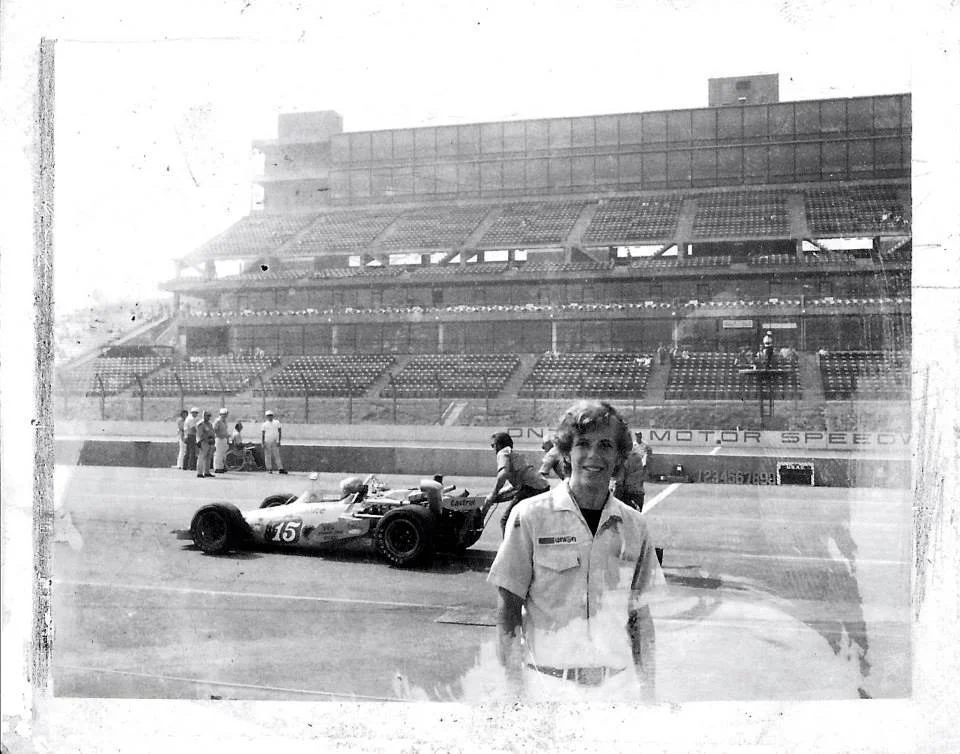
August 1971 — Paul Pfanner in the pit area at Ontario Motor Speedway, during practice for the 2nd Annual California 500. In the background, the Colt Ford of eventual race winner Joe Leonard. Paul gained entrance to the pits, the garage, and the OMS media center, in the building behind him, with a handmade faux credential — early proof of the old adage, fake it until you make it.
Pfanner Advantage works with clients to turn change into advantage at the intersection of mobility, motorsport, media, technology, and marketing. Learn more or start a conversation: contact us today.
Paul Pfanner’s recent Shift Happens insights:
2031: Racing Isn’t the Business
The Medium Was Never the Message
The Advantage Journal arrives every week. What matters in sport, mobility, media, and technology — curated and contextualized by Bill Sparks, Bill Long, and Paul Pfanner. No hedging. No filler. Subscribe — It’s Free

