
Sunday Made the Case
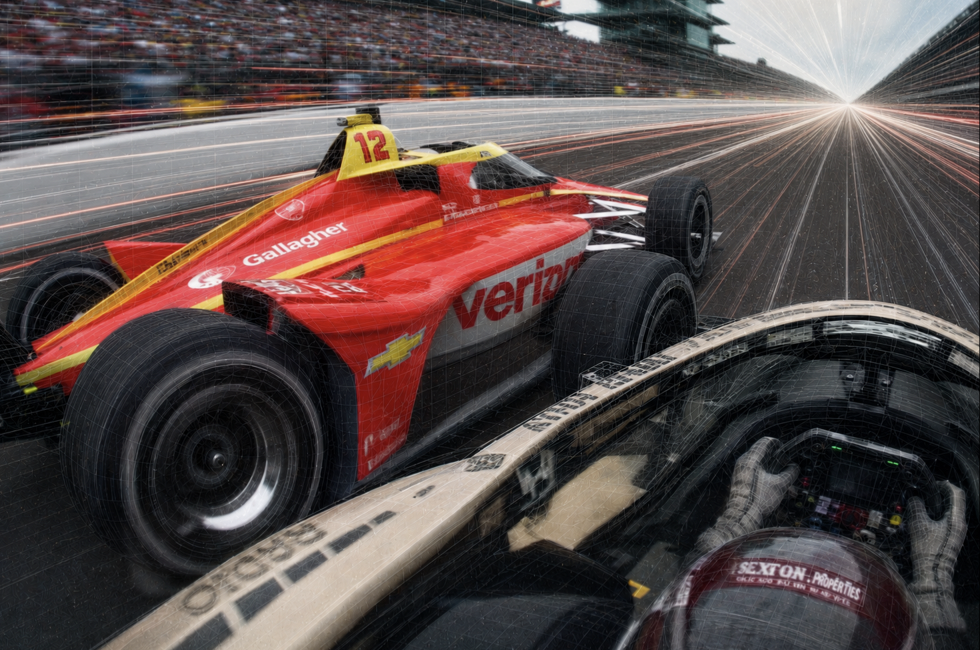
Felix Rosenqvist's onboard, final lap, 110th Indianapolis 500. David Malukas to his left. The Yard of Bricks straight ahead. 0.0233 seconds later, it was the closest finish in the race's 110-year history.
Paul Pfanner surveys Sunday's 110th Indianapolis 500 — the closest finish in the race's 110-year history — and builds the case that the Penske Entertainment era reached its best moment to date. The argument runs from the 2008 reunification through Sunday's record-setting, sold-out race, and arrives at a conclusion the coverage from every major outlet reached by nightfall.
Felix Rosenqvist won the 110th Indianapolis 500 by 0.0233 seconds — the closest finish in the race's history. He restarted third on the final lap, went to the high line, passed his Meyer Shank Racing teammate Marcus Armstrong through Turn One, and caught Team Penske's David Malukas at the stripe. The previous record was Al Unser Jr. over Scott Goodyear in 1992 by 0.043 seconds. That one had stood for 34 years.
It stood until Sunday.
Rosenqvist climbed on top of his car and pumped his arms. The crowd — 350,000 people filling every seat, suite and GA viewing area, the second consecutive sellout — made the kind of noise that crowds make when they know they have just seen something they will be describing for years. I have been at this long enough to recognize that sound.
This was the Penske Entertainment era's best day.
The Coverage
ESPN called it a seven-lap shootout. Motorsport.com called the final lap arguably the greatest in Indianapolis 500 history. The Drive landed where most outlets landed: the Greatest Spectacle in Racing had delivered at the highest order of magnitude. IndyStar ran photo after photo of a sold-out Indianapolis Motor Speedway in full voice. The tone across motorsport coverage and general sports coverage was not qualified. The race broke through. Sports networks that do not regularly stop for IndyCar stopped for this one.
The 110th Indianapolis 500 averaged 6.635 million viewers on FOX — down 6% from 2025's 7.09 million, but still the second-largest Indy 500 audience since 2012. The closest finish in race history peaked at 8.349 million viewers from 4 to 4:15 PM ET, within one percent of last year's comparable peak. The race drew more than twice the audience of the Coca-Cola 600 on Prime Video, which averaged 3.06 million. Through the first seven IndyCar races of 2026, the series is averaging 2,383,000 viewers per event — up 9.7% from the same point last year.
The Race
The 110th set records throughout its distance, not just at the end. Seventy lead changes, past the previous mark of 68 from 2013. A red flag at lap 105 for light rain paused the race for twelve minutes. Multiple caution periods in the final third compressed the field and kept a genuine group of cars in contention deep into the closing laps. Palou — the three-time defending IndyCar champion and defending 500 winner — led a race-high 59 laps and could not convert any of it. He and Scott Dixon traded the lead between themselves 26 times, a record for two drivers in a single race. Malukas held the point on the final restart and had every reason to believe he was going to win. The prize fund reached $4.34 million — another Indy record.
None of the teams that arrived as favorites left with the trophy. Meyer Shank Racing won it — an independent IndyCar operation that Mike Shank built from decades in sports car racing, won the Rolex 24 at Daytona with, and brought to Indianapolis on the belief that doing the right work long enough was sufficient. Their first 500 was Helio Castroneves in 2021, his fourth — tying the all-time record. Sunday was their second win in four years, with both of their cars genuinely in the hunt in the final laps. Armstrong ran side by side with his own teammate in the closing sequence. Meyer Shank Racing had two cars positioned to win the 110th Indianapolis 500. The sport is healthy when that can happen to a team of that size.
Rosenqvist is the third Swede to win this race, after Kenny Brack in 1999 and Marcus Ericsson — also a Meyer Shank driver — in 2023. He is 34, born in Värnamo, now in his eighth IndyCar season and third with this team. He had qualified in the top nine in five straight years. He finished fourth in 2024 and fourth in 2025. The speed was never the question.
The moment was what had been missing. It came on the final lap, on the high line, at full commitment.
"That's the way I've always pictured it in my head," he said afterward. "It was almost like muscle memory when it happened."
The Stewardship
Roger Penske closed the acquisition of the Indianapolis Motor Speedway and the IndyCar Series on January 5, 2020 — the fourth owner in the facility's history, after Carl Fisher, who built it in 1909; Eddie Rickenbacker, who purchased it in 1927; and Tony Hulman, who saved it from postwar ruin in 1945 and held it through his family for 74 years. What Penske inherited was an institution that had survived a generation of self-inflicted damage. The split that began in 1996 took twelve years to resolve. Another decade of rebuilding followed before he arrived. The bones were always there. The stewardship is what changed.
The arc of this era has not been a straight line. The 2020 race ran without fans — COVID had taken the crowd from the only venue in the world that defines itself by its crowds. The next year brought 135,000. Attendance climbed year by year through 2022, 2023, 2024. In 2025 the grandstands sold out for the first time since the 100th running in 2016. In 2026 they sold out again, faster, and the infield followed — the first time both had filled since 2016. When you watch that trajectory from inside the sport, what it tells you is that the product improved and people noticed.
Eric Shanks brought FOX Sports in as a one-third equity owner of Penske Entertainment, not merely a rights partner. The distinction matters. A rights partner wants ratings for its window. An equity partner wants the institution to grow. What that difference produces — in production quality, promotional architecture, how the race is positioned in the sports landscape — is visible in the results. The field that ran Sunday looks far more like what CART championed in its best years than anything the original IRL envisioned. International drivers. Road course specialists. The best from anywhere, running at Indianapolis. The IRL said the sport needed to be something other than that. The audience, as it turned out, always knew better.
I wrote something last week, titled The Split at 30, about standing in a press box at Michigan International Speedway on May 26, 1996 and hearing Dan Luginbuhl — Roger Penske's longtime communications chief — say two words quietly at the moment the sport hit the wall on the pace lap before the green flag ever dropped at the inaugural US 500 - that ran directly opposite the 80th running of the Indianapolis 500.
"It's over."
Not anger. Clarity. He named what everyone in that room felt.
A week earlier,, in a hotel hallway at Michigan, Roger watched a No Fear television spot I had conceived about what defined this race — built around the argument that the sport's best were not at Indianapolis. I had intended it to run in the first commercial pod of the 1996 Indianapolis 500. He watched it several times. Then he said what he said, and it has stayed with me since: "We can't do this. We have to go back there."
He spent the next thirty years making sure that was true. The 110th Indianapolis 500 ran on Sunday in front of 350,000 people, on a network that is a partner in the enterprise, and produced the closest finish in the race's history.
The stewardship argument does not need elaboration.
The Penske Entertainment era has had its best day. The sport is not finished having them.
Updated May 28, 2026, with final Nielsen viewership figures for the 110th Indianapolis 500.
Pfanner Advantage works with clients to turn change into advantage at the intersection of mobility, motorsport, media, technology, and marketing. Learn more or start a conversation: contact us today.
Paul Pfanner’s recent Shift Happens insights:
2031: Racing Isn’t the Business
The Medium Was Never the Message
The Advantage Journal arrives every week. What matters in sport, mobility, media, and technology — curated and contextualized by Bill Sparks, Bill Long, and Paul Pfanner. No hedging. No filler. Subscribe — It’s Free

