
A Ferrari Without a Pulse
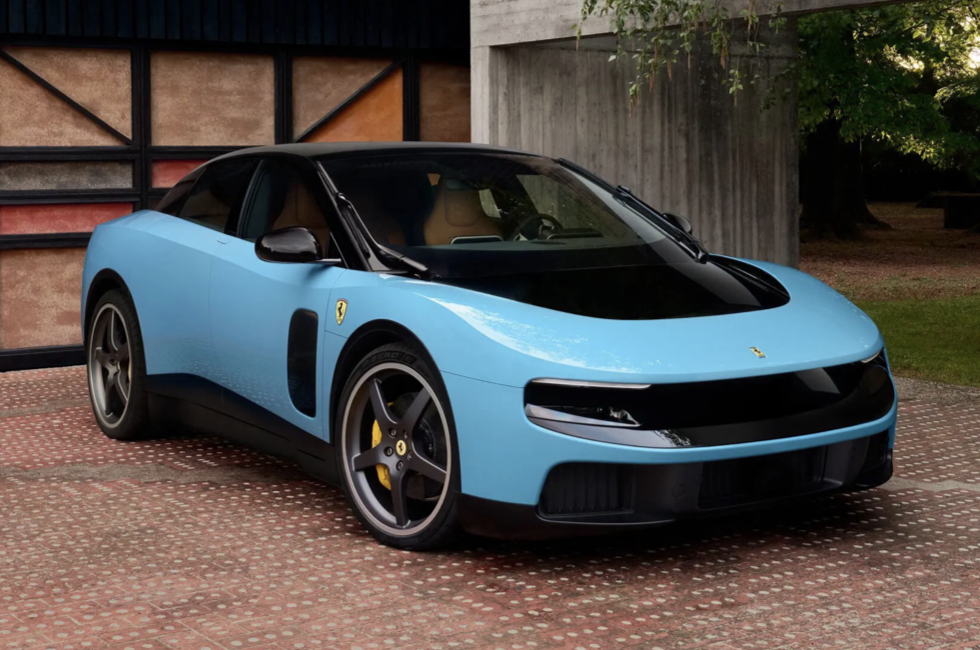
Photographed in its launch blue, the Luce is a beautifully resolved object — every surface considered, every reflection earned. Whether a beautiful object can also be a Ferrari is the question that follows.
Paul Pfanner has spent fifty years around the design of cars, and in 2009 his OnCars Studios produced the "Launch Vehicle" series that helped debut the Tesla Model S. So when a new Ferrari makes him uneasy, the unease is worth pausing on. Here he interrogates his own reaction before trusting it — and finds a troubling story about the difference between rejecting the future and grieving a version of it that got away.
I went looking for a formula.
When the Ferrari Luce came across my screen, my eye said no before my brain had a chance to be polite about it. That bothered me, because I don't usually operate that way, and because I admire the people who made it. So I did what a person does when he doesn't trust his own reaction. I went hunting for the reason I might be wrong. I pulled up the golden ratio, 1.618, the proportion the Greeks built temples to and good designers feel in their hands. I wanted to lay it over the car and discover that the shape I was rejecting was actually obeying some older, deeper rule I'd been too quick to dismiss. I wanted the math to overrule the gut.
It didn't. And the hunt for that formula turned out to be the most honest thing I did all week, because it told me what kind of objection I was really having.
The intuitive yes
I'm not a trained designer. I'm an illustrator who has spent his whole life around cars — drawing them, styling them, watching them come off the truck before they'd turned a wheel. I came up almost self-taught, and the one thing I trust after fifty years of it is the intuitive yes. Beauty announces itself. You don't argue your way into it. You see the thing and something in you settles, the way it settles when a car sits right on its springs before anyone's checked the corner weights.
That yes isn't soft. It isn't the same as pretty. Some of the most beautiful machines ever built are brutal, and brutal earns its yes slowly — you have to give it time, let your eye come around to it, let the unfamiliar stop being a threat. I've done that for plenty of cars that frightened people at first. I was ready to do it for this one. I wanted to.
I never got the chance, because the Luce didn't read as brutal-and-difficult. It read as clumsy. And clumsy is a different animal entirely.
Unfamiliar is not the same as wrong
This is the trap every critic falls into, and it's worth slowing down on, because it's the whole question. When something new lands badly, you owe it an honest second look, because the history of design is littered with masterpieces that got booed at the premiere. The first time people saw a Citroën DS, an iMac, half the great Ferraris of their own decades, they recoiled — and the recoil dissolved the moment their eyes built a place to put the thing.
So how do you tell the difference between that and a genuine misfire? I've come to think it's about what your objection is actually pointing at.
If the objection is this breaks a rule I expected followed — that's a broken expectation, and broken expectations heal. They're just conventions, and conventions get rewritten all the time. If that were all I had against the Luce, I'd tell you to wait five years and check again.
But if the objection is the body and the wheels are in the wrong places relative to each other — that's not a rule. That's geometry. And geometry doesn't get a honeymoon. A car that carries its mass too high and pulls its wheels in from the corners will look heavy this year and look heavy in twenty, because it is heavy and the proportions are reporting the truth. Time doesn't soften that. Time just gives you more chances to confirm it.
Everything I keep landing on with the Luce is geometry. The tall roofline. The long body riding on a wheelbase shorter than the Purosangue's, which leaves all that sheet metal drooping out past the axles at both ends. The strange, anonymous heaviness of a thing that should have been planted and low. I'm not saying it doesn't look like the Ferraris I know. I'm saying the relationships are wrong. That's the part that won't come right with age.
My control group
I have one piece of evidence that settles it for me, and it's personal.
In the spring of 2009, our OnCars Studio team was hired to launch the Tesla Model S. We made a three-part “Launch Vehicle” film series, directed by Rick Graves. The response generated a flood of deposits — the kind of response that helped make the rest of the story possible. Which means I saw that car as a prototype, when it was one day old. The single most unfamiliar a car can be: a clean sheet from a company that had never built one from scratch.
My eye said yes immediately. And it's still yes, seventeen years later. Franz von Holzhausen drew a car that knew exactly what it was and refused to over-say it — low, clean, wheels shoved to the corners, every surface doing one job. Nothing about it was familiar, and none of that mattered, because the proportions were right.
So I know I'm not a man who rejects the new. I had the most precedent-free car of its generation put in front of me and I loved it on sight. The eye that recoils from the Luce is the same eye that sang at the Model S. It's not a conservative instrument. It's a calibrated one. It rewards the unfamiliar when the unfamiliar is right, and it flinches from the heavy when the heavy is wrong, and it has done both inside the same decade.
What the makers actually said
Before I committed any of this to print, I went and read the interviews, because I'd told myself I'd find no redeeming reason and I owed it to Ferrari to actually look.
Here is what I found, and it's the most telling thing of all. The entire defense of this car is a defense of the interior.
Ferrari's stated rationale is about the cabin — about refusing to let electric mean a dashboard full of screens. Jony Ive's own argument, when pressed, is about why touchscreens don't belong in a car: that they pull your eyes off the road, that real controls should be tactile, felt by muscle memory. And he's right. That's a genuine philosophy, beautifully reasoned, and the interior that came out of it is the best thing about the car. I find the cabin handsome, clever, functional in ways I wish more carmakers were brave enough to try. The glass switches you identify by touch, the screen-free volume, the obsessive reduction — that's real work by serious people, and it deserves its credit.
But notice what nobody defends. There is no comparable argument for the shape. The one functional claim made for the exterior is that it achieves the lowest drag coefficient ever measured on a road car. That's it. That's the formula I went looking for, and it turns out it does exist — it just isn't 1.618. It's Cd. The car was optimized to a number. Slipperiness. And slipperiness was never the promise a Ferrari made to anybody.
So the split I felt in my gut — lovely inside, wrong outside — is not my confusion. It's the split the creators built and the split they defend. They can tell you, at length, why the cabin is what it is. They cannot, or will not, tell you why the body droops the way it does. The silence is the answer.
What was actually available
Here's where the disappointment lives, and I want to be careful to call it disappointment and not contempt, because contempt would make me the very reflex-rejector I've spent this whole essay disproving.
The shift to electric was never the problem. Beauty was available in this new space — the Model S proved it nearly two decades ago, and proved it could survive without an engine to organize the drama around. The gift of an electric car is that you can push the wheels into the corners and build something planted and athletic and honest about its mass. Ferrari, of all the houses on earth, had every tool to find the beauty native to that form. They had the engineering, the heritage, the budget, and a design partner whose entire reputation rests on making things feel inevitable.
And they handed in a car that doesn't know what it is. Shooting brake, wagon, sedan, crossover height on a sports-car badge — those aren't choices in tension, they're a design that never decided. The minimalists, of all people, made something cluttered with indecision. The originality men made something anonymous. The car fails by the exact philosophy its own creators are famous for.
That's not the future being rejected by a timid old man. That's a missed one being mourned by someone who wanted it badly.
The end of the pause
Every Ferrari I have ever seen made me stop and look. That's the contract. You don't have to want one, you don't have to afford one, you don't even have to like the era it came from — but it makes you pause, because it was built by people who cared whether you did. The Luce doesn't move me when I look at it. It doesn't move me in a good way at all. And that, for this marque, is the only unforgivable sin.
I keep coming back to one uneasy thought. Maybe this is a car made by someone who doesn't make cars, for people who don't care about cars. The interior supports that reading — it's a magnificent object, a thing to be operated and admired the way you admire a good watch. But a Ferrari was never supposed to be an object. It was supposed to be an argument for being alive.
If Ferrari has decided to start building cars for people who don't care about cars, then I'll say the only thing left to say.
The end times are upon us.
And I hope, more than I can tell you, that I'm wrong about that — the way I was once so happy to be wrong about a brave prototype, one day old, that turned out to be right all along.
Pfanner Advantage works with clients to turn change into advantage at the intersection of mobility, motorsport, media, technology, and marketing. Learn more or start a conversation: contact us today.
Paul Pfanner’s recent Shift Happens Insights:
Sunday Made the Case - 110th Indianapolis 500
2031: Racing Isn’t the Business
The Medium Was Never the Message
The Advantage Journal arrives every week. What matters in sport, mobility, media, and technology — curated and contextualized by Bill Sparks, Bill Long, and Paul Pfanner. No hedging. No filler. Subscribe — It’s Free

