
Why Business Plans Fail
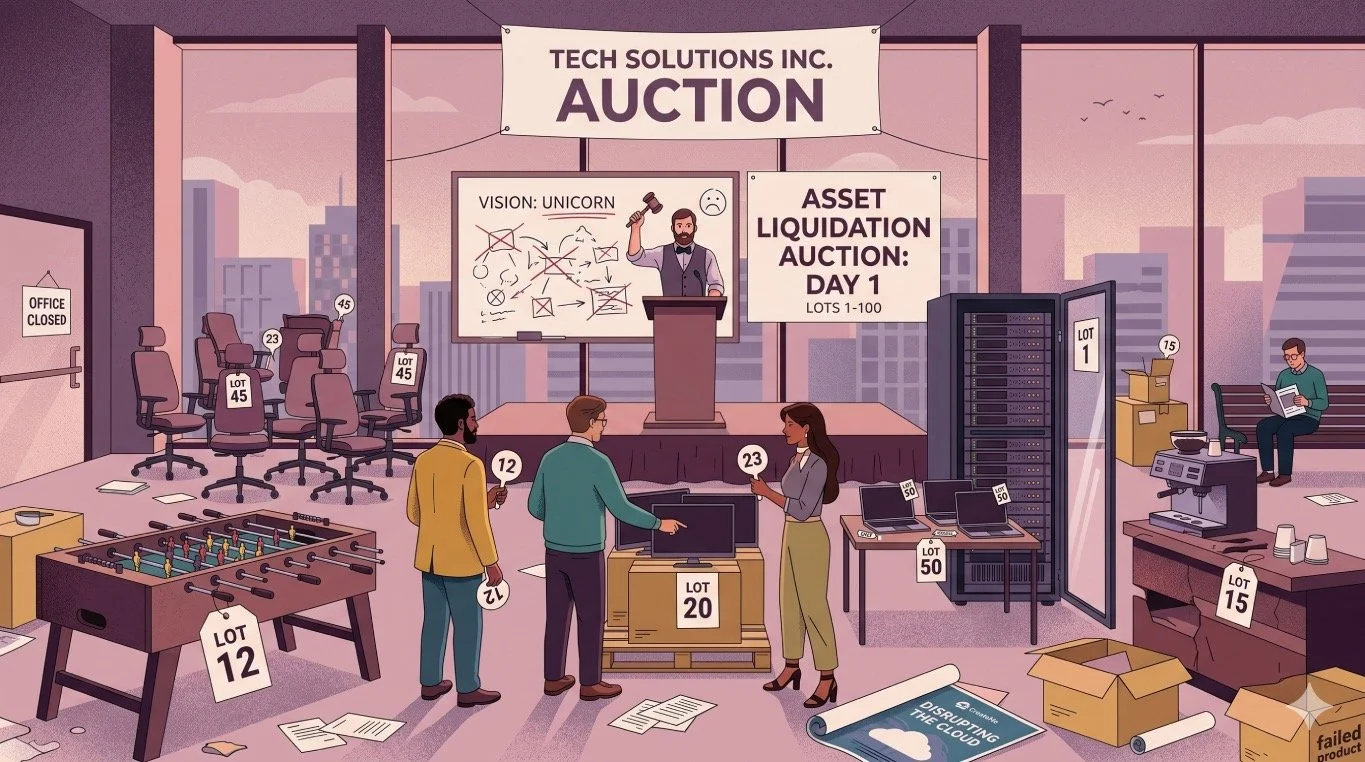
Don’t become a statistic. A business plan has to be more than a selling document.
Most founders treat a finished business plan as proof the idea works. Bill Sparks has read enough of them — and watched enough companies built on them — to make the opposite case. In this Cold Read, he walks through what the failure research actually shows, why the patterns are predictable rather than random, and where the gap between a persuasive plan and an accurate one tends to open up. It is not an argument against planning. It is an argument for planning honestly.
Business plans are among the world's most carefully written documents. Founders spend weeks or even months on them. Consultants charge thousands to review them. Investors read hundreds a year. And yet the U.S. Bureau of Labor Statistics reports that only about half of all businesses are still operating after five years. Twenty-one percent don't make it through the first year.
The question isn't whether business plans fail. They clearly do, at a rate that should give anyone pause before they mistake a polished document for a viable strategy. The question is whether the failure is random or follows patterns that could be anticipated. It turns out the patterns are consistent, and the research is thorough enough to be taken seriously.
What the Research Shows
CB Insights has conducted the most comprehensive analysis of startup failure available. Their most recent study analyzed public post-mortems, founder interviews, and shutdown announcements from 431 VC-backed companies that closed since 2023. "Ran out of capital" tops that list at 70 percent, but CB Insights is explicit: running out of capital is almost always the final cause of death, not the root problem. The more telling causes — poor product-market fit (43 percent), bad timing (29 percent), and unsustainable unit economics (19 percent) — reveal why the capital dried up in the first place.
The people dimension is equally well documented. Noam Wasserman at Harvard Business School spent a decade studying nearly 10,000 founders, publishing his findings in The Founder's Dilemmas (Princeton University Press, 2012). His conclusion: 65 percent of failed startups cited people problems as the primary cause, compared to 35 percent that pointed to product or market issues. The business plan is almost never about the people. That turns out to be a significant omission.
One caveat worth keeping in mind. The CB Insights data, like most failure research, is based on founder self-reporting. Founders have predictable incentives to frame failure favorably. "The market wasn't ready" is easier to say than "we misjudged our customers." The actual percentage of failures driven by execution and team problems is almost certainly higher than the published numbers show.
The Early Customer Problem
One of the most reliable traps in a business plan is projecting growth from initial traction. The first customers arrive through founder networks, personal referrals, and word-of-mouth. Those customers are enthusiasts. They accept rough edges, fill in missing features with their own patience, and give the benefit of the doubt. They are not a representative sample of the broader market, and treating them as one is a planning error that shows up consistently in post-mortem research.
Geoffrey Moore documented this dynamic in Crossing the Chasm (1991, updated 2014). The gap between early adopters and mainstream customers is not a gradual slope. It is a discontinuity. Mainstream customers want a complete, tested, socially validated solution. They don't assemble half-finished products, and they don't ignore missing features. When the early adopter pool runs dry, growth stalls. Most plans say it won't.
The practical failure mode looks like this: a startup gets traction with a few hundred enthusiastic customers, extrapolates to tens of thousands, and then runs into that gap. The early market wasn't a preview of the mainstream. It was its own small, unrepresentative segment. A plan that doesn't account for this transition isn't being optimistic. It's being imprecise about something that kills companies regularly.
The Customer Acquisition Cost Trap
Most business plans either underestimate customer acquisition costs or don't model them with any rigor. Research from multiple sources identifies this as the second biggest practical cause of startup failure. Most entrepreneurs underestimate their overall startup costs by 30 to 50 percent, and CAC is frequently where the largest gap appears.

Founders are good a finding customers through hustle, relationships, and personal credibility. It’s the next phase that gets expensive.
The underlying dynamic is straightforward. The first wave of customers costs almost nothing to acquire. Founders get them through hustle, relationships, and personal credibility. Plans model this as evidence that the marketing approach works. It isn't evidence of anything except that founders are good at finding early adopters. When a business needs to acquire customers at scale through paid channels, a sales team, or structured referral programs, the economics change considerably.
Peloton is a recent and well-documented case. In fiscal year 2021, each customer was worth 5.6 times their acquisition cost. As pandemic-era tailwinds faded and the company needed to spend its way to growth in a normalized market, that ratio collapsed to 1.8 times — essentially breakeven after acquisition spend. The company eventually concluded it needed to cut CAC by at least 50 percent just to reach a positive contribution margin. Multiple restructurings and a near-bankruptcy followed. The product hadn't changed. The unit economics had.
When Incumbents Decide to Care About You
Business plans tend to treat competition as static. The competitive landscape section names the players, acknowledges their strengths, and explains why the new entrant has an angle they don't. What it almost never models is what happens when an incumbent decides to respond.
In practice, if a startup is growing into a real market, the established players notice. Sometimes they copy the product. Sometimes they reprice aggressively to defend their customer base. Sometimes they simply lock in their best customers with long-term contracts before the new entrant can reach them. The response doesn't have to be elegant. It just has to be sufficient to slow momentum at the moment when momentum matters most.
This is compounded by a timing problem. By the time a startup's growth attracts serious competitive attention, the company has usually spent most of its runway building to that point. There isn't much left to fight back with. A plan that assumes incumbents will remain passive until the startup has achieved scale is a plan that has never tested its own central assumption.
The Team Problem No One Plans For
Business plans present the founding team as an asset. Wasserman's research suggests the team is also frequently the primary liability, and that the failure mode is predictable. Co-founder conflict tends to peak not during the difficult early days, but at the moment of first real traction, when decisions about control, equity, and company direction become concrete rather than theoretical.

When success becomes concrete rather than theoretical, things get real. Defining co-founder relationships at the business plan stage avoids problems later.
Wasserman frames the underlying tension as a "rich vs. king" dilemma. Founders who prioritize wealth creation and founders who prioritize maintaining control over their company are pursuing goals that are largely incompatible. Most founding teams don't work through this explicitly before it becomes a crisis. When it surfaces, it surfaces at the worst possible time.
The practical solution is straightforward and rarely applied before it's too late. Written agreements on equity vesting, role definitions, and decision rights should be in place before the first external dollar is raised. Not because co-founders don't trust each other, but because traction changes what's at stake. People who were perfectly aligned when nothing was on the line sometimes discover they're not when something is.
Regulatory Friction Gets No Budget Line
In regulated industries — healthcare, fintech, food production, transportation, anything involving consumer data or children — regulatory compliance timelines are almost never modeled with the same discipline as product development timelines. The assumption tends to be that compliance is a minor procedural step rather than a parallel work stream with its own costs and delays. That assumption is expensive.
The Roblox situation in early 2026 is a useful reference point even for companies far smaller than Roblox. The company implemented mandatory age verification and age-tiered account structures, and in doing so absorbed a roughly $1 billion reduction in its annual bookings forecast. That is what regulatory compliance costs a mature, well-resourced public company. For an early-stage company operating on a runway of 18 months, a very small fraction of that can be terminal.
Plans operating in regulated categories should model the compliance timeline explicitly and show what happens to the business if that timeline extends by six months. If the business doesn't survive that scenario, that's a finding worth knowing before launch.
The Structural Problem
There is a more fundamental issue beneath all of these specific blind spots. Business plans are written for an audience. They are pitch documents as much as operational guides, and the incentive is to present well rather than plan accurately. Competition gets acknowledged but rarely modeled seriously. Incumbent responses to new entrants get minimized. Sales cycles get compressed. Risks get footnoted rather than quantified.
This produces a systematic bias that no individual section of the plan can fully correct, because the bias is baked into the purpose of the document. The plan is designed to persuade. Accurate planning often requires the opposite: sitting with uncomfortable numbers, stress-testing scenarios that don't resolve cleanly, and treating the plan as an instrument of discovery rather than advocacy.
The companies that navigate this well tend to maintain two versions of their thinking. The external plan is written for investors and partners. The internal operating model is deliberately harder on the business, running scenarios where things take longer and cost more than expected. The gap between those two documents is often a reasonable proxy for how clearly leadership understands what they're actually building.
What Good Planning Looks Like
None of this argues against writing a business plan. The research argues for writing a more honest one.
That means modeling customer acquisition in two distinct phases and showing explicitly where the transition from founder-driven growth to scaled acquisition occurs and what it costs. It means mapping competitive responses, not just competitive positions — asking what the incumbent does when the startup starts winning customers, not just whether they exist. It means treating founding team alignment as a business risk rather than an assumption, and documenting how that risk is managed. It means building regulatory timelines into the schedule with the same rigor applied to product development. And it means running at least one scenario in which things take longer and cost more than projected, because the data consistently shows they do.
The companies that get this right are not being pessimistic. They're being more precise. In a market that is reliably unforgiving of imprecision, that distinction tends to matter quite a bit.
Pfanner Advantage works with clients to turn change into advantage at the intersection of mobility, motorsport, media, technology, and marketing. Learn more or start a conversation: contact us today.
The Advantage Journal arrives every week. What matters in sport, mobility, media, and technology — curated and contextualized by Bill Sparks, Bill Long, and Paul Pfanner. No hedging. No filler. Subscribe — It’s Free