
The Wrong Question
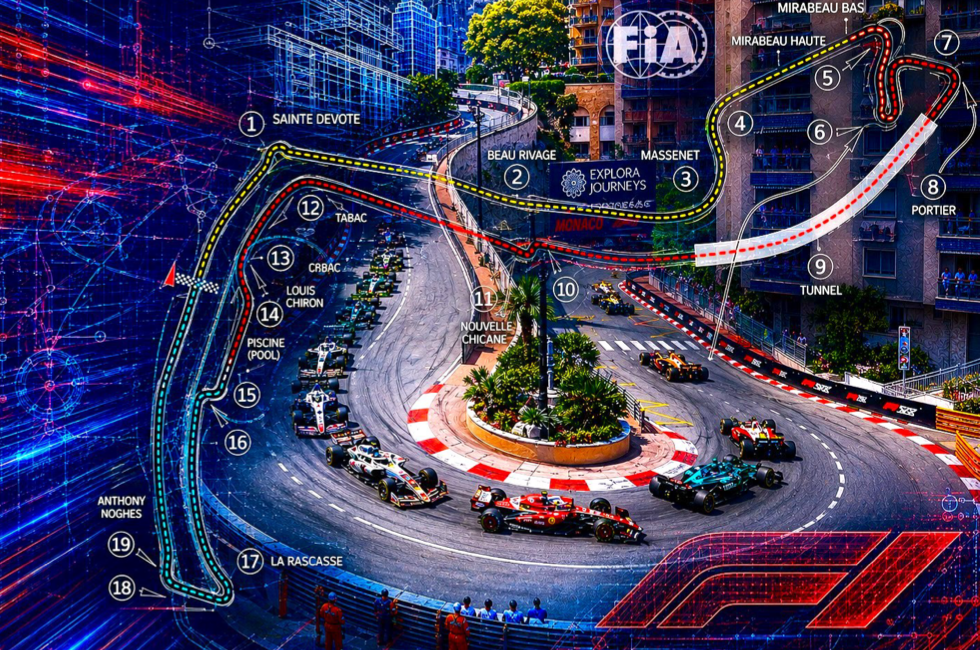
Formula 1 returns to Monaco this week with the FIA having switched off the centerpieces of the 2026 architecture — and F1’s stakeholders are facing a decision about what the sport has actually built.
The Formula 1 paddock arrives in Monaco this week, and what the FIA has chosen to switch off there tells you most of what you need to know about where the sport now stands. RACER Brand and Pfanner Advantage founder Paul Pfanner has been watching the 2026 regulations since the cars first ran. The supermajority for change is now in place. The diagnosis is sharper, and so is the path back.
The Monaco Grand Prix opens practice on Friday with the cars running a special engine map the FIA has built only for the principality, called Rev 1, that limits electrical deployment on the straights. The active-aero zones that sit at the centre of the 2026 architecture have also been switched off, because Monaco does not meet the FIA's safety criteria for them. And Monaco has the shortest power-limited distance on the calendar at 1,388 metres — Spa, for context, is 4,594.
The drivers, asked about it, have not hidden how they feel. Oliver Bearman, ahead of the weekend: "Maybe they'll be a bit more fun to drive. We can just drive how we want, use the gears that we want, and not have to do any silly lift-and-coast and these things." Charles Leclerc, who knows these streets better than anyone on the grid: "I'm quite excited for Monaco. I think it should be a good track for these cars."
Two of the men paid to drive the 2026 formula are openly looking forward to the one race where most of the 2026 formula has been switched off.
After the first race in Melbourne I asked one key question — what is really powering F1? The question is more pointed now. The 2027 votes came into place last week. This is the sixth race of the year, and the room will be in Monaco for three days.
A sport that answered the wrong question
The deeper problem is not the 50/50 power split. It is what the rulebook is measuring.
Senna at Donington in the rain in 1993. Verstappen at Brazil in 2024, coming from seventeenth on the grid. Different drivers, different decades, same thing — a driver doing something with the machine that nobody else on the day could do, and everyone watching. Formula One has spent seventy years selling that, and the audience came back because it could feel what it was watching.
The 2026 formula is measuring something different. It measures who manages an energy system most effectively across a lap. Call it management racing. It is a real test, and a difficult one, but it is not a test of what the driver does. It is a test of what the engineers and the algorithms can do.
The numbers in the European broadcast figures are the clearest evidence. In France, the Canal+ audience for the Japanese Grand Prix fell from 705,000 to 404,000 — a 43 per cent drop. In Spain, DAZN's audience for the same race fell from 124,000 to 63,000 — a 49 per cent collapse. Italy is the one major European market that is up, and the reason has a name. Andrea Kimi Antonelli, an 19-year-old Italian, has won four of the season's first five races. Where there is a human figure to follow, the audience is there. Where there is energy management software, the audience is not.
The Ferrari Luce is the cleanest illustration of the misreading. In my recent essay, A Ferrari Without a Pulse, I recognize that the new car is a piece of extraordinary engineering, and Maranello will tell you it is a Ferrari. On most measures they are correct. But anyone who knows what a Ferrari is supposed to be feels something off the moment they see it. The execution is brilliant. The category has shifted. Jaguar's EV transformation is the same misreading in reverse — engineering competence answering a question the brand's audience never asked, with that audience walking away faster than the company can replace them.
The manufacturers did exactly what they were asked
Manufacturer cynicism is not the story here.
Every manufacturer in the paddock made its commitment in good faith. Audi came in because the road car business needed an electrification story that pointed forward. Honda reversed its decision to leave F1 because the new formula gave it a reason to stay. The rest invested billions on the basis of a rulebook the sport built collectively, with them at the table.
They did not build the wrong car. They built precisely the car they were asked to build. The 50/50 hybrid is a technical achievement, and the integration of it is, by any standard, an act of collective virtuosity.
The misalignment is not between manufacturer ambition and execution. It is between what the rulebook asked the engineers to optimise and what the audience came to watch. Brand is behavior, and the behavior that keeps a brand alive in a consumer market is reading what the customer wants and answering it. That is what these companies do every day in their core businesses, and it is the reason there is genuine optimism here. In an age when audiences pull rather than manufacturers push, the brands that survive are the ones that listen. The supermajority that assembled around the 2027 changes last week is the evidence.
Indy just reminded us what we used to feel
The 110th Indianapolis 500 ran a week ago. It is a hybrid race now, and the technology was decisive in the closing laps. Almost nobody watching noticed.
The hybrid in IndyCar is a tool. The driver carries the show. You did not sit watching that race calculating energy budgets, you sat watching people do something almost nobody can do, and you felt it in your soul. People are still talking about it.
There is a version of these regulations in which the hybrid recedes and the driver returns to the front of the picture. The engineering excellence already built does not need to be discarded. It needs to be repositioned.
The harder thing to admit is this. A Gen-4 Formula E car around Monaco may produce a more dramatic lap than a 2026 F1 car around the same streets. The entire commercial justification for the current regulations was that they kept F1 at the technological pinnacle. If the category F1 itself created as a sister series produces more visible drama at the most demanding street circuit in the world, the pinnacle argument collapses on its own terms.
The audience owns the sport
Anyone who lived through the CART/IRL split recognises the rhythm of this moment. I have been publishing in this sport since 1973, and I watched CART/IRL play out from the publisher's chair, alongside the journalists who covered it day-to-day rather than in their place. What I watched was both sides deciding they owned the sport, rather than the audience that paid to watch it. The shorthand: someone in authority decides the sport belongs to the new audience, not the old one. The old audience gets reframed as purists who do not understand where things are going. The new audience is held up as the future. Both sides are told they are right.
Thirty years later, there was no audience for either side, and an entire generation has been spent rebuilding what was thrown away in one decade of misreading. I have a long memory about this.
The audience owns the sport. Not the other way around. That is structural, not romantic. Manufacturers, sponsors, broadcasters and tracks all exist at the audience's discretion. Toni Cowan-Brown, whose Idée Fixe newsletter bridges tech, culture and motorsport better than almost anything I read, put the same idea this way recently: "There's a difference between growing an audience and diluting a brand, and those two things can happen simultaneously without anyone noticing until it's too late."
Sport is in a strange position right now. Almost nothing else can hold a global audience in real time the way sport does, and live simultaneous attention is the rarest commodity in modern media. Getting the product wrong at this moment is not just a commercial mistake. It is a cultural surrender at the point in history when live sport has become the most valuable cultural product on the table.
That value is showing up in two directions at once. The European audience is defecting. At the same time, the American audience is growing sharply, as F1 has migrated from ESPN to Apple TV under a $160 million-a-year exclusive deal. Apple's Eddy Cue told the Autosport Business Exchange in Miami that ratings for the first three races were "way up over where they were last year on linear, significantly." Two parallel revolutions, in opposite directions, in the same calendar year. The regulatory one is the question Monaco will force.
What Monaco will decide
Monaco is where everyone who matters in the sport will be in the same place at the same time. Conversations fractured across calls and paddock corners since Miami will, for three days, happen in person.
The FIA has already given a preview of what Monaco will demonstrate. It has switched off active aero in the principality and mandated a Monaco-specific engine mode. The sport itself has acknowledged that the 2026 architecture is not safe to run at the calendar's most demanding venue.
The decision Monaco will force is not which numbers go in which column of the 2027 rulebook. It is whether this sport is willing to say plainly that what it has built and what it intended to build are not the same thing. Sixty-forty splits, race distances, fuel-flow rates — those are tactical questions. The strategic question is whether F1 still measures what F1 used to measure. If the answer is yes, the engineering already built becomes the foundation of the recovery. If the answer is no, the sport should say so publicly and let the audience decide what it follows next.
The path back
The signs of recovery are visible. F1 CEO Stefano Domenicali, who was defending the current formula publicly last month, this week aligned with FIA president Mohammed Ben Sulayem on the long-term return to V8 power. Formula One Management and the FIA are now speaking with one voice on direction. That is not a small thing.
The path back is not complicated. It asks the manufacturers to do what they do every day in their consumer businesses — read what the customer wants and answer it. The engineering already done can be redirected toward the right question, which is what manufacturers do when the market tells them to move.
Denial is the opposite of performance. In Formula 1 you get paid for performance. A sport that built itself on the numbers cannot pretend the audience is reading the situation wrong.
The room in Monaco will either start talking about what it has actually built, or it will keep talking about how to defend it. One leads back to Formula 1. The other leads somewhere else, under a different name.
The audience owns this decision too, and it is already making it.
Pfanner Advantage works with clients to turn change into advantage at the intersection of mobility, motorsport, media, technology, and marketing. Learn more or start a conversation: contact us today.
Paul Pfanner’s recent Shift Happens Insights:
Sunday Made the Case - the 110th Indy 500
The Advantage Journal arrives every week. What matters in sport, mobility, media, and technology — curated and contextualized by Bill Sparks, Bill Long, and Paul Pfanner. No hedging. No filler. Subscribe — It’s Free

