
The Death of Creativity (Again)
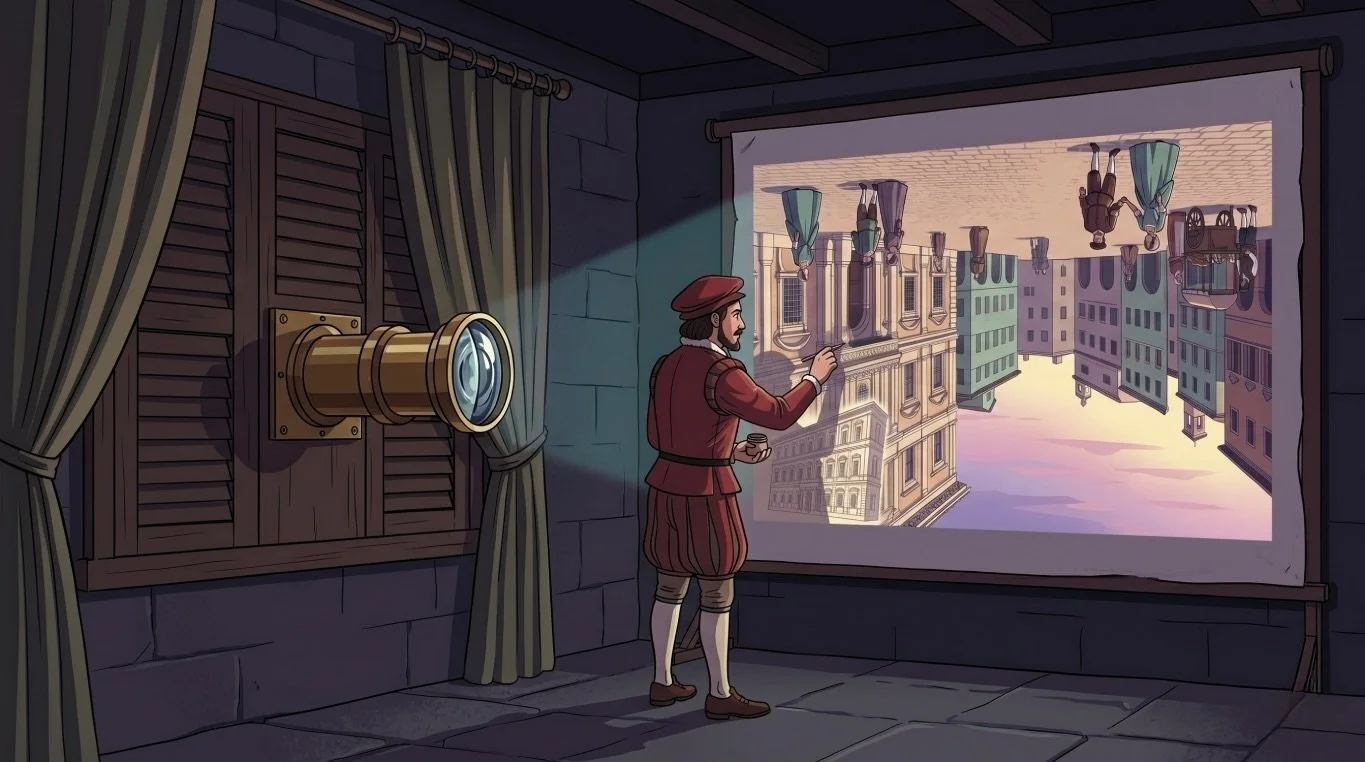
Sixteenth century Camera Obscura technology created a Renaissance-era art scandal.
In his latest Cold Read, Bill Sparks reaches back six hundred years to put the current AI debate in context. Every significant creative technology — Renaissance perspective, photography, the synthesizer, Photoshop — has been declared the death of "real" art by the establishment of its day, with accusations that sound remarkably consistent across the centuries. Sparks examines where generative AI fits in that pattern, and what the productive question looks like once the predictable one is set aside.
In 1859, the French poet Charles Baudelaire called photography "art's most mortal enemy." He believed it would destroy the human imagination itself. In 1982, the Central London Branch of the Musicians' Union voted to ban synthesizers (although, it was never ratified as national policy). The magazine NME (New Music Express) called them "MU loonies." In 2023, a coalition of artists filed suit against Stability AI, arguing that generative image tools trained on their work were, in effect, a machine built to replace them.
The specific technologies change. The language doesn't. "It's just pressing a button." "There's no real skill." "It has no soul." These accusations have been leveled at every significant creative technology for roughly six hundred years. The legal and economic dimensions of the current AI debate are real, and I've explored them in previous articles on creator compensation and artist resistance. But the cultural reaction, the gut-level conviction that a new tool has stolen something essential about human creativity, is a much older phenomenon. And it follows a pattern that's worth understanding to gain perspective on the current controversies surrounding AI-generated content.
The Grid and the Soul
The first recorded version of this argument happened in the early 1400s, when Leon Battista Alberti and Filippo Brunelleschi codified linear perspective. Before their work, paintings arranged figures by theological importance. The Virgin Mary was large because she mattered, not because she was standing closer to the viewer. Perspective replaced divine hierarchy with geometric hierarchy, and that was a genuinely radical philosophical shift, not just a technical one.
Critics revived arguments from Plato to make their case against it. Geometric tricks were deceptive. They trapped the viewer's eye into a single fixed line of sight and replaced the artist's spiritual interpretation with cold calculation. The Draughtsman's Net, a literal grid placed between the artist and the subject, was particularly offensive. If you needed a grid to draw, what exactly were you contributing?
What actually happened was more interesting than either side predicted. Perspective didn't diminish the artist. It elevated the artist from manual laborer to intellectual, someone whose value lay in mastering a system rather than simply having a steady hand. The "skill" didn't disappear. It moved. Understanding spatial mathematics became the new creative credential.
The Projected Image Controversy
The Camera Obscura was the Renaissance's most literal "cheating" scandal. Giambattista della Porta popularized the device as a drawing aid in the 16th century. Artists used it to trace images projected onto a canvas, allowing them to create paintings with an unprecedented level of realism.
The debate didn't stay in the 1500s. In 2001, the artist David Hockney and physicist Charles Falco published Secret Knowledge, arguing that Old Masters including Vermeer and Caravaggio had used optical aids to achieve their famous realism. The art world reacted as though someone had accused the saints of blasphemy. If these painters were tracing projected light rather than free handing anatomy and shadow, did the work lack virtù, the innate talent and soul of the maker?
The counterargument is worth remembering. The Camera Obscura didn't paint Vermeer's paintings. It allowed him to see things the naked eye misses: circles of confusion in reflected light, subtle color gradients at the boundary between shadow and illumination, spatial relationships that the brain normally simplifies. It was a perception multiplier, not a talent replacer. Vermeer still had to decide what to paint, how to compose it, and what to leave out. The tool expanded what he could see. The art was still in what he chose to do with it.
Art's Most Mortal Enemy
If perspective was a tremor and optics were a crack, photography was the earthquake. Baudelaire's specific fear was not just that photography would replace painters. He believed that by making realistic image creation mechanical and instant, it would atrophy the human capacity for imagination. The machine wouldn't just take the artist's job. It would diminish the artist's mind.

French poet and art critic Charles Baudelaire believed the camera would atrophy the human capacity for imagination.
The institutional response was exclusion. Photography was barred from fine art exhibitions for decades. The 1859 Salon des Beaux-Arts relegated it to the industrial science section, a classification designed to keep it from contaminating "true" painting. The arguments sound remarkably contemporary: anyone can press a button, the machine does the real work, and the result is a copy of reality rather than an act of creation.
Walter Benjamin formalized this anxiety in his 1935 essay The Work of Art in the Age of Mechanical Reproduction. His concept of "aura," the unique authenticity that comes from a work's singular existence in time and space, is the intellectual ancestor of every argument that AI-generated content is "soulless." When you can produce infinite copies of an image, what happens to the quality that made the original valuable?
But Benjamin himself saw something the critics missed. Mechanical reproduction, he wrote, "emancipates the work of art from its parasitical dependence on ritual." It made art accessible to people who would never set foot in a gallery. And the strategic consequence that actually played out was the opposite of what Baudelaire feared. Since photography "solved" realism, painters were liberated to pursue what a camera couldn't do. Impressionism, Expressionism, and Abstract Art are all, in a meaningful sense, children of photography. The technology didn't kill art. It forced art to discover what made it irreducibly human. The answer turned out to be emotion, abstraction, and interpretation, things no machine could replicate by pointing a lens.
The Synth Ban and the Pixel Wars
The pattern didn't stop in the 19th century. Two 20th-century examples show the cycle accelerating.
In May 1982, the Central London Branch of the Musicians' Union voted to ban synthesizers after Barry Manilow toured Britain using electronic instruments to simulate a full orchestra. The ban would have outlawed synths, drum machines, and any electronic device "capable of recreating the sounds of conventional musical instruments." Although never ratified as national policy, the intent was clear.
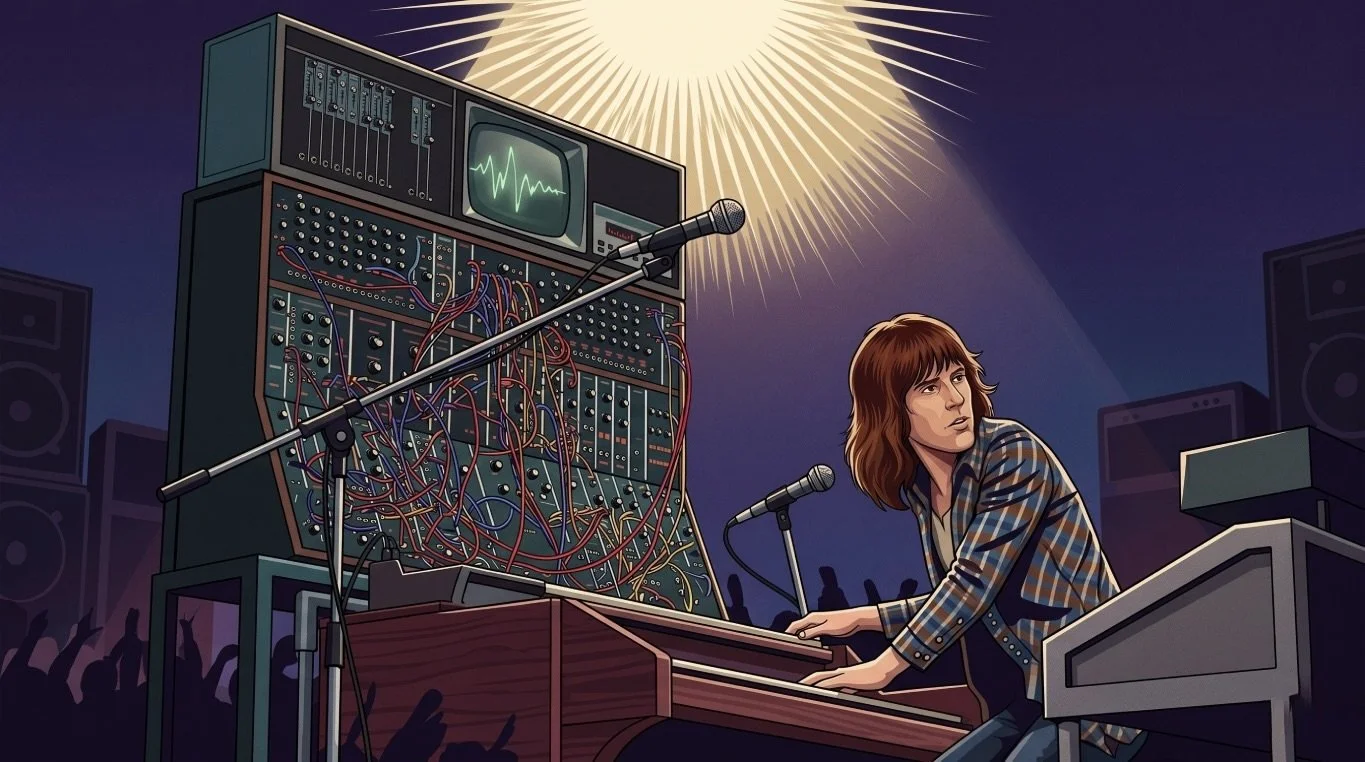
Nearly 500 years after the Camera Obscura, musicians’ unions tried to ban synthesizers.
The American Federation of Musicians banned the Moog from union work in 1969. In the following years, "synthesizer player" became a union job classification, and electronic music was absorbed into the trade. Today, the instruments those unions tried to kill define multiple mainstream genres and generate billions in annual revenue. The musicians who mastered them are considered pioneers, not cheaters.
A decade later, the same fight moved to visual art. When Adobe released Photoshop in 1990 and Wacom tablets became affordable, the established art community dismissed digital work as "nothing more than shortcuts to making art without learning the fundamentals." Art teachers penalized students for bringing tablets to class. MoMA didn't begin exhibiting digital installations until the early 2000s. The accusation was identical to the one aimed at the Camera Obscura five centuries earlier: if the computer did the hard part, the work lacked authenticity.
Both cases show institutional gatekeeping trying to freeze the definition of craft at whatever the current practitioners happened to be doing. Both failed. Both produced entirely new creative disciplines that nobody anticipated.
The Current Earthquake
So where does generative AI fit in this six-hundred-year pattern?
The cultural reaction is textbook. The accusations are the same ones Baudelaire made about photography, the same ones the Musicians' Unions made about synthesizers, the same ones art teachers made about Photoshop. "It's just a prompt." "There's no real skill involved." "The output has no soul." Line them up side by side and you could shuffle the centuries without losing coherence. The institutional gatekeeping reflex is textbook too. Barring photography from the 1859 Salon, banning the Moog from union sessions, and the current push to deny copyright protection to AI-assisted works are structurally the same move: the establishment drawing a line around what counts as legitimate creative output and declaring the new tool on the wrong side of it.
The legal and labor-displacement dimensions of the AI debate are real, and they deserve the serious treatment we've given them. Training data provenance, creator compensation, and the economics of displacement at scale are not trivial concerns. But the cultural panic, the visceral accusation that AI-assisted work is fundamentally illegitimate, is a separate question from the economic one. And historically, it has resolved the same way every time: not by freezing the definition of craft, but by expanding it.
The difference this time is speed. What took photography roughly fifty years to resolve and synthesizers about fifteen is happening with AI in something closer to three. The cycle is compressing. Companies that sued in 2023 are licensing in 2026. Disney went from legal opposition to a massive partnership with OpenAI's Sora in under two years — an alliance that evaporated just as quickly when OpenAI shuttered the platform due to unsustainable computing costs. The underlying pattern is identical to the past, but the clock is running faster than any previous iteration.
The Pattern
There is a through line here that matters for anyone making strategic decisions about creative work.
Every time a technical barrier is breached by new technology, the humans working in that space build a new wall around intentionality, curation, and concept. In the 1400s, the new creative skill was understanding a geometric grid. In the 1800s, it was selecting the right lens and composing within a frame. In the 1990s, it was mastering digital tools that most traditional artists refused to touch. In the 2020s, it is becoming the ability to direct, curate, and synthesize AI-generated outputs into something coherent and purposeful.
The debate over whether AI-assisted work is "real" creativity is, based on six centuries of evidence, a dead end. It's the wrong question. Every generation has asked it, and every generation has eventually moved on. The productive question is what new creative skills this technology demands and whether individual creators are developing them or still arguing about whether the old ones should be sufficient.
Every past creative-technology panic eventually resolved not because the critics were wrong about what was being lost, but because the gains created new territory that no one had imagined. Photography didn't kill painting. It forced painting to discover abstraction. Synthesizers didn't kill musicianship. They invented entirely new genres. The question is not whether AI will change creative work. It already has. The question is what new territory it opens, and whether you'll be positioned to work in it when everyone else stops arguing and starts building.
Pfanner Advantage works with clients to turn change into advantage at the intersection of mobility, motorsport, media, technology, and marketing. Learn more or start a conversation: contact us today.
The Advantage Journal arrives every week. What matters in sport, mobility, media, and technology — curated and contextualized by Bill Sparks, Bill Long, and Paul Pfanner. No hedging. No filler. Subscribe — It’s Free