
Now. 34-Years Ago.
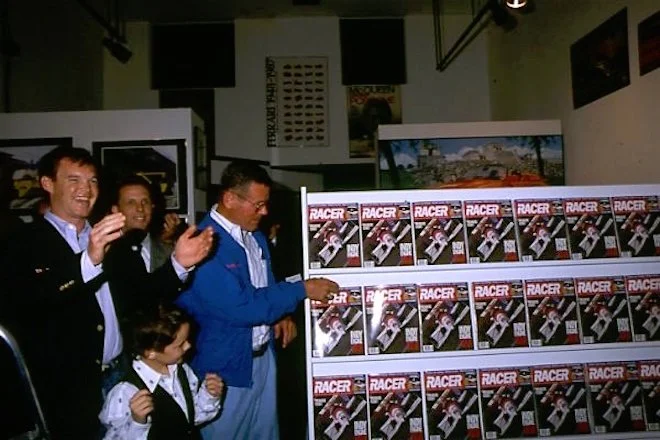
Founder Paul Pfanner (standing rear) looks on as Bobby Unser, Al Unser Jr., and Al Unser III unveil RACER magazine Issue No. 1 at the launch party in downtown Long Beach, California. April 11, 1992, on the eve of the Toyota Grand Prix of Long Beach. Paul Webb Photo
On the morning of April 11, 2026 — the thirty-fourth anniversary of the launch of RACER magazine — Paul Pfanner reflects on what it costs to build something that lasts, and what it teaches you when your chapter of it is done.
It is six o'clock on the morning of April 11, 2026. Thirty-four years ago today, in a small motorsports art gallery in downtown Long Beach, a black shroud came off a magazine that nobody had seen before.
Al Unser Jr. and his uncle Bobby did the honors. Emerson Fittipaldi was in the room — he was on the cover. Chris Economaki, the most credible voice in American motorsport media, raised a champagne glass and offered a toast I have carried ever since: "There is room in this sport for both of us."
That was the night RACER magazine was born.
I have attended every Long Beach Grand Prix since the inaugural race in 1975. I know this city, this weekend, this community. And nothing in my professional life has felt quite like that evening — not because of what we had accomplished, but because of what we didn't yet know. We didn't know if it would survive. We didn't know if the audience we believed in would believe in us. We only knew that we had built something we were proud of, and that we had staked everything on the idea that the American racing audience deserved better than what existed.
A Promise Made in a Yellow Porsche 914-6
That bet took fourteen years to place.
Jeff Zwart and I first talked about it on a January morning in 1978, driving north on Highway 101 in his yellow Porsche 914-6, on our way to scout camera positions for a SportsCar magazine shoot. Jeff had just begun his second professional automotive photo assignment. I was SportsCar's art director, and I had been part of the FORMULA magazine launch back in 1973. We both knew what a great racing publication could be, and we both knew that nothing yet published in America had fully delivered on that promise.
The idea we shaped that morning was simple and completely impractical: a great American racing magazine that could stand alongside the best from Europe and Japan. We made each other a promise and went back to our lives.
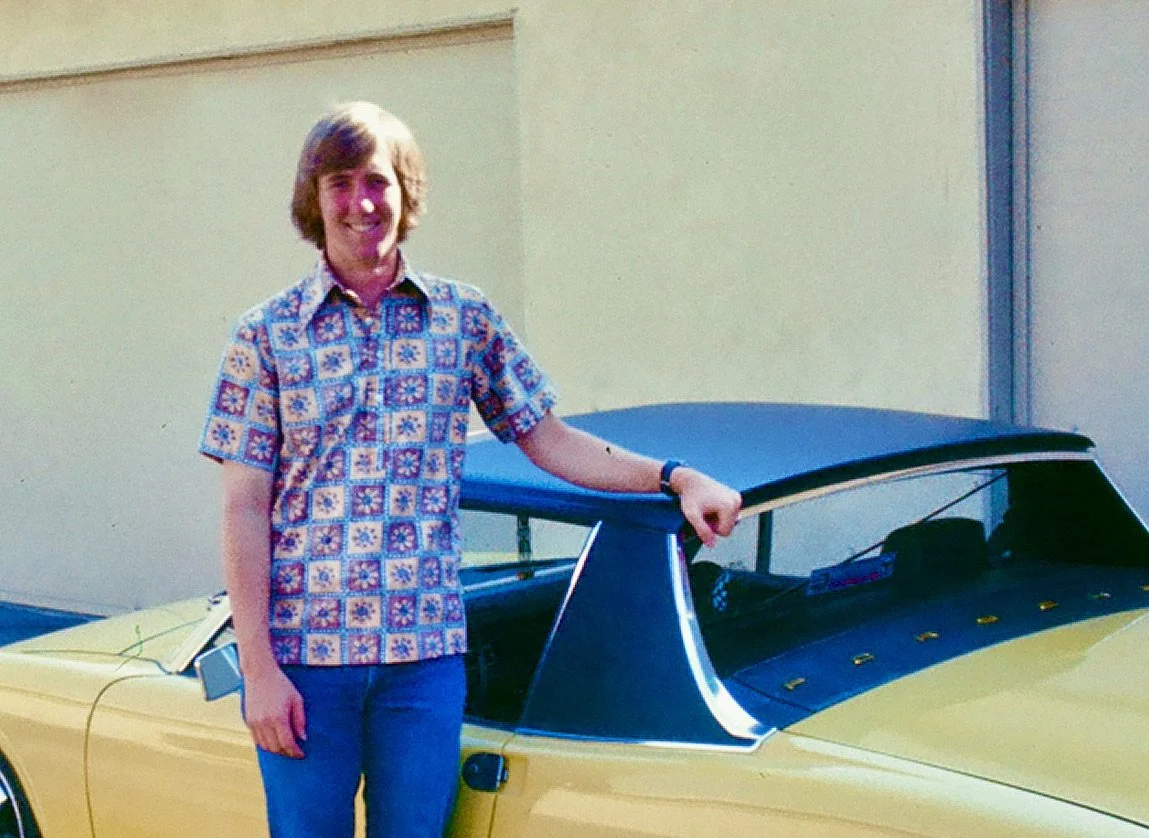
Jeff Zwart with his Porsche 914-6, mid-1970s. The promise that became RACER magazine was made from this car.
What Jeff Zwart would become in the years that followed is worth pausing on. He is one of the most gifted automotive image-makers who has ever worked — a Road & Track photographer, a world-class commercial film director whose clients include Porsche, BMW and virtually every major automotive brand, a rally champion, an eight-time class winner at Pikes Peak, and the second unit director of The Art of Racing in the Rain. He is also a racing driver of genuine accomplishment, a man who once drove a Porsche 997 GT2 RS from Los Angeles to Pikes Peak, raced it up the mountain, and drove it home. He is, in the truest sense, someone who lives what he creates. When Jeff Zwart made a promise in that 914-6 in 1978, he kept it — with his investment, his talent, and his hands-on commitment when RACER needed both most.
The Architecture of a Launch
Someday arrived in stages, as it always does.
Bill Sparks joined the effort — and brought with him the business architecture that would make RACER real. His subscription marketing campaign outperformed every projection. His printing specifications — larger format, perfect-bound spine, heavier and brighter paper stock — signaled from the first issue that this was not an ordinary American racing magazine. And five years after launch, it was Bill Sparks who conceived and executed the launch of RACER.com in May 1997, planting the brand's flag in digital territory before most of our competitors understood the terrain.
John Zimmermann became founding editor. A young, all-female sales team — led by ad director Donna Chamberlain — went out and sold the thing before most of the industry believed it would last.
The name itself came from two people whose judgment I trusted completely. Gordon Kirby, one of the finest motorsport writers alive, made the case for it with characteristic precision. And the seed had been planted years earlier by Nick Craw— former SCCA president and CEO, ACCUS president and CEO, FIA Senate President, and an accomplished IMSA championship-winning racer himself — whose BMW 2002 carried a personalized plate reading RACER during his years as Director of the Peace Corps. When I saw a photo of that plate, something registered. When Gordon Kirby argued for it, I knew.
The first issue did not play it safe. Maurice Hamilton wrote an unsparing assessment of Nigel Mansell. Gordon Kirby warned presciently about American racing's habitual failure to manage technology and cost. Pete Lyons documented the twilight of IMSA's Camel GT era. We came out swinging, because we believed the audience could handle the truth.
They could. They still can.
The Haymarket Chapter
The thirty-four years since that night have not been a straight line. They never are in racing, and they never are in media — and we were competing in both simultaneously, which made for a particularly demanding race.
By 2001, RACER had grown into something substantial enough to attract Haymarket Media, one of the most respected motorsport publishing houses in the world. The Haymarket era brought new resources, expanded reach, and colleagues whose passion for the craft matched our own. It was a legitimate and productive chapter, conducted with mutual respect on both sides. Among its most significant developments was the arrival of Laurence Foster as Editor-in-Chief — a journalist who had twice led Haymarket's own Autosport magazine while simultaneously running its Special Projects division. Laurence brought to RACER a standard of editorial excellence that has now spanned more than two decades. He is, without qualification, the best in the business.
By late 2005, I was ready to evolve personally and professionally. I left on good terms — the kind of terms that are only possible when both parties have conducted themselves with integrity throughout. Bill Sparks came with me, and together we reestablished Pfanner Communications, Inc., the strategic consulting and brand development practice that remains active to this day. The clients we served in that period — ALMS/IMSA, IndyCar, the Indianapolis Motor Speedway, iRacing among them — kept us close to the industry we had spent our careers building.
But what we really wanted was to move into video creation and online distribution. That led to OnCars, a video-first platform launched in 2008 in partnership with media entrepreneur Jay Penske. We introduced the prototype for the revolutionary Tesla Model S in a 2009 launch vehicle series that was, in retrospect, years ahead of its moment. The Great Recession had other plans. We absorbed the lesson and moved forward.
The Return
The reacquisition of RACER happened in March 2012, on the eve of the brand's 20th anniversary.
The reacquisition of RACER happened in March 2012, on the eve of the brand's 20th anniversary. Rob and Chris Dyson, whose original investment had been instrumental in building RACER, returned as anchor investors to make the reacquisition possible. The Haymarket relationship, built on mutual respect over eleven years, made the transaction possible. Bill Sparks came back with me. We relaunched the magazine at Long Beach — again — with a DeltaWing on the cover. Something unconventional. Something that made people stop and look twice. We called it the RACER 3.0 era, and we meant every word of it.
In his own words, RACER co-founder Jeff Zwart reflects on the promise made on the way to a photo shoot — and what it meant to keep it. captured at the time of the RACER 3.0 relaunch on the brand's 20th anniversary in 2012.
What followed was more than a decade of sustained building — the magazine, the website, the agency, the video platform, the streaming network. The standard we set in that gallery in 1992 remained. The audience stayed with us because we stayed with them.
I am proud of what the RACER team continues to build. The talent and loyalty of the people who have given their professional lives to this brand is something I do not take lightly. I am watching with genuine admiration as Taro Koki leads a creator summit at this very Grand Prix weekend — a reflection of exactly the kind of forward vision this industry needs and this brand has always been capable of delivering.
What the Laboratory Taught
My time at RACER ended on December 31, 2025. It was, without question, the hardest and most rewarding proving ground of my professional life — and I say that as someone who has been at this since 1972. Everything I know about building something that endures, I learned by doing it, losing it, and building it again. You don't acquire that kind of knowledge. You earn it, at real cost, over real time, and you carry it forward.
What I carry forward is the same instinct that drove that yellow 914-6 north on a January morning in 1978: that the people who love this sport and this industry deserve serious, independent, authoritative work. Not content. Not posts. Not engagement bait. Work.
Bill Sparks, my creative partner since 1981, is still at my side. Donna, who was in that room thirty-four years ago tonight is with me. Now.
Some things, built right, endure.
The race that began in a gallery in Long Beach in 1992 taught me something I did not fully understand until I was standing on the other side of it: the publication was never the destination. It was the laboratory. Every issue, every editorial argument, every reinvention under pressure was training for the work I am doing now — bringing fifty years of earned perspective to bear on the forces reshaping mobility, motorsport, media, and technology.
That work continues. And it is just getting started.
Victory travels at the speed of thought.
Paul Pfanner is the co-founder of Pfanner Advantage and Pfanner Communications, Inc. He co-founded RACER magazine on this date in 1992. His creative partner since 1981, Bill Sparks, writes Cold Read for the Pfanner Advantage platform.
Pfanner Advantage works with clients to turn change into advantage at the intersection of mobility, motorsport, media, technology, and marketing. Learn more or start a conversation: contact us today.
The Advantage Journal arrives every week. What matters in sport, mobility, media, and technology — curated and contextualized by Bill Sparks, Bill Long, and Paul Pfanner. No hedging. No filler. Free. Subscribe — It’s Free

