
Integrity
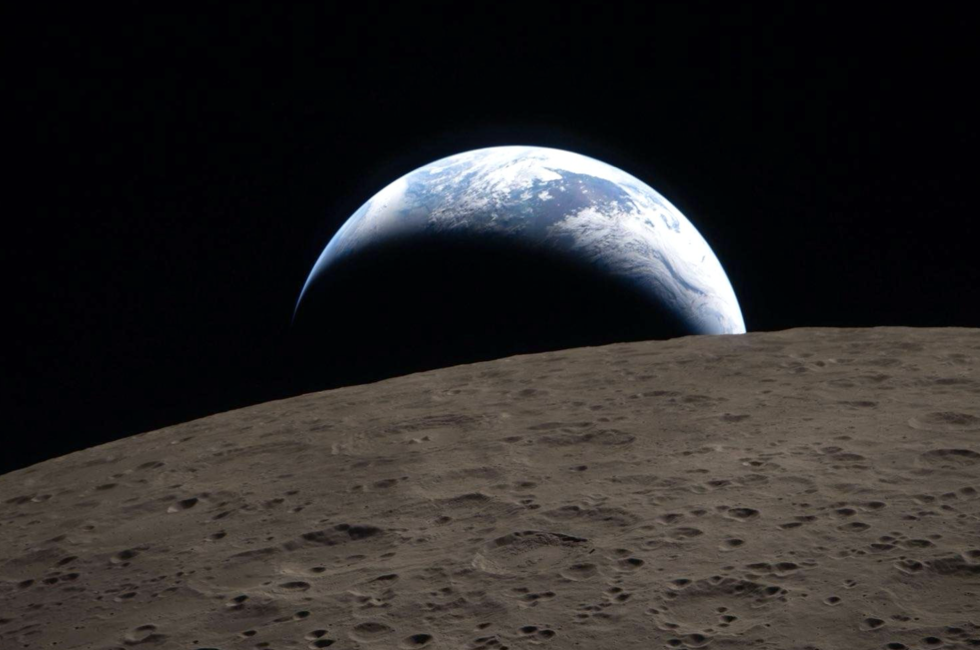
Truth in our shared Now. Earth setting over the lunar surface, April 6, 2026. Courtesy NASA / Artemis II crew, aboard Integrity.
In a world fractured by war and social uncertainty, four human beings just did something extraordinarily difficult together — and brought it home. Paul Pfanner reflects on what that means, where he first learned it, and why it matters more now than ever.
Something stopped people mid-scroll recently. Not a controversy. Not a result. Not an algorithm-optimized provocation.
Four human beings — Reid Wiseman, Victor Glover, Christina Koch, and Jeremy Hansen — climbed into a spacecraft, flew around the moon, and came home. The Artemis II mission didn't land on the lunar surface. It did something quieter and more consequential. It showed us intelligent people working together to do an extraordinarily difficult thing — and reminded us that this is still possible.
We ache for that right now. Consequential wars are raging in multiple regions. The social contract most of us grew up believing in is being renegotiated loudly and without consensus. In that environment, watching four human beings execute something at the absolute limit of human capability — with precision, with grace, with complete commitment to each other and to the mission — is not simply inspiring. It is a reminder of who we actually are when we are operating at our best.
Artemis II astronaut Christina Koch, returning from lunar distance, put it with the precision of someone trained to use precise words: "Earth was just this lifeboat hanging in the universe. Planet Earth, you are a crew."
A crew has no margin for the failure of integrity.
Real Is Gold
Sport has always known this. And right now, sport is proving it with a force that no algorithm can replicate.
The live experience of human beings doing something extraordinary in real time — on a circuit, in a stadium, on a field, or watching a capsule break through the atmosphere and splash into the sea — is irreplaceable. Audiences are not just growing. They are paying more, traveling further, and committing deeper to the live moment than any previous generation of fans. Formula 1 fills the streets of Miami and Las Vegas. The NFL plays in London and São Paulo. The Olympic Games draw billions to screens in real time not because of the production value but because of the consequence. Something is actually happening. To real people. Right now.
In a world increasingly mediated, filtered, and artificially generated, real is gold.
Sport delivers reality. Exploration delivers reality. Both remind us what human beings look like when they refuse to accept limitation — when they hold to a standard that does not negotiate with circumstance, and do the difficult thing together.
My late father understood this before I was born.
What He Knew
Ron Pfanner loved racing and the sea long before the war. As a young man he wrote a story about Midget Car racing — drawn to it for the same reason he was drawn to the ocean: both delivered the reality of consequence at full speed, without softening.
He went to war underaged, as many of his generation did. He served as a sonar operator in the United States Navy, hunting U-boats in the North Atlantic. The Great Depression had already taught him that consequence was real and margin was thin. The war confirmed it at a frequency that never left him.
After the Navy we stayed in San Diego, where he went to work at Convair on the Atlas missile program — the rocket that would put the first Americans into Earth orbit. In 1962, he was recruited to North American Aviation in Downey, California, where he spent his career writing training materials for the engineers and simulator teams working on the Apollo Command Module. He was not building the spacecraft with his hands. He was translating its demands into human understanding — making sure the people responsible for bringing astronauts home knew exactly what was required of them and why.
He gave me racing because it delivered what he had learned through war, through the sea, and through a career spent at the edge of what human beings could build and survive: the reality of consequence.
Not metaphor. Not simulation. Consequence.
In early 1958, he sat with me on the front porch of our family home in San Diego and pointed at the night sky. He explained what Explorer 1 was — the first American satellite, launched weeks earlier — and why it mattered. I don't remember seeing it pass overhead. I remember the awe. A small boy, his father beside him, looking up at something human beings had put into the sky and understanding, without yet having the words for it, that the world had just changed.
We left San Diego in 1962 when Apollo called him to Downey. He carried the same standard with him that he had carried out of the North Atlantic — precise, unsparing, and completely committed to bringing people home safely.
The Circle
Artemis II splashed down off the coast of San Diego.
The earliest city in my memory. The waters dad looked out at from the Coronado Naval base. The same coastline where a small boy sat on a porch in 1958 and felt awe before he had the words for it.
That is not a coincidence I manufactured. It is one I recognized.
The image Artemis II returned — the Earth, small and luminous, suspended in the absolute darkness of space — makes the case for human cooperation more powerfully than any argument ever written. You cannot see it and believe that our divisions are large. You cannot see it and accept that small thinking is enough.
My father knew this. He felt it in both directions simultaneously — the racing he loved before the war, and the spacecraft he helped sustain through the most demanding engineering program in human history — as expressions of the same conviction: that human beings, operating with complete integrity, are capable of things that seem impossible until they are done.
Epilogue
My daughter Eden sits in Mission Control at Virgin Galactic Spaceport, preparing for the coming era of regular civilian suborbital spaceflight. She did not choose aerospace because of her grandfather. She chose it because it called to her — the way racing called to me, the way the Atlas program called to Ron Pfanner in San Diego in the late 1950s.
But the thread is there.
A man who hunted U-boats in the North Atlantic and wrote training materials for the Apollo program. A boy on a porch in 1958, looking up. A granddaughter in Mission Control, bringing civilians safely home from the edge of space.
Some things, built with integrity, endure.
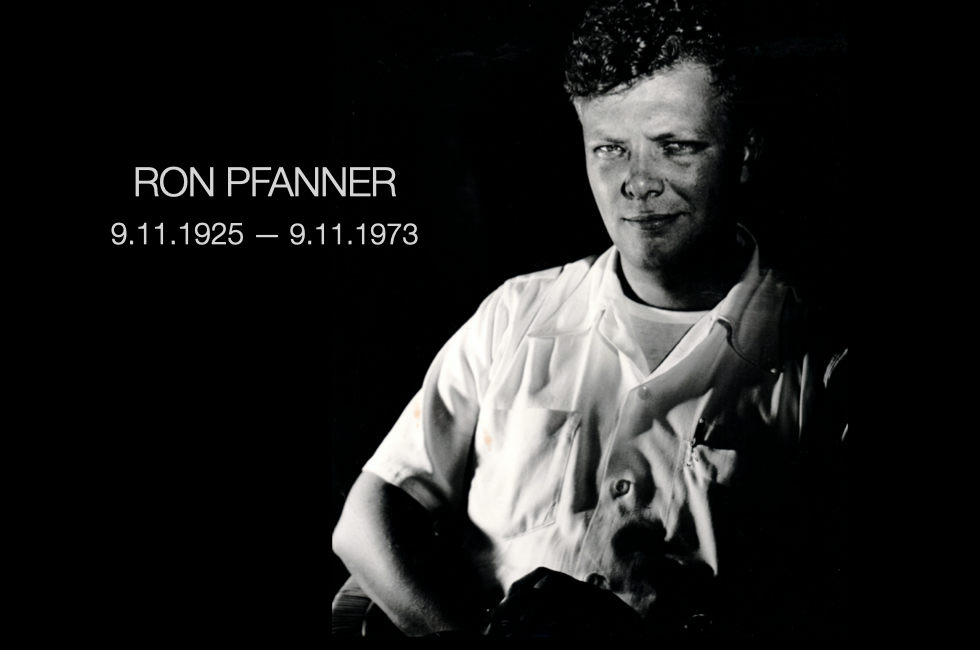
Ron Pfanner, 1925–1973. He wrote the training processes for the engineers and simulator teams who built the Apollo Command Module. He understood that integrity was not a value. It was an engineering requirement.
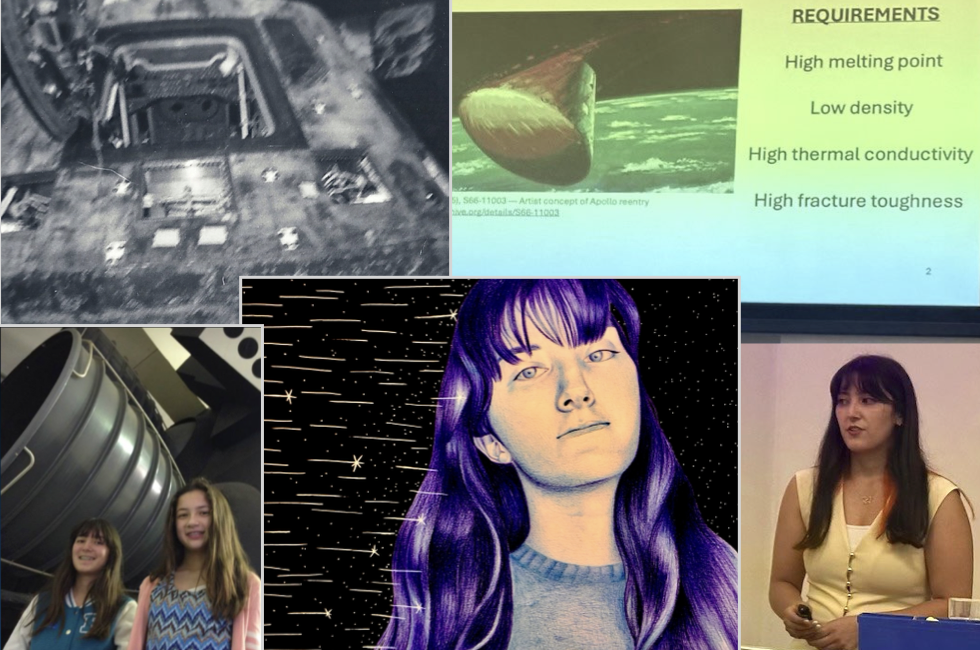
Five images. One thread. Clockwise from top left: the Apollo Command Module at North American Rockwell in 1969, photographed by Paul Pfanner on the day his father brought his family to see it after it returned to where it was built. An 1965 NASA artist's concept of Apollo reentry was included in Eden Pfanner's graduate thesis on heat shield material requirements. Eden Pfanner presenting her master's thesis at TU Delft, Netherlands, July 2025. An illustration of Eden against a field of streaking stars, by her twin sister Sofia, then in high school — now a professional illustrator and designer. Sofia and Eden Pfanner on 2/1/2013 at the Columbia Memorial Space Center in Downey, California, on the 10th anniversary of the loss of Columbia, and her crew of seven brave astronauts. Sofia and Eden are standing at the rear of the shuttle mockup known as Inspiration — built in 1972, on the grounds where North American Rockwell once stood. Paul Pfanner first saw Inspiration on September 11, 1973, on the day his father died, when he went to collect his belongings. Ron Pfanner’s North America Rockwell teammates wanted him to see what his dad had been working on.
Pfanner Advantage works with clients to turn change into advantage at the intersection of mobility, motorsport, media, technology, and marketing. Learn more or start a conversation: contact us today.
The Advantage Journal arrives every week. What matters in sport, mobility, media, and technology — curated and contextualized by Bill Sparks, Bill Long, and Paul Pfanner. No hedging. No filler. Free. Subscribe — It’s Free

