
Who Pays The Witness?
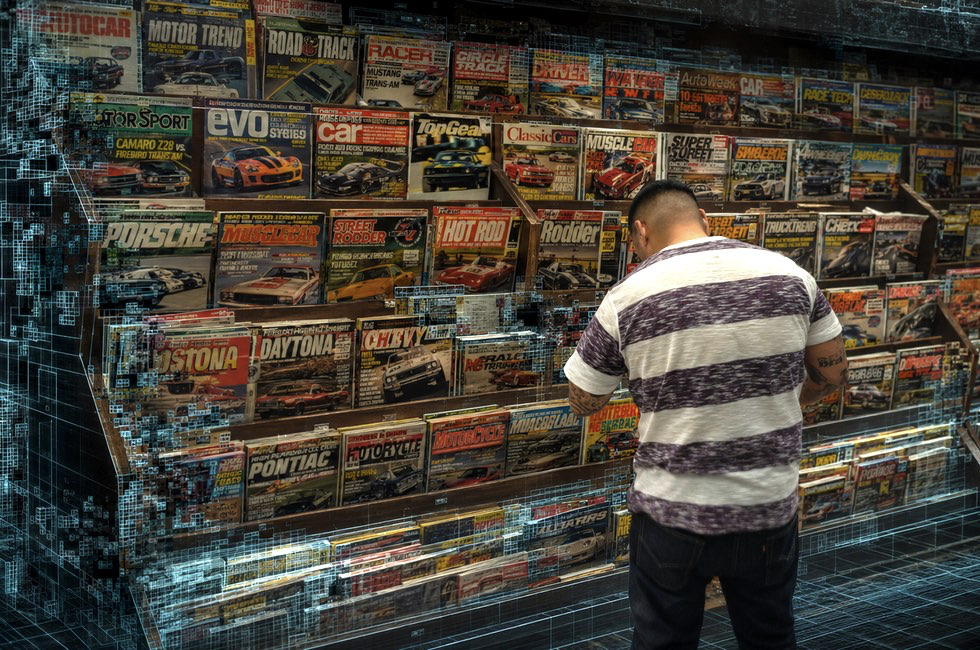
A newsstand, circa January 2013. Motorsport doesn't need magazines the way it once did to reach its audience. What it still needs is what it will always need, people who know what they're looking at, and a sustainable way to keep paying them to do the work.
Paul Pfanner has spent most of his working life building motorsport media. He launched RACER magazine in 1992, RACER.com in 1997, and published SportsCar, the Sports Car Club of America's member magazine, for forty years. He calls himself a publisher rather than a journalist, though in practice the work always came down to hiring good journalists and giving them the room, and the cover, to do their jobs while the technology and the audience kept changing underneath them. Here he sets aside the familiar story of print's decline for a harder question: what kind of media business can still pay for independent judgment now that the sport, the people in it, and the creators around it can all reach the audience on their own? Whatever the answer, one thing holds for him: a belief in magazines, in the spirit of RACER and the people who give it life, and in the readers who still want it.
For most of the last century, the value in this business was made by individuals — a writer who could see what mattered in a race and tell you about it, a photographer who could set you trackside with the drivers. The publisher didn't make that work. It gathered it, paid for it, packaged it, and carried it to a doorstep. Editing, ad sales, printing, the post, the newsstand — all of it existed to move a few talented people's work to an audience that had no other way to reach it. And the whole arrangement held for one reason: information, access and distribution were all hard to come by, and the publisher controlled the path through them.
Two of those three are gone now. Information and distribution aren't scarce anymore, and access is no longer something publishers control by themselves.
You can see the decline without pretending anyone keeps a clean global count of English-language car and motorsport magazines. In 2019, one large American publishing group shut 19 of its 22 automotive print titles. Autoweek ended its regular print edition that same year. MotorTrend and Hot Rod later dropped from monthly to quarterly. In Britain, Autosport went from weekly to monthly in 2025 and absorbed GP Racing. And after eighty years, SportsCar ended its regular print run in early 2024.
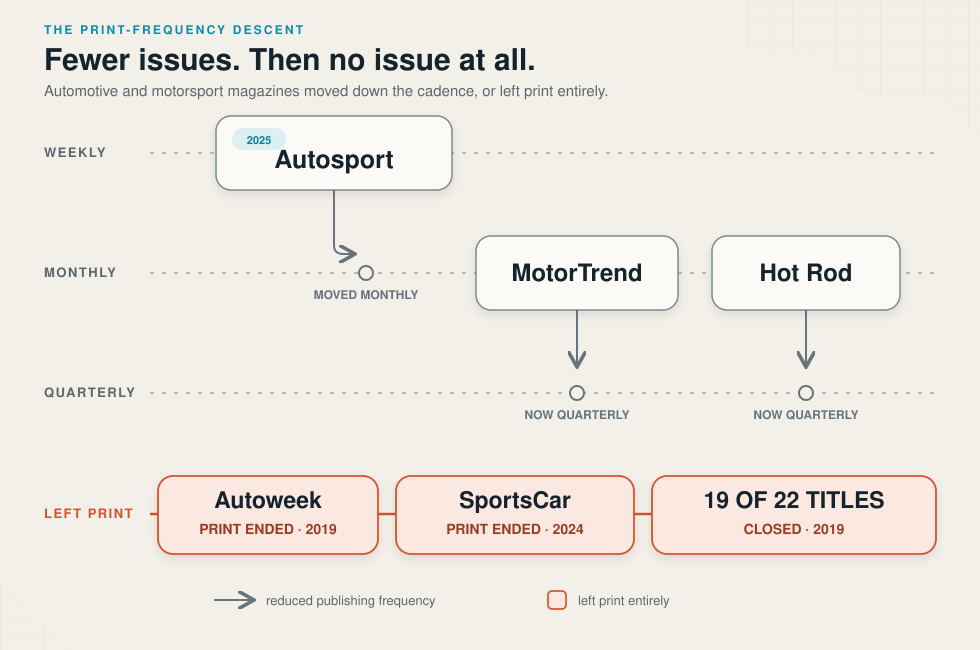
Plenty of good titles are still standing, but counting survivors hides the slope. A monthly and a quarterly each count as a single title, yet the quarterly puts out a fraction of the pages and keeps a fraction of the people employed to make them.
I've spent most of my working life inside this business. The wins were nice. The failures taught me more. A success will happily hide the assumptions a model is standing on; it's the failures that drag those assumptions into the light.What mine eventually made clear was that we were working hard to hold a bundle together long after the reasons for bundling it had started to fall away.
Let me be plain before I go any further. I believe in magazines. I believe in the spirit of RACER, in the people who report it, shoot it, and edit it, and in the readers who still want it in their hands. Everything that follows is in service of that. The only question I care about is how we keep work like this alive.
The sport learned to publish
Today the sanctioning body has its own cameras, archives, timing and scoring, data, credentials, an email list, social channels, and commercial partners happy to help pay for the production. The teams run their own studios. Every driver is walking around with a broadcast network in his pocket. A single creator can make a technical, faraway sport feel personal and immediate, often while a traditional outlet is still working on its headline.
The scale of all this isn't open to argument. Formula 1 puts its global fanbase at 827 million in 2025, with 43 percent of it under 35. At the 2025 Las Vegas Grand Prix, more than 1,200 creators turned out 5,000 posts and 1.8 billion impressions. IMSA closed January 2026 with 3.7 million social followers and 1.5 million YouTube subscribers, and nearly two-thirds of the international YouTube audience for that year's Rolex 24 was between 18 and 34.
Deloitte found that for 52 percent of fans, social platforms are now the main way they come across anything new. Among Gen Z, it's 73 percent. ⁽⁹⁾
That's not a press office firing off releases. It's a full media operation, and it has two things most niche publishers gave up years ago: control of the raw material, and a direct line to the audience.
The series can show you the race while the driver tells you what it felt like, and some creator turns the whole thing into a moment. By the time a magazine shows up with its recap, the facts have already been shared, argued about, and chopped into clips and memes.
You can't out-produce that. Trying to compete by making more of the same commodity coverage isn't a strategy, it's just a cost you can't cover.
The one thing still in short supply
So if the series, the people in them, and the creators can all out-scale the traditional publisher, what's left for journalism? The part that was always the hardest to do in the first place.
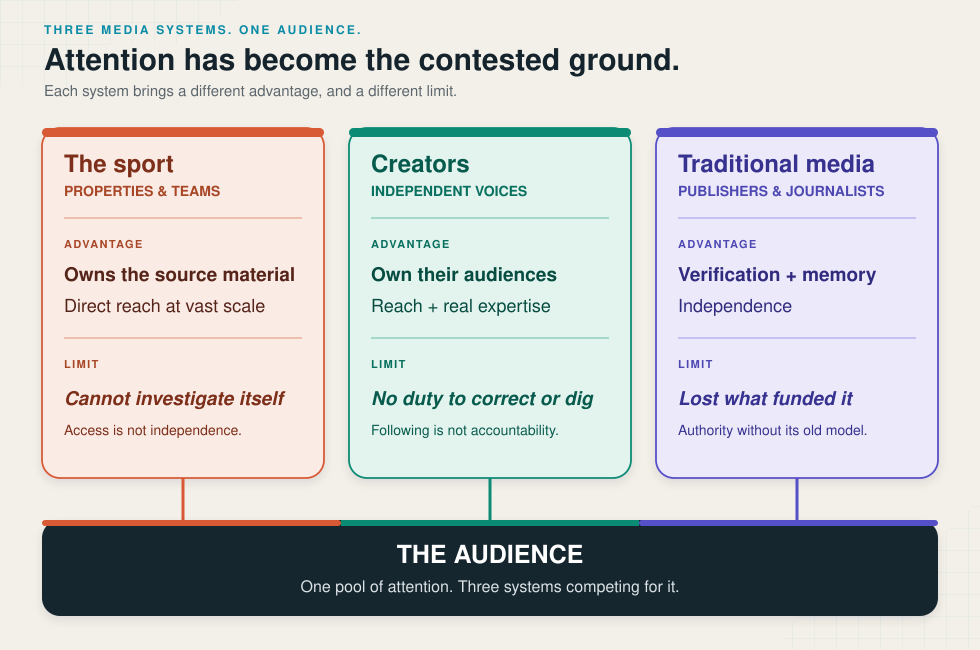
The people who own a sport can document it beautifully. What they can't do is investigate themselves — that's not what they're built for. A driver can be completely honest about what a race felt like from inside the car and still have no real view of the business going on around him. And a creator can be sharp and independent — many of the best now run real teams, with editors and standards of their own — yet a following, even a huge one, still doesn't come bundled with an obligation to correct the record, or a mandate to investigate the people who hand out the access.
The Reuters Institute's 2026 Digital News Report backs this up. It found that audiences see creators as more entertaining, easier to follow and more relatable than traditional news organizations — and, in the same breath, as less trustworthy and less impartial. Only 3 percent of people across 48 countries said they rely on creators alone for their news. A separate UNESCO survey found that 62 percent of digital content creators don't do any rigorous, systematic fact-checking before they share something.
None of that is a knock on creators. They saw a problem most of traditional media wouldn't look at, and they fixed it. They talk like human beings, they understand how the platforms work, and they build a real relationship with people instead of leaning on some assumed institutional authority. Journalism ought to be taking notes.
And in motorsport this is not a sideshow. The biggest creators in the sport now command audiences that outrun almost anything the traditional titles ever built. Scott Mansell's Driver61, run by a former professional driver, breaks down technique for well over a million subscribers. Emelia Hartford, a builder and racer, reaches a couple of million more. Plenty of them know the material cold. So the honest framing isn't amateurs against professionals — it's that reach, and sometimes real expertise, now sit with individuals rather than institutions.
But a following isn't verification, and access has never been the same thing as independence. Journalism earns its keep exactly when the official account, the personal account and the popular one are all already out there circulating. Its job is to ask the questions those versions skip: what's missing here, who comes out ahead, does the evidence hold up, and what will any of this mean once the feed has moved on to the next thing?
Good journalism also builds memory. Social media lives entirely in the present tense. A serious publication can tie what happened this weekend back to a decision someone made ten or forty years ago. That kind of memory isn't nostalgia — it's how a sport understands what its choices cost.
The magazine was never the whole product
The mistake is to treat the journalism and the container that once paid for it as one and the same.
Print still has real value when it gives you something worth slowing down for — an object worth keeping, or a way of belonging to something. A beautifully made magazine can survive as a premium product. What you can't assume anymore is that a printed schedule, a website and some ad inventory will somehow add back up to the economics of the old bundle.
The business used to sell scarce distribution. That's gone, so now it has to sell something people can't get anywhere else.
A few of the businesses still standing show what that looks like. Motor Sport pairs its monthly print edition with digital access, databases and a searchable archive going back to 1924. Sports Car Market runs its magazine alongside pricing intelligence and a database of more than 400,000 auction sales. Hagerty tucks its media inside a much bigger machine of insurance, membership, valuation, a marketplace and events. The Race is built around a handful of recognizable expert voices working across articles, podcasts, video and live events.
These are four very different businesses, and each draws its own line on editorial independence. But they're all making the same basic point. Media holds a durable place when it's attached to something real — authority, usefulness, a sense of belonging. Page views by themselves were never a business, and stacking up print subscribers was never a whole strategy on its own.
The next model
The next niche media company worth building won't be a magazine with a few digital add-ons bolted on. It'll be a network of trusted people who share a set of standards, own their relationship with the audience directly, and run on one shared commercial engine underneath.
Discovery happens out in the open — social video, podcasts, newsletters, other creators. But the relationship that lasts has to be owned directly, through membership and subscription, through email and events and the community that grows up around them. And what people pay for has to be hard to copy on the cheap: real reporting, analysis from someone who knows the subject, data you can use, archives with depth, buying intelligence, the pull to convene the people who matter, and access that's been earned rather than just credentialed.
The money behind it has to be just as deliberate, and spread across several sources rather than resting on one. Advertising can stay in the mix, but it can't be the thing the newsroom is standing on. Print can stay too — as a product someone chooses, with its own reason to exist, rather than as the operating system the whole company runs on.
It also needs rules people can see. Sponsorship gets labeled, conflicts get disclosed, mistakes get corrected out in the open. And the editorial side has to be free to produce work that makes an advertiser or a powerful insider uncomfortable. Without that freedom you can still end up with something useful and entertaining and good for business, but it's communications, not journalism, and it's worth being honest about the difference.
There's nothing wrong with communications, as long as it's honest about being communications. The trouble only starts when everybody pretends every kind of content is the same kind of thing.
The first RACER TV spot, 1993. We knew even then the market was moving, and that sound and moving image would matter — which is why we tied ourselves to ESPN early. The magazine was never about the race report. It was about the personalities, the culture, and the stories nobody else was telling. By 1997 we'd launched RACER.com, which drew the interest of the SpeedVision television network and the deep alignment that followed.
So, who pays?
The economics will look different from one case to the next. Readers might pay for depth, for usefulness, for the feeling of belonging to something. Commercial partners pay to reach a defined, high-trust audience, with no say over the conclusions. Events and services can bring in money around the knowledge without putting the integrity of the work up for sale. And a shared structure lets a group of exceptional people split the cost of the technology, the production, the selling and the back-office work, instead of standing up a whole separate publishing company around every little niche.
In that model the company isn't the star, and it shouldn't try to be. Its job is quieter than that: give credible people enough support to do hard work, help them build a direct relationship with an audience, and guard the standards that make that relationship worth anything at all.
That's where the real opportunity sits. The point isn't nostalgia for how the industry used to be organized. It's to recover the things the best magazines used to make possible — the time to look closely, the room to ask a question nobody wants asked, an editor who won't let something go out wrong, and a record that's still there years later — and then find a way to pay for those things in the world as it is.
So read none of this as an obituary. I believe in the spirit of RACER, in the people who make it, and in the readers who still want it. What I want is a way to keep work like that alive and paid for. That has been the whole point.
The world moved on from the old distribution model. It did not move on from journalism. The work in front of us now is to build a business that can pay for the difference.
Sources Appendix
Scope and method
No audited source maintains a complete global census of English-language automotive and motorsport enthusiast magazines. Definitions also blur the result: a staffed monthly publication, a quarterly premium book, a club magazine, a special issue and a digital brand may all be counted as a “title.” The market evidence in this essay therefore uses documented closures, print cancellations, title mergers and frequency reductions to establish direction and publishing capacity. Current audience figures are taken from the organizations or research institutions identified below.
Market contraction and publication frequency
“MotorTrend publisher TEN Publishing discontinuing 19 automotive magazines,” December 9, 2019. Documents the closure of 19 of 22 automotive print titles and lists the affected publications. LINK
“Crain Communications announces license agreement with Hearst Magazines,” October 14, 2019. Confirms the transition of Autoweek to a digital and experiential brand; contemporary reporting confirmed the print edition ended. LINK
MotorTrend subscriber FAQ. States that MotorTrend publishes four times a year. LINK
Hot Rod subscriber FAQ. States that Hot Rod publishes four times a year. LINK
Autosport, “Magazine: Hamilton at Ferrari leads first monthly issue,” January 23, 2025. Confirms the new monthly format and merger with GP Racing. LINK
Sports Car Club of America, “SCCA Relaunches Iconic SportsCar Brand as Digital Newsletter,” August 26, 2024. States that SportsCar ended its print run at the beginning of 2024 after eighty years. LINK
Audience, distribution and creators
Formula 1, “Formula 1 2025 Season Review,” December 19, 2025. Reports an 827 million global fanbase, 43 percent under age 35, and the Las Vegas creator program’s 1,200 creators, 5,000 posts and 1.8 billion impressions. LINK
IMSA, “The Numbers Are In: 64th Rolex 24 At Daytona Was Record-Setting in Multiple Ways,” February 6, 2026. Reports 3.7 million social followers, 1.5 million YouTube subscribers and a YouTube audience that was 63 percent age 18 to 34. LINK
Deloitte, “2026 Digital Media Trends,” March 25, 2026. Reports that social platforms are the primary discovery channel for 52 percent of fans and 73 percent of Gen Z fans. LINK
Trust, verification and the role of journalism
Reuters Institute for the Study of Journalism, “Overview and key findings of the 2026 Digital News Report,” June 16, 2026. Reports the perceived strengths and weaknesses of creators relative to traditional news outlets. LINK
Reuters Institute for the Study of Journalism, “Digital News Report 2026, Episode 2: The true global impact of news creators,” June 23, 2026. Notes that about 3 percent of respondents across 48 countries rely only on creators for news. LINK
UNESCO, “Two-thirds of digital content creators do not check their facts before sharing,” November 27, 2024. Reports that 62 percent of surveyed creators did not carry out rigorous and systematic fact-checking before sharing information LINK
Models referenced
Motor Sport, subscription and archive information. Describes monthly print, digital access, databases and an archive dating to 1924. LINK
Sports Car Market, subscription information. Describes print and digital subscriptions, pricing guides and an auction database with more than 400,000 sales. LINK
Hagerty, investor overview. Describes its insurance and membership model and automotive enthusiast platform. LINK
The Race, current editorial, podcast, video and events platform. LINK
Prior work by Paul Pfanner on media evolution
“The Ghost in the Machine,” March 4, 2026. LINK
“Distribuption,” April 7, 2026. LINK
“The Medium Was Never the Message,” April 8, 2026. LINK
“The Company You Keep,” April 10, 2026. LINK
“The Audience Has Already Voted,” April 14, 2026. LINK
“Now Is Impatient,” April 16, 2026. LINK
“You Are Here to Witness Truth,” May 25, 2026. LINK
“Truth or Power?” June 4, 2026. LINK
“Real Just Got Expensive,” June 21, 2026. LINK
“Who Owns the Audience Now,” June 26, 2026.LINK
“Are Creators Formula One’s Most Effective Media?” July 17, 2026. LINK
Biographical context
“RACER turns 32: Endurance, commitment and the power of you,” April 15, 2024. Documents the April 11, 1992 launch and Paul Pfanner’s role in the founding vision. LINK
“Statement on the conclusion of 40 years of publishing SportsCar magazine for the SCCA,” September 13, 2023. Documents the forty-year publishing relationship. LINK
Pfanner Advantage works with clients to turn change into advantage at the intersection of mobility, motorsport, media, technology, and marketing. Learn more or start a conversation: contact us today.
Paul Pfanner’s recent Shift Happens Insights:
Jeff Krosnoff Has Been Gone Almost As Long As He Lived
The Advantage Journal arrives every week. What matters in sport, mobility, media, and technology — curated and contextualized by Bill Sparks, Bill Long, and Paul Pfanner. No hedging. No filler. Subscribe — It’s Free

