
The Caretaker
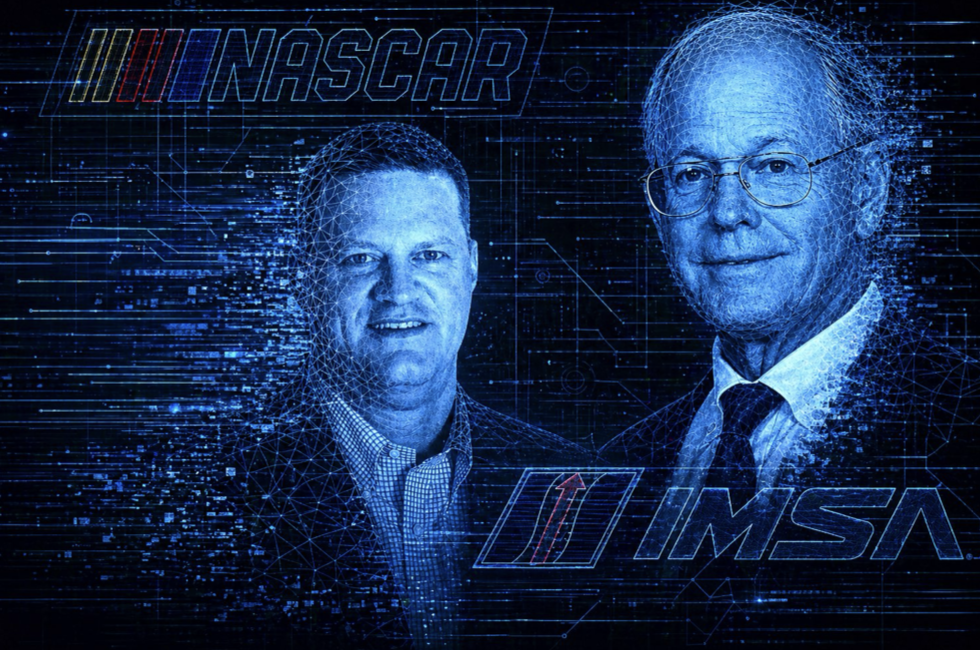
The handoff. Jim France and Steve O'Donnell — the day a family business became an institution.
Jim France stepped down as NASCAR's CEO on April 24, 2026 at Talladega Superspeedway — the first leadership transition outside the France family in the organization's 78-year history. Paul Pfanner has been watching this sport a long time. This is what he sees.
The Fifth Name
On Friday afternoon at Talladega Superspeedway, Steve O'Donnell was introduced as the Chief Executive Officer of NASCAR. He is the fifth person to hold that title in the 78-year history of the organization Bill France Sr. founded in a Daytona Beach hotel room in 1948.
The first four were named France.
That is not a footnote. What happened at Talladega wasn't simply a leadership transition. It was the moment a family business became an institution. And the man most responsible for that transformation is the one walking quietly out the door.
The Man Nobody Was Watching
Jim France never wanted to be CEO. That is not an assumption. It is written in everything he did for fifty years before the title was forced on him. While his brother Bill Jr. built NASCAR into the sport Tom Brokaw called the greatest in America, Jim built the tracks that housed it. When the dynasty faced its most public crisis, Jim was the one who stepped forward — overseeing ISC, serving as NASCAR's vice chairman, and carrying sixty years of institutional knowledge into a role he never sought and couldn't refuse.
He was 73 years old when his nephew's arrest made him the only France available to step forward. He did it without drama and without apparent ambition. He just showed up.
Our team worked with Jim and Lesa France during the ISC years, developing a global brand study and the brand architecture for the Daytona 500 through the mid-2000s. When NASCAR announced the merger of Grand-Am and the American Le Mans Series in 2012 and needed to think carefully about what the new IMSA would be and what it could become, we were part of that conversation too — grounded in our prior work in IMSA and the American Le Mans Series. I knew Bill Jr. through Pfanner Communications' years as the creative agency for Penske Motorsports. So when I say Jim France operated without ego, I am not offering flattery. I am offering testimony. The man in the room was always prepared, always direct, and never once made you feel the conversation was about him.
That is rarer in this industry than it should be.
Unprecedented Storms
The eight years that followed were not ceremonial. They were among the most turbulent in the sport's history — and Jim France met every one of them without losing his footing or his composure.
He guided NASCAR through a global pandemic without canceling a season, racing in empty stadiums when the rest of professional sports went dark. He presided over a racial reckoning that put the sport on the front page for reasons that had nothing to do with racing, and he responded with a clarity of institutional purpose that the moment demanded.
Then came the charter war. The first antitrust lawsuit in NASCAR's 78-year history — brought by Michael Jordan's 23XI Racing and Front Row Motorsports — put the sanctioning body's foundational operating philosophy on trial. The France family had run NASCAR as a private authority since 1948, and that authority had never been seriously challenged in a federal courtroom.
Jim France was deposed. He testified. There were moments on the stand that were uncomfortable — an 81-year-old man, under oath, in territory no France had ever navigated before. He did not hide from it. He showed up for that too.
The settlement that came in December was historic in ways the sport has not fully reckoned with yet. The teams got the permanent charters they had sought. But more significantly, NASCAR did something it had never done in its history — it agreed to share financial power with its teams. The sanctioning model the France family had maintained since 1948 was formally modified under Jim France's watch. Whether by necessity or wisdom or both, he presided over the moment the sport became something more like a partnership.
The settlement also cost NASCAR one of its most capable executives. Steve Phelps had been the right person to carry the sport's commercial momentum forward. What discovery revealed made that impossible. It was a quiet loss inside a consequential moment.
The announcement at Talladega came four months after the settlement closed. The timing was not accidental.
What O'Donnell Inherits
Steve O'Donnell steps into a role carrying real assets and real challenges in equal measure. The track portfolio — thirteen active facilities, eighteen Cup Series events — is vertically integrated in a way no other major motorsport sanctioning body can match. The fan loyalty NASCAR has always carried — the measurable, sponsor-supporting, product-buying loyalty that makes NASCAR fans unlike any other sports audience in America — is the sport's most durable asset. O'Donnell's job is to make sure it stays that way.
But O'Donnell also inherits a fragmentation problem NASCAR created for itself. A fan wanting to watch every Cup Series race in 2026 needs accounts with Fox, Amazon Prime Video, TNT Sports, and NBC. That is not a fan experience. That is an obstacle course. Full-season viewership in 2025 fell nearly 15% — the steepest single-year decline since 2018. The answer is already visible inside NASCAR's own portfolio: the O'Reilly Series, carried entirely on The CW in 2025, saw viewership jump 22%. One platform. Easy access. Twenty-two percent growth. The lesson is already in the numbers.
Then there is the EV question, and it deserves honest scrutiny. NASCAR's R&D unit has built a crossover utility vehicle prototype — developed with Ford, Chevrolet, and Toyota — and executives have signaled it could one day race in the O'Reilly Series. The stated rationale is brand differentiation and OEM relevance. Those are two different arguments, and only one of them is about the fan.
Dale Earnhardt Jr., who fields cars in that very series, was unambiguous: he would not be interested in competing if NASCAR made the switch. The fan reaction was louder still. Meanwhile the OEM rationale is weakening globally — Ford has stepped back from Formula E, and manufacturer EV commitments have softened significantly in the last 18 months. Building a NASCAR EV series to please manufacturers who are themselves retreating from electrification is building on sand.
O'Donnell called NASCAR a "badass American sport" in his first public remarks as CEO. The sound of that sport is not silent. The fans who fill Talladega, Bristol, and Darlington every season already know that. The question is whether NASCAR's technology strategy will honor what they came for — or chase an audience that was never coming anyway.
The Grace Note
There is one part of the NASCAR portfolio that answers its hardest questions. It carries Jim France's fingerprints more than anything else in the organization. And it was his long before the CEO title was.
I first walked an IMSA paddock in 1974 at Road Atlanta, when Peg Bishop still knew every entrant by name. Fifty-two years later, IMSA is a quietly compelling growth story in American motorsport. The Rolex 24 at Daytona drew more than 180,000 fans over four days this January — a record. The Twelve Hours of Sebring set an all-time attendance record in March. Global viewership for Sebring alone exceeded one million. Its manufacturers — Porsche, BMW, Ferrari, Lamborghini, Cadillac — are premium global brands that bring international audiences NASCAR proper cannot reach from Talladega.
IMSA already runs hybrid powertrain technology in its GTP class — not as a political statement, but because prototype racing follows the engineering. It solved the technology transition without a fan revolt. Its alignment with the ACO and the 24 Hours of Le Mans gives it a global credential no other American motorsport property possesses.
Jim France saw all of this when he founded Grand-Am in 1999 and drove the merger that created the new IMSA in 2014. He then did something that revealed exactly how seriously he took it: he hand-picked its leadership. Scott Atherton built the modern IMSA. When Atherton retired, his chosen successor — and Jim's — was John Doonan, who runs the organization today with the same instinct the Bishops brought to it in 1969: the door open, the standards high, and the racing first.
Jim isn't disappearing. He still owns Action Express Racing. He still shows up. The caretaker didn't leave the garage. He just handed someone else the keys to the office.
The Relay Baton
Bill France Jr. once said that your most important job is to identify your replacement. Les Richter carried that forward. Jim Michaelian built a career around it. Jim France answered it under the hardest possible conditions.
Jim France didn't get to choose his moment at the top of NASCAR. The moment chose him — in August 2018, under circumstances no one would have designed. But what he did with the eight years that followed speaks for itself. He met the pandemic, the reckoning, the lawsuit, and the negotiating table — and he left the institution stronger than he found it.
He built the conditions for a professional succession — positioning Ben Kennedy, now COO at 34 and the fifth-generation France in the building, to carry the dynasty forward without the dynasty having to run the sport.
That is not retreat. That is architecture.
Steve O'Donnell gets the title. The France family keeps the equity. Ben Kennedy is being grown into the responsibility. The sport moves forward — structurally clearer, the succession resolved, and the next chapter open.
Jim France walked into the CEO role because no one else could. He walked out because the institution no longer needed a France to run it — only to be strong enough to survive without one.
That is what a caretaker does.
And it is not a small thing.
Pfanner Advantage works with clients to turn change into advantage at the intersection of mobility, motorsport, media, technology, and marketing. Learn more or start a conversation: contact us today.
The Advantage Journal arrives every week. What matters in sport, mobility, media, and technology — curated and contextualized by Bill Sparks, Bill Long, and Paul Pfanner. No hedging. No filler. Subscribe — It’s Free

