
The Last Drivers
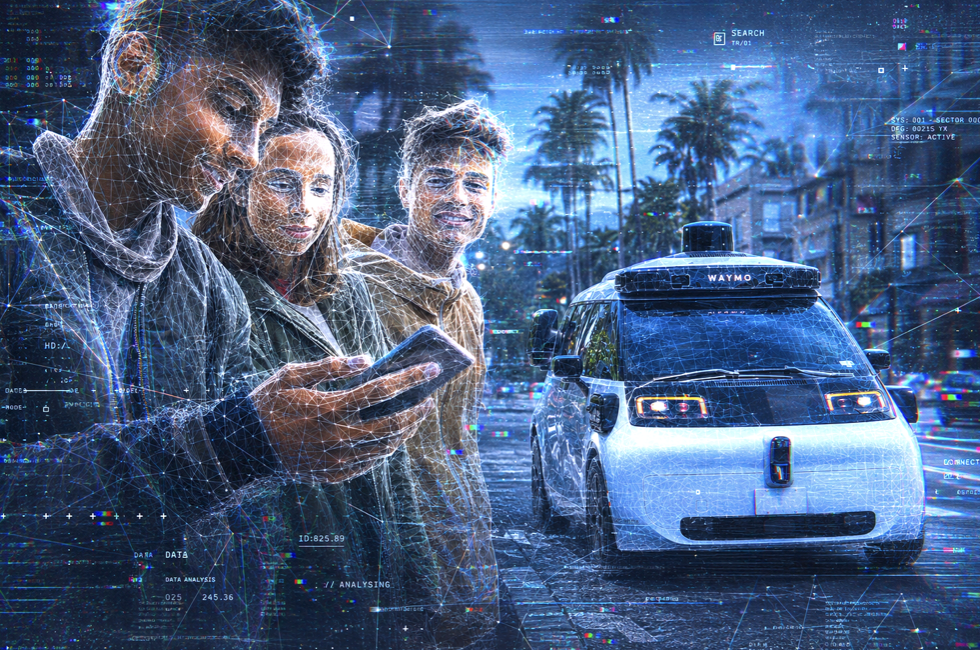
At home with being moved. A Gen Z trio waits on a driverless taxi rather than a car of their own.
The F1 grandstands have never been fuller — and many of the young fans packing them may never bother to learn to drive. With the Strait of Hormuz choking off the world's oil, driverless taxis turning up on ordinary city streets, and new cars slipping out of reach, what it means to move is being quietly redrawn. After fifty years watching shifts like this one, Paul Pfanner thinks racing might be the one place that still remembers why we ever wanted to move at all.
I have a habit, not entirely by choice, of starting things into the winds of chaos and change. I had a hand in the first issue of FORMULA magazine that was distributed in October 1973, just as the Yom Kippur War began in the Middle East. The resulting autumn oil embargo hit and America learned that the line at the gas station could run longer than the line for anything else worth having. I started this my company in 1979, the year revolution in Iran sent the second oil shock rolling through the West and the gas lines returned. RACER came together in 1991 and 1992, just after Operation Desert Storm. We launched our OnCars video channel and studio in 2008, just as the Great Recession took hold, and within months, the Carpocalypse. Then came the global pandemic, only months after we'd acquired another media company. Fifty years of seeing the fallout from that teaches you one useful skill: telling the difference between a gauge that's twitching and a gauge that's failing.
The one I'm watching now is failing, and it isn't the price of oil — though the Strait of Hormuz has spent the spring choking off a fifth of the world's supply. It's something underneath. We are quietly deciding that most people will not drive. Three numbers point the same direction.
Through the Windshield in Los Angeles
There is one development that will decide which way this tips, that turns a slow generational drift into a structural turn, and I didn't read about it. I saw it through a windshield last month, helping my daughter move across Los Angeles. They were everywhere — Waymo's white driverless taxis, some gliding along with no one at all in the front seat, a few still carrying a quiet human observer, threading the city as ordinarily as the buses. A year ago they were a curiosity you pointed at. Now they are simply traffic.
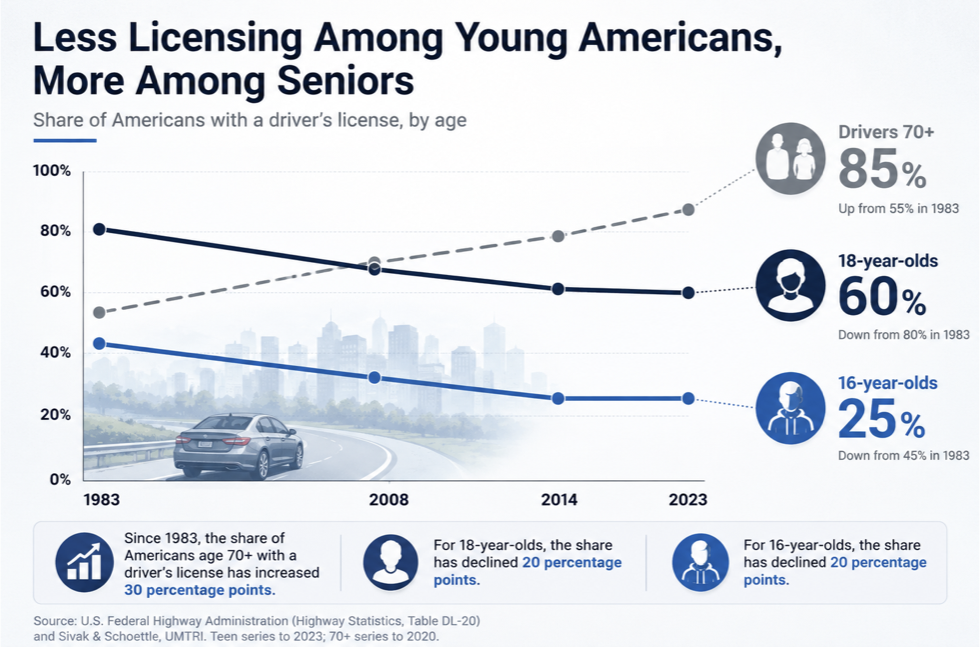
Share of Americans with a driver's license, by age, 1983–2023. Teen licensing has roughly halved — 18-year-olds from about 80% to 60%, 16-year-olds from 46% to 25% — and has held flat near those lows for a decade, even as drivers over 70 climbed to record highs. The act of driving isn't disappearing; it's being handed down rather than taken up. Source: Federal Highway Administration (Table DL-20); Sivak & Schoettle, UMTRI.
The Behavior Already Moved
In the early 1980s, eight in ten American eighteen-year-olds held a driver's license; today it's six in ten, and among sixteen-year-olds the figure has fallen from about half to a quarter and stayed there — even as licensing among older drivers climbed to record highs. Those are Federal Highway Administration counts, and the chart tells it at a glance. The young aren't failing to get licensed. They're declining to. Meanwhile, in roughly two years, Waymo's driverless taxis went from a curiosity to half a million paid rides a week — a tenfold jump. The shift isn't coming. It's here.
The Price Makes It Permanent
Goldman Sachs Research puts the cost of a robotaxi mile at about three dollars today, falling below a dollar by 2030 and toward fifty cents by 2040. Owning and driving your own car runs a little over a dollar a mile. Read those two lines until they cross — somewhere around 2030 — and you have the moment summoning a car becomes cheaper than keeping one in the driveway. Behavior follows price. It always has.
The Map Is Being Drawn
Robotaxis run in a handful of cities today; the same operators are laying plans for dozens more, London and Tokyo among them, with credible forecasts of tens of millions of autonomous vehicles on the road by 2030. China, which means to win this outright, expects the large majority of its new cars to drive themselves by the end of the decade. The roadbed of a driverless world is being poured now, while the rest of us argue about whether it's coming.
When Driving Ends
So when does driving end? Not on a single date, and not for everyone — the honest answer is a range, and the people who study this for a living don't agree on its width. The bulls at Goldman see autonomous-capable cars making up the majority of new sales in the United States, Europe, and China by 2040. The cautious — the World Economic Forum's own roadmap — argue that assisted, not autonomous, vehicles will dominate showrooms through 2035 and beyond, with true robotaxis penned in a few cities for another decade. The most conservative voice in the field, transportation economist Todd Litman, doesn't expect half the cars on the road to drive themselves until around 2060.
Hold those bookends together and the picture is clear enough to act on. The economics tip near 2030. The new-car fleet turns over through the 2040s. And somewhere past that, for most of humanity, driving stops being something you do and becomes something you summon. A teenager who skips the license today will spend their entire adult life watching that happen — which is exactly why they're skipping it. They can already feel which way the gauge is pointing.
What Racing Is For
Here is where it stops being an economics story and becomes the only story I have ever really told. If the world is deciding that driving is a chore to be automated, the question for my industry isn't whether it survives the turn. It's what the sport is for on the far side of it.
I think I know. Walk into a Formula One Grand Prix and the grandstands have never been younger or fuller — packed with young people who may never hold a license and don't care to. They aren't there for transportation. They're there for the thing transportation was always secretly about: speed as joy, the machine as an extension of the self, a human being pressed to the edge of what's possible and choosing to go faster anyway.
That is what racing becomes — the last place that remembers why anyone wanted to drive in the first place, the cathedral of a relationship the rest of the world is automating into the background. The last drivers won't be on the road. They'll be on the grid — and in the stands, cheering for something they've decided to keep doing by hand.
The strait will reopen and the oil will flow. The robots will get better. Movement isn't ending; it's about to widen to people who never had it. What's ending is the driving — the having to, and for most, the getting to. This kind of shift has come before, and it will come again. After fifty years of it, I've learned to keep my eyes up — on the road ahead, where the next corner is, and let everyone else watch their mirror.
Pfanner Advantage works with clients to turn change into advantage at the intersection of mobility, motorsport, media, technology, and marketing. Learn more or start a conversation: contact us today.
Paul Pfanner’s recent Shift Happens Insights:
Sunday Made the Case - the 110th Indy 500
The Split at 30 - On the eve of the Indy 500
The Advantage Journal arrives every week. What matters in sport, mobility, media, and technology — curated and contextualized by Bill Sparks, Bill Long, and Paul Pfanner. No hedging. No filler. Subscribe — It’s Free

