
The Mountain Doesn’t Care
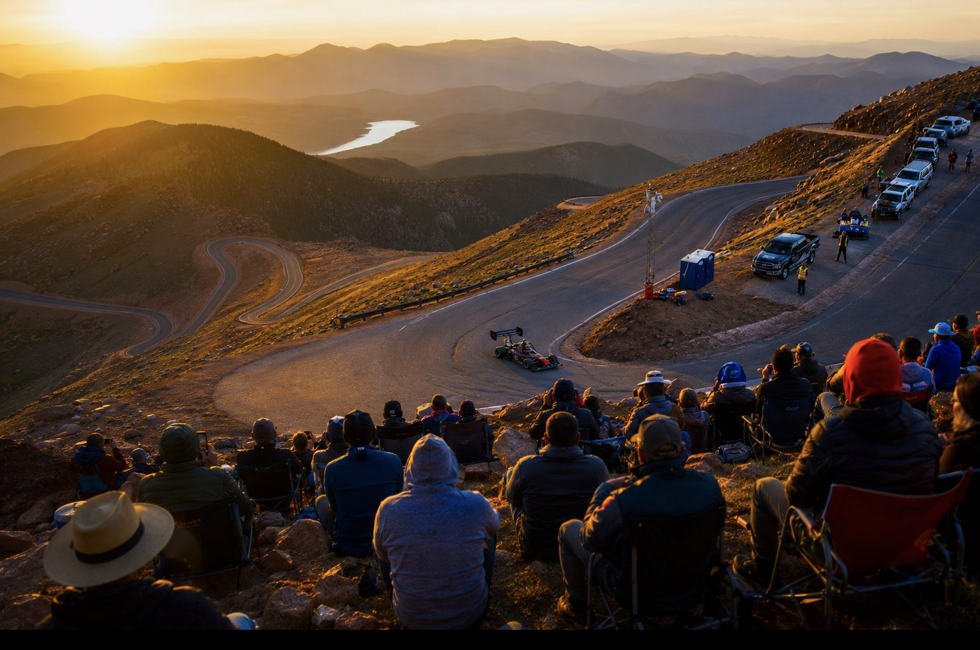
A race car runs up the mountain as spectators look on from above. On Pikes Peak, getting there is part of what everyone has in common.
Paul Pfanner on Pikes Peak, a mountain that's been settling arguments since 1916, and the competitors who test themselves against it.
I've been paying closer attention than usual to what's happening in Colorado the last couple of weeks, and part of that is personal. My friend and RACER co-founder Jeff Zwart is back at the Broadmoor Pikes Peak International Hillclimb presented by Gran Turismo, and was quick in testing, which is the way he usually rolls in his Porsche GT2 R Clubsport after decades of running that mountain. My pal J.R. Hildebrand is in the entry in a Corvette ZR X1 , as is Emelia Hartford, also in a Corvette. I met her in 2024 and admired her boundless ambition. Around them is an entry list full of competitors whose names carry real weight inside the Pikes Peak and hill climb community — people who've spent the better part of a year, sometimes longer, building the machine they're about to point at the summit.
I first came to Pikes Peak in the mid-1990s, when the course was still mostly gravel. Rod Millen's fire-breathing Toyota Celica Super Sport Turbo, and later, a Toyota Tacoma, were what everyone wanted to see. Millen and those Toyotas won the thing five times. Watching that happen on dirt and gravel with no guardrails is not something you forget.
I do this every June. Check the entry list, read the testing reports, try to guess which stories are about to happen on that road. On-mountain testing wrapped up last week. Practice and Qualifying run from June 16 through 19, with Race Day on Sunday, June 21.
Above the Treeline
The course itself does most of the explaining. It climbs from roughly 9,390 feet to 14,115 feet at the summit — nearly a mile straight up, in 12.42 miles. The lower section runs through trees and switchbacks that have names if you've been paying attention for a while: the Ws, a stack of hairpins that punish anyone who gets greedy on the way in. Higher up, the road breaks out above the treeline near Glen Cove, and the world changes — thinner air, no guardrail. Bottomless Pit and Devil's Playground aren't just colorful names. They're sections where a mistake doesn't end in a gravel trap. It ends somewhere else more consequential.
The course used to be part gravel, part pavement, and drivers who ran it both ways will tell you the gravel sections separated the field in ways pavement never could. It's been fully paved since 2012 — faster, and in some ways less forgiving, because there's less room for error when the car can carry more speed into a corner with nothing beyond it but the mountain and sky. None of that changes with who's behind the wheel. Every year, for somebody, the edge isn't figurative.
What Michèle Mouton Understood
I had dinner with Michèle Mouton once, years ago, at the FIA Sport Conference in Mexico City. What stayed with me wasn't anything about times or results. It was how she talked about the mountain itself — like it was something she still had a relationship with, decades after she'd raced there. She wasn't talking about a run. She was talking about what the mountain had asked of her, and what it still meant to her.
That's the thing Pikes Peak has always understood about motorsport, going back to the Unsers, to Millen, and to everyone else who came to Colorado looking for an answer to a question nobody had asked them. Challenge is the original attractor in this sport — before sponsorship and media rights ever entered the picture, someone looked at a mountain and wanted to know if they could get up it faster than the person before them. Pikes Peak is one of the only places left where that's still the entire premise.
Eight Years Unbeaten
In The Patience Tax, a column I wrote in this space, I made the case that Formula E should bring its new Gen4 car to Pikes Peak. Gen4 isn't a concept or a technology demonstrator. It's already run — Paul Ricard, Monaco — and it's already impressed people who don't hand out praise lightly. When the 2026-27 season opens at the end of this year, it becomes the competition platform for the ABB Formula E FIA World Championship: permanent all-wheel drive, well over 300 kilometers per hour, the fastest car the series has ever built. Proving itself there is its own achievement, against the best competition the series has to offer.
Pikes Peak measures something else. A FIA world championship is decided over a season, by points, against a field of identical chassis. Pikes Peak has been deciding other things, one run at a time since 1916 — and it doesn't care what a car has already proven anywhere else.
The outright record at Pikes Peak — the fastest any car has ever climbed that mountain — belongs to an electric car. Romain Dumas drove a Volkswagen I.D. R to the top in 7 minutes, 57 seconds back in 2018. That record has now stood for eight years. Every internal combustion car, every hybrid, everything anyone has thrown at that mountain since, has come up short of an EV. If Gen4 is everything it's already shown itself to be, this is the place that would prove it — and the number it would have to beat has been sitting there, unchallenged, since 2018. Dumas — the man who set it — is back again this year, in a Ford Super Mustang Mach-E, another electric car, on the same mountain that's never let anyone get back under that time.
The Entry
Jeff Zwart is a racer, filmmaker and photographer who's been part of this mountain's story for most of his life. J.R. Hildebrand is an IndyCar driver with a genuine appetite for the kind of engineering puzzle and a racer’s ultimate challenge Pikes Peak presents. Emelia Hartford builds cars, makes content, and races them herself, bringing a different audience to this kind of motorsport just by being good at all three. Robin Shute, a four-time King of the Mountain, returns this year in a brand-new prototype — the Sendycar V1 — making its first runs up the mountain.
Onboard with Robin Shute his new Sendycar V1. Not boring.
Then there's the rest of the entry — 75 competitors from 11 countries this year, across six divisions, from production-based cars to purpose-built Unlimited machines. Inside this sport, those names mean something, even if the wider world hasn't caught up.
2025 was also the first time in the event's history that the full race aired live, start to finish, on RACER Network — eight hours of coverage.
What Hasn’t Changed
I won't be on the mountain this year, but between RACER Network's coverage and the live timing on PPIHC.org, I'll be watching for Jeff, for J.R., for Emelia, and for the rest of an entry that hill climb fans know well — even if the wider sporting world hasn't caught up yet. For some of them, this will be the run they've been building toward all year. For others, it won't go the way they hoped. Either way, the mountain doesn't care. It didn't care in 1916, and it doesn't care now. The road has changed over one hundred and ten years — pavement, route, timing — but the climb to 14,115 feet still comes down to the same thing it always has: beat the clock, beat the competition, or beat neither.
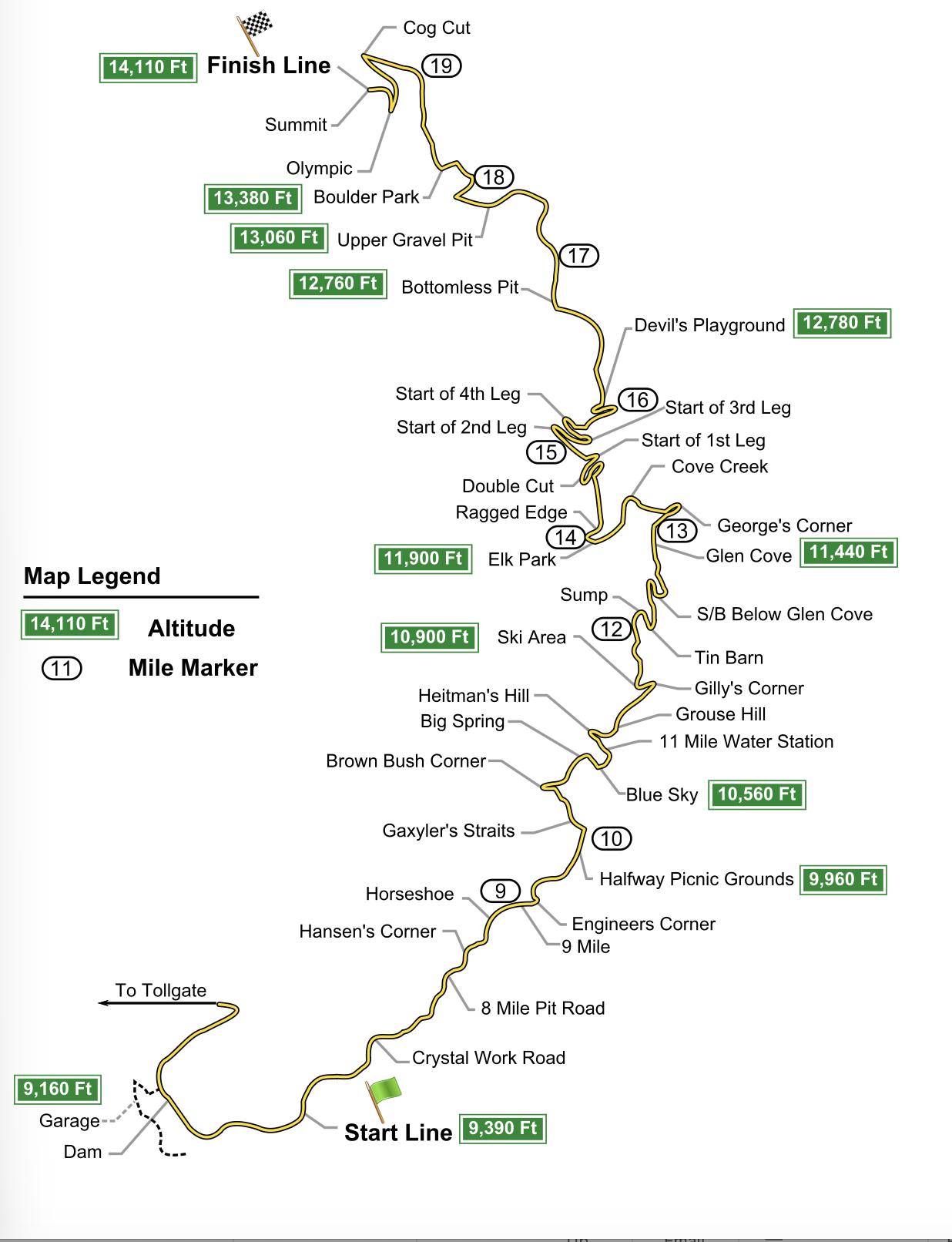
The 12.42-mile course from Cascade to the summit — 156 turns, climbing from roughly 9,390 feet to 14,115 feet.
Pfanner Advantage works with clients to turn change into advantage at the intersection of mobility, motorsport, media, technology, and marketing. Learn more or start a conversation: contact us today.
Paul Pfanner’s recent Shift Happens Insights:
Sunday Made the Case - the 110th Indy 500
The Advantage Journal arrives every week. What matters in sport, mobility, media, and technology — curated and contextualized by Bill Sparks, Bill Long, and Paul Pfanner. No hedging. No filler. Subscribe — It’s Free

