
Distribuption
The signal was always there. The question was whether anyone was watching — or whether the watching was the signal.
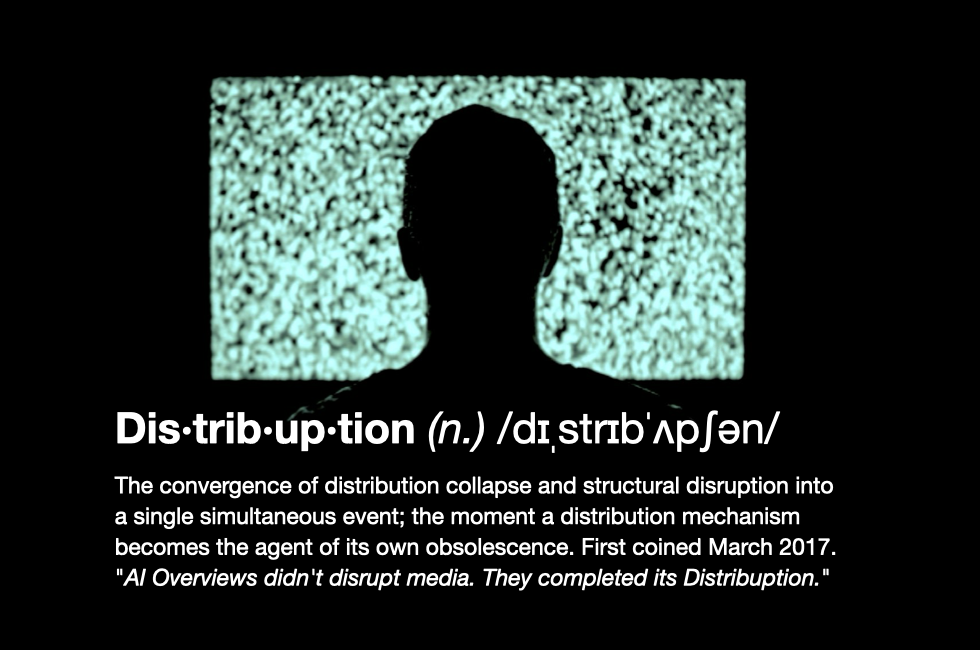
The word came first. The data followed. Nine years after our founder Paul Pfanner coined Distribuption to describe what was coming for media, it has arrived — and the organizations that still don't have a name for it are already losing something they can't identify.
Marshall McLuhan predicted the internet thirty years before it existed. He died in 1980. The industry he was describing still hasn't absorbed what he was saying.
Here is what he was saying: the mechanism was never the business. Distribution was never the mission. The printing press, the transmitter, the cable franchise, the server farm, the algorithm — these were the cost of delivering the actual product.
The actual product was always trust.
Every wave of media disruption for the last thirty years has exposed this truth and been ignored. Cable. Web. Video. Social. Each time, the organizations that chased the mechanism lost. Each time, the organizations that protected the trust relationship survived. Each time, the audience knew what was happening before the publishers did. The audience always does.
Now comes Distribuption — the moment distribution and disruption became the same event. AI is not changing how audiences access content. It is changing whether they need to access it at all. Google's AI Overviews are intercepting the transaction between publisher and reader before it happens. The click — twenty-five years of digital media economics — is being eliminated for anything that can be summarized.
This is not a performance problem. It is an architectural one.
The organizations that survive will not be the ones that beat AI summarization. They will be the ones that create content AI cannot summarize — because it requires presence, relationship, forty years of earned access, and a voice that has proven it will tell the truth when it costs something to do so.
You cannot summarize bearing witness.
Video is not the answer. Video is the arena. Streaming destroyed the scarcity of the broadcast channel without replacing its authority. A single individual with a camera, genuine expertise, and a direct audience relationship is now more economically viable than a mid-sized publisher with legacy infrastructure and a generalist mandate. This is not disruption. It is permanent restructuring.
The journalist's irreplaceable function is being the person in the room whose presence changes what happens in the room. The photographer's irreplaceable function is proving the moment happened. In a world saturated with synthetic imagery, authentication is the new scarcity.
The Now-ist organizations already know this. They are building for the audience that remains after AI has taken everything it can take — and discovering that audience is smaller, more engaged, more loyal, and more valuable than anything platform dependency ever delivered.
Here is what Distribuption has made unavoidable: the audience is now the infrastructure. Their attention, behavior, and choices are the mechanism by which everything gets distributed or disappears. McLuhan told us the medium is the message. What he couldn't have known is that the audience would eventually become the infrastructure.
The audience owns you.
And your future.
What business are you actually in?
Pfanner Advantage works with clients to turn change into advantage at the intersection of mobility, motorsport, media, technology, and marketing. Learn more or start a conversation: contact us today.
The Advantage Journal arrives every week. What matters in sport, mobility, media, and technology — curated and contextualized by Bill Sparks, Bill Long, and Paul Pfanner. No hedging. No filler. Subscribe — It’s Free

