
The New Sovereignty: Mastering Algorithmic Meta-Capital

You must be visible to the digital gaze.
Bill Sparks latest Cold Read introduces Algorithmic Meta-Capital — the strategic asset class that determines whether your organization exists in the AI decision-making loop or has already been written out of it.
The Death of Market Share
For nearly a century, the primary metric of corporate health was Market Share. It was a game of physical and psychological territory. In the late 2010s, this evolved into Share of Mind, as brands fought for real estate within the increasingly fragmented attention economy.
However, as we approach the midpoint of 2026, both metrics have become lagging indicators. The new frontier of competition is Share of Model.
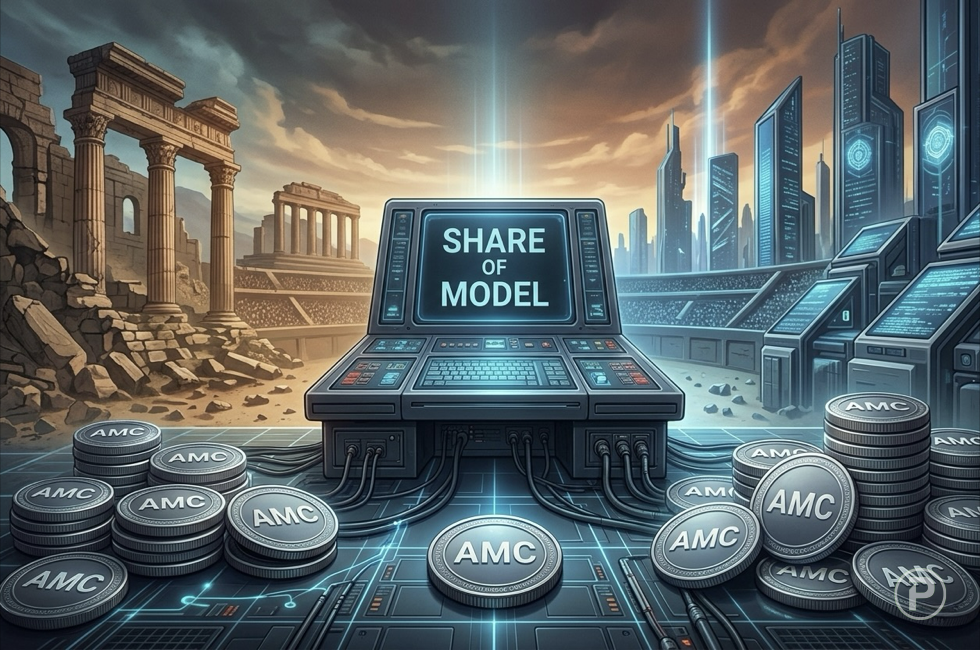
Market share old, Share of Model new.
Today, there’s a growing trend that the primary interface between a business and its stakeholders is no longer a storefront or even a website; it’s an AI agent. Whether it’s a B2B procurement officer using a specialized multi-agent system to vet supply chain resilience or a consumer asking a personal assistant for a recommendation, reality is now mediated by algorithms. If your organization’s core truths, innovations, and values are not "legible" to these models, your company effectively ceases to exist in the decision-making loop.
To navigate this, leadership must master a new asset class: Algorithmic Meta-Capital (AMC).
Defining Algorithmic Meta-Capital
Algorithmic Meta-Capital is the strategic accumulation of digital provenance, structured data, and narrative authority that ensures an organization’s identity is accurately prioritized and validated by third-party algorithmic systems. It is the "capital" that allows a business to maintain sovereignty over its own story in a world where that story is constantly being synthesized, summarized, and potentially distorted by AI.

Analog prestige must be made digital.
In the 2026 landscape, the World Economic Forum’s Global Risks Report has identified "Information Disorder" and "Cognitive Manipulation" as top-tier systemic threats. For a legacy business, this doesn't just mean "fake news." It means the erosion of their brand’s factual basis. AMC is the defensive "moat" that protects the brand from being "hallucinated" into irrelevance.
The Trap of "Analog Prestige"
The greatest risk for legacy businesses is a reliance on Analog Prestige alone. This is the assumption that decades of physical excellence, heritage, and "gut-feeling" reputation will automatically translate into digital authority.
Inside a Large Language Model, a century of heritage is only as valuable as the data that proves it. AI agents do not "feel" the prestige of a logo; they weigh the statistical probability of a brand’s relevance based on the training data they consume. Without a deliberate strategy to encode heritage into structured, machine-verifiable truth, legacy firms risk being bypassed by "digital-native" competitors who may lack history but possess superior Algorithmic Legibility.
The Narrative Policy Framework (NPF)
To build AMC, we must look to the Narrative Policy Framework (NPF), a theory increasingly gaining traction in 2026. NPF suggests that narratives are not just stories; they are cognitive infrastructures that dictate how groups perceive reality and make policy decisions.
In a business context, your AMC is the fuel for this infrastructure. It ensures that when an algorithm "looks" at your company, it sees a coherent, evidence-backed narrative of innovation and reliability, rather than a fragmented collection of outdated press releases and low-quality digital artifacts.
From Theory to Action: The Executive Roadmap
How does a senior leadership team begin to accumulate Algorithmic Meta-Capital? It requires moving beyond traditional marketing and into Narrative Engineering.
1. Conduct a "Model Audit"
The first step in any 2026 strategy is to treat the world's leading AI agents—Gemini, GPT-5, Claude, and specialized industrial models, as your most critical "secret shoppers."
The Action: Perform a "blind" audit. Ask these models to analyze your company's strategic vulnerabilities, compare your performance to rivals, and summarize your last five years of innovation.
The Objective: Identify the "hallucination gap"—the distance between what your company actually is and what the models believe it is.
2. Implement "Structured Truth" Architecture
AI agents struggle with "vibes," but they thrive on structured data. To build AMC, your company’s intellectual property must be formatted for machine consumption.
The Action: Transition from PDF-heavy communication to Knowledge Graph architectures and High-Fidelity Schema Markup.
The Objective: Ensure that your white papers, case studies, and all other public information are indexed by AI as "Primary Facts" rather than "Secondary Sentiments." This is the move from SEO (Search Engine Optimization) to AEO (Answer Engine Optimization).
3. Establish a Digital Provenance Protocol
In 2026, "fake" is the default setting of the internet. To maintain the value of your Meta-Capital, you must be unquestionably real.
The Action: Adopt the C2PA (Coalition for Content Provenance and Authenticity) standards for all corporate communications. Use digital watermarking and blockchain-anchored timestamps for every strategic report and executive statement.
The Objective: Create a "verifiable trail" of truth that AI agents can use to validate your claims, protecting your narrative from being diluted by synthetic competitors.
4. The "Human-in-the-Loop" Red Team
The final piece of AMC is resilience. You must know where your narrative can be broken before your competitors do.
The Action: Task a "Narrative Red Team" with using generative AI to create "counter-narratives" or competitive simulations against your own firm.
The Objective: To find the weaknesses in your "Share of Model" and reinforce them with better data and clearer communication before those weaknesses are exploited in the real world.
AMC Success Stories
1. The ABM Agency: Achieving 82% Model Citation
In late 2025, The ABM Agency, an industrial marketing firm, demonstrated the power of Answer Engine Optimization (AEO) by restructuring Chemours Titanium Technologies’ fragmented industrial digital presence into an AI-first authority. By converting technical white papers into "high-fidelity" structured data and knowledge graphs, they achieved a staggering 82% mention rate in ChatGPT and Perplexity for specific industrial applications.
They didn't just wait for the AI to "find" them; they engineered their data to be the most authoritative and legible answer available. This demonstrates how a legacy industrial company can move from digital "invisibility" to becoming the primary technical source cited by AI models.
2. The Mayo Clinic: Defining the Health Narrative
The Mayo Clinic has become a leader in "Algorithmic Stewardship." By structuring hundreds of condition-specific pages using FAQ schema and concise, block-based answer formats, they have ensured that AI agents—from voice assistants to Google’s AI Overviews—cite them as the primary source for health information. In 2025, this resulted in a 40% increase in visibility across voice searches, effectively "owning" the clinical narrative before a user ever clicks a link.
What is FAQ Schema?
Think of Schema as a specialized "metadata label" that sits in your website's code. While a human sees a question and answer on the screen, an AI sees a string of text. FAQ Schema tells the AI: "This specific string is a Question, and this following string is the definitive Answer."
By using this, the Mayo Clinic isn't just hoping an AI understands their page; they are handing the AI a pre-packaged "fact" that the model can trust and cite instantly.
Growth capital formation in the AI-fueled age of acceleration.
Formatting Concise, Block-Based Answers
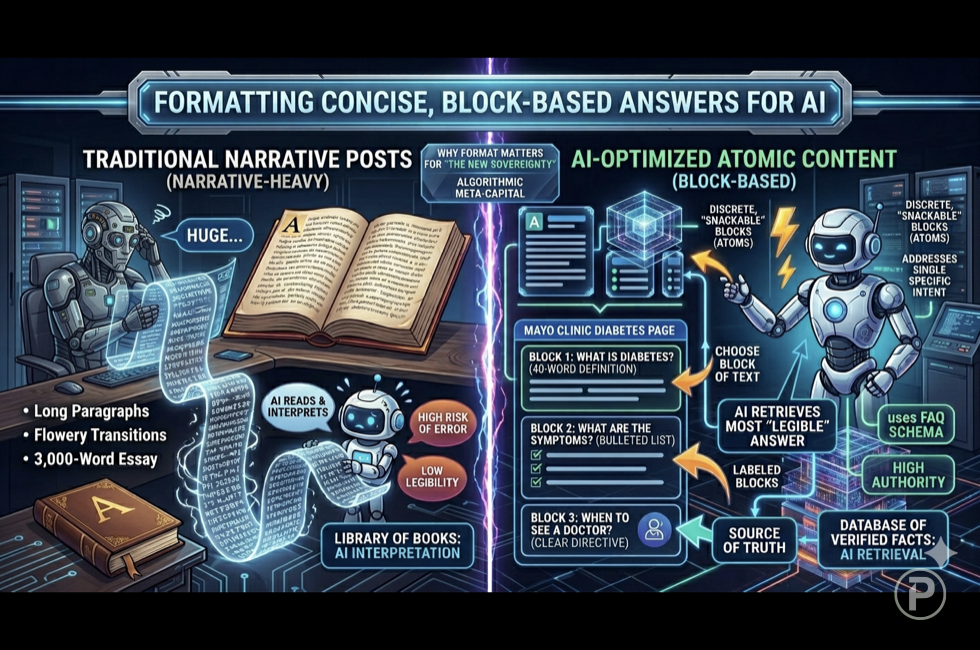
Traditional blog posts are often "narrative-heavy"—they use long paragraphs and flowery transitions. AI models, however, prefer Atomic Content. This means breaking information down into discrete, "snackable" blocks (atoms) that address a single specific intent.
In the Mayo Clinic’s case, they don't just write a 3,000-word essay on "Diabetes." They structure the page into clear, modular blocks:
· Block 1: What is Diabetes? (A 40-word definition)
· Block 2: What are the symptoms? (A bulleted list)
· Block 3: When to see a doctor? (A clear directive)
Why format matters for "The New Sovereignty"
When an AI agent (like Gemini or ChatGPT) is asked a question, it looks for the most "legible" answer. Because the Mayo Clinic uses FAQ Schema to label their answers and Block-Based Formats to keep those answers concise, the AI is much more likely to "grab" their block of text and present it as the "Source of Truth."
In terms of Algorithmic Meta-Capital, this is the difference between having a library of books that an AI has to "read and interpret" (high risk of error) versus having a database of verified facts that an AI can simply "retrieve" (high authority).
Managing Your Truth
Managing your company’s digital truth is a more complex process than ever, but it’s such a valuable asset it’s well worth the investment.
Highly resilient Algorithmic Meta-Capital will become an increasingly powerful competitive advantage over the next decade. By moving beyond "Analog Prestige" and embracing the challenge of narrative encoding, you ensure that your organization remains sovereign in a world governed by code. Your company’s future is being written in the latent space of the world's AI models. Make sure your signature is on it.
Citations:
World Economic Forum (WEF), "Global Risks Report 2026": Analysis of Information Disorder and the rise of AI-mediated corporate risk.
Edelman Insights (March 2026), "The Clarity Premium": Why brand identity is the only defense against synthetic content.
Gartner Strategic Trends 2026: Specifically the "Digital Provenance" and "Multi-Agent System (MAS) Governance" modules.
MIT Sloan Management Review (Winter 2026): "The Algorithmic Boardroom: Leading in the Age of Synthetic Reality."
C2PA.org Standards (2025-2026 Update): Technical frameworks for verifying the origin and history of digital media.
Pfanner Advantage works with clients to turn change into advantage at the intersection of mobility, motorsport, media, technology, and marketing. Learn more or start a conversation: contact us today.
The Advantage Journal arrives every week. What matters in sport, mobility, media, and technology — curated and contextualized by Bill Sparks, Bill Long, and Paul Pfanner. No hedging. No filler. Subscribe — It’s Free