
Indychella Didn't Ask Permission
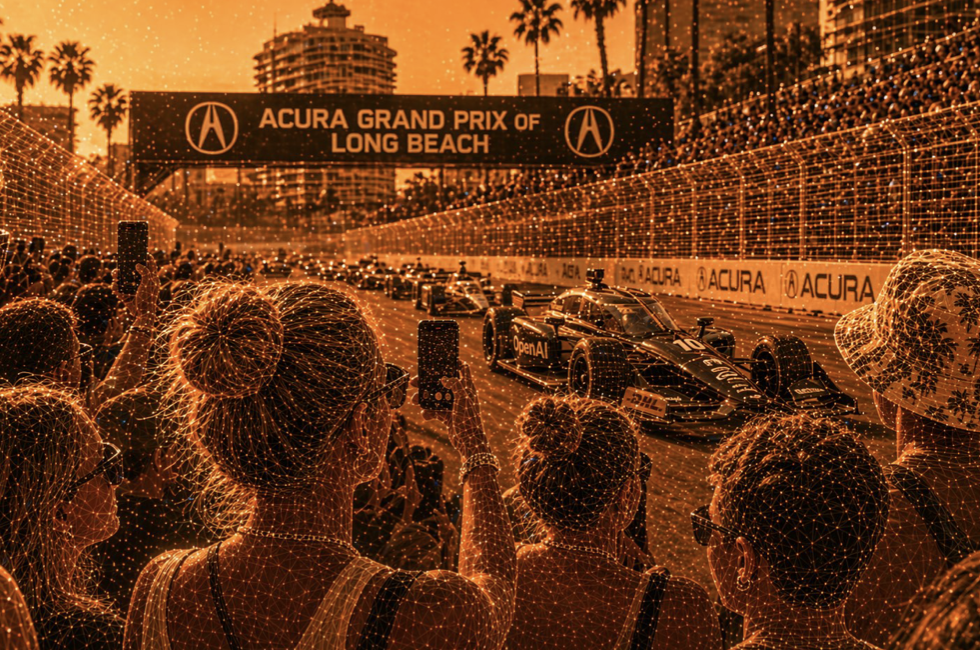
The audience the sport didn't build, didn't plan for, and can't afford to lose.
Few people alive have attended every Grand Prix of Long Beach weekend since the inaugural 1975 race. Paul Pfanner is one of them. Fifty-one years later, something arrived that the sport didn't build, didn't plan for, and hadn't seen before. It called itself Indychella. This essay is about what that means — for the race, for the man now running it, and for every sport that has spent decades trying to convert fans it should have been inviting to belong.
The Streets That Taught Me Everything
In the spring of 1975, Dan Gurney drove a Volkswagen Rabbit through streets that didn't yet know what they were about to become. He was giving FORMULA Magazine an exclusive preview of the new Long Beach Grand Prix circuit — F5000 coming that fall, Formula 1 the year after — and I was standing at the edge of something I couldn't yet fully name. I understood enough to know I wanted to be there for all of it.
Fifty-one years later, I still am.
Every race weekend. Without exception. Through F5000 and Formula 1, through CART and ChampCar and the reunification that became IndyCar. Through RACER's launch in 1992 — announced at Long Beach, because where else — and its reimagining in 2001, 2012 and 2025.
And through an evening in 2017 that I will not forget. Mario Andretti helped us unveil RACER's 25th Anniversary issue at the annual RACER Party on the eve of that year's race. It was the right man in the right room. Mario is the only driver in history to have won the Grand Prix of Long Beach in both Formula 1 and IndyCar. His 1977 victory in the John Player Special Lotus 78 literally saved the race, according to founder Chris Pook. His CART wins in 1984, 1985, and 1987 cemented Long Beach as the proving ground of American open-wheel racing's greatest era. If you want to understand what this race means, start with Mario. Then count the decades.
What I saw last weekend — or more precisely, what I saw about last weekend on the phones of people who weren't born when Gurney drove that Rabbit — was unlike any of it.
They called it Indychella. They named it before the industry could. The word is exactly what it sounds like: a mashup of IndyCar and Coachella, the April music festival happening simultaneously across the desert in the same Southern California cultural orbit. Same spring energy. Same generation. Same appetite for spectacle and experience over outcome. The overlap wasn't manufactured. It was noticed — by the fans first, on TikTok, where it became a tag, a trend, and then a lens through which an entire weekend was seen and shared.
What the Sport Won't Say Out Loud
The motorsport industry has known for years what it will not say in public: the audience replacement model is broken. Not catastrophically. Not in a way that triggers crisis communications or emergency board meetings. Slowly. Structurally. The way a building loses heat — invisibly, steadily, expensively, until the gap between what's going out and what's coming in becomes undeniable.
The industry's answer has been, almost universally, a conversion project. Take someone who doesn't care about racing and make them care about racing. Explain the competition. Teach the terminology. Build the context. Trust that comprehension will eventually produce attachment.
Conversion is old school. Immersion is what actually works.
The Indychella generation didn't come to Long Beach to be converted. They came for the experience — the city, the noise, the energy, the concerts, the drivers as personalities, the cars as objects of identity. They came for the feeling of being somewhere real. And what they found inside that feeling was actual racing. Unscripted. Unmanaged. Genuinely uncertain until the final pit stop.
What we love represents who we are. That is not a marketing insight. It is the operating system of an entire generation — one that chooses its sports, its brands, its communities, and its weekends the way previous generations chose their neighborhoods. With identity at the center. With devotion, not casual interest, as the goal. The question is not how to get them to care about racing. The question is whether racing is worth caring about on their terms. Long Beach last weekend suggested it is.
Some people left knowing Pato O'Ward's name. Some left with a TikTok made in Turn 9 and a sense that this was worth their Saturday. Every single one of them is a more valuable long-term prospect than the fan who stayed home — and every single one of them is a question the sport now has to answer.
The Man Who Built a Culture From Scratch
I met Jim Liaw and Ryan Sage in 2002. My associate publisher at RACER, Rodney Wills, made the introduction. I remember the conversation clearly — not because it was formal, but because it had the quality that the best conversations in this business always carry: two people who had seen something the sport hadn't seen yet and were absolutely certain about what to do next.
What they had seen was drifting. A Japanese underground discipline with no American audience, no American infrastructure, no American vocabulary. What they understood — and this is the thing that separates the people who build something from the people who study it — is that the audience already existed. It just hadn't been given a sport yet.
They didn't market to youth culture. They were youth culture. Formula Drift was built from inside a community that motorsport had never thought to claim. The aesthetic was entirely different. The music was different. The access was different. The relationship between driver and fan was different. Within a few years, Formula Drift was filling venues with people who had never attended a motorsport event and would not have described themselves as racing fans — but who had found something that represented who they were, and came back because of it.
This year, Formula Drift opened its 2026 season on the Streets of Long Beach on April 10-11 — one week before the Grand Prix — and returns to close the season at the same venue on October 23-24. The same streets. The same waterfront. A different culture with the same ZIP code. That is not a scheduling coincidence. That is a cultural infrastructure that Liaw helped build and now, as President and CEO of the Grand Prix Association, he is positioned to connect.
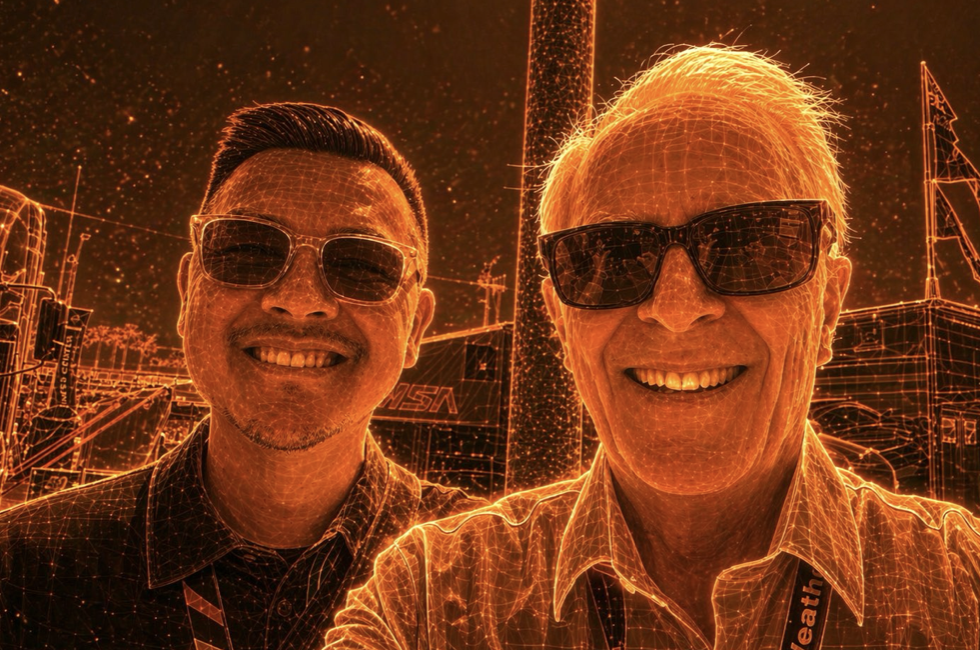
Jim Liaw and Paul Pfanner, Long Beach, April 17, 2026. His first Grand Prix weekend as President and CEO. Fifty-one years in the making for one of us. Day one of the main event for the other.
The Free Friday Question
During the Grand Prix weekend I had several conversations with Jim Liaw, and one of them went to the heart of what Indychella actually represents as a strategic challenge.
Free Friday admission has been a fixture of the Long Beach Grand Prix for years. It is a genuine act of generosity toward a market that includes a lot of people who would not otherwise walk through the gate — including, last weekend, a significant number of people who arrived for the atmosphere, the culture, the spectacle, and the novelty rather than for the racing itself.
The question Liaw is sitting with — and it is exactly the right question — is what comes next. Getting the explorers through the gate is the easy part. Giving them a reason to return, pay, and belong is the actual work.
This is where the conversion model completely fails. You cannot convert your way to devotion. You cannot explain someone into identity. What you can do — what Formula Drift proved is possible — is create conditions for immersion deep enough that people begin to see themselves inside the experience. When that happens, they don't need to be converted. They have already arrived. They come back because leaving would mean leaving part of themselves behind.
Free Friday served a specific purpose in a specific era. Its future depends on whether the Grand Prix can build the bridge between the first visit and the identity investment that makes the second visit — the paid one, the committed one, the one where someone shows up with a favorite driver and a point of view — feel not just worthwhile but necessary.
That is a design problem as much as a marketing problem. And it requires someone who has solved it before.
A Moment or a Movement
Liaw's first operating weekend as President and CEO came under circumstances none of us would have chosen. Jim Michaelian spent five decades building the Long Beach Grand Prix into the longest-running street race in America. He passed away in March. Every car on the circuit last weekend carried a sticker in his memory. The weight of that was visible, appropriate, and real.
Liaw ran the race forward. Because that is the only direction available, and because what Michaelian built deserves to be carried by someone who understands both what it was and what it must become.
The programming told the story this year: Lupe Fiasco on Friday. Kings of Chaos on Saturday. A Mornings CARnival on Sunday bringing automotive culture as a standalone draw. Murals on pedestrian bridges commissioned from Long Beach artists. New grandstands. Expanded viewing areas. This is not an accident of scheduling. This is a thesis — about what a race weekend can be, who it can be for, and what happens when an institution stops defending its perimeter and starts expanding it.
The sport now has to answer the question that Indychella raised without asking it: Is this a moment or a movement?
Moments are meteorological. They arrive, generate energy, and dissipate. The industry takes note, holds a panel at its next conference, and returns to what it has always done.
Movements compound. They generate their own infrastructure — language, identity, community, recurring behavior. They create conditions for the next moment to be larger than the last. They turn explorers into devotees. Not through explanation. Through experience deep enough to become identity.
The difference between a moment and a movement is almost entirely determined by what the institution does in the eighteen months that follow. Formula Drift opens the 2026 season at Long Beach and closes it there in October. The same streets. The same city. A proven model for building devotion out of discovery, running on the same pavement where Indychella arrived uninvited last weekend and named itself.
The Streets Still Have Something to Say
Fifty-one years ago, Dan Gurney drove a Volkswagen Rabbit through empty Long Beach streets and showed me what was coming. I didn't know then that I would spend the next half century measuring my professional life against that circuit. I didn't know that the publication I helped launch would be born in those streets, reborn in that city, or that Mario Andretti would help us mark its 25th Anniversary at a party on the eve of the 2017 race — in the same city where he had won on two different kinds of cars, four times, in two different eras and, in doing so, helped make the whole thing possible.
What I know now is that something new arrived at Long Beach last weekend. It arrived without credentials, without context, without any of the fluency the sport usually requires before it lets you belong.
The sport didn't build that audience. The audience built itself.
The sport's job now — Jim Liaw's job, and the job of everyone who has spent a career at this intersection — is to be worth what just walked through the door. To build the conditions for immersion. To earn the identity investment. To turn the explorers who showed up for Indychella into the devotees who show up in October, and the year after that, and the year after that.
The explorers are here. What happens next is entirely up to us.
Pfanner Advantage works with clients to turn change into advantage at the intersection of mobility, motorsport, media, technology, and marketing. Learn more or start a conversation: contact us today.
The Advantage Journal arrives every week. What matters in sport, mobility, media, and technology — curated and contextualized by Bill Sparks, Bill Long, and Paul Pfanner. No hedging. No filler. Subscribe — It’s Free

