
Fast, Cheap and Wrong
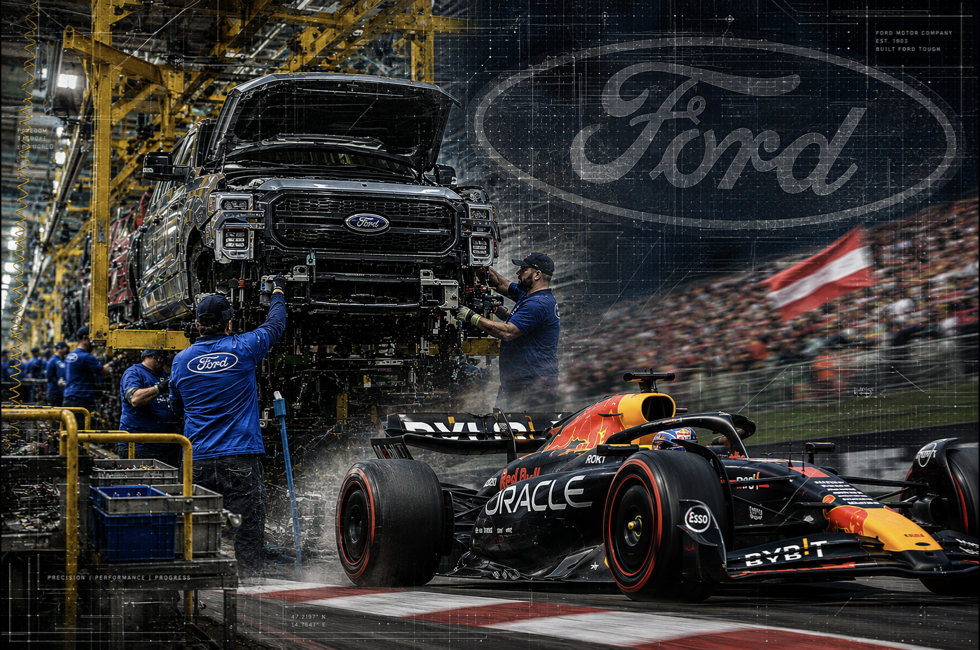
Speed you can see. Judgment you can't.
In one stretch of June, Ford showed both the best and the worst of what artificial intelligence does to a business. Paul Pfanner on why the machine is a magnificent tool and a ruinous replacement, and how to tell which one you're buying.
Two Fords, one week
Back in June, the same company put its name on the best and the worst of what this technology can do, and the two stories only make sense side by side.
On the track, at the Formula 1 Austrian Grand Prix, the Red Bull Ford power unit ran with the fastest cars on the grid. That engine is a partnership in which Red Bull leads and Ford's engineers have spent more than two years helping build a Formula 1 power unit from a blank sheet. Max Verstappen put a heavily upgraded car second on race day, splitting the two Mercedes of race winner George Russell and championship leader Kimi Antonelli, the cars that set the pace all weekend. For an engine program this young, running with the Mercedes is no small thing, and it came from people doing the slow, unglamorous work of making an engine run.
Away from the track, the other Ford. For two years the company had bet that AI could carry the quality work its veteran engineers used to do on the plant floor. In June it quietly brought 350 of them back, because the bet came up short. The automated systems looked fine right until the warranty and recall bills came in, and by then the number had climbed into the hundreds of millions of dollars.
Same company, same technology, and it won a race on one side of the building while running up a nine-figure bill on the other.
The machine goes where people can't
Start with the winning side, because it is the hopeful story and the one people get wrong.
The Red Bull Ford engineers lean on AI to do things no human can. Their simulation runs a thousand times faster than real time, so a driver can feel how an engine behaves before the physical engine exists. Their 3D printing took a part that used to need sixteen days and turned it around in five. That is the real beauty of this technology. It goes where no person can, and it lets a young, late team close a gap on rivals who have been at this for decades.
Now look at what the machine is doing there. It is answering questions that expert engineers already know how to ask. The simulation is only as sharp as the person who knows which failure to point it at. The machine supplies the speed, and the judgment about what matters still comes from someone who has been under the car. AI is an amplifier, not an author. It multiplies whatever judgment is feeding it.
What the other side forgot
The plant floor is what that same idea looks like with the judgment taken out. Ford's quality side used AI to do without its veterans rather than to sharpen them. It fed design requirements into a model and trusted the clean-looking answer that came back, and that answer looked right on the screen and sailed through the review. What it could not do was know where the part fails in year three, on the customer's own driveway. The veteran knows, because he has seen it break. That knowing was the whole job, and it was the thing the model was quietly faking.
So the inversion is simple, and most companies are learning it the expensive way. The tools went free and universal, which did nothing to lower the value of knowing what you are doing. It raised it, because the tool now multiplies that knowing, in both directions. The value moved to judgment, and judgment only comes from having done the work with your own hands, long past the point where it was fun.
Not just cars
None of this is a car story. It is happening anywhere a machine can now produce a convincing surface. A contract that reads clean until the one clause that sinks you. Code that runs fine until it quietly corrupts the thing it was built to protect. The surface is cheap now, and getting cheaper. The person who can look at that surface and tell you it is lying is worth more than they have ever been.
What Ford forgot to ask
So here is what I would ask any leader this week. You can buy the look of almost any work now for almost nothing, and pretending otherwise is its own way to fall behind. But before you thin out the people who know where things break, ask the question Ford's two halves answer so differently. Not what these people cost. What they are quietly holding together, and what your expensive new machine is worth without them.
Point the amplifier through them and you get Austria. Point it at their empty chairs and you get the recall. The machine made looking right cheap. It made being right expensive. You can learn that on purpose, or you can learn it the way Ford did, one recall at a time.
Pfanner Advantage works with clients to turn change into advantage at the intersection of mobility, motorsport, media, technology, and marketing. Learn more or start a conversation: contact us today.
Paul Pfanner’s recent Shift Happens Insights:
Sunday Made the Case - the 110th Indy 500
The Advantage Journal arrives every week. What matters in sport, mobility, media, and technology — curated and contextualized by Bill Sparks, Bill Long, and Paul Pfanner. No hedging. No filler. Subscribe — It’s Free

