
How Young Athletes Are Building Personal Brands

In the era of social media marketing, it’s never too early to start the personal branding journey.
Young athletes building their own personal brands is reshaping the economics of sponsorship. Bill Sparks looks at how this is impacting sports marketing.
The fastest kid on the track doesn't always get the best sponsorship deal. Increasingly, the one who treats racing like a business does.
That's an oversimplification, but not by much. Across motorsport and youth athletics broadly, personal branding has shifted from a post-career afterthought to a pre-career requirement. The global motorsport sponsorship market was valued at $5.1 billion in 2025, according to Globe Market Research, with a projected compound annual growth rate of 8.9% through 2035. The Name, Image, Likeness (NIL) economy in college sports reached an estimated $2.6 billion in 2026, per industry projections compiled by Opendorse and corroborated by Athletic Business reporting. These aren't vanity metrics. They represent a fundamental reallocation of capital toward athletes who can demonstrate audience reach and engagement before they've reached the top of their sport.
The business question is no longer whether young athletes should build personal brands. It's how the ones doing it well are reshaping the economics of sponsorship.
The NIL catalyst
The NCAA's 2021 Name, Image, and Likeness policy change was the inflection point. Before it, college athletes in the United States couldn't legally monetize their personal brands. After it, an entire marketplace infrastructure emerged almost overnight. The 2025 House v. NCAA settlement accelerated the shift further by allowing Division I schools to directly compensate student-athletes, creating what amounts to a professional talent market within collegiate sports.
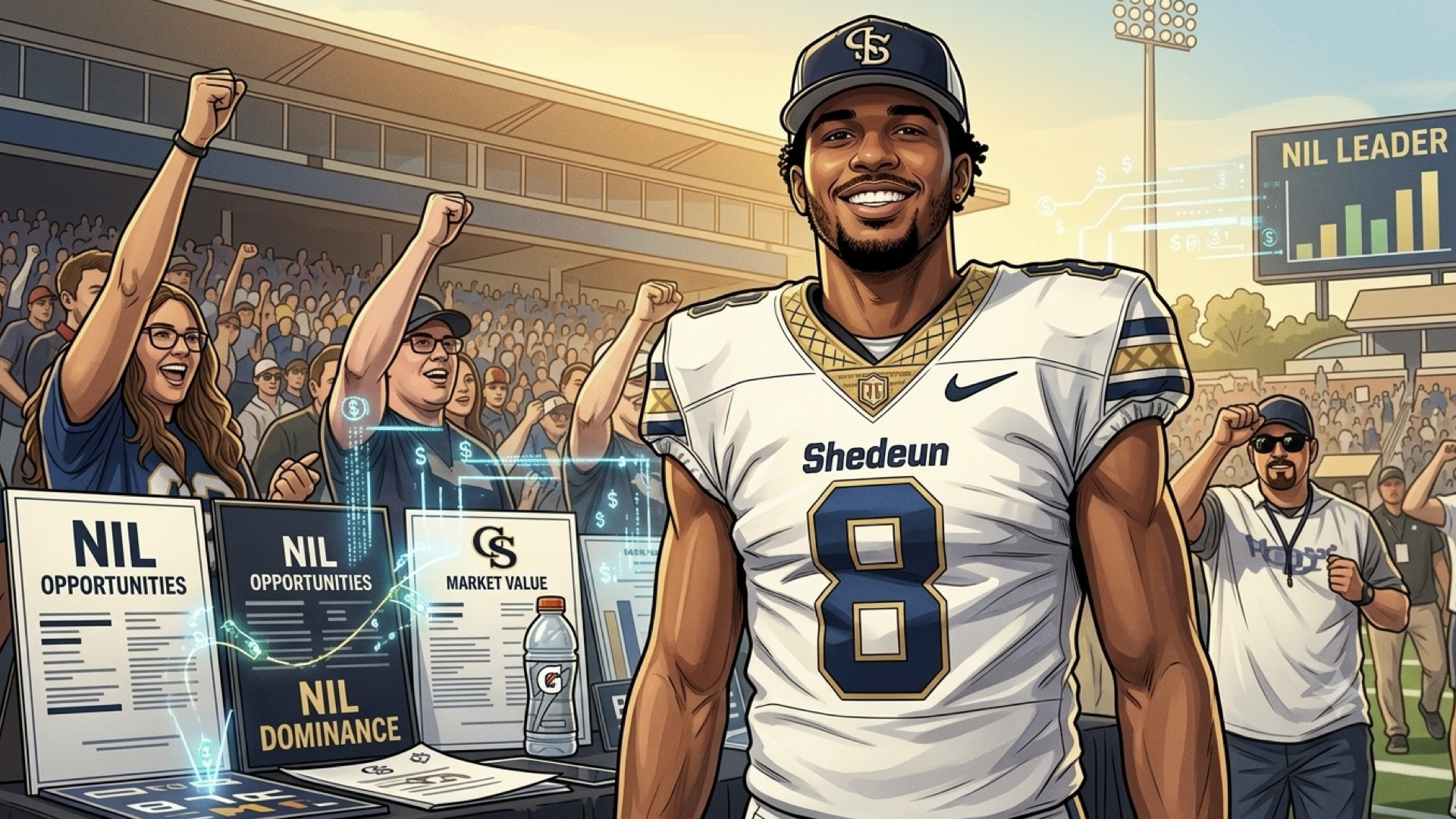
College quarterback Shedeur Sanders NIL earnings have reached $4.7 million.
The platform ecosystem that followed tells the story of how quickly capital organized around this opportunity. Opendorse, which pivoted from a content-sharing tool to a compliance and deal marketplace, is now embedded at roughly 98% of NCAA, NAIA, and NJCAA schools. INFLCR, owned by Teamworks, serves more than 270 collegiate and professional teams and over 90,000 student-athletes with content distribution, compliance tracking, and brand-building tools. NIL Club, which launched its Brand Deals marketplace in late 2025, reported paying more than $50 million to athletes and facilitating over 50,000 partnerships within three months of launch.
What's notable about the current NIL landscape is its evolution beyond simple endorsement deals. The most sophisticated arrangements now involve equity partnerships and founder-led athlete brands, where athletes take ownership stakes in companies rather than accepting flat fees for social media posts. For sponsors evaluating young talent, this shift signals that the athletes arriving in professional ranks over the next few years will think of themselves as businesses, not just endorsers.
What racers are doing
A common playbook is emerging, and it has less to do with production value than with consistency and authenticity.
Nick Persing is a useful case study. Persing, a 21-year-old professional racing driver competing in the Lamborghini Super Trofeo North America series for Wayne Taylor Racing, is simultaneously finishing a business administration degree at Boise State University. He started karting as a kid, competed in national karting championships, moved to cars at 14, and raced in Formula 3 before finding his current seat. In 2025, he won three races and finished third in the standings. This year he was promoted to the team's No. 1 car alongside defending champion Hampus Ericsson, and won again at Laguna Seca in May. What distinguishes Persing from equally talented peers is how explicitly he treats racing as a business. As he told Boise State News, drivers need to "know how to sell themselves and how to tell a good deal from a bad deal as they navigate team contracts." He races in a Boise State-branded helmet, a personal branding move that ties his identity to something beyond the team livery. His long-term goal isn't just to keep driving. It's team ownership or management, backed by the finance and people-management skills his degree provides.
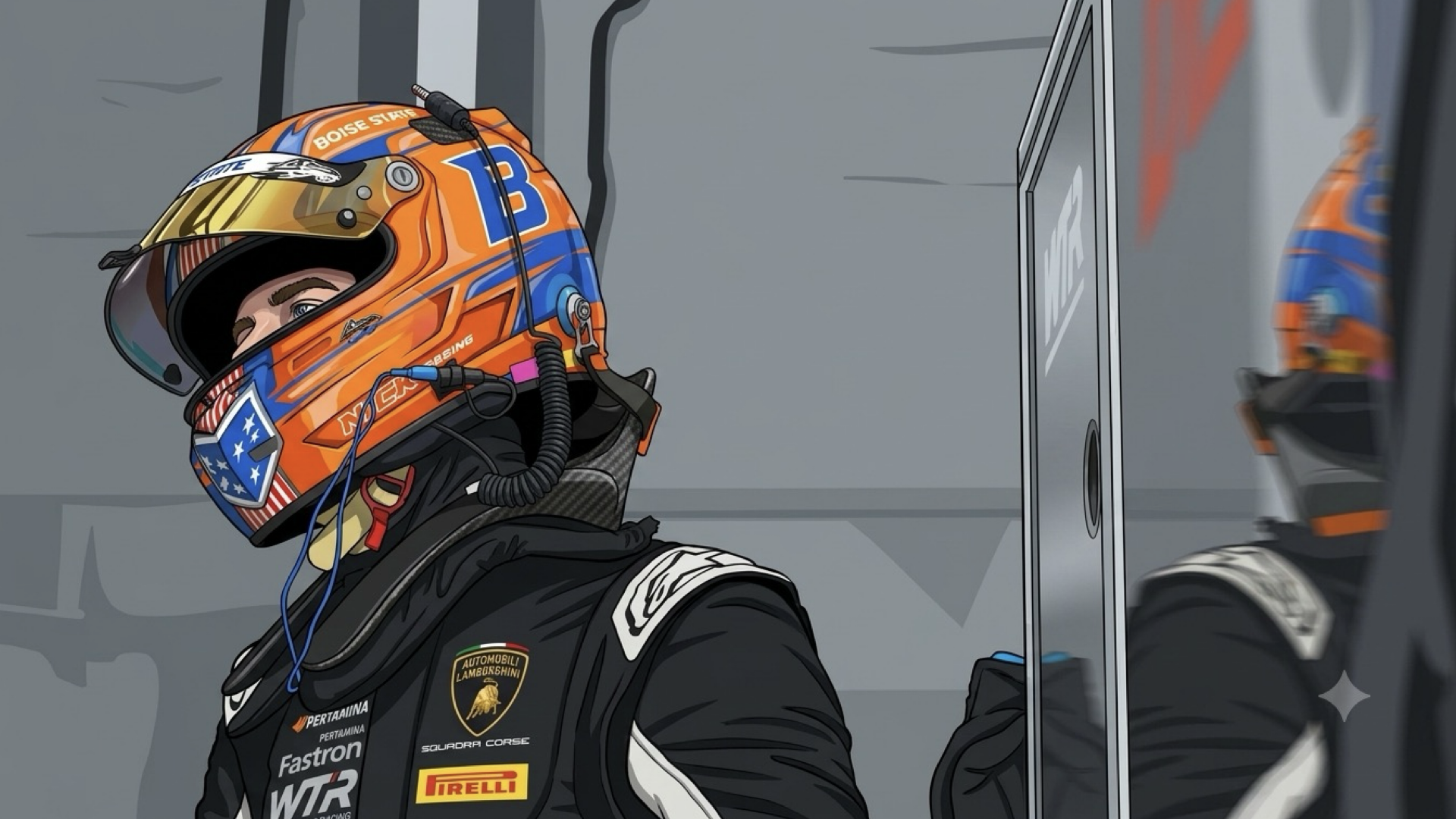
Lamborghini racer and business administration graduate Nick Persing’s long-term goal is team ownership or management.
The pattern holds at higher levels of the sport. Lando Norris, now with approximately 11.9 million Instagram followers, built a significant portion of his early audience not through traditional motorsport media but through Twitch streaming during the 2020 pandemic lockdowns. His content was gaming and memes, not polished PR. It worked because it was genuinely him, and it gave fans a reason to care about him as a person before they cared about his lap times. Norris has since scaled back his social media activity during race seasons to protect his competitive focus, which is itself a branding decision: knowing when to pull back is as strategic as knowing when to post.
Sabré Cook's career arc illustrates a different but complementary path. A 14-time karting champion with a mechanical engineering degree from the Colorado School of Mines, Cook won the Infiniti Engineering Academy global final in 2018 and worked as a suspension composite design engineer for the Renault F1 team before building her racing career through deliberate sponsor-value creation. She progressed from product sponsorships to cash sponsorships to her current position racing a Porsche 911 GT3 in the Carrera Cup North America series backed by PenFed Credit Union. Her progression wasn't accidental. She learned, through trial and error, how to articulate and deliver measurable value to partners.
The common thread across these three examples isn't talent, though all of them have it. It's the treatment of personal brand and business acumen as a parallel career track that runs alongside athletic development, not something bolted on after the fact.
What sponsors are learning
The sponsor side of this equation is shifting just as fast. Digital presence now directly influences sponsorship valuations, and the metrics that matter have changed.
RTR Sports, a motorsport marketing agency, has reported that social media generated a dominant share of total brand value at major Grand Prix events in 2025, with brands using broadcast-only measurement frameworks missing most of the value their sponsorships generated. That finding has pushed sponsors to prioritize athletes and teams with strong digital footprints over those with marginally better on-track results but smaller audiences.
The practical implications are significant. Sponsors increasingly evaluate engagement rates rather than raw follower counts, looking for athletes with active, responsive communities rather than passive audiences. They're structuring deals around content activation rather than logo placement, asking drivers and athletes to produce social media content, event appearances, and branded storytelling as core deliverables. Measurement has gotten more sophisticated too, with QR code campaigns, UTM tracking, lead capture forms, and CRM integration replacing vague "brand awareness" as the standard for ROI evaluation. In B2B contexts, paddock hospitality and networking access have emerged as particularly high-value sponsorship components, with strategic use of event access capable of advancing multiple significant business relationships in a single race weekend.
For the motorsport industry specifically, this means the sponsorship pitch has been inverted. The most effective young drivers are no longer asking sponsors for money. They're presenting documented audiences, engagement data, and activation plans that make a business case for partnership.
The emerging infrastructure
An ecosystem of formal training and support has grown around athlete branding, which itself signals market maturation.
Build Your Future Brand, a 12-week bootcamp in Miami, teaches teens to develop digital portfolios, articulate their personal brand identity, and build an online presence with business applications. The U.S. Olympic and Paralympic Committee offers personal branding programs for elite amateur athletes through the USOPC. Sports Management Worldwide runs a dedicated Athlete Marketing and Branding Course covering NIL strategy, sponsorship acquisition, and social media management.
In motorsport, the infrastructure is more fragmented but growing. Motiv8 Training publishes sponsorship strategy resources and runs an AI-assisted course on winning sponsors. The Racing Mentor offers comprehensive guides to motorsport sponsorship. Motorsport Prospects covers the business side of being a racing driver, including case studies of drivers funding careers through social media. These aren't niche operations anymore. They reflect a market recognition that brand building is a trainable, measurable skill with direct financial returns.
Where this is heading
The athletes entering professional motorsport and elite sports over the next three to five years will arrive with something their predecessors didn't have: established audiences, proven content capabilities, and pre-existing sponsor relationships. Some will have been building their brands since their early teens.
For teams, that changes talent evaluation. A driver who brings a track record of delivering sponsor ROI, and a clear understanding of their own marketability is a different economic proposition than an equally fast driver who's never thought about the commercial side. For sponsors, it means the talent pool of athletes capable of executing sophisticated brand partnerships is expanding. And for the broader motorsport business, it suggests that the line between athlete and media company will continue to blur.
The young athletes who figured this out early aren't just building personal brands. They're building the next generation's model for how athletic careers work.
Pfanner Advantage works with clients to turn change into advantage at the intersection of mobility, motorsport, media, technology, and marketing. Learn more or start a conversation: contact us today.
The Advantage Journal arrives every week. What matters in sport, mobility, media, and technology — curated and contextualized by Bill Sparks, Bill Long, and Paul Pfanner. No hedging. No filler. Subscribe — It’s Free