
The Future Arrived Looking Familiar
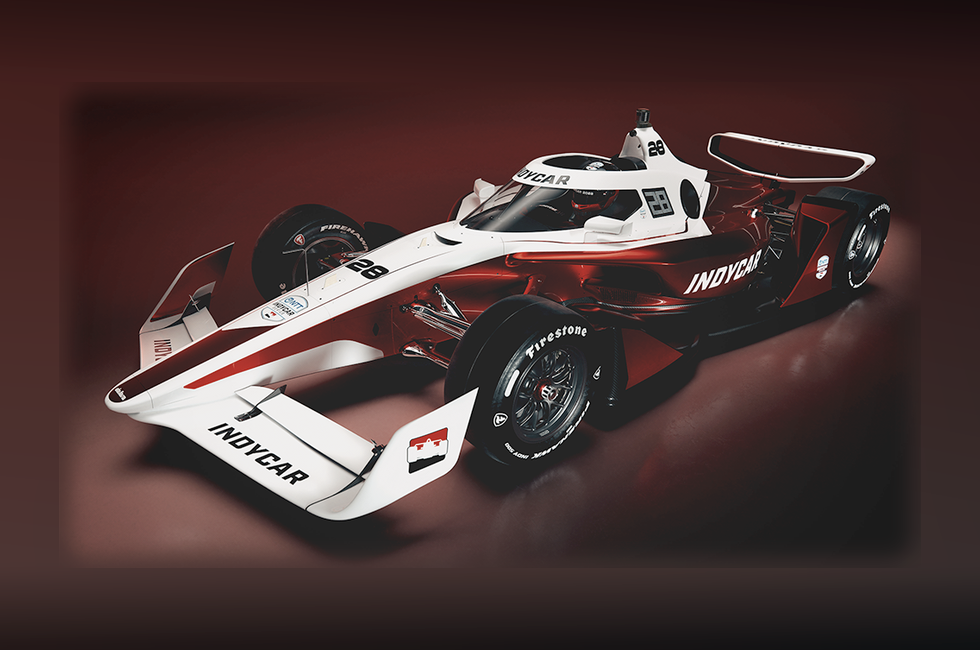
The IR-28, IndyCar's car for 2028. It's lighter, faster, and safer than what it replaces. The harder question is what it's for. (Image: IndyCar)
Paul Pfanner’s first company grew out of the friendships he made around Dan Gurney's All American Racers, and decades later he was part of the small group IndyCar asked to imagine its own future.
Two weeks ago, a convocation of Dan Gurney's Eagles came together at Road America. They were built for all kinds of racing, because that's what Gurney's shop did. All American Racers turned out Indy cars, Formula 5000 cars, Formula Fords, and the iconic Formula One Eagle that Gurney drove to a Grand Prix win in a car of his own making, which no American had done before him and none has done since. One of those Formula Fords is how I fell in with the family. My roommate, David Loring, won the Formula Ford title at the SCCA Runoffs in 1978 in a Gurney Eagle. The friendships I made around that shop are most of the reason I started my own company a year later.
Dan is my racing hero, and after my father he is the man I've admired most in my life. My dad, who worked on the Apollo program, felt the same way about him. He used to call Dan the eighth Mercury astronaut, because he was that brave and that far out ahead of the rest of us.
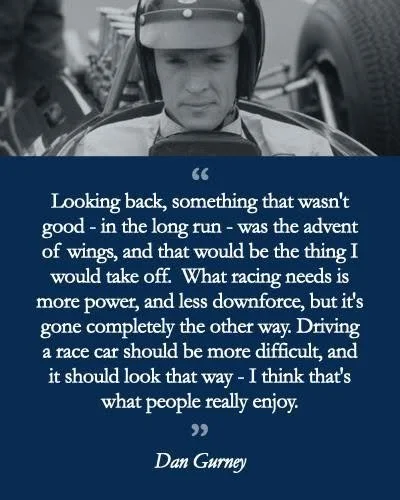
Gurney had strong opinions about the cars, too. He thought the worst thing that ever happened to racing was the arrival of wings, and given the chance he would have taken them off and given the cars more power and less grip. A race car, he said, "should be more difficult, and it should look that way." Hold onto that. It comes back.
What the place was built for
I've had reason to think hard about why the Speedway exists. Years back, Joie Chitwood, who was President then, brought Pfanner Communications in to help envision the Centennial Era of the 500 (2009 — 2016), and we spent a long time exploring its origins and its lore. So I come at this with some mileage.
The Speedway was never meant to be a stadium. It went up in 1909, when nobody had settled what the automobile even was, and the point was to work that out in front of a crowd. The Indianapolis 500 became an argument you could watch. Front-drive fought rear-drive. Turbine cars turned up to embarrass the piston engines. Turbochargers arrived years before anyone trusted them, and when the establishment insisted the engine belonged in front of the driver, the rear-engine cars came and settled it on the track.
Plenty of those ideas failed, and the failing was part of why you watched. You wanted to see whether somebody's strange bet would hold together at speed. You didn't just go to see who was quickest. You went to find out which idea about the car was going to win.
IndyCar’s beautifully produced videos introducing the IR-28, narrated by Matt Damon and James Hinchcliffe.
A fair look at the new car
So here is the IR-28, the car IndyCar showed the world this week for 2028. About a hundred pounds lighter than the one it replaces. A new 2.4-liter twin-turbo V6, up to 760 horsepower, a reworked hybrid, the aeroscreen built in instead of bolted on later, a bigger and safer cockpit, and bodywork shaped to let the cars run closer and pass. Dallara builds excellent racing cars and this looks like one. It might turn out to be the best-racing and safest Indy car anybody has run. The engineering is not the problem, and I'm not going to pretend it is.
The name tells you something
The old car had a name, and the name had a man behind it. Dan Wheldon won the 500 in 2011, the Centennial race, for my friend Bryan Herta's team. He didn't have a full-time ride that year, so when the series needed someone to develop the car that was coming, Dan did most of the testing. Then he was killed that October, in the last race of the season. They named the car for him. The DW12. Nobody turning laps in it back then had the faintest idea it would still be racing in 2027.
That's how it usually went. A racing car carried a person's name. Sometimes the builder, Marmon, Miller, the Watson roadsters, a Duesenberg, Lotus, Lola or Eagle . Sometimes the driver, like Brabham, McLaren, Parnelli, or the DW12. Either way there was a human being you could point to who inspired the idea, and us as fans. This new one is the IR-28. Indy Racing, twenty-eight. It's named after the slot it goes in.
Look at what's new that you can see while wandering the paddock, or from a grandstand seat. A clear panel in the engine cover so the Chevrolet and Honda badges show through. More room for sponsor logos. A reintroduction of the position led panel that tells you where a car is running. The hybrid buried down inside it is a serious piece of engineering, and you can sit there all afternoon and never once feel it. Most of the visible news is there to sell you something.
What IndyCar has built is an optimized 230 mph parity appliance. I don't mean that as a cheap shot, I mean it precisely. The car is a fixed tool, the same for everyone. The only things that move are how a team and driver use it and whatever performance Chevrolet or Honda can pull out of the engine. Everything else is held level on purpose. That is the design goal, and the car meets it.
It wasn't the money
My friend Jim Bowie has spent his working life selling this sport. He ran marketing for Champ Car, for Treadway Racing the year it won the Indianapolis 500, for PacWest, for Skip Barber. He has sat across a table, put a number on what a racing property is worth, and then gone out and gotten it. So when Jim takes apart the cost question, it isn't a theory.
Everybody assumes IndyCar stayed close to the old car to hold costs down. Jim priced it out. Call it eight million dollars to put a strong two-car team on the grid with these new cars and the spares to keep them running. Now set that beside the company IndyCar wants to keep. Formula One's budget cap this year is two hundred fifteen million a team. The NFL salary cap is north of three hundred. A thirty-second spot in this year's Super Bowl went for more than ten million, and that is only the airtime, before anybody shoots a second of film.
So, the new car isn't expensive. In big-league sport it's a bargain, which means cost was never really the wall. The wall is that the product doesn't throw off enough value for anyone to want to spend on something braver. The way Jim puts it, expensive is relative to value, and when the value runs thin even a fair price starts to look like too much.
So, what is it now?
For most of its life the 500 was a contest of ideas about the future. That was the job from the day they laid the bricks. Somewhere this century the job changed and nobody sent a memo.
Maybe the race isn't about the future anymore. Maybe it's mostly a show now, a chariot race with the horses swapped for engines, cars an inch apart and the grandstands roaring, and nobody walking out any the wiser about where the automobile is going. Stefano Domenicali, the man who runs Formula One, put it bluntly this year. Most of his fans, he said, don't care about the technical details. They watch for the overtaking and the action, for a move like the one Verstappen put on Hamilton in Hungary. The ones who still want the engineering data are, in his word, a niche. He runs the biggest racing series on earth, and he may be right about the crowd. That's the part that bothers me.
What's gone missing is the meaning, and it used to live in the car. The car stood for something. A race of ideas. A battle to get to the future first and faster. You could read a team's whole theory of what was coming in the machine they showed up with. That is mostly gone now. The car has become a set piece in a story about culture and personalities. A two hundred and thirty mile an hour soap opera. The racing can still be great, and the drama can still be real. The car just isn't where the meaning lives anymore.
The car Dan Gurney wanted
There's a knot of coincidence in all this that I can't quite ignore. The car being replaced is named for Dan Wheldon, who the Centennial Indy 500 in 2011, and who I once wrote an immigration letter for when he was young and trying to stay in the country. His team owner, Bryan Herta, was the second driver Jeremy Shaw and I sent abroad through the Team USA program we started in 1990. And Herta's team won the 500 again in 2016, the hundredth running, the same year a few of us sat down to imagine IndyCar's future. None of that proves anything. It's just why this one isn't abstract for me.
That work is where the other kind of car came from, the one that doesn't just manage the racing but changes what the car is for. Mark Miles asked J.R. Hildebrand to imagine what an Indy car should be for the rules coming in 2020. J.R. pulled in a few of us. Diego Rodriguez, Clay Dean, Reilly Brennan, me. People who had spent their careers in design and engineering and mobility, who knew how a product gets built and gets sold. We called ourselves the Velocity Collective, and we still trade messages almost every day, nine years on. I've written the whole Velocity Collective IndyCar 2020 story elsewhere, so I'll leave it there.

J.R. Hildebrand’s Blackbird 66 wingless, high-powered open-wheel race car concept.
What came out of it, in the end, is J.R.'s Blackbird 66. He took the wings off. He cut the car's reliance on downforce and gave the work back to the driver, so you can watch a person wrestle the thing again instead of watching the aerodynamics do the hard part in silence. Car and Driver called it a radical rethink of the open-wheel car. It is, near enough, the car Gurney was describing. More power, less grip, hard to drive and honest about being hard.
Gurney knew J.R., and he cut to the point in the way he always did with me. In January 2017, Dan and I sat in his office at All American Racers, just the two of us, the way we had over the years, with the rest of the group on a speakerphone. Dan wanted the point, and the point was a question he aimed down the line at J.R. Are you a fan? J.R. didn't catch it at first, so Dan brought his cane down on the table and asked again. Are you a fan? Not your racing credentials. Whether you loved the thing like he did. Once we got into that, it turned the whole conversation around on what we were there for. Dan did that for people. He could sit in a moment and show you the opportunity hiding in it. A brilliant man.
Blackbird 66 hasn't been built. It's renderings and a manifesto for now, and those of us who were in that conversation in 2016 and 2017, keep pushing J.R. to make it real.
Now builds next
I'm not writing any of this to be hard on the people who built the IR-28. They're very good at what they do and the car shows it. But being very good at the job was never the promise. The promise was the future, where you could stand at the fence and watch it work or watch it fail in front of you. Competence used to be a byproduct of chasing that. Now it looks like the goal, and being competent isn't enough.
The Speedway got built on a plain proposition, that you find the future by racing at it where people can see. I still believe that bet, and it's most of why I get up and build things now, when the gap between having an idea and making it real has almost closed. Which makes this a strange time to decide the shape of a racing car is a settled question. Nobody is asking IndyCar to go broke, or to reopen a spending war that chased good people out of the sport. It's a smaller question, and a harder one. Does it still want to show us something we haven't seen, or is it content to run the show?
The car is going to be fast. Fast was never the thing I loved about any of this. When it turns its first laps this week, I'll be watching for the other thing. Whether it's still trying to build something.
Pfanner Advantage works with clients to turn change into advantage at the intersection of mobility, motorsport, media, technology, and marketing. Learn more or start a conversation: contact us today.
Paul Pfanner’s recent Shift Happens Insights:
Are Creators Formula One’s Most Effective Media?
The Advantage Journal arrives every week. What matters in sport, mobility, media, and technology — curated and contextualized by Bill Sparks, Bill Long, and Paul Pfanner. No hedging. No filler. Subscribe — It’s Free

