
A Moonshot Run Out of a Race Shop
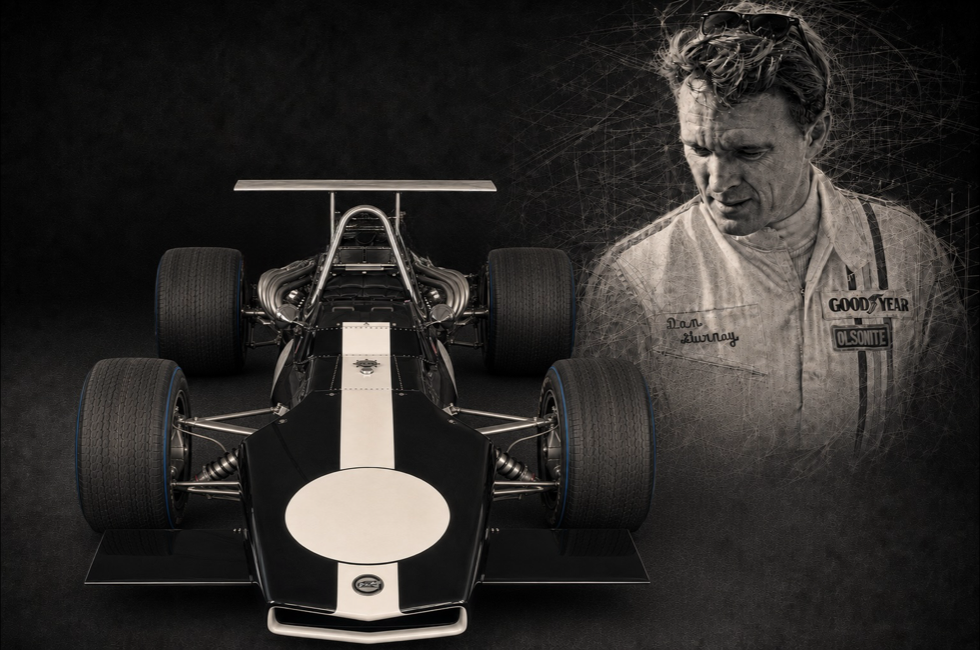
Dan Gurney's final Formula 1 design for the 1969 season was abandoned in September 1968 and finished in July 2026. The wait is the story. Illustration of Dan Gurney based on photo by Harry Hurst.
In July 2018. Paul Pfanner saw a corroded, unfinished monocoque that had come down from the rafters at All American Racers. This month at Road America, the Gurney family unveiled it as a finished Formula 1 car, fifty-eight years after Dan Gurney set it aside. This is what it was waiting for.
On the third Friday of July at Road America, Justin Gurney pulled the cover off a Formula 1 car that took fifty-eight years to finish. It sat beside the Eagle his father drove to victory at Spa in 1967, lower and smaller than the older car. A shape from 1968 that almost nobody outside the Santa Ana shop had ever seen whole. All American Racers identifies it as the Mk VI. The people who kept its memory alive called it the Stillborn Eagle. Nobody should call it that anymore.
Eight days in June
In June 1967 Dan Gurney won Le Mans with A.J. Foyt in the Ford Mk IV and sprayed champagne off the podium because the joy had to go somewhere. Every winner who does it now is copying him. Seven days later he won the Belgian Grand Prix at Spa in a car carrying his own name, built in his own shop in Santa Ana. Only Jack Brabham and Bruce McLaren ever matched that, winning in cars of their own creation. No American has done it since.
My father spent those years training the crews who built and rebuilt the Apollo command module after the fire of January 27, 1967, the one that took Gus Grissom, Ed White, and Roger Chaffee. He admired Gurney above every other racer, and even as a kid I understood why. The Eagle Formula 1 effort was a moonshot run out of a race shop. Gurney designed his own chassis and funded his own Weslake V12 in England, then took the results to fight bigger teams with better funding. And he did it in an era that killed four front-line drivers in a single season. Jim Clark was my first racing hero, and I thought of him as Dan's friend and equal. Hockenheim took him in April 1968. I was still mourning that when everything else happened.
The autumn of 1968
In September 1968 the Goodyear money contracted and Gurney shut the Formula 1 program down. Tony Southgate's new car, a magnesium-skinned monocoque using titanium through its bulkhead and suspension, sat half-built on the fabrication bench. Gurney had his own doubts about all that magnesium after Jo Schlesser burned in the magnesium-skinned Honda RA302 at the French Grand Prix at Rouen on July 7. So the tub went up into the rafters, and AAR turned toward American racing, where Eagles would win Indianapolis three times and dominate IMSA competion in multiple classes.
Martin Luther King and Robert Kennedy were already dead that autumn, and Chicago had just finished fighting itself on live television. Soviet tanks were parked in Prague. And inside the same ninety days, the first crewed Apollo flew and Boeing rolled the first 747 out of its factory at Everett. In December a quiet engineer named Douglas Engelbart stood up in San Francisco and demonstrated the computer mouse and text linked to other text, seeds of the machine you're reading this on. The tools that would someday collapse the distance between an idea and its execution were shown in public for the first time, four hundred miles up the coast from a shop where an idea had just been put on hold.
I had just begun my freshman year at Whittier High School as Richard M. Nixon (WHS class of 1930) was elected the 37th President of the United States. On Christmas Eve, my posse of pals saw Planet of the Apes at the nearby Whittwood Mall theater.. After the movie I walked out and looked up at a crescent moon in the western sky. Three astronauts were circling it at that hour, my father's work flying with them, and earlier that evening they'd read from Genesis on the broadcast. I remember thinking that the sky was no longer the limit and anything I dreamed of was now possible. I was right. I just had no idea how long some of it would take.
He couldn't leave anything alone
Years later I got to watch Gurney up close around the Eagle Formula Ford program. That car became a winner, though the program was never easy, and the part I remember best is Dan changing the car between practice and qualifying, then again between qualifying and the race. He couldn't leave anything alone. My friend and roommate, David Loring, who drove it, was driven slightly crazy by this and admired him without reserve, because what are you going to say. It's Dan Gurney.
That habit was the whole deal. Dan never declared anything finished, including his own conclusions. He riveted a small aluminum strip to a rear wing at a Phoenix test in 1971 because Bobby Unser wanted more grip, and the Gurney flap now flies on aircraft. He wore a full-face Bell helmet at Indianapolis and the German Grand Prix in 1968 when open faces were the norm. He read the data and the circumstance in front of him, and he moved. Shutting down his own beloved F1 program was the same mental muscle. So was hanging up his helmet while he was still alive to do it, in an era when too many of his friends were not. I'm selfishly glad. It's why I got to know him and why my company was born.
Finished in a world he couldn't have pictured
That car didn't become a car until now. Dan and Justin talked about finishing it more than once, and time ran out for him in January 2018. So Justin gathered family and AAR veterans and made it an after-hours labor. Tony Southgate came back to complete his own fifty-year-old thinking. And Terry Malone, Piggy to everyone who knows him, returned original front suspension pieces he'd kept since the car was new. A man holding onto pieces of an unfinished car for half a century tells you something about what that shop meant to the people inside it.
I saw the beginning of the finishing. On July 12, 2018, six months after Dan passed, Justin and Evi Gurney showed a few of us from RACER and SportsCar magazines around the AAR shop, and the tub had just come down from the rafters. Magnesium skin, titanium bulkheads, dark with corrosion and still obviously ahead of something. They were starting to work out what the nose was always meant to be. I was moved, and I took the pictures that run with this column.
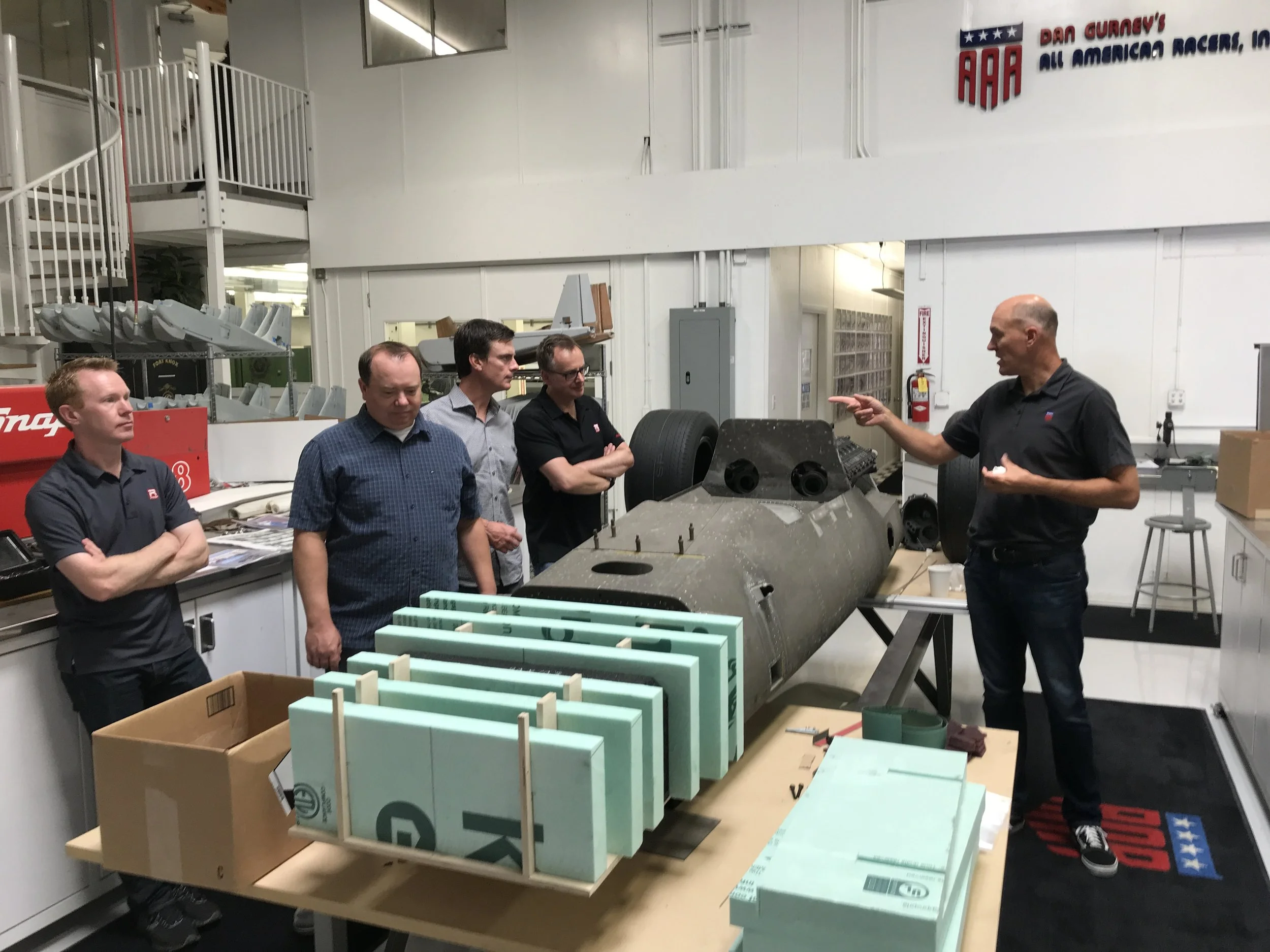
Justin Gurney shares the backstory on the Eagle Mk VI monocoque with (L-R) RACER Editor-in-Chief, Laurence Foster, Editor Mark Glendenning, SportsCar magazine Associate Editor, Jason Isley, SportsCar Editor, Philip Royle.
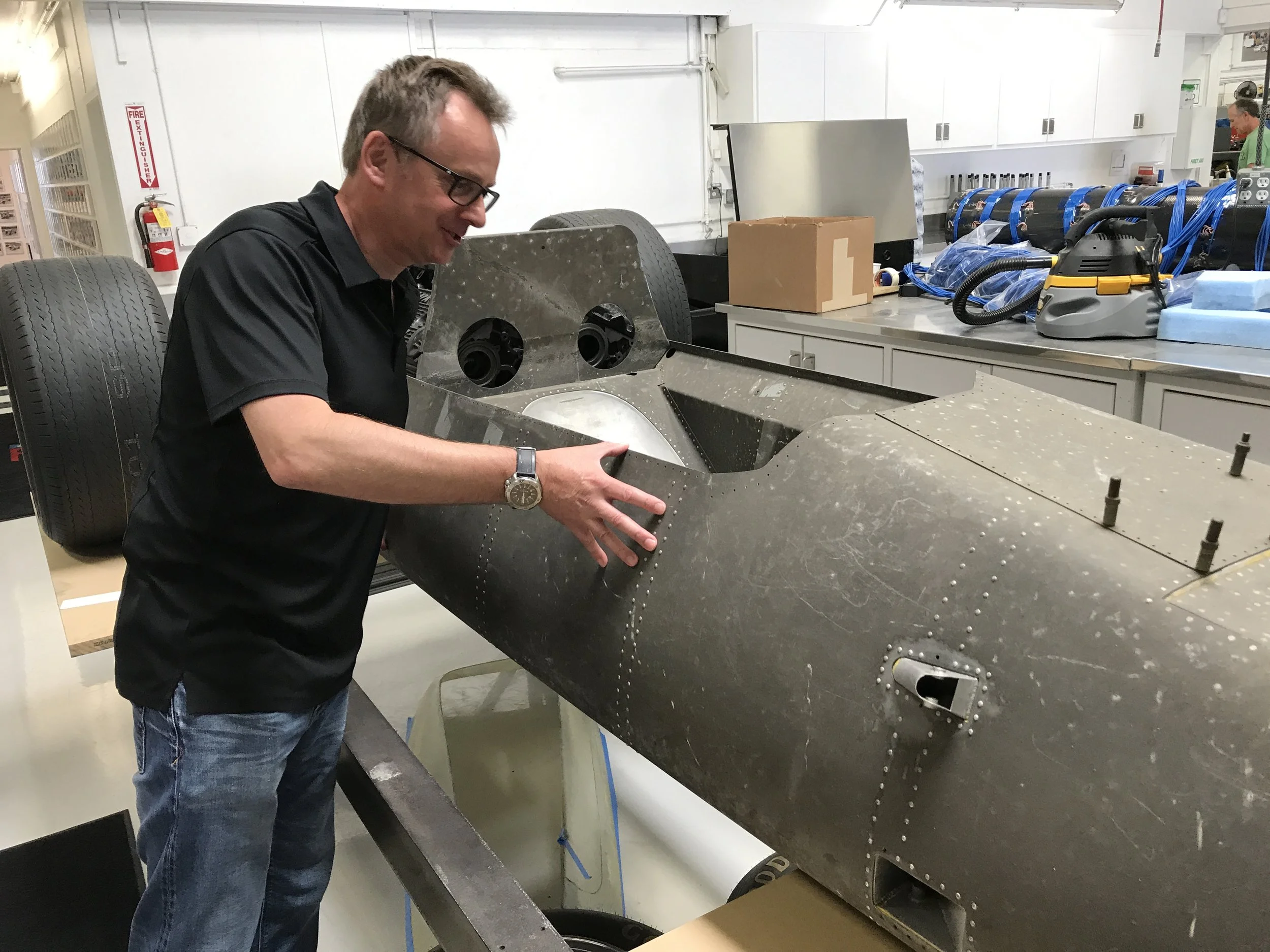
RACER Editor-in-Chief Laurence Foster, who is an also an aerospace engineer, inspects the magnesium-skinned tub of Tony Southgate’s Eagle Mk VI F1 car.
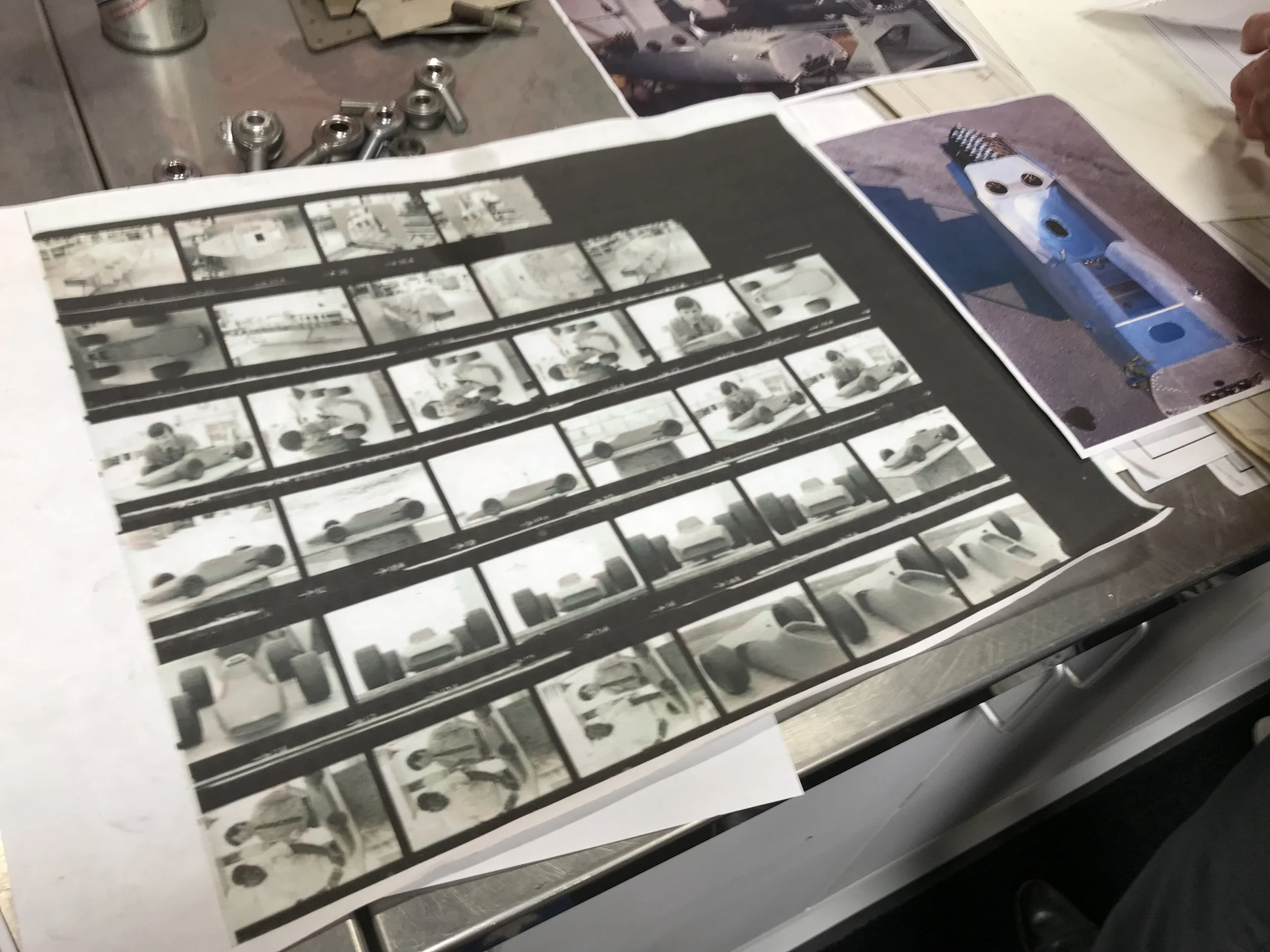
Photo proof sheets of images taken in 1968 of the completed Eagle Mk VI tub and the clay model created to visualize the shape of the car.
On April 13, 2024, Dan's birthday, they riveted the chassis plate to the frame. I keep coming back to the same reading. This car is a lost love letter to the essence of the sport, written by a man who shaped it for decades and delivered by the people who loved him. But what interests me as much as the love is the timing. This car could only be finished in a world with capabilities 1968 never pictured, by people using tools descended from the very demonstration given the season the tub went into the ceiling. In 1968, money could kill an idea on the bench. It can't do that so easily anymore, not if the idea is good and somebody keeps the thought. The rafters were a decision too. Dan kept the thought.
The bench in front of you
My motto for years has been that victory travels at the speed of thought. That tub was traveling at it the whole time it sat still.
Ten years after Dan ended the build of the Eagle Mk VI, I was sharing a house with David while he drove for Dan, and some nights I hung around the AAR shop watching him work on the Eagle into the small hours as the program wound down. Within a year, with a push from people inside that building, I'd started my own business. More of the inspirational fuel for it came out of that race shop than I fully understood at the time.
Most people I know, in racing or any other business, has a Mk VI on the bench right now. Something ambitious that money or fear interrupted. The chaos of this moment now share is real, and so is the other half of what 1968 teaches, which is that the future gets built in the same ninety days the old world burns.
There's no purpose for this Eagle now beyond the one it's serving. There's nowhere for it to race, and nobody should try. A magnesium-skinned F1 tub in 1969 was a deadly fire looking for a cruel spark, and if Dan had raced it, the era that took Clark and Schlesser might well have taken him. Thank God it never turned a lap in anger. Everything AAR built afterward exists because Dan looked at the most ambitious and dangerous thing in his shop and left it on the bench.
So the lesson cuts both ways, and you need both edges. The tools in front of you right now are the ones 1968 could only demonstrate, and the idea you've been sitting on deserves your full commitment today. But when you've carried a thing all the way to building it and the data says it could quickly end through a unacceptable risk, or a lack of the right competitive resources, you, don't strap-in. You learn from it instead.. That clarity is what keeps you alive to build the next one. Dan's proof sat in the daylight at Road America, fifty-eight years apart from the Eagle that won Spa beside it. Both of them are victories.
Pfanner Advantage works with clients to turn change into advantage at the intersection of mobility, motorsport, media, technology, and marketing. Learn more or start a conversation: contact us today.
Paul Pfanner’s recent Shift Happens Insights:
Are Creators Formula One’s Most Effective Media?
The Advantage Journal arrives every week. What matters in sport, mobility, media, and technology — curated and contextualized by Bill Sparks, Bill Long, and Paul Pfanner. No hedging. No filler. Subscribe — It’s Free

