
The Trust Problem: From Threat to Opportunity
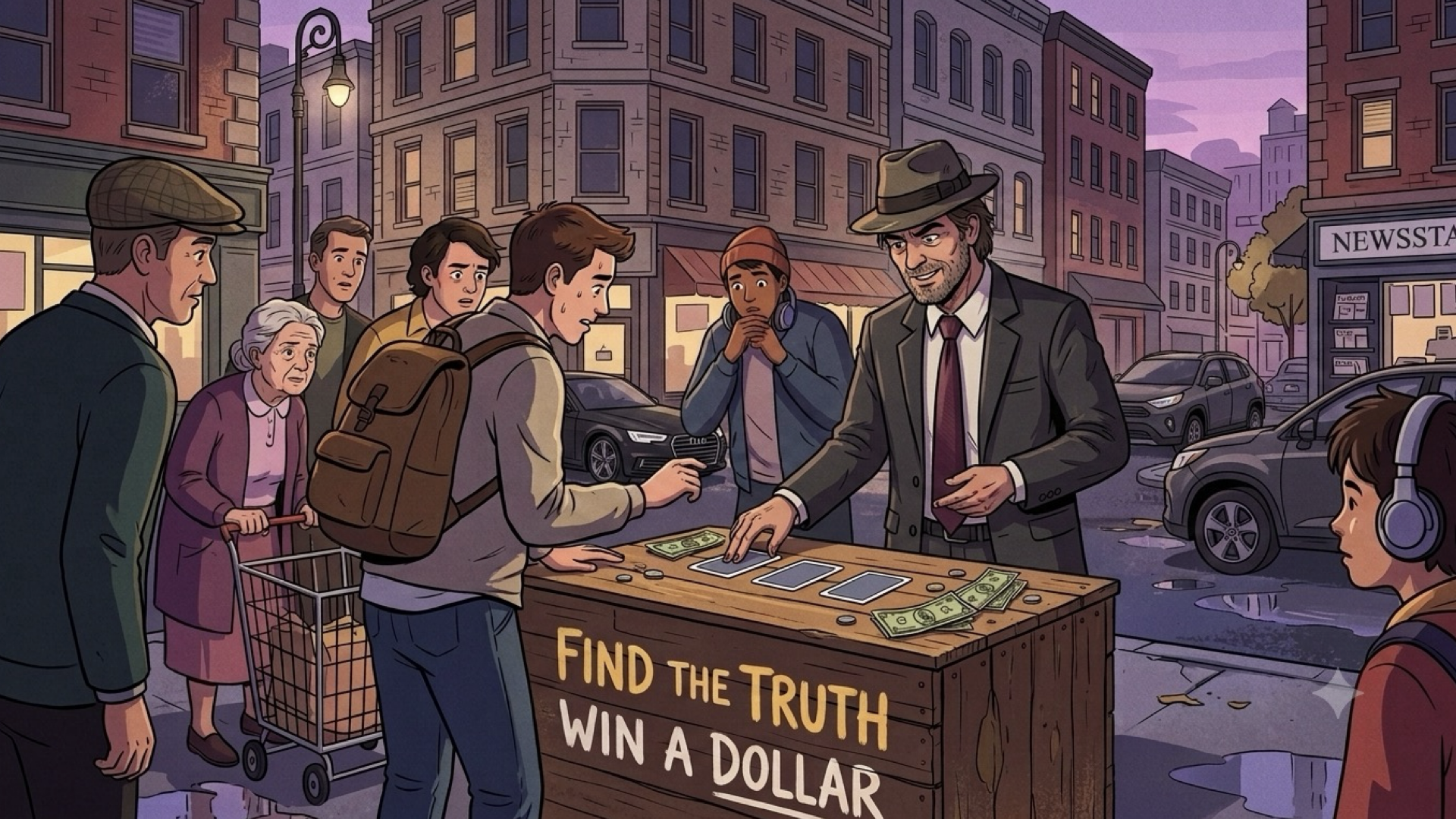
Corporations lost public trust by using their communications monopoly to play three-card monte with the truth. The internet brought that game to an end.
Part two of Bill Sparks' series on the evolution of branding. Companies have never had more ways to reach us, and audiences have never believed them less.
Here is the central paradox of modern brand storytelling: companies have never had more channels through which to reach consumers, and consumers have never been less inclined to believe what companies tell them. The techniques that built Coca-Cola, Marlboro, and General Motors into household names across a generation don't just perform worse today. In many contexts, they actively backfire.
The 2026 Edelman Trust Barometer, the most widely cited annual study of institutional trust, found that trust is, in Edelman's phrasing, "in peril," with society sliding from what researchers characterized as grievance into insularity. People aren't just skeptical of brands. They've pulled inward, trusting smaller circles and demanding that institutions prove their relevance on personal, not abstract, terms. For a company trying to tell its story, this represents something more fundamental than a shift in media preferences. It's a change in what audiences are willing to accept as true.
The End of Information Asymmetry
For most of the twentieth century, brands operated with an enormous structural advantage: they knew far more about their products than their customers did. A car company could advertise a vehicle as safe and reliable, and the typical buyer had no efficient way to verify the claim before purchase. A food company could position a product as healthy based on selective data. A hotel chain could present a curated image of its properties that bore limited resemblance to the experience of staying there.
The internet dismantled this arrangement with remarkable speed. Review platforms gave consumers a collective memory. A single bad product experience, once confined to a complaint letter that disappeared into a mailroom, could now reach thousands of potential buyers through an Amazon review, a TripAdvisor post, or a Reddit thread. Social media compressed the feedback loop further. When United Airlines had a passenger forcibly dragged from a flight in 2017, the cell phone video circled the globe before the company's communications team had drafted its first statement. The brand spent weeks recovering from an incident that, a generation earlier, might have produced a brief mention in a local newspaper.
Volkswagen's Dieselgate scandal offered an even starker lesson. The company had built a marketing narrative around "clean diesel" technology. When researchers at West Virginia University discovered that VW had installed software to cheat emissions tests, the deception wasn't just exposed. It was exposed in a way that allowed millions of consumers to understand exactly how they'd been lied to, and to share that understanding instantly with everyone they knew. VW eventually paid more than $30 billion in fines and settlements. The financial cost was staggering, but the trust cost was arguably worse. Years later, surveys continued to show the brand carrying a credibility deficit.
These are dramatic examples, but the underlying dynamic operates at every scale. A restaurant that inflates its online photos gets called out in Yelp reviews. A SaaS company that overpromises features gets dismantled in a subreddit. A fashion brand that claims sustainability while operating sweatshops gets investigated by a college student with a TikTok account. The information advantage that once gave brands storytelling power has been redistributed to the people they're trying to reach.
What the Data Says
The shift shows up clearly in the research. Nielsen's global trust studies have consistently found that the most trusted form of advertising is recommendations from people the consumer knows personally, with trust rates above 90 percent. Branded content, by contrast, hovers in a range that should make any CMO uncomfortable. Only about one in three consumers trusts brand-created content at face value, according to multiple studies tracking the metric over the past several years.

Research shows user generated content is trusted by 80 percent of consumers. Only 33 percent take brand-created content at face value.
User-generated content has filled the gap. Research compiled across multiple industry surveys in 2025 and 2026 shows that roughly 80 percent of consumers say UGC has a meaningful impact on their purchasing decisions, and they consistently rate it as more trustworthy than brand-produced content or traditional advertising. An Emplifi survey published in mid-2026 found that 93 percent of consumers say "authentic" brand engagement builds trust. They're saying they want engagement that feels real, and they can tell the difference.
Edelman's 2025 special report on brand trust, titled "From We to Me," captured a subtler evolution. For years, the marketing industry had embraced the idea that brands should take stands on social issues, champion causes, and position themselves as agents of societal change. Edelman's data suggests the audience has moved on from that. Consumers increasingly want brands to improve their personal world, not save the broader one. The shift is from "change the world" to "change my world." It's a quieter, more practical demand, but a harder one to meet with a campaign. It requires a company to actually deliver tangible value to the individual, not just signal virtue to the crowd.
The Purpose Trap
This brings up an uncomfortable reality for companies that spent the past decade wrapping themselves in purpose-driven branding. Consumers haven't stopped caring about values. But they've developed a sharp detector for the gap between what a company says it stands for and what it actually does. Academic researchers have given this the clinical name "purpose washing," and its effects are well-documented. A 2024 study published in the Journal of Advertising found that when consumers perceive a brand's activism as performative, the resulting credibility damage is worse than if the brand had said nothing at all.
The examples are abundant. Companies that posted black squares on Instagram in 2020 and then made no material changes to their diversity practices were cataloged and called out by journalists and consumers alike. Brands that ran Earth Day campaigns while maintaining supply chains with significant environmental impacts found their sustainability claims turned into punchlines. The lesson isn't that purpose doesn't matter. It's that purpose without proof is now a liability.
This is what "authenticity as the price of admission" actually means. It's not a marketing strategy. It's a prerequisite. A company that wants to tell its story in the current environment must first ensure that the story is verifiable, that its behavior matches its messaging, and that it can withstand the scrutiny of an audience that has both the tools and the motivation to check.
Patagonia Films is the outdoor brand’s owned media platform. The company produces truly useful content that reflects its customers’ values.
What This Means for Brand Storytelling
The trust problem doesn't make brand storytelling impossible. It makes it harder and more interesting. The companies succeeding in this environment have recognized that the old model of narrative control is finished and have replaced it with approaches that are fundamentally more transparent and participatory.
Some are building owned media platforms that provide genuine value rather than thinly disguised advertising. Some are partnering with creators who bring their own credibility and audience relationships. Some are building communities where customers participate in the brand narrative rather than passively receiving it. And some are using AI to personalize their storytelling in ways that make the message more relevant to the individual, aligning with the "me" in Edelman's "We to Me" shift.
Each of those approaches is the subject of a subsequent post in this series. What they share is an acknowledgment that the audience is no longer a passive recipient of the brand's chosen narrative. The audience is a participant, a fact-checker, and increasingly, the storyteller. The companies that treat this as a threat are struggling. The companies that treat it as an opportunity are building something the old playbook never could: trust that survives contact with reality.
Next in the series:
Brands as Publishers — The Rise of Owned Media
Pfanner Advantage works with clients to turn change into advantage at the intersection of mobility, motorsport, media, technology, and marketing. Learn more or start a conversation: contact us today.
The Advantage Journal arrives every week. What matters in sport, mobility, media, and technology — curated and contextualized by Bill Sparks, Bill Long, and Paul Pfanner. No hedging. No filler. Subscribe — It’s Free