
The Age of Distribuption is Now
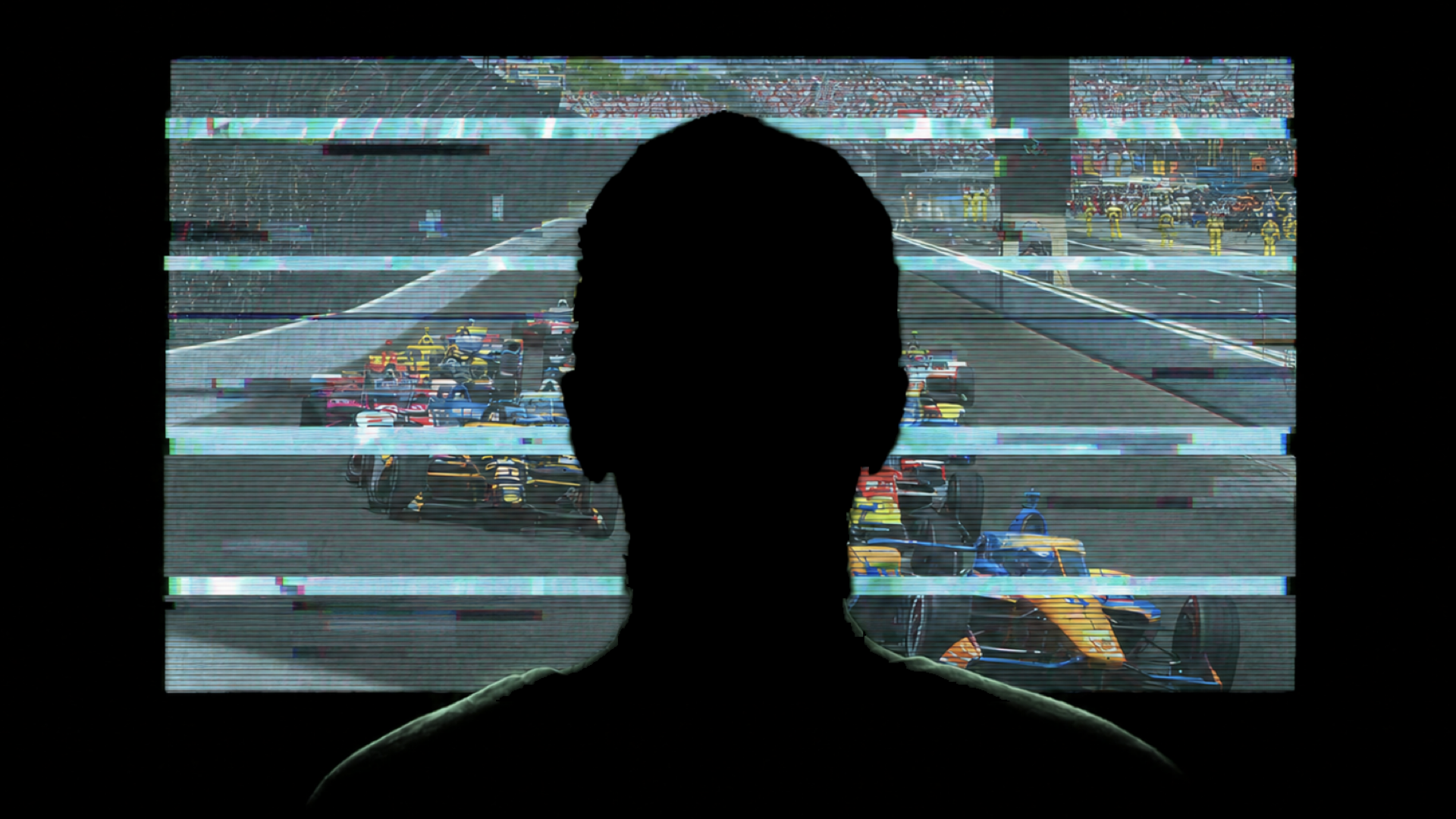
One channel used to be the whole broadcast. Now everyone is one.
Paul Pfanner created a word that came out of a 2017 assignment from IndyCar's leadership to imagine the sport's future, for a shift just starting to show: distribution itself becoming the disruption. The evidence is in now becoming visible everywhere.
Dis·trib·up·tion (n.) /dɪˌstrɪbˈʌpʃən/
The convergence of distribution collapse and structural disruption into a single simultaneous event; the moment a distribution mechanism becomes the agent of its own obsolescence. First coined February 2017. “AI Overviews didn’t disrupt media. They completed its Distribuption.“
Now the Evidence Has Arrived
The word for what is happening to every institution right now is one I made up in 2017. I called it Distribuption, and I couldn’t prove it conclusively then. The evidence has since arrived, and it is much clearer than I expected.
Start with what changed. In the old model, institutions controlled distribution. Broadcasters owned the channel, publishers owned the presses, and a racing series owned its event, its feed, and most of the story told around it. Fans got whatever they were handed. Social media broke that. Drivers spoke directly, fans passed moments around and decided for themselves what counted, and distribution stopped being the last step after you made something. It was becoming part of the thing itself. Distribution and disruption were turning into the same event.
Now the numbers. AI search answers your question without sending you anywhere. Pew found that in 2025, when Google showed an AI summary, people clicked through to a real result only 8 percent of the time, against 15 percent without one. The link inside the summary got clicked 1 percent of the time. Authority has gone personal, too. In the Reuters Institute’s 2026 survey, 76 percent of media leaders said they would push their journalists to act more like creators. The vocabulary is new. The thing underneath it isn’t.
The audience has become the infrastructure.
That holds in journalism, in sport, in any organization that assumed owning distribution was the same as owning its future. Which raises a fair question. How does a word for all of this come out of an assignment about a race car?
A Question Bigger Than the Car
In May 2016, the Indianapolis 500 ran its 100th running, closing out the Speedway's Centennial Era, a stretch of years Pfanner Communications had helped IMS leadership envision back in 2006 and 2007. That same month, Mark Miles, who was the CEO of IndyCar’s parent company, Hulman & Company. asked my friend J.R. Hildebrand to imagine what an Indy car should be for the 2020 rules era. J.R. was the right person to ask. He was racing in the IndyCar Series at the time, he had turned down MIT to go racing, and he was lecturing at Stanford’s Revs program on autonomous vehicles. He didn’t take the project on alone. He pulled in a few friends, and we called ourselves the Velocity Collective.
The Velocity Collective
Diego Rodriguez was a senior partner at IDEO, for years the most influential design firm in the world and the one that taught business to think like designers. He's a close friend and one of the finest thinkers I know, so I still wince at having once turned him down for an internship at RACER.
Clay Dean led Global Advanced Design at General Motors. I had known him since college, and he could look at a vehicle and see the machinery and the sculpture and the thing people fall for, all at once.
Reilly Brennan had edited AOL Autos and went on to run Stanford’s Revs program. He saw across transportation, media, and technology, and understood the people moving between them.
I came out of a career spent where racing, media, marketing, and publishing run into each other. Nobody assembled this group by committee. We were friends who trusted each other enough to say what we really thought, and the conversation we started in 2016 still hasn’t stopped, thankfully.
More Than a Car on the Track
On paper the assignment was a race car. It didn’t take long to decide the real question was bigger. What did IndyCar need to mean to people, and what would make them care? The emotional engine was the ghost in the machine we were searching for.
So we went outside the usual racing fan base. One meeting with the team behind Gran Turismo, a video game that had already shaped how two generations understood cars and has sold more than 100 million copies. We sat down with Hot Wheels team too, and not about a toy license. Mattel Hot Wheels makes more cars than anyone on earth, and its designers knew what a kid reaches for long before that kid knows a thing about horsepower or 0-60 times. Above all, they knew a car carries meaning.
That was the point. It was never only about what an engineer creates for a racer to optimize at speed. It was about what a young person remembers, races in a video game, and someday pays real money to see in person. The car on the track was never the whole story. The story was the presence IndyCar could build by how it behaved culturally, and by how well it treated the people who cared.
The word itself came out of the work. The afternoon before the February 2017 meeting, we ran through the presentation at Stanford, we’d produced an opening video that we realized would have stalled the discussion’s momentum, so I rebuilt my presentation about the shift in media, overnight. Somewhere in that long night, I settled on Distribuption. What it came down to was simple. IndyCar could own its trademarks and its rights. It could never own the audience’s attention, and that has to be earned again every time.
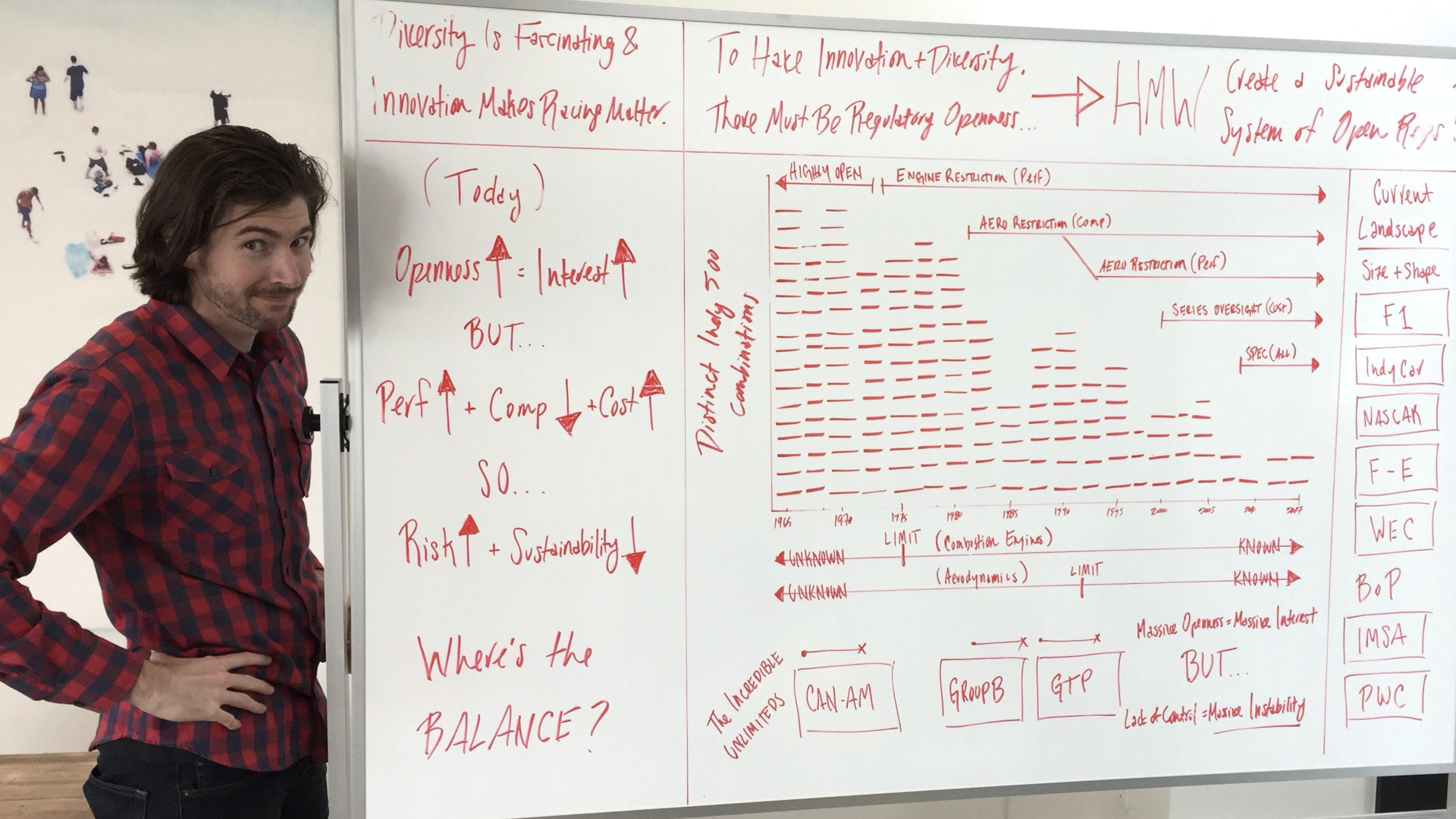
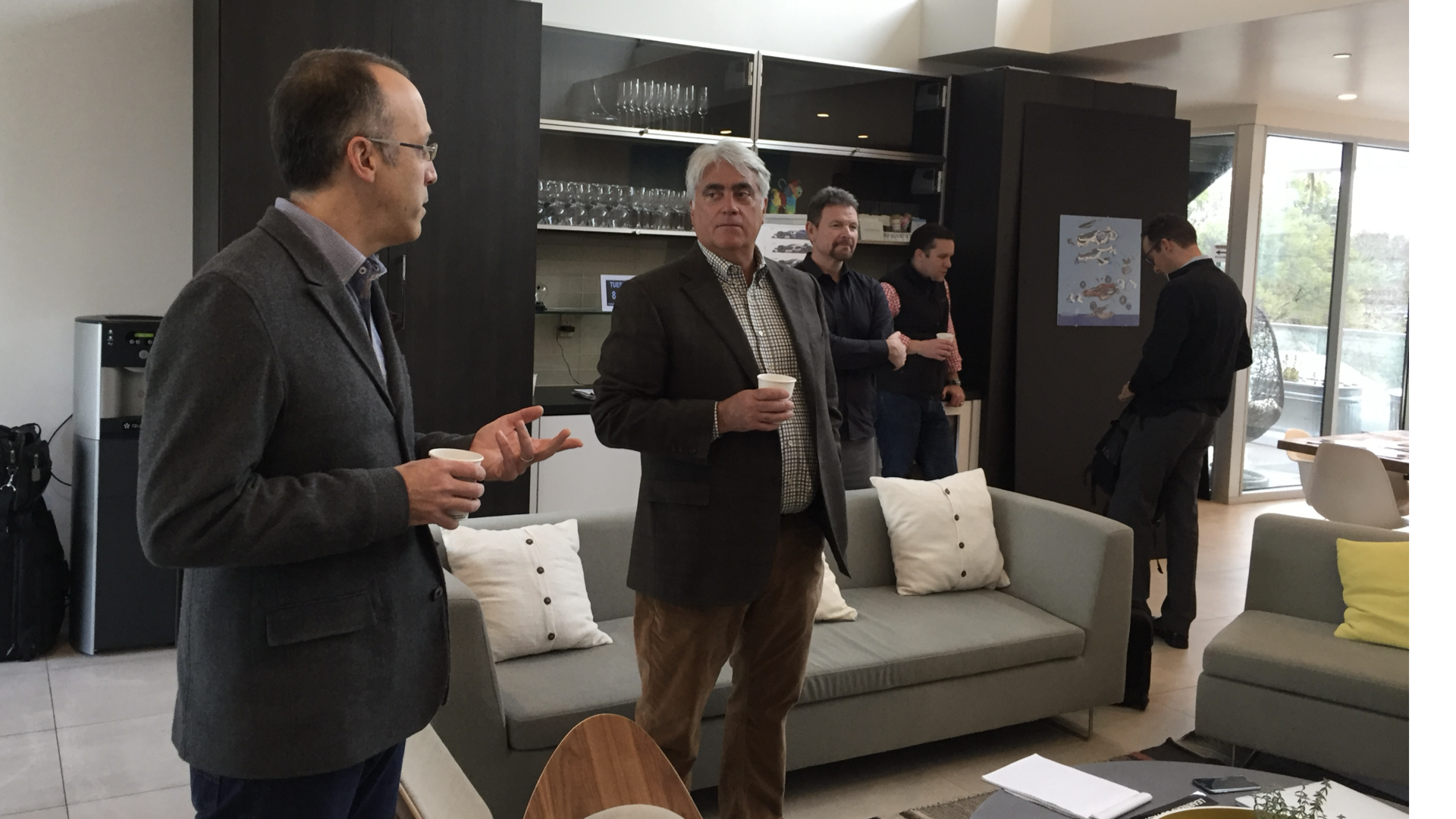
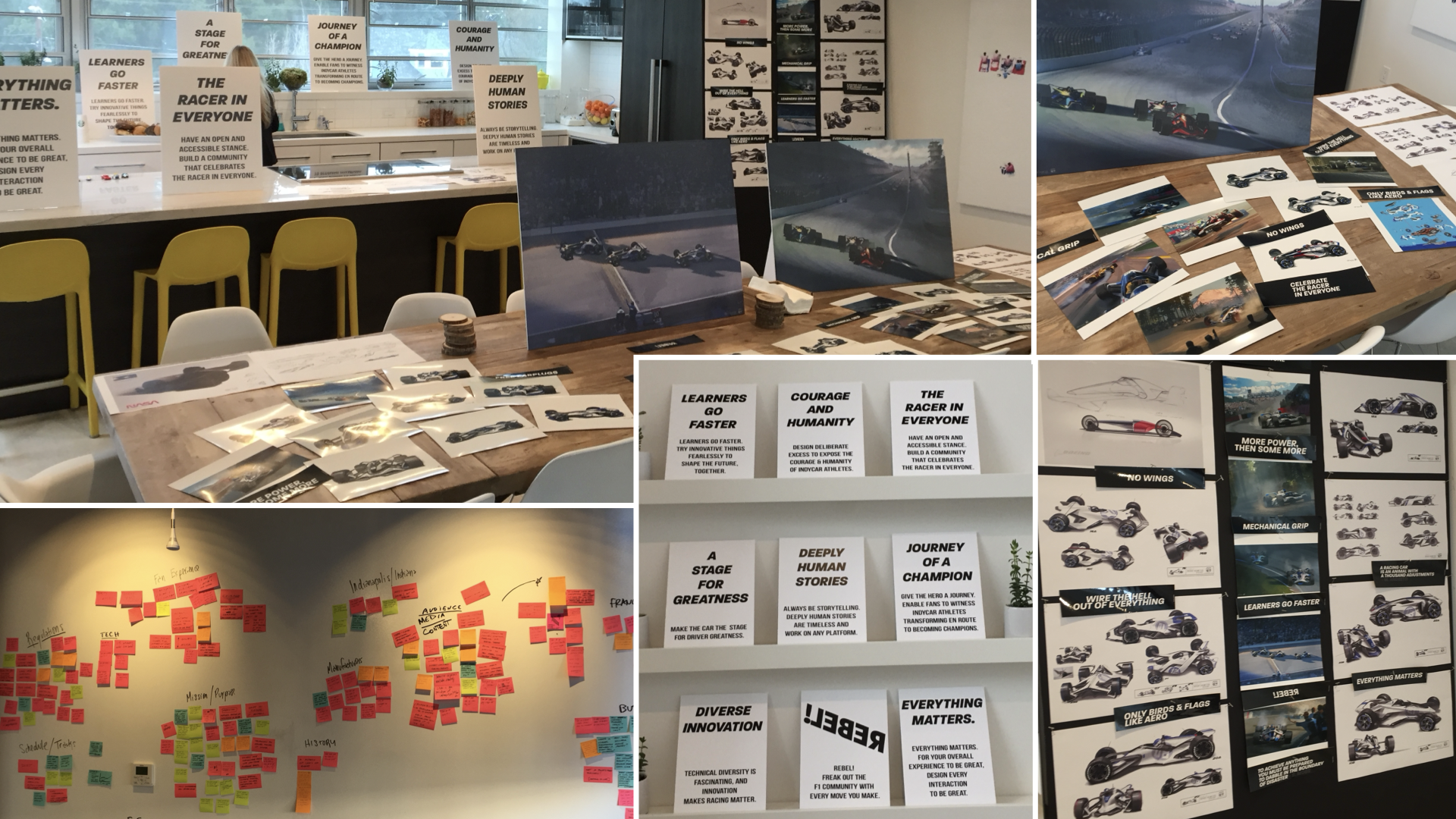
Palo Alto, February 21, 2017. My iPhone photos from the day the Velocity Collective brought its thinking to IndyCar’s leadership: JR Hildebrand at the whiteboard, Diego Rodriguez with Mark Miles, Clay Dean and Reilly Brennan nearby, and the concept boards behind the pitch. Credit to Miles, then CEO of Hulman & Company and now CEO of Penske Entertainment, for convening it. The ideas ran ahead of their moment. Nine years on, the series is averaging over two million viewers on FOX, its best start since 2008 - and the network is a co-owner.
Here’s something that never saw daylight. We made this short video in February 2017 to open a presentation to IndyCar’s leadership about where the series should go from 2020 on. The afternoon before the meeting, we parked it and took the presentation a different direction. JR Hildebrand wrote the script, and the team at Innovative i in Indianapolis edited it. Three minutes and forty-seven seconds of what we thought was coming, before it happened.
The Idea That Was Not Taken
J.R. developed the vehicle fully. The ideas didn’t make it into the 2020 evolution of the Indy car, and maybe the ideas asked for too much too soon. I don’t read that as a failure. We were asking what a car needs to do once you get past lap times and operational economics.
He never let the question go. His Blackbird 66 concept is where that thinking went next. It strips the wings, adds power, and forces the driver to work at the edge where you can see it. Car and Driver called it a radical rethinking of open-wheel racing. Right now it lives in drawings, digital models, and a manifesto, not a running car. All of us keep pushing him to build it, because it deserves to be built.
Before Penske. Before the IR28.
One piece of context matters. All of this happened almost three years before IndyCar, the Speedway, and IMS Productions were sold to Roger Penske’s organization, a deal that closed in January 2020. The sport is in different hands now, with different resources. Nothing here is a verdict on an ownership group that didn’t yet own the series.
What matters is what is in front of it. IndyCar is about to test the Dallara IR28, the new chassis and 2.4-liter twin-turbo V6, with an upgraded hybrid built for 2028. I am writing in July 2026, and the first laps are expected any day. I don’t need it to look like Blackbird 66 or our 2017 future Indy car concepts, and that was never the test. The test is whether it makes the driver’s performance more visible, gives IndyCar a presence of its own, and means something past the tech and the lap time. Will a kid recognize it, reach for it in a bin of toy cars, or stop on it while scrolling before knowing a single rule? A race car is engineering. It is also theater and identity and memory, and the best ones are all of that at once. Emotional connection is the force multiplier.
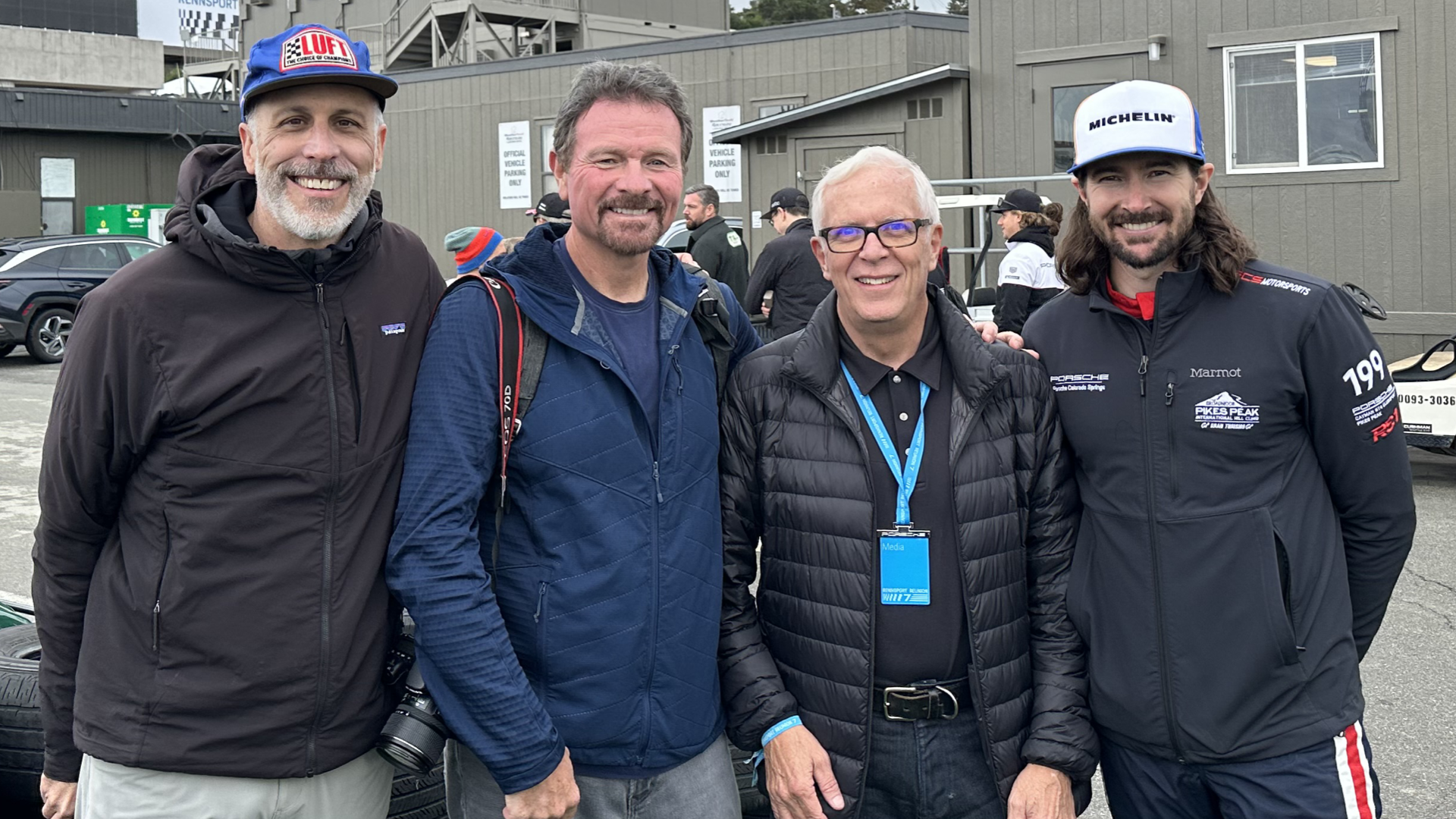
Porsche Rennsport Reunion VII, September 2023. Left to right: Diego Rodriguez, Clay Dean, me, and JR Hildebrand, in a driver’s suit under his jacket because he was racing that day, and he kicked ass. Reilly Brennan couldn’t make it. This is what the Velocity Collective looks like six years on. The meetings ended in 2017, but the conversation never did. It has carried on by text, by phone, and in person ever since, and the question underneath it, what comes next, has never gone quiet.
Where the Velocity Collective Went
All five of us have moved a good distance since 2017. Diego left IDEO to become chief product and design officer at Intuit and now sits on public boards, with LendingTree among them. Clay went to Under Armour as chief innovation officer and came back to vehicles as VP of design at Polaris. Reilly co-founded Trucks Venture Capital, which has backed around 100 companies, and writes a newsletter that reaches more than 10,000 people in the business. J.R. stayed closest to the original work, and in June 2026 he drove a Corvette ZR1X up Pikes Peak in 9:30.104, the fastest production-car time anyone has run on that mountain, by more than 23 seconds. I have kept going with RACER until the end of 2025, and I’m now refocused on building Pfanner Advantage. Careers moved, companies changed hands, families grew, and the daily thread among us never broke.
The Audience Owns the Future
We never got our car built. The argument only got more true.
Every brand now lives inside a relationship it can’t fully steer. Institutions compete with the people they used to just serve. Every technical decision gets read, sooner or later, as a statement about who you are. None of that makes leadership matter less. It puts leadership more on the hook. You can’t manufacture relevance from inside the building and expect anyone outside to feel it.
In 2017 we met in Palo Alto to talk about the future of IndyCar, and left having named a handover of power that was already underway. That handover is further along now, not finished. The work worth doing is what gets built on the other side of it.
The audience owns you and your future, not the other way around.
Postscript: Blackbird 66
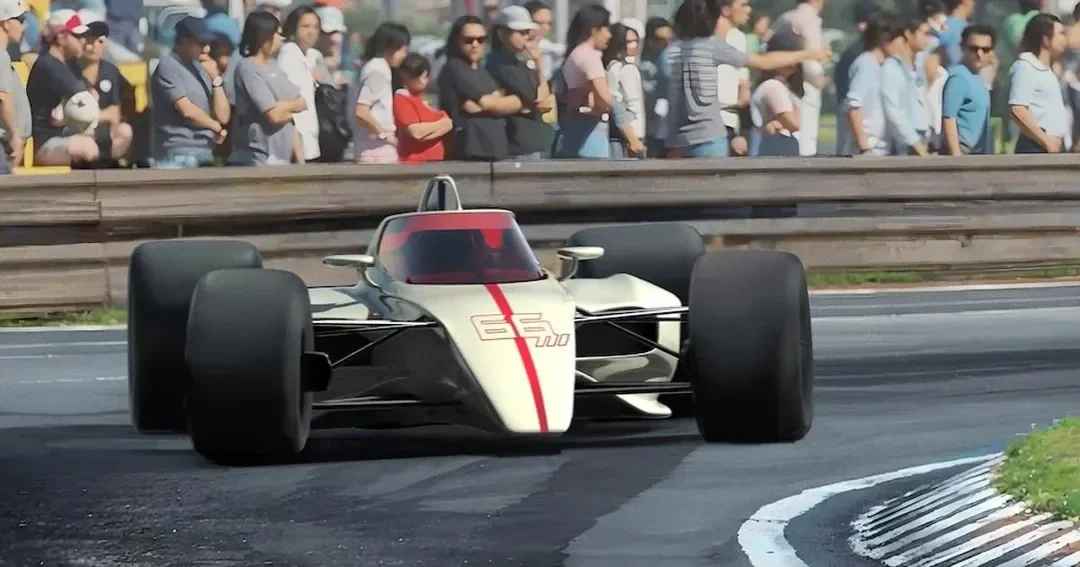
Pictured here is JR Hidebrand’s Blackbird 66, the clearest expression of where the thinking went after 2017. He took the wings off an open-wheel car and cut its dependence on aerodynamics, which throws the work back onto the driver. High downforce has spent decades hiding that work. The car sits so planted and carries so much speed that what the driver is doing disappears from view. Blackbird 66 removes that technical masking and puts the human being back at the front of the picture, visible the way an athlete is visible in any other sport. The point isn’t to make one qualifying run a spectacle. It’s to make any lap worth watching, because the person is forward in how the car is balanced and driven.
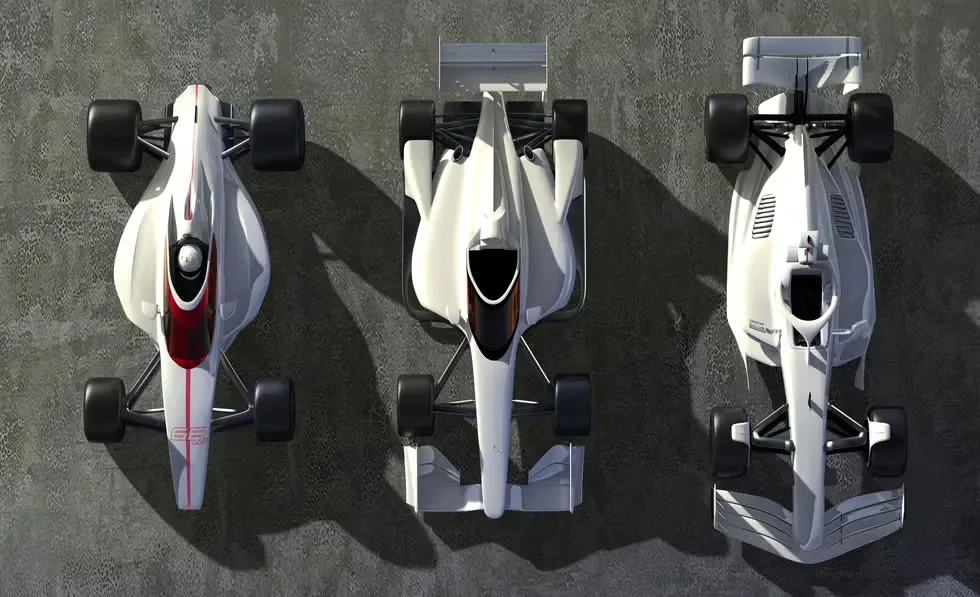
Blackbird 66 in a plan view comparison with a current Indy car and a generic Formula One car.
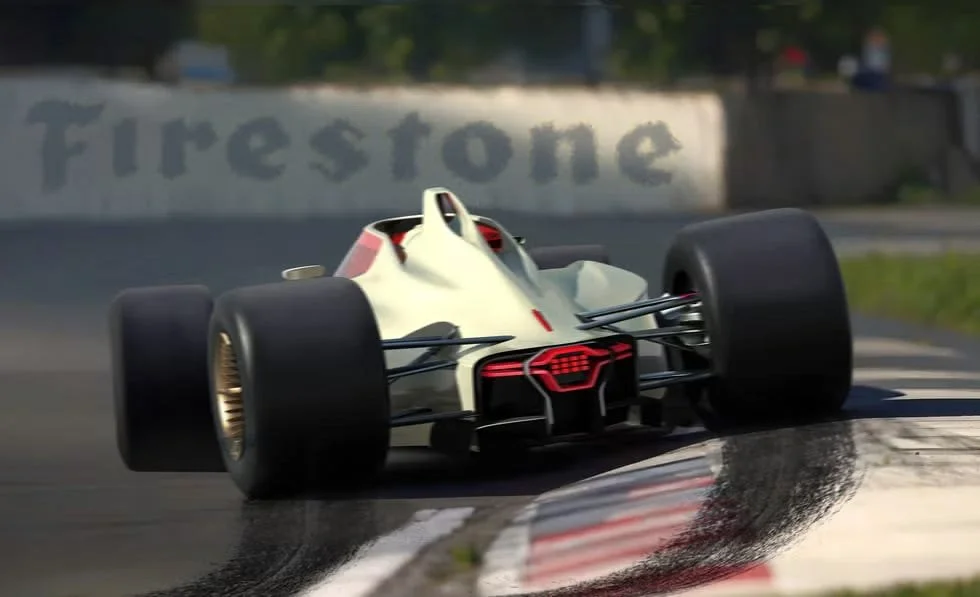
Since JR revealed it, Blackbird 66 has been covered across automotive and motorsport titles in print and online, Car and Driver, Motorsport, and RACER among them. For now it lives in renderings and a manifesto. JR fully intends to change that. He means to see this car built, and those of us who were there with him in 2017 will encourage him until he does.
Pfanner Advantage works with clients to turn change into advantage at the intersection of mobility, motorsport, media, technology, and marketing. Learn more or start a conversation: contact us today.
Paul Pfanner’s recent Shift Happens Insights:
Are Creators Formula One’s Most Effective Media?
The Advantage Journal arrives every week. What matters in sport, mobility, media, and technology — curated and contextualized by Bill Sparks, Bill Long, and Paul Pfanner. No hedging. No filler. Subscribe — It’s Free

