
Are Creators Formula One’s Most Effective Media?
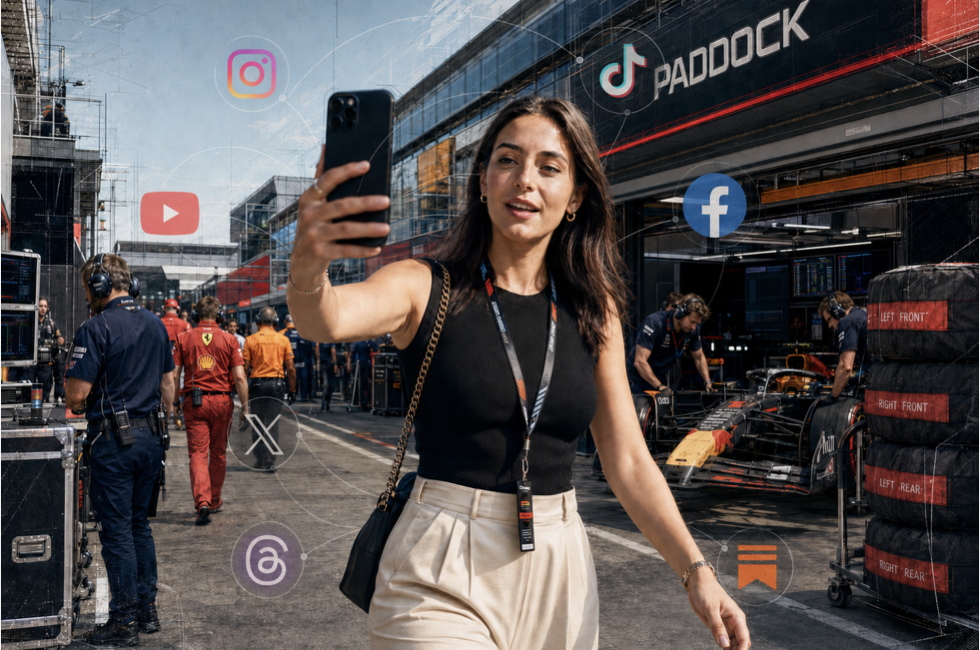
Formula One creators have built their own distribution networks, reaching new audiences and giving fans a more personal way into the sport. An invited Formula One creator in the paddock under a team, promoter or commercial-partner content arrangement.
Racing was once sold as “The Sport of the Seventies.” Fifty years later, Paul Pfanner explains why creators are reaching the audience its old media never could.
Five Rolls of Film
On March 28, 1971, I walked into Ontario Motor Speedway using a press credential I had made myself. You could say that I simply forged ahead. Just five high school pals on a miscreant adventure with fake credentials. We had a Super 8 movie camera, and five rolls of film.
Let’s just say we were “creators” before that meant what it does today. I had no reason to think any of this would soon become my life.
We wanted to share what we saw. Regrettably, the film was lost for more than 45-years. The first video made from that film did not appear until September 4, 2020, only 18,459 days after our production began. Thankfully, the ease of content production, distribution and asset storage has improved dramatically in the 21st century.
The event was the Questor Grand Prix, a one-off match race between Formula One and Formula 5000. Mario Andretti won both heats in a Ferrari. The speedway was new, enormous and expensive. It was supposed to represent the bright and ambitious future of American racing.
People were calling auto racing “The Sport of the Seventies.” Ontario Motor Speedway was built around that promise. It is long gone, demolished in 1981 and almost forgotten.
Two years later, I was part of the group that created FORMULA, an American magazine covering Formula One and road racing. The first issue appeared in October 1973, the same month the Yom Kippur War began and the Arab oil embargo followed. Gasoline shortages and an energy crisis were terrible timing for a sport attempting to establish itself as the next big thing.
FORMULA struggled for most of its life. I have since checked the circulation. It never reached 10,000 real readers and was probably much lower. The publisher claimed more, but those figures did not represent the magazine’s actual circulation. It became RACECAR in 1979 and published its final issue in October 1980.
I care about that magazine. It helped start me in this business, and I am proud of the work we did. I also have no reason to pretend it was an efficient way to reach people.
We spent weeks producing an issue that went to a small audience. The reader could not respond in real time, share it with thousands of other people or start a conversation with us. We published. They read. That was about it.
From 10,000 Copies to Billions of Engagements
Compare that with Formula One now.
Its official social platforms generated more than 2.3 billion engagements in 2025 and reached 114.5 million followers. At the Las Vegas Grand Prix alone, 1,200 creators produced 5,000 posts and 1.8 billion impressions. Those are not the same measurements as magazine circulation, but the difference in speed, reach and response is hard to miss. Formula 1’s 2025 digital figures
So when I hear longtime media people or older fans complain about all the creators in an F1 paddock, I think they are looking backward.
Creators are among the most effective media Formula One has.
They reach people immediately and personally. With a phone, some knowledge and a point of view, they can take someone inside the paddock. They can also reach people traditional motorsport coverage never understood very well.
The Audience Motorsport Missed
The change among women may be the most important result.
Formula 1 says its global fan base reached 827 million in 2025 and 42 percent of those fans were women, up from 37 percent in 2018. It added 43 million women fans in one year.
Women accounted for 48 percent of all new Formula One fans.
For a sport that spent most of its history talking primarily to men, that is a breakthrough. Women and girls make up almost half the world. Motorsport treated them as a niche audience for far too long.
I have said for years, long before social media, that women were the key to unlocking the real potential of motorsport. At the time, I was thinking mostly about women competing. I still want to see that. What I had not considered fully was the importance of fandom as the place where involvement often begins.
A Different Sport to Invite People Into
The sport these new fans are discovering is also very different from the one I entered in 1971.
During the 1970s, eight drivers died from crashes at Formula One World Championship weekends. Eight other people were killed in on-track incidents: four at the 1975 Spanish Grand Prix, a track worker at the Austrian Grand Prix later that year, a marshal in South Africa in 1977, and a marshal and photographer at the Japanese Grand Prix that same year.
The wider Formula One toll was higher because that count leaves out drivers killed in testing and non-championship races. Jo Siffert had raced at Questor. Seven months later, he was killed in a non-championship Formula One race at Brands Hatch.
Sixteen people died during Grand Prix weekends in the 1970s. The comparable on-track number for this decade is zero.
Formula One remains dangerous. It always will be. But death is no longer treated as a normal cost of doing business.
That changes who can feel welcome around the sport. It also changes which companies are comfortable being associated with it. Formula One’s official partner count grew from 12 in 2020 to 31 in 2025. LVMH began a 10-year global partnership that includes Louis Vuitton, TAG Heuer, Moët & Chandon and several other brands.
Safety is not the only reason for that growth. It is hard to imagine fashion, luxury and other aspirational brands making commitments on this scale if Formula One still looked like a meat grinder surrounded by beautiful cars.
What Happened Is Easy to Find
The way information moves has changed just as much.
The results, qualifying order, lap times and championship points are available instantly from Formula One, the FIA and the teams. AI can organize that information and explain the basic facts in seconds. Nobody needs to wait several weeks for a magazine to report who won.
The harder work is explaining why something happened. That still requires access, reporting and judgment. There is less of that work than there should be, which makes it more valuable.
Creators are filling a different need.
They show people what it felt like to be there.
That experience can turn someone watching on a phone into someone who wants to attend a race. It gives people a way to imagine themselves inside the sport.
Fashion and design may be part of that connection. So might a driver’s personality, the engineering, the competition or a creator whose way of seeing Formula One feels familiar. Nobody has to justify the reason the sport first caught their attention.
This is what I find so interesting about the influx of women creators. They are making Formula One relatable to people traditional coverage rarely reached. They understand their audiences and talk about the sport in their own language.
You Never Know Where a Fan Will Go
You do not have to strap yourself into a racing car to appreciate racing. You need a reason to care. Once that connection is made, you do not know where it may lead.
That forged credential was fandom becoming participation.
I wanted to be a racing driver, and I eventually did race. But most of my life in the sport happened in media and marketing. My enthusiasm took me somewhere I could not have predicted when teenaged me walked into Ontario Motor Speedway that Spring morning so long ago.
The same possibility exists for every new fan.
A woman may first find Formula One through a creator and eventually work in media, marketing, design, engineering or team management. She may become an owner or a driver. She may remain a fan for the rest of her life. Every one of those outcomes matters.
Women belong at every level of the sport. Fandom is often where that journey begins.
As the father of two daughters born in this century, that means more to me than an audience statistic. Sofia and Eden have followed very different paths, but neither grew up believing gender should define the size of her ambition. I want motorsport to meet them and every other woman on those terms.
I understand nostalgia. There are periods of racing I miss too. But I do not miss the deaths, the cultural barriers or a media system that allowed a good magazine to work very hard to reach fewer than 10,000 people.
An Inspiration Business
Racing isn’t just an entertainment business. Racing is an inspiration business.
That is the most powerful thing it does. It changed the direction of my life.
Now it is reaching millions of people the sport overlooked for most of its history. I want to see where their enthusiasm takes them.
Pfanner Advantage works with clients to turn change into advantage at the intersection of mobility, motorsport, media, technology, and marketing. Learn more or start a conversation: contact us today.
Paul Pfanner’s recent Shift Happens Insights:
The Advantage Journal arrives every week. What matters in sport, mobility, media, and technology — curated and contextualized by Bill Sparks, Bill Long, and Paul Pfanner. No hedging. No filler. Subscribe — It’s Free

