
Jeff Krosnoff Has Been Gone Almost as Long as He Lived
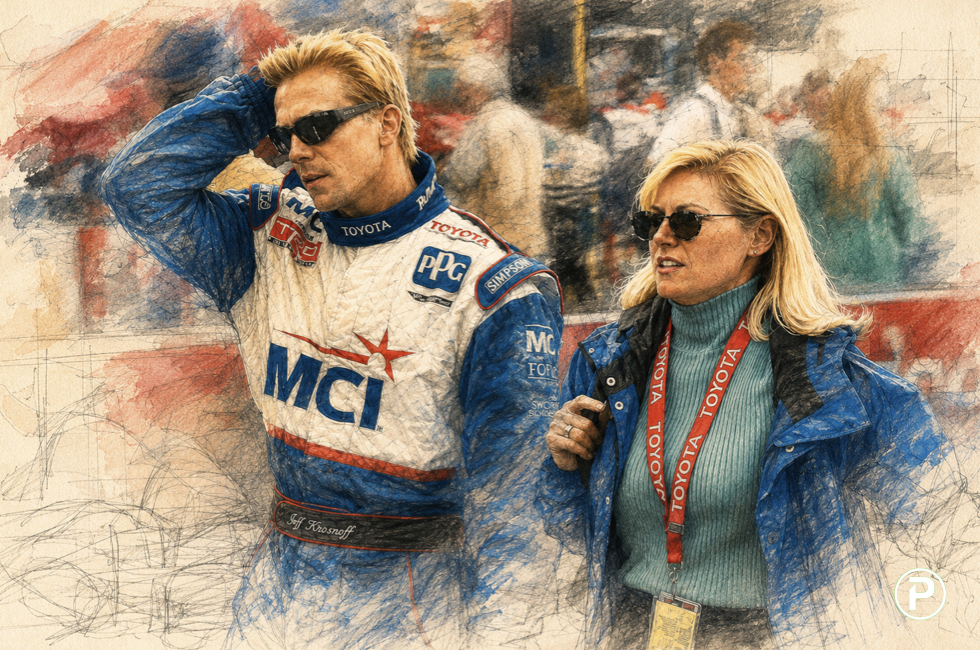
Jeff and Tracy Krosnoff walk through the Toronto paddock during the final race weekend of Jeff’s life, still looking ahead to everything they believed was yet to come.
Thirty years after Jeff Krosnoff was killed at Toronto, RACER founder Paul Pfanner remembers his friend, a gifted driver and a far bigger man than that, whose life had barely gotten started.
The Things That Came Home
Jeff Krosnoff's iconic helmet is here at home with me now. So is one of the driving suits he wore during his 1996 IndyCar season.
For years the helmet sat in a glass case in the lobby at RACER. It was the one Jeff wore at Le Mans in 1994, the year he and Mauro Martini and Eddie Irvine came painfully close to winning for Toyota. Every time Jeff came by the office, he'd check the case to make sure his helmet was still sitting a little higher than everybody else's.
He was joking. Not entirely, but joking.
The suit got to me a different way. My friend Jacques Dresang, a fellow Formula Ford racer who idolized Jeff, bought it at auction and later brought it to me. He figured it belonged with somebody who'd known Jeff and loved him.
I've never thought of the helmet and the suit as memorabilia. They belonged to my friend.
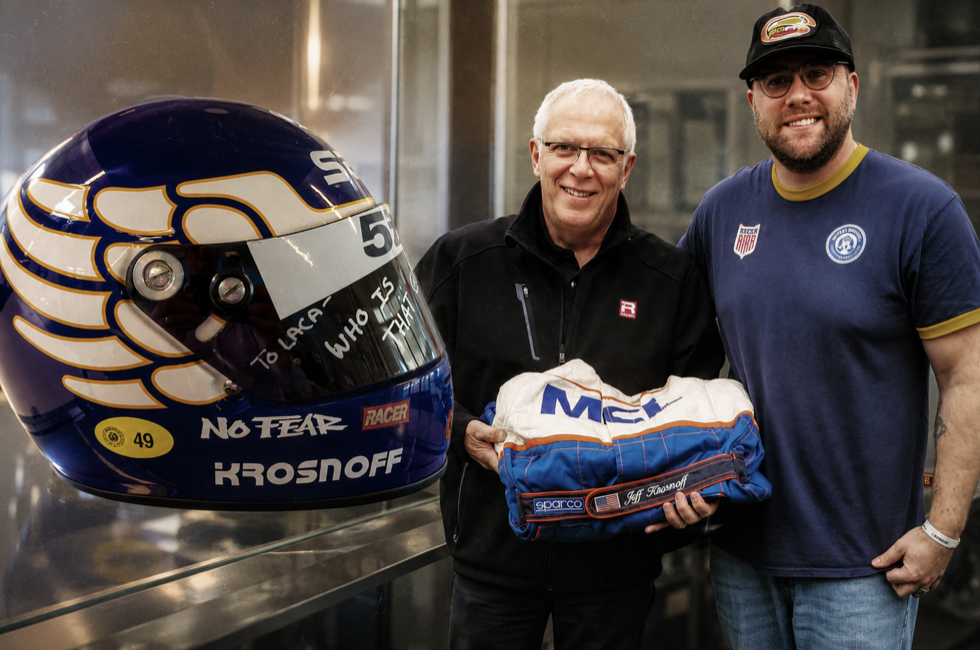
Jeff gave me his helmet in January 1996. Twenty-three years later, at the 50th Anniversary of American Formula Ford celebration at Road America in September 2019, fellow racer Jacques Dresang presented me with one of Jeff’s 1996 driving suits. Today, both are here at home with me.
The week before the 1996 Toronto race, Jeff and his wife Tracy came by the office to see me. Donna and I were close to both of them, and the four of us spent a lot of time together. That last visit was the usual, a lot of laughing and a lot of needling. Jeff thought the Toyota engine in his Arciero-Wells Reynard was finally coming to him, and he was hopeful about Toronto.
And yes, he checked the case.
Before and After July 14
On Sunday, July 14, 1996, I was in San Diego, helping my friend Nick Craw, the SCCA's president and CEO, interview Dennis Dean for an important job at the club.
It wasn't like me to take a meeting on a Sunday. But Jeff was in Toronto and I wasn't, and there were no smartphones or live timing then, so when we finished I walked out to my car wanting to know how the race had gone.
It was a hot afternoon. I opened the door of my BMW, checked my Motorola StarTAC, and saw that Jim Hancock had left a message. Jim was the brand savant at No Fear, the apparel company that, fittingly, had a relationship with Jeff.
“Paul, call me about Jeff's accident. It's bad.”
I called him back from the parking lot.
Jeff died that afternoon. So did Gary Avrin, a volunteer corner worker hit in the same crash. He was somebody's whole world too, and I won't tell this story without his name in it.
For the first time in my life, I fell out of love with racing.
I watched Tracy face something no young wife should ever have to face. I watched Cal Wells and Jeff's crew try to hold her up, and hold each other up, and somehow get ready to go back to the very thing that had just killed their friend.
I'm still close to Cal, and I have enormous respect for the way that team carried Jeff with them afterward. Their PR rep, Heather Handley, was very young, and all at once she was handling the unthinkable, the calls and the press and the questions nobody should have to answer at that age. She did it with real grace. Jeff loved those people. The team and the new Toyota engine weren't ready to win in 1996. They got there. Jeff should have been there for it.
He Was Ready
Jeff spent most of his career in Japan, which was the road you took when you had a lot of talent and almost no money. He made himself into a superb development driver and came a lap or two short of winning Le Mans. He was quick, he was fit, and he understood the engineering well and the race engineers respected him. He had everything the top level asks for.
Mike Hull knew it. Mike is one of my closest friends and one of the people I've learned the most from. He runs Chip Ganassi Racing now, as managing director. Back then he was Chip's team manager, and he has always had an eye for talent. He'd been watching Jeff for a good while, and he made it his business to get him in front of the right people. In October 1995 he brought Jeff to the new circuit at Homestead to test for Ganassi against Alex Zanardi.
Jeff got there straight off a race in Japan and a night flight across the Pacific. He was wrung out, and I'd guess he left a fair amount of his usual spark somewhere over the ocean. Even so, he was right there with Zanardi. Mike has told me recently that Jeff was quicker.
Chip took Alex, which was his call, and it turned out to be a great one. But nothing about that took anything away from what Jeff did. He'd flown halfway around the world, climbed into an Indy car he'd never sat in, at a track he'd never seen, and run with the man who got the seat.
A week later he was back at Homestead for the Arciero-Wells test, and this time he got the ride he'd chased for years. Mike opened the door. Cal and Toyota walked him through it.
I've always believed Jeff would have won an IndyCar race, given time. His timing was just rotten. The 1996 season was the first year of the split between CART and Tony George's new Indy Racing League, and Jeff had finally made it home to race Indy cars right as the Indianapolis 500 was pulled out from under the side of the sport he was racing on.
Toyota was building its CART engine from nothing at the same time, so he wasn't in a car that could show anybody what he really had. He knew that, and he didn't sulk about it. He read the technical side better than almost anyone, and he could learn faster than the car was improving.
Jeff’s motto was “Stay Hungry”, borrowed from Arnold Schwarzenegger's mindset of avoiding comfort and embracing hunger for success.
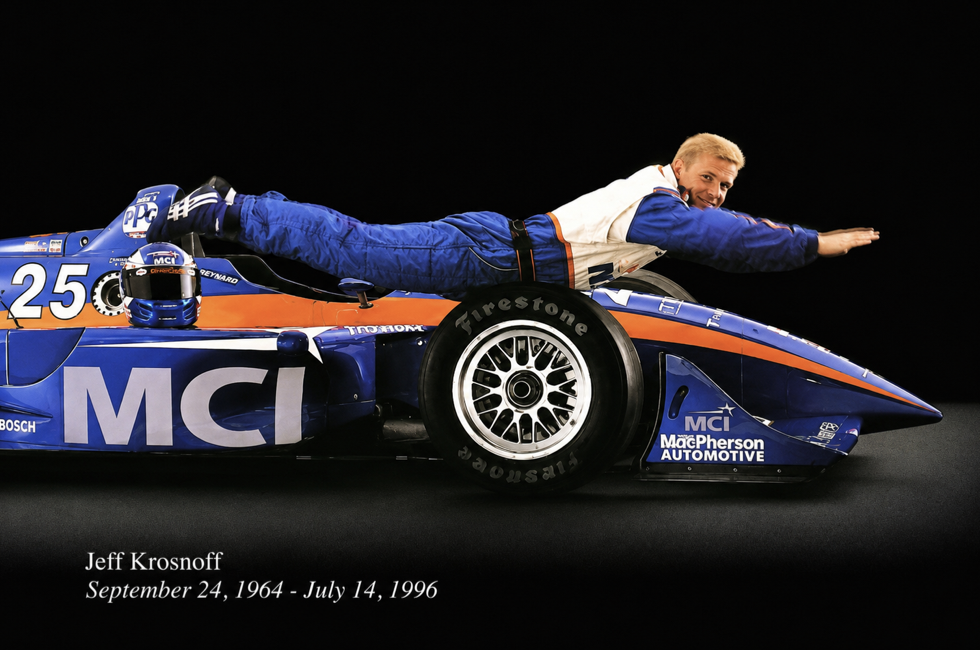
During a photo shoot with my friend and collaborator Rick Graves to introduce the new MCI sponsorship on Jeff Krosnoff’s Reynard 96i Toyota, Jeff did what he so often did — turned a formal moment into something playful, balancing himself in a Superman-in-flight pose on the car’s front wheel. The image later became the cover of Jeff’s memorial program.
More Than a Driver
That hunger to learn was one of the truest things about him. He wanted to know how everything worked, not just the car but everything around it, the team, the sponsors, the whole business the sport sits on. We used to talk about what he'd do when the driving was over, and how all of it might matter somewhere other than the cockpit.
Jeff could write, too, and I don't mean for a race driver. He wrote for a few of my magazines, and it never read like the dutiful column somebody files to keep a sponsor happy. He noticed things, people and small details and the plain absurdity of racing life, and he knew how to turn any of it into a story.
He played drums in a band called Mach V that he'd put together with some other racers. Music, photography, whatever it happened to be, if there was something in it to figure out, he wanted in.
He was also a total goof. Not many people have made me laugh as often or as hard. There was real mischief in him. When he was racing and testing in Japan, he'd call me at 3:30 in the morning from what he swore was the free phone in the Suzuka press room.
“Wake up, you bloody wanker!”
Then he'd tell me all about the car and the test and whatever he and Mauro Martini and Eddie Irvine and his good friend Roland Ratzenberger had gotten up to. Sooner or later it always came back around to home, and to how much he missed Tracy. That's where he really lived. Coming back to race in America was never only about reaching Indy cars for him. It was about building the career without being half a world away from his wife.
The Conversations That Stay With Me
When Roland was killed at Imola in 1994, the day before Ayrton Senna, Jeff and I talked about it for a long time. Roland wasn't just some driver Jeff had crossed paths with. He was one of his closest friends anywhere. Losing him put the danger right up in Jeff's face, and there was no pretending anymore that talent or preparation kept a person safe.
Two years later, Scott Brayton was killed at Indianapolis. I'd known Scott since his Formula Ford days. We weren't close, but I liked him, and his death hit me harder than I'd have expected. He'd just done one of the biggest things a driver can do, put his car on the pole for the Indianapolis 500. Six days later he was killed practicing in a backup car. He never got to lead the field to the green.
That was one of the things Jeff and I kept turning over. I remember sitting on the kitchen floor with Pokey, my dog. Jeff always made a fuss over her when he came to visit. The phone was against my ear and the two of us were trying to make it add up. Then John Menard asked Danny Ongais to take Scott's seat. Danny had been our very first client at Pfanner, Catheron & Brown Publications back in 1979, with his Interscope Racing shop right across the parking lot from us. Now here he was, years off the front line, going back to Indianapolis under about the worst circumstances anybody could draw up. That got into the conversation too, the way a life in this sport could stop cold, or start back up out of nowhere, with almost no say from you.
None of this was theoretical for Jeff. Roland was already gone. Now Scott. He knew the same thing could come for him. And he told me, in the same conversation, that he and Tracy wanted children. He wasn't making his peace with dying. If anything it was the opposite. He'd looked straight at the risk and still saw a long life on the far side of it, the one he fully intended to go live.
What Racing Learned
It’s hard now to look back at the 1990s and take in how often the sport handed us another death to absorb. In Formula One, Roland Ratzenberger and Ayrton Senna were killed on the same weekend at Imola. In America’s top open-wheel championships, Jovy Marcelo, Scott Brayton, Jeff, Gonzalo Rodríguez and Greg Moore all died in testing, practice, qualifying or a race across that decade.
Seven drivers, in just those two categories of the sport. And it was never only the drivers. Two course workers were killed at those same races in the same years, Jean-Patrick Hein at Vancouver in 1990 and Gary Avrin at Toronto in 1996. Volunteers, both of them..
It reached the grandstands, too. Six fans were killed by flying debris before the decade was out, three at a CART race at Michigan in 1998 and three at an IRL race at Charlotte in 1999. The wheel tethers and the taller, curved catch fencing we take for granted today came straight out of those two afternoons.
So far this decade, neither Formula One nor IndyCar has lost a driver or a course worker at a race weekend or a test. There have still been terrible crashes and bad injuries. But we've watched drivers walk away from hard hits that would have killed them for certain a generation ago. That came from safer regulations, stronger tubs and better barriers and safer circuits, from the HANS device, from medical crews that reach a driver in time, from the halo and the aeroscreen. Some of it came late, and all of it was paid for in full by those lost. But the sport did learn.
The American open-wheel world that was tearing itself in half when Jeff got home came back together in 2008, and IndyCar is pulling crowds it hadn't seen in years. Formula One is bigger now than the sport ever was, and sports car racing, where Jeff did some of his best work, has never been healthier.
Jeff would have loved all of it. He'd have understood the racing, of course, but he'd have been just as sharp on the business and the technology and the way media and money were bending the whole thing into a new shape. He'd have had questions. He'd have had opinions, loud ones. He'd have written it all down, and he'd have talked somebody into handing him a job that didn't exist yet. He'd never have watched this era from the cheap seats. He'd have gotten right into the middle of it, the way he always did.
Still Making Me Smile
Jeff was 31 when he died. This July, he's been gone 30 years. He's been out of the world now almost as long as he got to be in it.
I have a hard time making that sit still in my head, because the Jeff I knew was so full of the next thing. More races, sure, but also more writing and drumming and photographs, a real career in the business someday, kids with Tracy, a whole crowd of people he hadn't met yet.
I have a short video I shot in my backyard in July 1995, when Jeff and Tracy came to visit. Jeff looks into the camera and makes faces and clowns around. Nothing of any importance happens in it, which is probably why it captures him so well. He was just kind and fun to be around.
In this video he isn’t any of the Jeffs people knew from a distance. Not the determined racer grinding out a career in Japan, not the one who came a whisker from winning Le Mans, not the rookie with everything still to prove. He’s just Jeff. Young, laughing, completely alive. My dog Pokey makes a cameo appearance. She loved him.
That video means as much to me now as the helmet or the suit. Maybe more. The helmet stands for what he accomplished, and the suit for the driver he'd finally become. The video just hands him back to me for a minute.
He'd have won races. I have no doubt about that. But he'd have done so much more, too. He'd have made a pile of new friends and gotten every one of them with some prank or other and had them all laughing about it, and I doubt he'd ever once have managed to take himself seriously for more than ten minutes at a stretch. Most of all, he should have gotten to grow old, to raise the family he wanted, to find out about the whole rest of his life that none of us, Jeff least of all, could see coming.
The driver he might have become was only ever part of what we lost.
The helmet and the suit are here with me, and I'm grateful to have them. But when I want the man himself back for a minute, it's the backyard video I go to. He looks into the camera and starts making faces.
Thirty years later, he still makes me smile.
Epilogue
One more thing, and then I will let Jeff go for now.
On paper, 1996 was a good year for me. My businesses were booming and new investment was in. But my wife had left me. Donna and I were divorced, and she was the person I loved, and who helped make RACER happen. No amount of good news touched that core sadness.
Losing Jeff brought both of us back to the same simple truth. All we really have is now. Use it or lose it. Not long after, Donna and I got back together. We have two daughters now who turn 25 this summer, and when I look at them I think of Jeff, because a life like theirs is what he wanted for himself and Tracy. Losing him is part of why we have the life we do.
Pfanner Advantage works with clients to turn change into advantage at the intersection of mobility, motorsport, media, technology, and marketing. Learn more or start a conversation: contact us today.
Paul Pfanner’s recent Shift Happens Insights:
The Advantage Journal arrives every week. What matters in sport, mobility, media, and technology — curated and contextualized by Bill Sparks, Bill Long, and Paul Pfanner. No hedging. No filler. Subscribe — It’s Free

