
IMSA: The Future is Now.
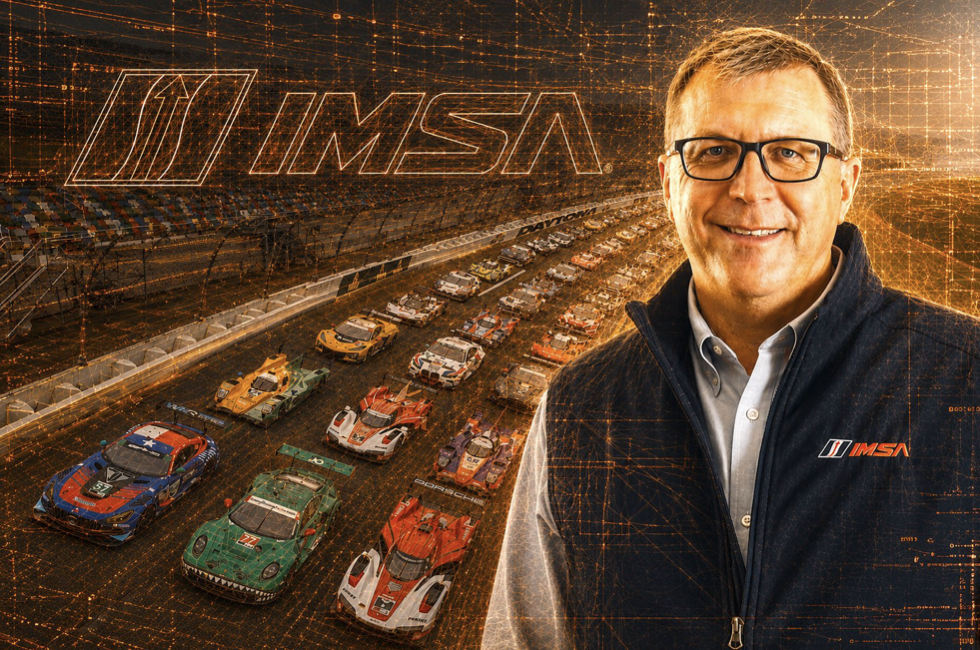
IMSA President John Doonan and the field he built. This is what a series on the rise looks like.
Paul Pfanner’s fifty-two years of engagement with IMSA — from a shaggy teenager welcomed into the paddock by Peg Bishop in 1974, to launching RACER magazine, RACER.com, and Pfanner Communications, which became the brand and creative agency for the American Le Mans Series from 2006-2008. He witnessed and supported the merger of ALMS and Grand-Am that built the current IMSA era. This informs a direct and personal case for what this sport represents.
How It Started
In the spring of 1974, I arrived at Road Atlanta for my first IMSA race weekend. I owned the new Tui BH-3 VW Super Vee that I had rented back to racer Dick Cooney, President of the Pacific Formula race car dealership that sold it to me, and I had as a client. We'd missed all of practice and qualifying after I had driven east from California, with a high school pal, for the first time in our lives. Mechanical trouble with the tow vehicle made us late. We walked in on race morning with a car that hadn't turned a wheel at the circuit and no idea what we were in for.
What happened next I have never forgotten. Peg Bishop — co-founder of IMSA with her husband John — was at registration. She arranged, without hesitation, for the tech inspector to meet us at our paddock space so that the car could be passed and we could at least make the warm-up. A shaggy teenage entrant from California, stressed and out of his depth, was welcomed without question. That courtesy — the simple human kindness of being made to feel like I belonged when I was most uncertain — shaped everything that came after. I stayed. I kept coming back. And I have spent fifty-two years trying to give back to a sport that gave me that feeling on a Saturday morning in Georgia.
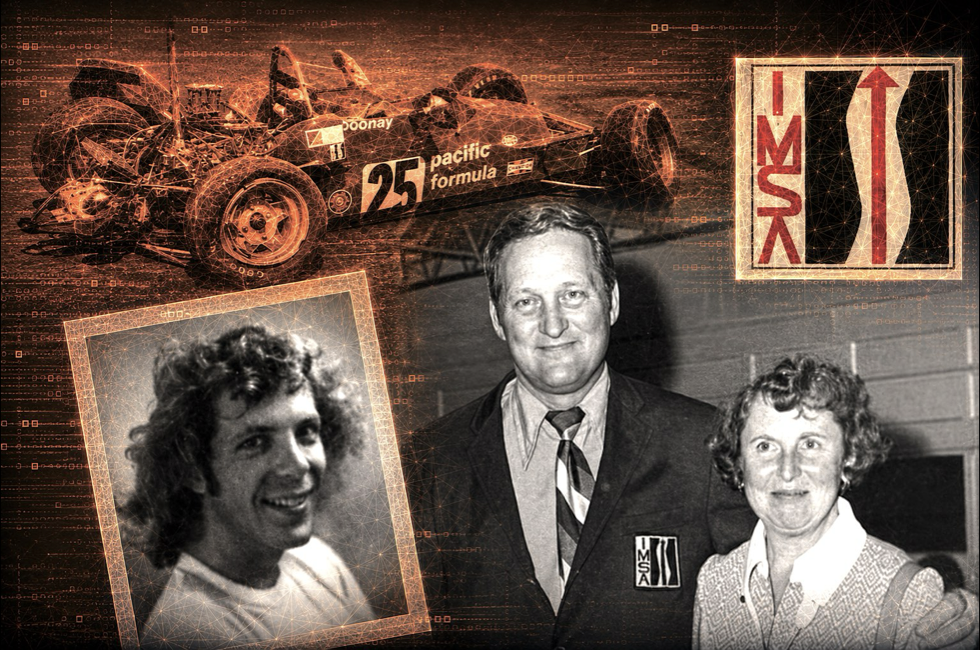
Three reasons IMSA has my loyalty for life: the race car that taught me humility, and the two people who showed me what this sport is supposed to feel like. John and Peg Bishop built something that welcomed everyone. Fifty-two years later, that still matters.
Sadly the new Tui BH-3 Super Vee never completed the out-lap. The pole winner drove into it. He was also a client of my new graphics business — awkward. We rebuilt the car from the usable parts and ran once more that year at Ontario Motor Speedway. My entrant career was brief and undistinguished. My belief in IMSA was formed for life.
A Different Kind of Racing
There is a distinction worth making plainly, because it explains why IMSA's growth is not coincidental.
In Formula One, the car is the instrument of driver greatness — or the explanation for its absence. The virtuosos at the front are the story, and the machinery is frequently their antagonist, blamed publicly when performance falls short.
In sports car racing, the car is the space-age hero and the drivers are its crew in the race to tomorrow. The machines are the point. They are versions — however exotic — of cars people drive, dream about, and aspire to own. The paddock is open, the elitism muted, and fans walk among the machinery and the people who build and race it. The sport is constructed for engagement at a human scale, and that accessibility is not incidental. It is the product.
The connection between what a manufacturer proves on Sunday and what a customer considers on a Saturday morning at a dealership is shorter and more direct in sports car racing than anywhere else in motorsport. That is not nostalgia. It is brand mechanics, and it is as true in 2026 as it was when Peg Bishop waved a teenager through registration fifty-two years ago.
The Leaders Who Built This Era
Scott Atherton spent two decades constructing the foundation this sport now stands on. He guided IMSA through the American Le Mans Series era, the merger with Grand-Am, and the formation of the WeatherTech SportsCar Championship, serving as president through the end of 2019. His patient cultivation of the relationship with the Automobile Club de l'Ouest across three ACO presidencies gave IMSA its global standing and laid the groundwork for the regulatory convergence that defines the GTP era and it’s bright future.
When I relaunched Pfanner Communications in December 2005 — with a small team, one client, and no guarantees — Scott Atherton gave us our first "yes." The campaigns we created for the American Le Mans Series — Experience Racing That's Relevant. Witness History As It Happens. Welcome to the Soul of Motor Racing — we’re not slogans. They were convictions we still hold.
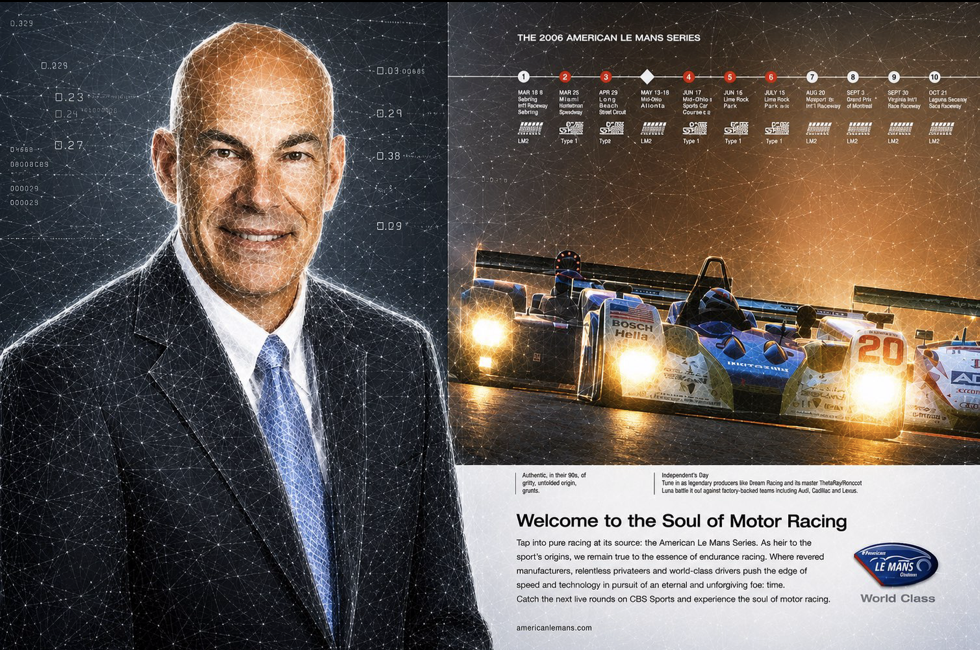
Two decades of leadership. One sentence that said everything. Scott Atherton gave the reborn Pfanner Communications its first "yes" in 2005 — and the brand review that followed produced this: "Welcome to the Soul of Motor Racing." Scott built the series. We tried to tell the world what it was. Neither of us was wrong.
The Right Man at the Right Time
John Doonan is the right successor, and his preparation for this role is unlike anyone who has held it before. He grew up as a classic track brat at Road America and other Midwestern circuits, watching his father compete in the SCCA — and then following him into the paddock with a wrench. He went to racing school in 1995 and competed briefly, finishing his driving career in the Formula Mazda series. His racing license lists competition in SCCA, NASA, IMSA, Grand-Am, and IndyCar. He then spent nearly 17 years at Mazda North America, rising to Director of Motorsports, where he built Mazda into one of the most beloved brands in American road racing. Even at the height of his corporate career, he was regularly found late at night turning wrenches alongside his crews — a manufacturer boss who saw no separation between his title and the team's needs when a car required fixing.
He has seen this sport from every angle that matters: as a child in the grandstands, as a competitor, as a manufacturer's steward, and now as the series' president. That complete-circle understanding is extraordinarily rare, and it is visible in everything IMSA has become under his leadership. Where Atherton built the architecture, Doonan has built the audience.
What the Numbers Say
The 64th Rolex 24 At Daytona delivered more than 180,000 fans — the highest attendance in the event's history. That number has doubled since 2018. NBC averaged over 1.1 million viewers, a 49 percent year-over-year increase, with a 52 percent surge in the 18-to-34 demographic. Internationally, IMSA's YouTube broadcast reached 3.8 million live viewers across 210 countries — 63 percent of them between 18 and 34. Sebring followed with an all-time attendance record of more than 115,000 fans, domestic viewership up 37 percent and international up 23 percent.
Then there is the number that reframes the entire competitive landscape. IMSA's official YouTube channel has passed 1.73 million subscribers — overtaking its parent company NASCAR, which sits at approximately 1.7 million. The comparison across North American motorsport is striking: IndyCar's official channel stands at 478,000 subscribers, NHRA at 278,000. SRO's global GT World platform — which encompasses SRO America and its entire international footprint — sits at 890,000. Even the FIA World Endurance Championship, supposedly the most prestigious sports car series on the planet, trails IMSA by more than 500,000 subscribers.
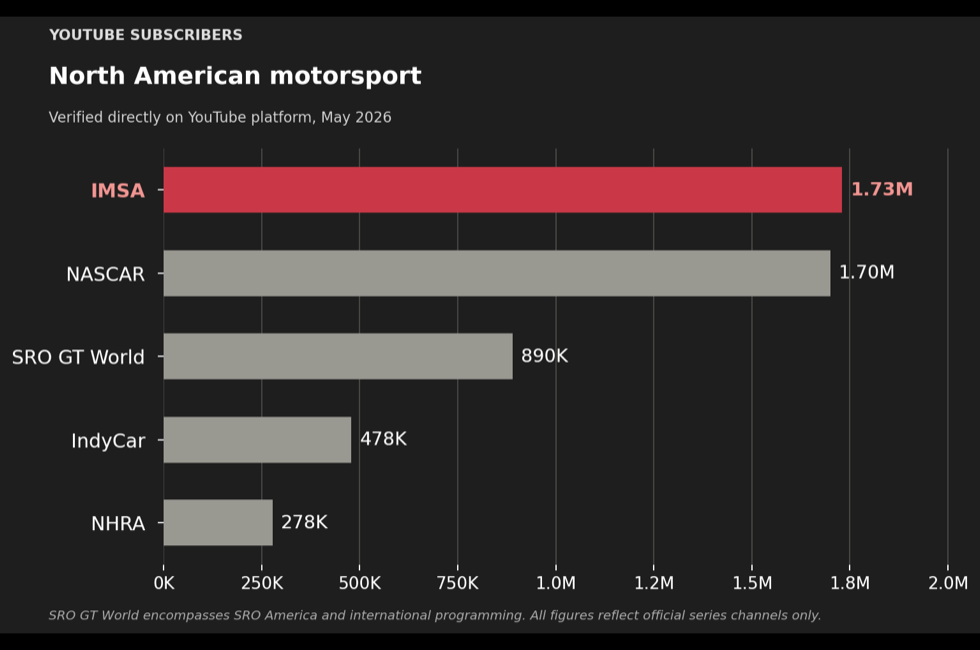
Subscriber counts measure attention. What they don't measure is passion. IMSA's audience watches, engages, shares, and shows up. That combination — scale plus devotion — is what every manufacturer in this paddock is ultimately paying to reach.
A sports car series built on endurance racing, with no legacy television infrastructure comparable to NASCAR, has become the most-subscribed motorsport channel in North America. That did not happen by accident and it did not happen overnight. It happened because John Doonan treated YouTube as a primary distribution strategy before most sanctioning bodies understood what that meant.
Sixty-three percent of IMSA's global audience is between 18 and 34. That is not the profile of a sport in decline. That is the profile of a sport that has found its future.
The calendar that produces these numbers is not interchangeable inventory. The Rolex 24 at Daytona. The Twelve Hours of Sebring. Long Beach. Watkins Glen. Road America. Laguna Seca. Petit Le Mans at Road Atlanta — the same venue where a tech inspector once came down the hill to pass a late-arriving teenager's car. Each event carries its own identity, history, and audience. That stability is a competitive asset, not a given.
The Le Mans Thread
Manufacturers competing in IMSA's GTP class can race the same car at the 24 Hours of Le Mans. That alignment — forged by Atherton across two decades and consummated under Doonan — means a program that wins at Sebring can carry the same machine to the Circuit de la Sarthe. But the Le Mans thread runs deeper than the GTP class alone. The Jim Trueman Award, earned by the top Bronze-rated driver in IMSA's LMP2 class, carries a Le Mans invitation. So does the Bob Akin Award, earned by the top Bronze driver in GTD. IMSA's 13-car LMP2 field is the most competitive in the world, and the series' alignment with the ACO extends that class through 2027. IMSA is the only motorsport series in North America where three separate classes maintain a direct pathway to the Circuit de la Sarthe. That is not a marketing line. It is the architecture of global relevance, and it makes every investment in this series — at every level — exponentially more valuable than any other domestic program can offer.
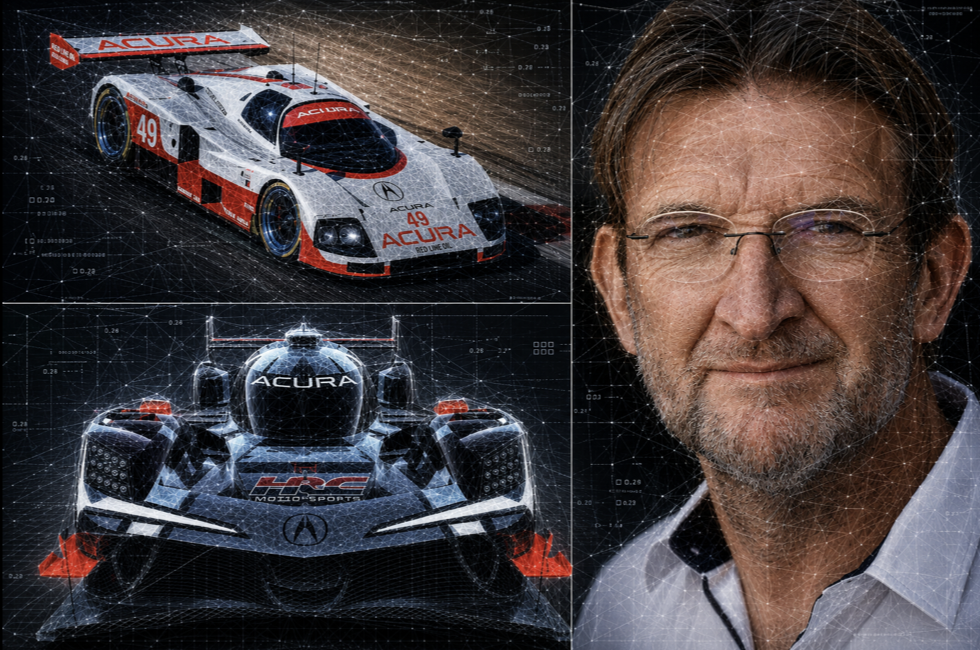
David Salters, President of Honda Racing Corporation USA. The car that started it and the car that carried it forward. Acura's sports car racing story began in an IMSA paddock in 1991 and was still being written when the pause was called. Some stories find their own ending.
On Acura — What Was Built, and What Is Pausing
To understand the weight of Acura's current decision, you have to understand what this brand has actually built in this sport over three and a half decades.
Acura's IMSA story began in 1991 — when Comptech Racing fielded a Spice Engineering chassis powered by a modified 3.0-liter NSX engine in the IMSA Camel Lights class. What followed was not merely competitive — it was dominant. Parker Johnstone won three consecutive driver championships. Acura won three consecutive manufacturer titles. Twenty-five victories in three seasons, including the Camel Lights class at the Rolex 24 at Daytona in both 1991 and 1992. IMSA was not a late addition to Acura's performance identity. It was the first place that identity was proven.
In parallel, my friend Peter Cunningham extended that proof in the SCCA World Challenge with RealTime Racing — a multi-decade program that secured fourteen manufacturer championships for Honda and Acura in production-based cars that real customers could actually buy. Peter's work built the cultural bridge between the circuit and the dealership that gave the brand its credibility with performance buyers. That his program ran through what is now SRO America — led by my friend Greg Gill, who once served as publisher of RACER — only deepens the web of relationships that makes the motorsports community what it is.
The most ambitious chapter was written in the American Le Mans Series under the leadership of the late Robert Clarke. Robert was the co-founder of Honda Performance Development — Badge Number One — and he possessed a quality that is genuinely rare in corporate motorsport: radical honesty about what racing actually does for a brand, and what it costs when you walk away from the right platform. His ambition, stated publicly as early as 2006, was to take Acura to the 24 Hours of Le Mans. He built HPD into a self-sufficient R&D organization specifically to make that possible.
The ALMS program ran from 2007 to 2009. The 2007 debut at Sebring in LMP2 was a storybook opening — a class win and a second-place overall finish. In 2008, Acura took its first outright ALMS victory at Lime Rock. In 2009, with the bespoke ARX-02a, Acura entered LMP1 and dominated — securing the Manufacturer, Engine, and Chassis championships in a technical tour de force. The car's signature innovation was running rear-dimension tires on the front axle — a solution so aggressive it was pure HPD. I had the honor of collaborating with Gil de Ferran and my longtime creative colleague Paul Laguette on the visual identity and liveries for de Ferran Motorsports that season. To see those cars win was to see the Acura brand exactly as Robert always believed it could be.
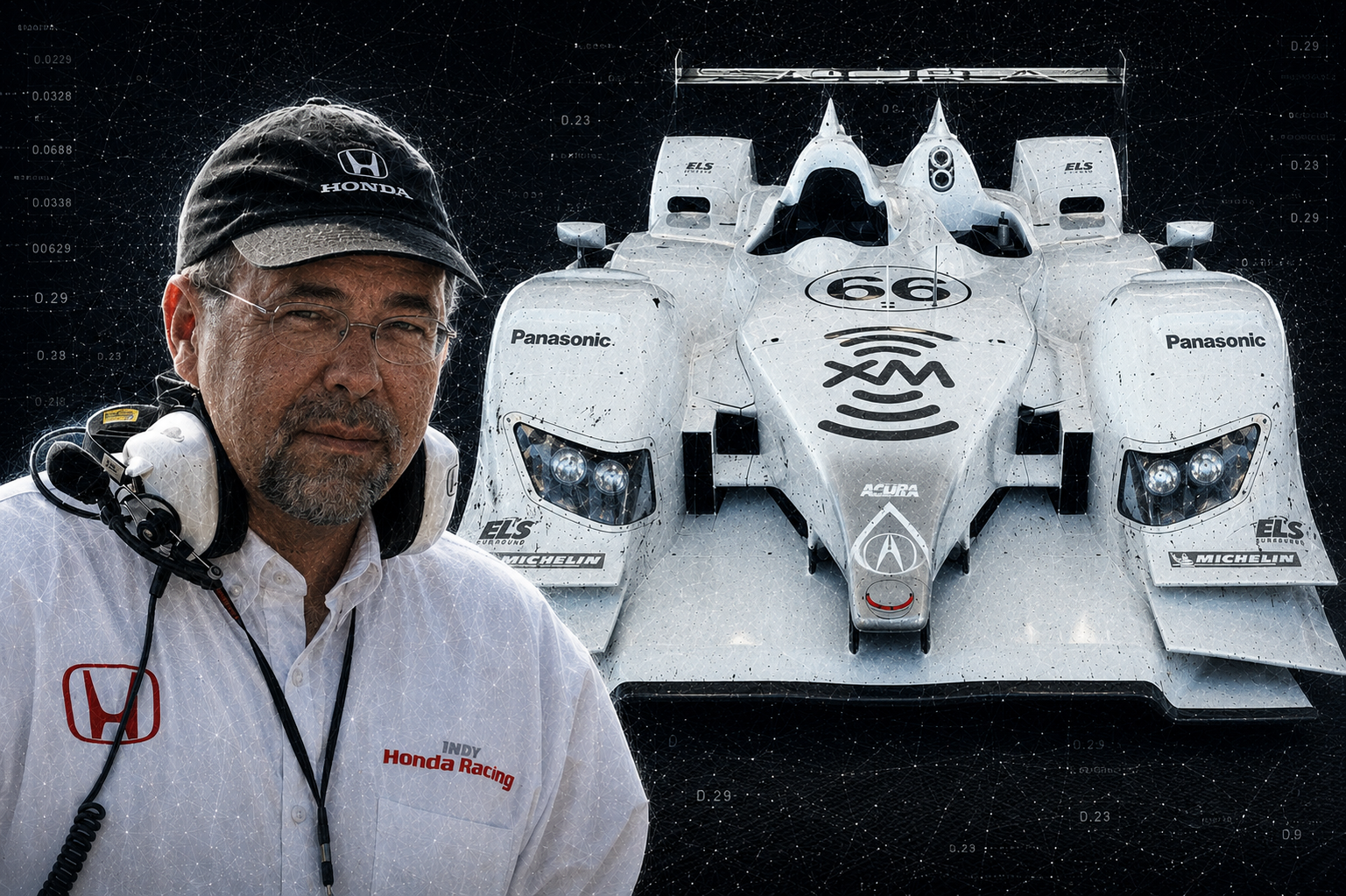
Robert Clarke, co-founder of Honda Performance Development — Badge Number One — alongside the Acura prototype that embodied his vision. Clarke built HPD from nothing into a world-class racing and engineering organization. He was fiercely honest about the value of this platform and never stopped believing in it.
He retired in mid-2008. The global financial crisis arrived. The program was withdrawn after 2009 — as undefeated champions. It remains one of the great departures in the history of American sports car racing: leaving at the top, for reasons that had nothing to do with performance.
During our final breakfast together in January 2025, Robert and I talked about how far IMSA had come — the GTP era, the technology, the audience energy. He saw the current moment as the spiritual successor to everything HPD had built. He passed away in September 2025, before the current departure was announced. I think about that often and I truly miss Robert’s wonderful friendship, his hard-earned wisdom and his competitive clarity.
I believe the current pause is a consequence of forces that extend well beyond the paddock — global market pressures, budget reallocations, and structural corporate priorities that have compressed what was possible. The decision to place Acura branding on IndyCar entries during this period is a consequence of those same forces, not a primary mission. It lacks the direct road-car engineering relevance that Robert championed.
I believe Acura's departure is a pause, not a farewell. The fit between this brand and this platform is too historically deep and too strategically logical to be permanently severed. The door to 2030 has been left open. That conversation is worth having.,
IMSA's leadership has seen this film before. When RACER launched in 1992, IMSA was entering a contraction cycle driven by an unhealthy dynamic — cost escalation pushing manufacturer after manufacturer toward the exit, and the series spending years rebuilding from it. That institutional memory belongs to everyone now running the series. They know exactly what is at stake, and they have earned the right to be trusted to address it.
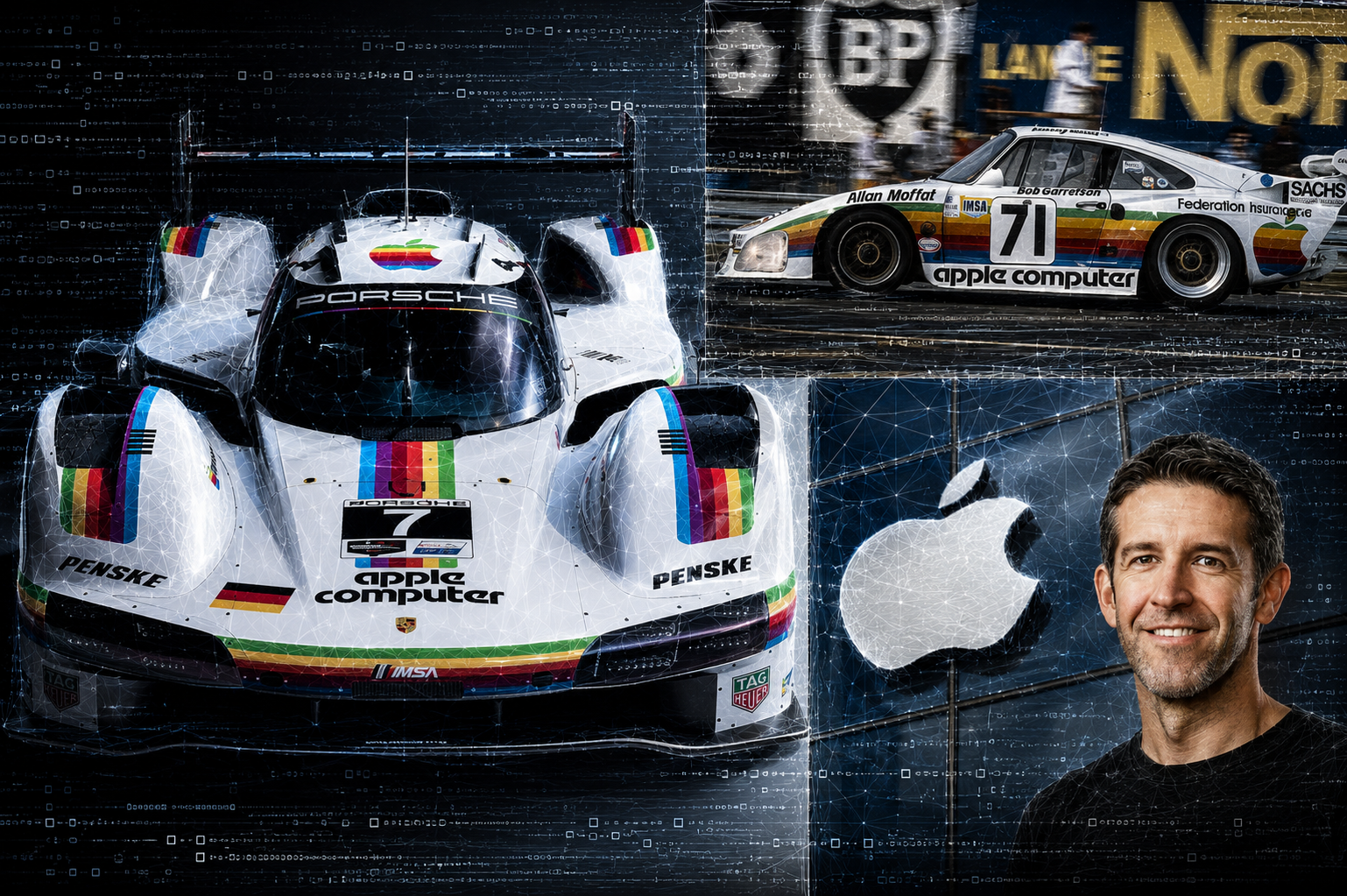
John Ternus, Apple's incoming CEO, was at WeatherTech Raceway Laguna Seca on the first weekend of May — while Formula One was in Miami. Behind him: the 1980 Apple Computer Porsche 935 that first carried the rainbow logo at Le Mans, and the 2026 Porsche 963 tribute livery that honored it at Laguna Seca. Forty-six years, two iconic circuits, and one special relationship between a brand that thinks differently and a sport that proves performance rather than proclaiming it.
The CEO in the Paddock
Numbers tell part of the story. Culture tells the rest.
On the first weekend of May, Formula One arrived in Miami. Apple TV was broadcasting it. Apple's head of services, Eddy Cue, was there to represent the company's growing investment in the sport. Apple's incoming CEO, John Ternus, was not. He was at Laguna Seca.
Ternus races his Porsche at WeatherTech Raceway Laguna Seca regularly, posting lap times that insiders describe as solid for an amateur driver. He was not there as a sponsor guest. He was there as a true fan. Apple’s Eddy Cue confirmed publicly that Ternus is even more deeply invested in motorsport than his predecessor Tim Cook, and that Apple's engagement with the sport will only deepen.
Consider what was happening on the circuit simultaneously. The Porsche Penske Motorsport works team ran a tribute livery on both of its Porsche 963s honoring the 1980 Porsche 935 that first carried Apple Computer branding at the 24 Hours of Le Mans — marking 75 years of Porsche Motorsport and 50 years of Apple in a single design stroke. The relationship between Apple and Porsche in motorsport began in a Le Mans paddock in 1980. It was honored in an IMSA paddock in 2026.
The CEO of one of the most valuable companies in the world — a mechanical engineer by training and a racing driver by passion — chose an IMSA paddock over Formula One on the same weekend his company's livery was running on the fastest prototype cars in North America. That is a cultural signal of a specific and meaningful kind. The people who build things — who think in systems, who respect performance that is proven rather than proclaimed — are drawn to this sport. They always have been. The numbers confirm the audience is growing. The paddock at Laguna Seca confirms what kind of audience it is.
Who's Coming In
The pipeline is the real story. Genesis Magma Racing — the motorsports team of Genesis, the luxury brand of Hyundai Motor Company — has publicly committed to joining the IMSA GTP class. Its WEC debut in 2026 serves as the bridge to a North American program, the timing of which will be determined by the car's readiness, not a lack of intention. The WEC driver lineup already includes André Lotterer and Pipo Derani — two of the most decorated endurance pilots in the world.
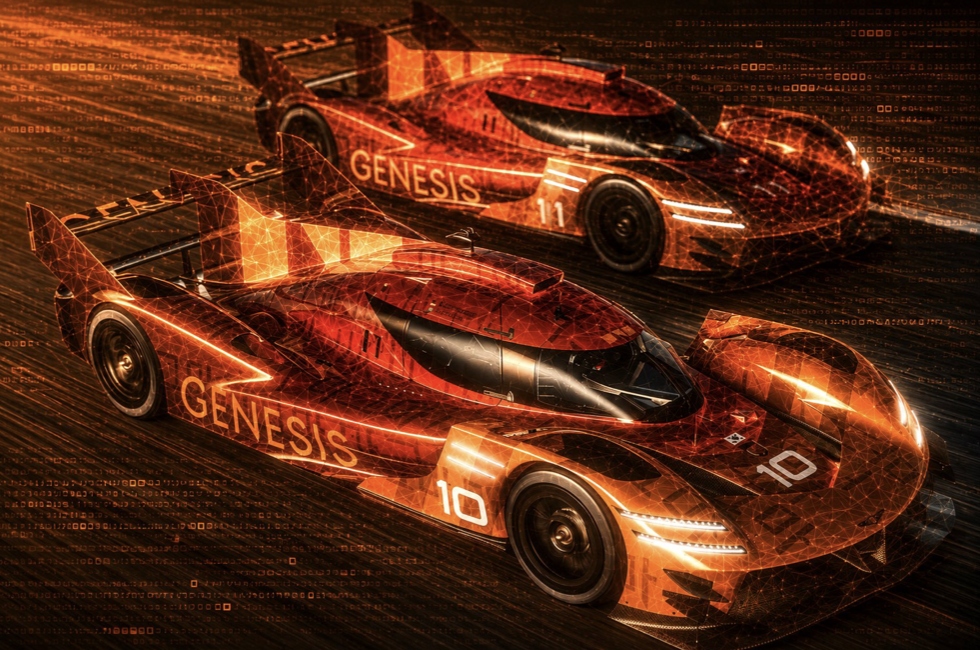
Genesis Magma Racing — GMR-001 Genesis Magma Racing has publicly committed to IMSA GTP. The luxury performance arm of Hyundai Motor Company arrives with championship infrastructure, world-class drivers, and something to prove. The pipeline is real.
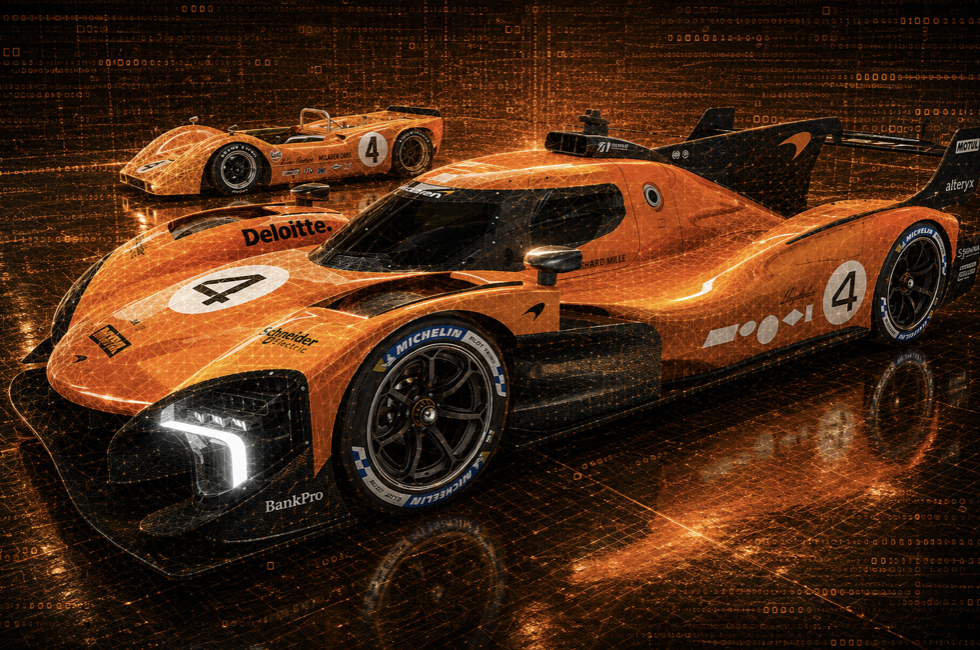
McLaren — Back Where It Belongs The McLaren WEC contender — with the 1967 M6A Can-Am car behind it. The brand that last won Le Mans outright in 1995 is returning to prototype racing. IMSA is on the roadmap. Papaya orange never really left.
McLaren Racing has confirmed that IMSA is firmly in the program's roadmap, with CEO Zak Brown stating explicitly that North America is a priority and that Daytona is a platform McLaren wants to be on. The WEC debut arrives in 2027 with United Autosports as the operating partner. An IMSA GTP entry will not come before 2028 — Brown has been direct on that timeline — but the intent is unambiguous. McLaren last competed in prototype racing's top tier when its F1 GTR won Le Mans outright in 1995. Its return will be a statement heard across the sport.
Alongside the existing commitments from BMW, Cadillac, Porsche, and Aston Martin — and with Ford understood to be in advanced evaluation of a GTP program of its own — the field over the next three years will represent the deepest concentration of major manufacturer commitment in North American prototype racing in a generation. Lamborghini, which paused its GTP program for 2026 to focus on its new Temerario GT3 platform, remains part of the broader conversation about the class's future. Series that are contracting do not attract Genesis, McLaren, and a potential Ford return simultaneously. Series on the rise do.
The Unfinished Chapter
IMSA's YouTube streams have already reached 138 million viewers in 185 countries without any advance promotion. That audience is arriving uninvited. The right media partnership converts that organic momentum into the commercial infrastructure this sport has earned. That is the one chapter still unwritten. Everything else is working.
#Endurance
I owe a debt to Peg and John Bishop that I have spent fifty-two years trying to repay — not to them personally, but to the sport they built and the way they chose to lead it. I showed up late that morning in 1974, stressed and uncertain, having missed all the preparation that every other competitor had managed. Without hesitation, they arranged for me to be welcomed anyway. That courtesy in a moment when I felt like an outsider shaped everything that came after. I stayed because I was treated like I belonged.
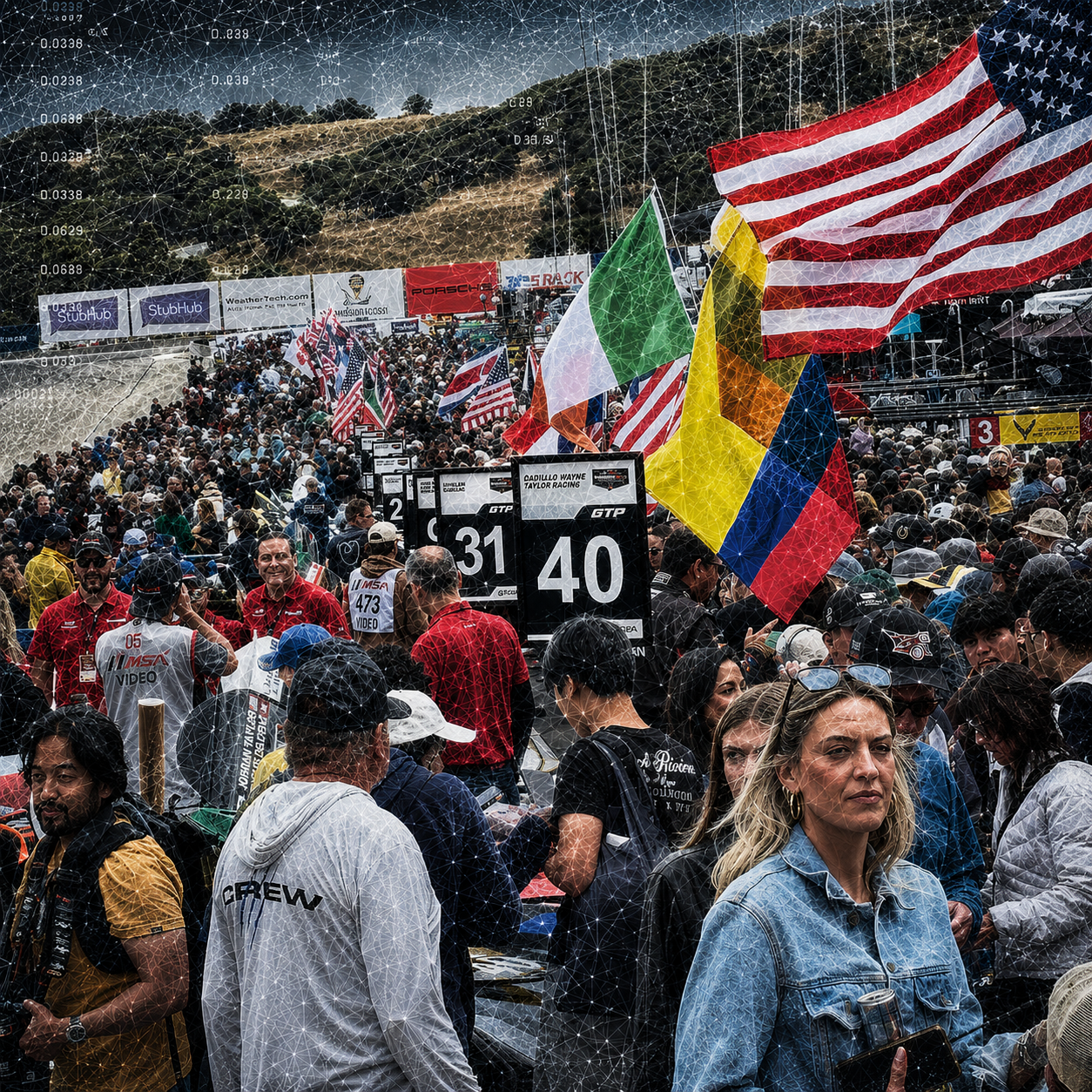
The thesis in a single frame. Flags from a dozen nations. Crew and fans sharing the same ground. No barriers between the people who build it and the people who love it. This is what a sport that belongs to its audience looks like — and why it keeps growing.
I belong today because of what I find in these paddocks — the beauty of the cars, the intensity of the competition, the extraordinary teamwork of drivers and crews operating at the edge of what is possible. Every time I walk through a paddock at Daytona, Sebring, Laguna Seca, or Road Atlanta, I am literally walking through the future being built in real time. That is not a figure of speech. It is the reason this sport exists, and it is the reason I keep coming back.
Today, I count Scott Atherton and John Doonan among my closest friends. We have shared the best and worst of times across the arc of this sport's most consequential chapter. Their vision, integrity, and infectious passion for sports car racing inspire me to win my own race to the future by creating what I want it to be. I am not concerned that writing this will be discounted because these men are my friends. They became my friends because they are doing the right thing — always — to grow this sport and to honor the people who love it. That is why I trust them. And that is why I am writing this.
To the leadership of Honda and Acura — in Japan and in the United States — I want to say this directly, in language I know you understand: There is no better place on earth to prove what your company actually stands for than an IMSA paddock. The Honda spirit was never about comfort or easy margins. It was about the relentless pursuit of engineering excellence in competition, about respect for the people you race alongside, and about the understanding that your brand gets built on circuits where everything you claim about performance gets tested in real time, against the world's best. Robert Clarke built HPD on that principle. He proved it in this series. He never stopped believing in it.
Acura's presence in this sport has never been merely about results. It has been about belonging — about a luxury performance brand that refuses to hide behind price point, that gets into the ring with the world's best, and that proves its character in competition. There is no substitute for that.
In our messages, Scott and I sign off with a single word: Endurance. In the literal sense, it honors a friendship built in these paddocks. In the broader sense, it is the only word that adequately describes what the Honda spirit demands of everyone who carries it forward — the willingness to learn, to come back, to believe again, and to treat the next person the way you were treated when you needed it most.
In IMSA, the future is not coming. It has always been here — in the technology, the audience, the open paddock, and the next lap that proves it all over again. That is what endurance means. That is why this matters.
POSTSCRIPT
In late 1985, my friend and co-conspirator, Jeff Zwart called me with an assignment. Jeff is many things — commercial filmmaker, national rally champion, eight-time Pikes Peak winner, and one of the most accomplished automotive photographers of his generation — and, not incidentally, a co-founder of RACER magazine — an idea we conceived together in 1978. In 1985 he was building his reputation as the go-to lens for the automotive world, and he was producing a photo shoot for the agency launching Honda's new Acura brand. The car was a pre-production Legend sedan, the flagship that would carry Acura's performance case to the American market. He needed a performance driver. He called me.
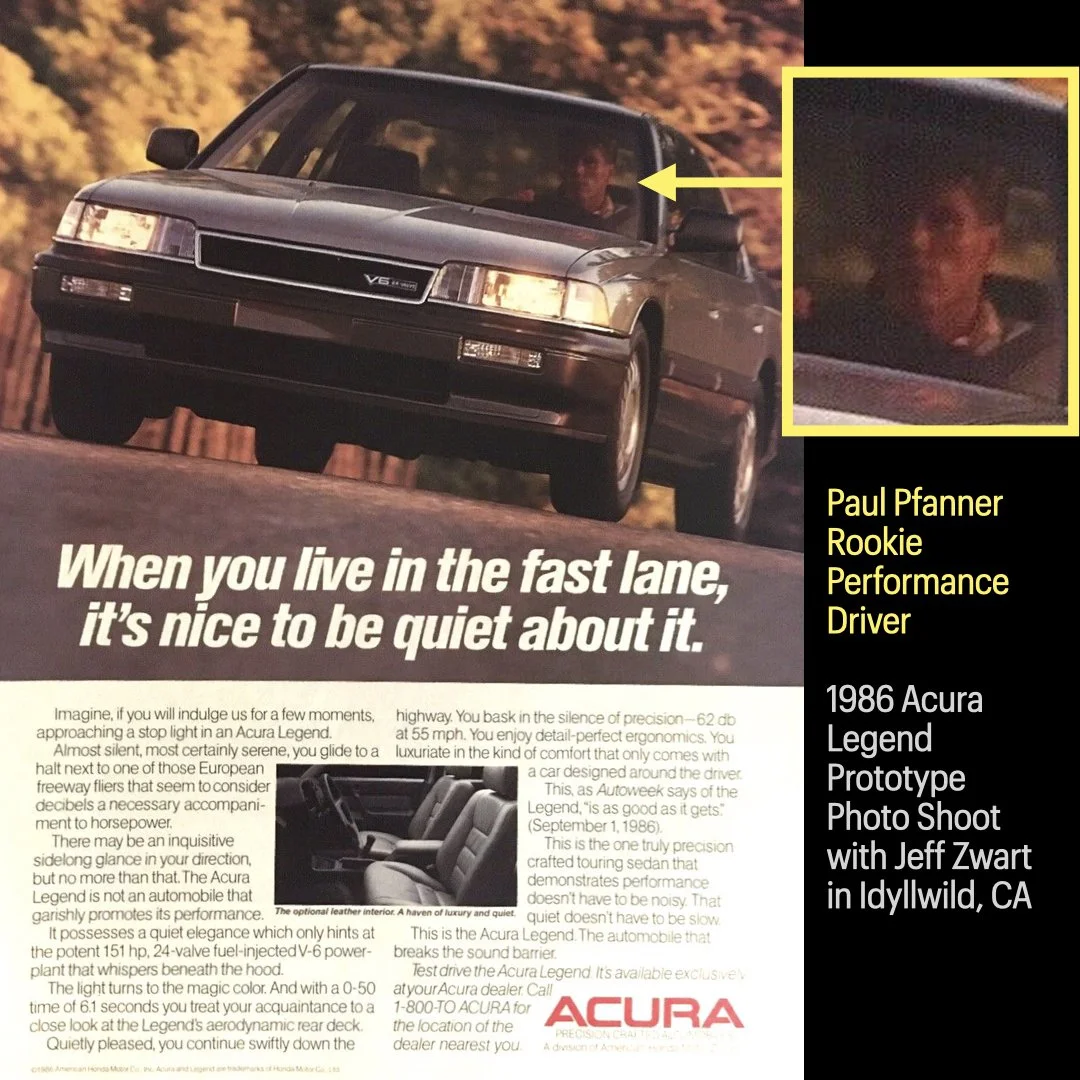
Destiny called. I was not up-to-speed for my close-up with the Legend.
The location was a mountain road at dawn above Idyllwild, California. Jeff directed from the tailgate of his Volvo 240 Turbo wagon — three people and a full camera kit aboard — via walkie-talkie. His instruction, repeated with increasing enthusiasm, was consistent: go faster.
The Volvo kept pulling away, and it wasn’t because the Legend was slow. For some reason, the “performance driver” was not invited back for future shoots. The Legend went on to help establish Acura as a genuine presence in the American performance and luxury market — and by the time we launched RACER in 1992, the brand's motorsport program was underway in an IMSA paddock. Some of us were there for the opening credits.
Pfanner Advantage works with clients to turn change into advantage at the intersection of mobility, motorsport, media, technology, and marketing. Learn more or start a conversation: contact us today.
Paul Pfanner’s recent Shift Happens Insights:
2031: Racing Isn’t the Business
The Medium Was Never the Message
The Advantage Journal arrives every week. What matters in sport, mobility, media, and technology — curated and contextualized by Bill Sparks, Bill Long, and Paul Pfanner. No hedging. No filler. Subscribe — It’s Free

