
America Is Building Cars the World Has Stopped Buying
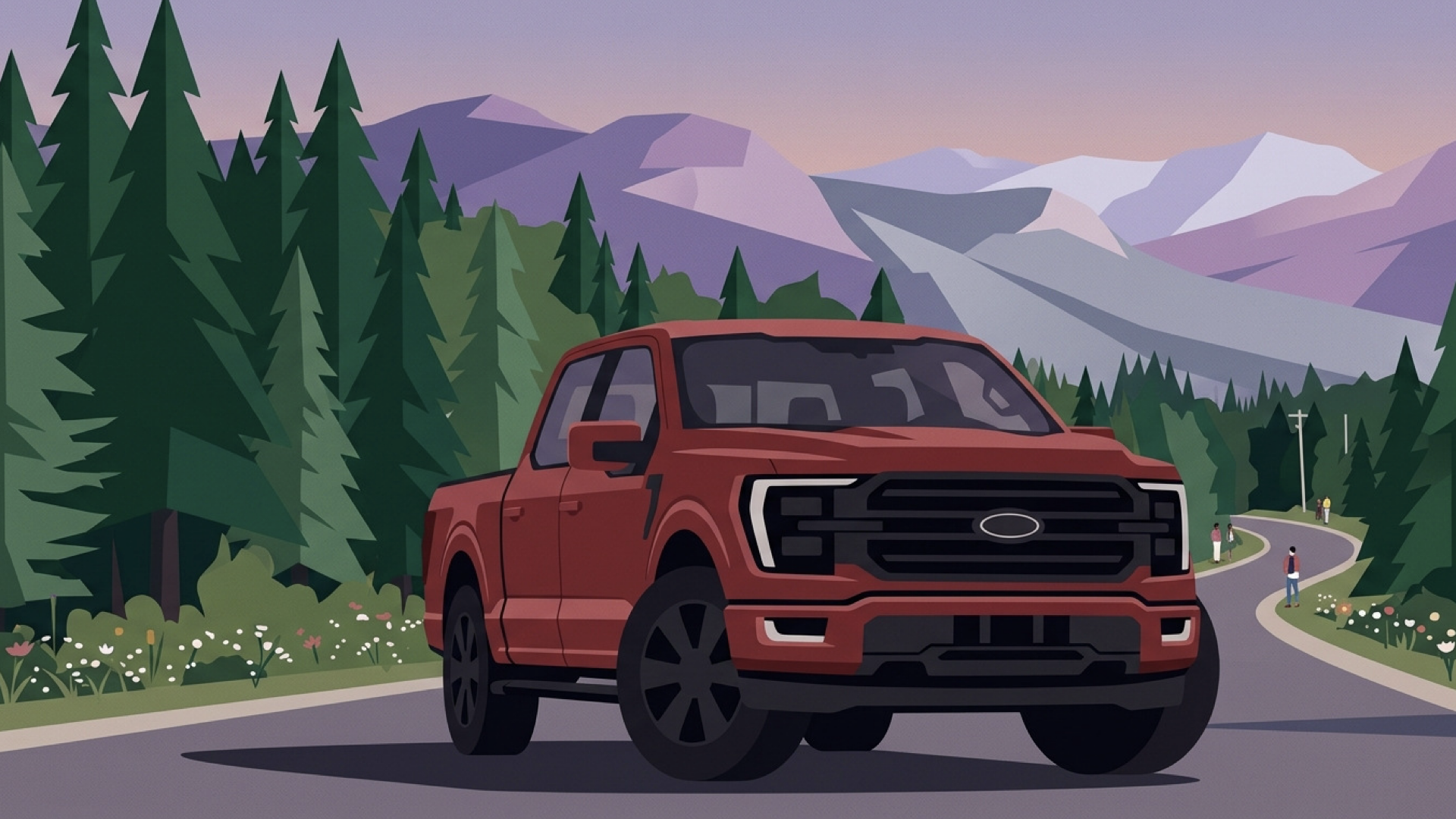
Despite high gas prices, the Ford F-150 remains the best-selling American-made vehicle. The rest of the world is going in a different direction.
Part 3 of Bill Sparks' series on how the current oil price crisis could impact the U.S. automotive industry. The rest of the world is shifting to EVs faster than the U.S. and China is setting the pace. The American response to this market shift is still being formed.
Look at a map of where new cars are going. In 2025, one in four new cars sold worldwide was electric, against about 10% in the United States. In the first half of 2026, battery-electric cars took 20.7% of the European Union market and conventional hybrids another 37.3%, leaving gasoline-only cars at 22.2%. China's plug-in share hit a record 65.2% in August. EV sales outside China, Europe, and North America nearly doubled. And the United States sat at 5.6% for new electrics in July.
Part 1 of this series argued that Americans did not reject EVs during the 2026 oil shock so much as run out of affordable ones. Part 2 argued that the last Iranian oil shock rewarded the competitor with the right car on the lot, and that trade protection bought Detroit time rather than competitiveness. This final part asks the question those two raise. What happens to the world's second-largest car market if it keeps building products the rest of the world is moving away from?
Islands are comfortable, until they are not
To be fair to Detroit, an island can be a profitable place to live. Large trucks and SUVs carry the margins that fund everything else, American buyers keep buying them, and the new-vehicle market has run at better than a 16 million annual pace for six straight months despite $4 gasoline. If the question were only about next quarter, the island would look fine.
The problem is scale, and scale is where the rest of the world is running away. China built nearly three-quarters of the world's electric cars in 2025, about 16 million of them, and produces more than 80% of the world's battery cells. It exported a record 2.5 million electric cars, more than 40% of global EV trade. Outside the major developed economies, Chinese imports accounted for 55% of electric car sales in 2025, up from about 10% in 2021. In Mexico, Chinese brands went from less than 1% of sales to 15% in five years and reached 17% in the first five months of 2026, even after Mexico raised its tariff on Chinese cars to 50% in January. That 17% is just the Chinese brands. Count every car made in a Chinese factory, including models from GM, Ford, and Kia, and the figure is 28%. Battery prices fell another 8% in 2025, helped by record-low prices for lithium iron phosphate cells.
Every one of those numbers compounds. Volume lowers cost, lower cost wins export markets, export markets add volume. An American automaker that sells mostly large gasoline and hybrid vehicles at home, behind a tariff wall, is not part of that loop. It risks paying for two technology stacks, one for a protected domestic market and one for global markets where it is steadily less competitive, while the wall itself thins at the edges through Canada and Mexico.
How these companies are responding
Not every automaker is betting the same way, and the differences are instructive.
Toyota is the company that looks smartest right now, largely by refusing to choose. It was long criticized as a laggard on battery-electrics while it kept building hybrids. In November it committed $912 million to five U.S. plants in Kentucky, Mississippi, West Virginia, Tennessee, and Missouri, largely to build hybrid engines and transaxles and to start U.S. production of a hybrid Corolla. In August, Toyota and Lexus sold 124,112 electrified vehicles in the United States, most of them hybrids, up 20% and equal to 57.6% of their volume. At Hyundai, hybrids set an August record, up 33% year over year, and reached 29% of the brand's sales. The hybrid is the bridge the island is walking across.
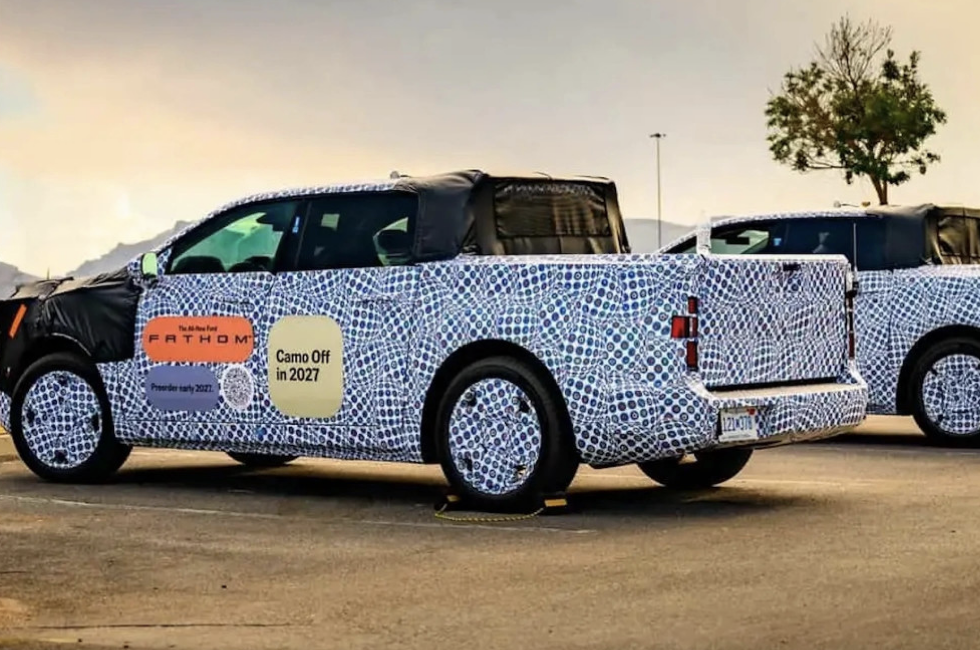
The under $30,000 Fathom EV is Ford's first response to the challenge posed by low-cost Chinese electric vehicles. (Photo: Ford)
Ford took the hardest hit and is making the most radical bet. After taking $19.5 billion in special charges and killing the F-150 Lightning, it put $5 billion into a Universal EV Platform at its Louisville plant. The first product, the Ford Fathom midsize electric pickup, starts at $28,350, just under $30,000 with delivery, with production due in the first quarter of 2027. Ford says the platform uses 20% fewer parts and 25% fewer fasteners than a typical vehicle, with 40% fewer workstations and 15% faster assembly. "We took inspiration from the Model T, the universal car that changed the world," said Doug Field, the executive leading the program. Whether it becomes Ford's Model T depends on whether Ford can build it at a profit at that price. That is exactly the thing Chinese automakers already do.
GM brought back the Chevrolet Bolt for 2027 at $28,995 to $29,990, with a lithium iron phosphate battery and production at its Fairfax Assembly Plant in Kansas City. But GM calls it a limited run, and reports say the plant will switch back to gasoline models after roughly 18 months of Bolt production. That looks less like a strategy than an option held open.
Then there is Slate Auto, the Jeff Bezos-backed startup building a deliberately stripped-down electric pickup in Warsaw, Indiana. It starts at $24,950 before a $1,450 destination fee, which makes it the cheapest new EV in America, with first deliveries expected in the fourth quarter and most shipping in 2027.
Notice the pattern. Every serious American answer to the Chinese challenge is converging on the same number, just under $30,000. That is the price point China defined.
Christian Meunier, who runs Nissan's Americas business, offered the counterpoint to Ford CEO Jim Farley's warning during a visit to São Paulo in February. "Competition is not a bad thing," he said. "Our duty is to provide a product and a service and an experience for the customer which is better than the Chinese. And if we do that, we'll be fine." It is the right instinct, and the hardest one to act on from behind a tariff wall that removes the pressure to do it.
If you do not build cars, this still reaches you
The divergence matters well beyond the auto industry.
Fleet operators are paying more than $6 a gallon for diesel today. The EIA expects diesel to average $5.07 this year and $4.40 in 2027, so any fleet that priced its next replacement cycle on 2025 fuel costs needs to rerun the numbers, whichever way it decides.
Dealers face a strategic choice they did not ask for. Ninety-two percent of U.S. franchised dealers say they have concerns about selling Chinese brands, yet a Toronto-area dealership brokerage reported nearly 400 Canadian dealers raised their hands to sell them when Ottawa opened the door, before many cooled on the franchise and warranty terms. The first ones to figure out those service questions will have an edge if the U.S. border ever softens.
Marketers should notice that fuel economy is a selling message again, and that "hybrid" has quietly become a mainstream badge rather than a niche one, at 18.2% of U.S. retail sales in August. Brands that spent a decade marketing horsepower and screen size are now fielding questions about miles per gallon.
Even public finance is shifting. Oregon signed a per-mile road charge into law as part of House Bill 3991. Voters rejected most of the bill's tax and fee increases through a referendum last May, but the per-mile charge was not subject to the vote and remains on the books: mandatory for existing electric vehicles starting July 1, 2027, extending to new EVs, hybrids, and plug-in hybrids the following year. Forty-one states already charge special registration fees on EVs, and many also charge plug-in hybrids. The more America moves toward hybrids, the more governments will look to meter the miles instead of the gallons.
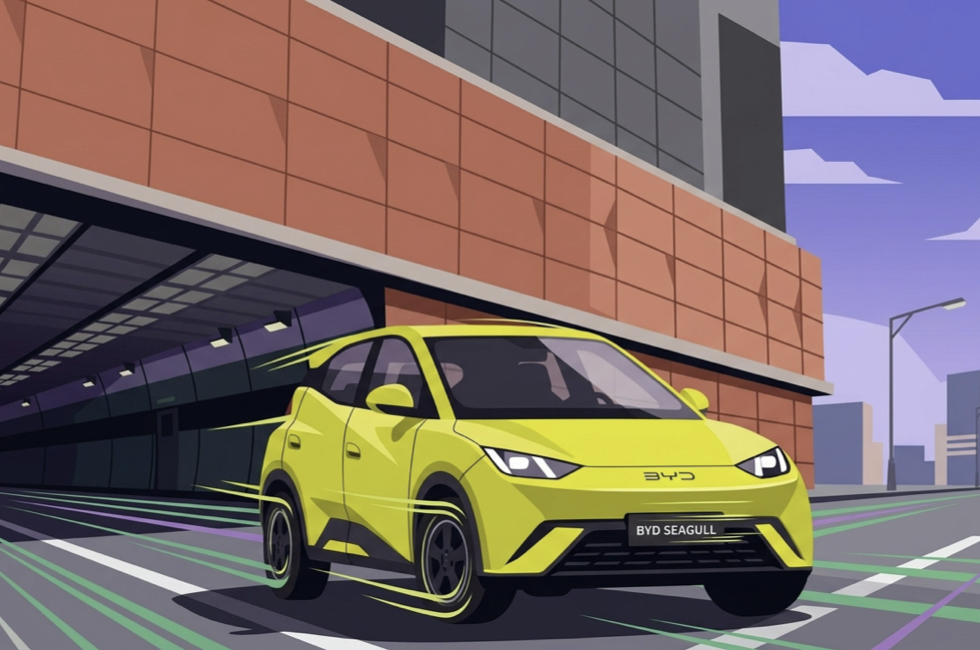
The 2026 BYD Seagull — one of the best selling cars in China — sells for approximately $15,000. Chinese cars are already coming to Canada and Mexico and the President has invited Chinese companies to build factories in America.
Someone is already building the bridge
Islands stay comfortable until someone builds a bridge, and Canada is building one. Its quota for China-built EVs opened a second window on September 1, with 33,397 permits available over the next six months, including those left unused from the first window. The annual quota is set to grow by about 6% a year, reaching roughly 70,000 vehicles within five years. The Chinese brands are slow to arrive, as Part 2 described, but slow is not the same as never. Mexico already has its own crossing, with Chinese brands at 17% of its market despite a 50% tariff.
Whether Washington opens the door, keeps it shut, or lets Chinese automakers build plants here as the President has suggested, the executives who plan for a North American market where affordable Chinese EVs are one border away will be far better placed than those who assume the wall will hold. In 1979, the small-car threat looked like a fuel-price problem that would pass when gas prices did. Gas prices did fall in the 1980s. Japan's share of the American market never went back to 12%.
Pfanner Advantage works with clients to turn change into advantage at the intersection of mobility, motorsport, media, technology, and marketing. Learn more or start a conversation: contact us today.
More Cold Read Insights from Bill Sparks:
What 1979 Telss Detroit About 2026
What Aren’t Americans Buying EVs?
Part 8: State of the Art Branding Case Studies
Part 7: How the Ad Industry is Reinventing Itself
Part 6: AI and the Personalization of Brand Narrative
Part 5: Building Brand Loyalty Through Community
Part 4: Independent Creators as Brand Storytellers
Part 3: Brands as Publshers: The Rise of Owned Media
The Advantage Journal arrives every week. What matters in sport, mobility, media, and technology — curated and contextualized by Bill Sparks, Bill Long, and Paul Pfanner. No hedging. No filler. Subscribe — It’s Free