
Let the Car Move
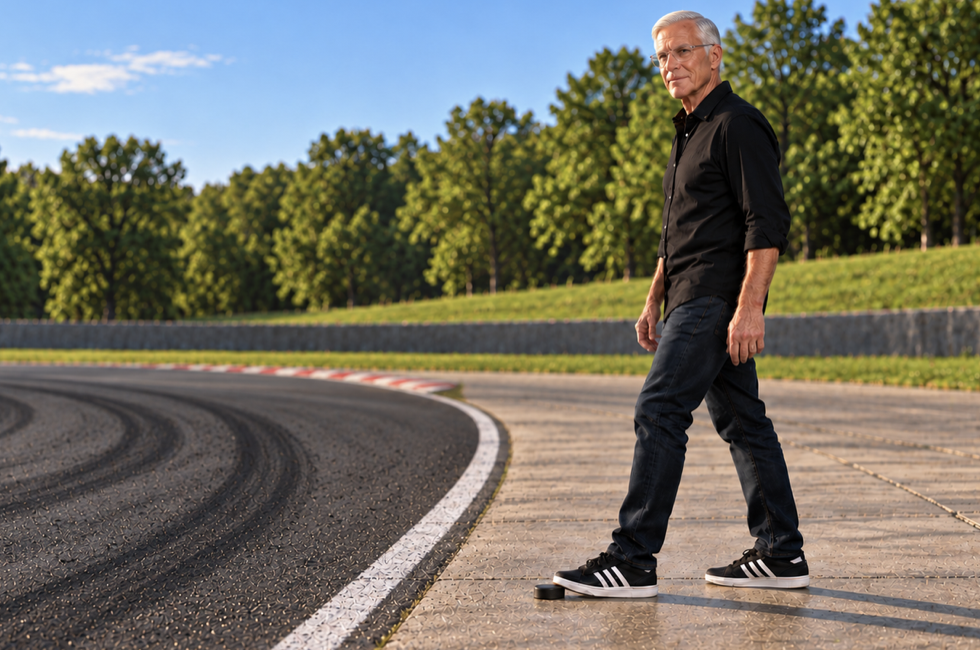
AI-generated image of me (with better hair) standing at a racetrack corner with the toe of his shoe resting on a hockey puck. The frame reveals the setting after a TV spot sequence built around equipment from other sports.
Paul Pfanner had never written a song until this August. A month later he had an album. Here, off the Suno platform and gathered in one place, is all of Last Man Standing, along with the cover and the videos he made to carry the songs further.
II made this spot to show something I have been trying to explain for years. An Indy car can do more than carry a driver at extraordinary speed. It can let us see what makes that driver extraordinary.
The film is a speculative TV spot I made myself. The car is the Blackbird 66, a concept, and the figure standing at the track is an AI version of me. I put myself there because I wanted to take responsibility for the idea. Before I tell you how the spot came together on Sunday, I should tell you why it took ten years to get here.
A car that lets us see the driver
Pfanner Communications had been retained in 2007 to help architect the Indianapolis Motor Speedway’s Centennial Era strategy. That assignment called for deep research and a great deal of work. We had to find and assemble the material ourselves, and the thinking took time. Its public arc began with the Speedway’s centennial in 2009 and looked toward the 100th running of the Indianapolis 500 in 2016. During that race week, discussions began about what an Indy car should be for the 2020 era. Mark Miles asked J.R. Hildebrand to lead the exploration, and IndyCar retained me to join it. With J.R., Reilly Brennan, Diego Rodriguez and Clay Dean, we called ourselves the Velocity Collective.
J.R. was a formidable racing driver and one of the most curious, original minds I have known. Reilly had edited AOL Autos and went on to run Stanford’s Revs program; Diego was a senior partner at IDEO; Clay led global advanced design at General Motors. I brought my own history in racing and a conviction that the car itself could help tell the sport’s story. I was in extraordinary company. We were trying to imagine a future for the sport. A decade later, new tools would let me show a piece of that future in motion. That feels like a small, satisfying self-fulfilling prophecy.
The sound of Dan’s cane
In the last year of Dan Gurney’s life, I was with him in his office. J.R. and the rest of the Velocity Collective were conferenced in on a speakerphone at the center of Dan’s table. They all heard what happened next. J.R. was making a point Dan wanted to interrupt. Dan cracked his cane against the tabletop. The conversation stopped. “Are you a fan?” he asked J.R. I still smile when I remember it.
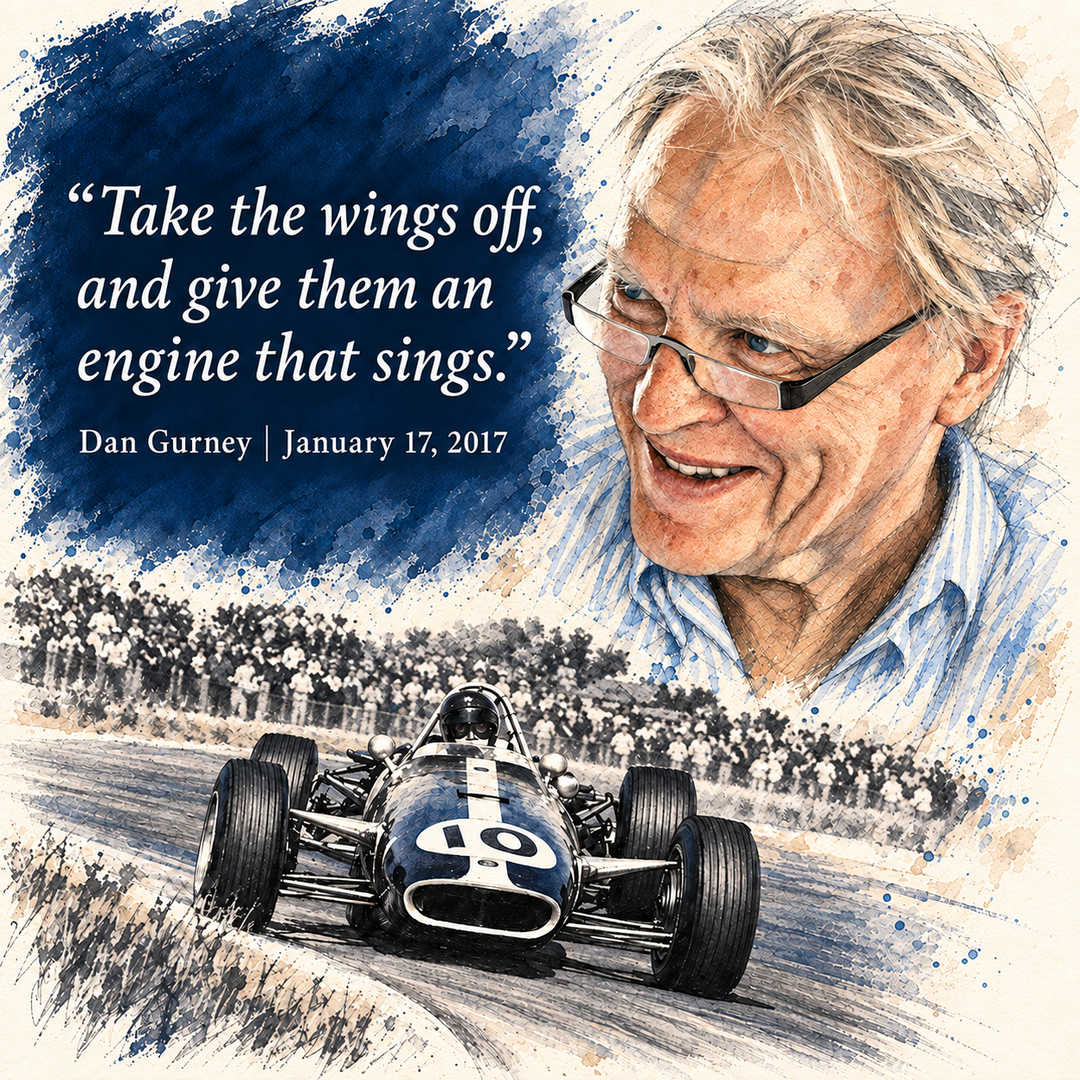
The direction of the discussion changed. Dan was asking something bigger than whether a proposed car would be fast: would anyone want to watch the best drivers try to master it? What he said that day inspired all of us. The spark outlived him, and his answer, in the fewest possible words, belongs at the end of this story.
Dan was a friend, a mentor and a hero to me. My father admired him too; he called Dan the eighth Mercury astronaut. Dan could drive a car sideways beautifully, and he understood what an audience can read in that movement. He wanted the car to reveal the driver’s hands, feet and judgment. In his own work, invention and courage belonged together. He spoke from lived experience, with the courage to say what he believed. I hope my own work can do the same.
An idea still in motion
The formal IndyCar project ended in early 2017. Our recommendations were not adopted at the time. Then, in January 2020, the Hulman-George family sold the Speedway and the series to Roger Penske, whose Penske Motorsports had once been our agency client. COVID followed soon afterward. The setting changed dramatically, and the idea was set aside.
The Velocity Collective kept talking. Our group conversation has continued since 2016, trading thoughts about how the world is changing and what each of us cares about. That connection has been an engine of ideas for me; we never really set the collaboration down. J.R. kept pursuing the car as well. With designer Patrick Faulwetter, he developed the Blackbird 66. A decade on, none of us has stopped asking what the car could be. I intend to keep working on it.
I have shown images of the Blackbird before. Yet a still picture cannot convey the heart of the proposal. This is a powerful car on wide tires, driven on the throttle with its tail out. The driver works with it and brings it under control. That movement is the visible expression of skill.
Six columns of work
The Blackbird 66 appears in the sixth and final column of my IndyCar series, “The Race Beyond the Race.” The six columns took weeks of research, writing and revision. The facts and the sport kept moving while I worked. I waited for the season’s audience results so the last column could deal with what had actually happened, and I checked the claims before making them.
I used ChatGPT to locate material, organize the research and work through the argument. Claude helped me edit and refine the writing, and gave me another way to challenge and cross-check it. I chose what to say and remained accountable for every word. Even with that help, the series took time. It needed to.
What the songs unlocked
Five weeks ago, I also decided to write a song. The first piece I wrote about that adventure was called You Are Out of Excuses. Sixteen songs later, the album is called Last Man Standing, and I understand that first essay differently. I wrote lyrics drawn from my life and learned, with ChatGPT and Claude, to direct the music toward the sounds in my head. I could not have made these recordings alone, and the tools could not have lived the stories for me.
Five weeks ago, I knew none of the specific skills that made this spot possible. I knew how to make videos the old way, but I learned these new methods by doing, the way I have learned throughout my life: describe a scene precisely, test a result, find what is false, and try again. More than anything, the music changed the distance I expected between an idea and a visible result. As I worked on the final IndyCar column on Sunday morning, I thought: I can make this car move.
Sunday morning to early afternoon
By early afternoon, between other work, I had a finished concept spot. I wrote and voiced the line, directed the scenes, chose what to keep, and trimmed the picture and sound by hand. ChatGPT helped me work through the visual idea, test the cuts and refine the sound; Hedra helped create the moving images. Some attempts were plainly wrong. A generated version of the car distorted its geometry, so we discarded it and returned to the Blackbird image I trusted. The spot got better through those decisions.
Twenty years ago, I would have needed hand-drawn storyboards, a production crew, locations, a car and a substantial budget just to show people what I meant. I estimate that showing the idea this way could have taken a month and cost $100,000 or more. A broadcast version would still call for a real shoot and professional production. What I made on Sunday conveys the concept believably: an idea went from my head to a moving demonstration in half a working day. I have spent my life shortening the distance between an idea and its execution. I have never seen that distance shrink quite like this.
What the car can say
The FOX partnership gives IndyCar a bigger stage than we could have imagined for this project in 2016. I used FOX graphics in my speculative spot to ask what a message about the car and its drivers might look like on that stage. This is my proposal, not a commission from FOX or IndyCar. The sport has an opportunity to make its people matter to viewers beyond a single race result.
Other sports have their equipment. IndyCar has a machine that can become part of the contest we watch: a demanding instrument in the hands of a person with rare courage and command. The car need not be a fixed appliance. It can express the greatness of the driver, so fans can see the difference between good and exceptional and feel a reason to follow that person.
That is the invitation behind both the film and The Race Beyond the Race, the final column, which will be published the day after this article. It is also why my recent work in music belongs in this story. Intention came first. New tools allowed me to communicate it. The past informed the idea; for me, the car was unfinished business. I finish what I start, even when it takes a decade.
I am fortunate to be alive at a moment when I can learn so quickly and share more of what is in me. I am not afraid of these tools; I am interested in what a person can do with them. The tools are here. If there is something in you waiting to be made real, bring it into the world. Begin now. Finish the work.
Dan’s words can have the last say.
Pfanner Advantage works with clients to turn change into advantage at the intersection of mobility, motorsport, media, technology, and marketing. Learn more or start a conversation: contact us today.
Essays on the next Indy Car after the IR-28
The Fastest Thing off the Shelf
The New Indy car is No Accident
It was never Just the Car, It’s Who Get’s the Seat
Paul Pfanner on the launch of the 2028 IR-28 Indy car
The Future Arrived Looking Familiar
Standing Still at 230 Miles Per Hour
Paul Pfanner’s recent Shift Happens Insights:
The Advantage Journal arrives every week. What matters in sport, mobility, media, and technology — curated and contextualized by Bill Sparks, Bill Long, and Paul Pfanner. No hedging. No filler. Subscribe — It’s Free

