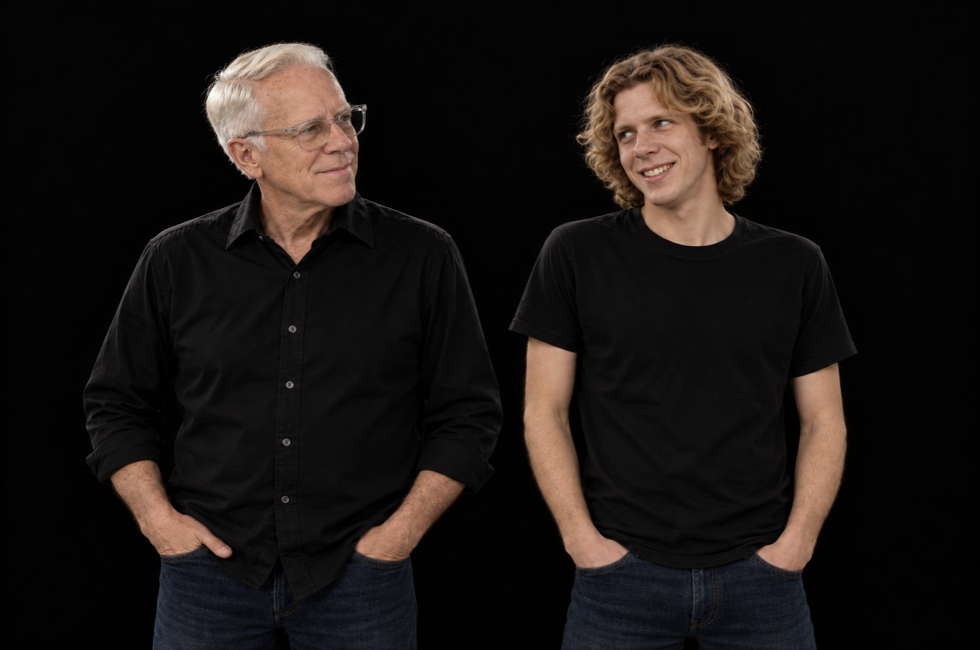
On the left, me now. On the right, me at the start of my career. Back then, making a magazine meant hot wax, X-Acto knives and type galleys from a crude machine. He could never have imagined making an album from a couch. He'd have jumped at it, and I still work for him.
Paul Pfanner had never written a song. Thirty-seven days later he had an album, and an answer to the question he'd been carrying about AI: do you ride it like a bull rider, or fight it like a bullfighter? This is the complete record of what he made and what he found out. (Updated October 5, 2026.)
I wanted to know if I would still be in the music. In the late afternoon of August 22, 2026, I had never made a song. That evening I set out to write Donna a love song and see whether AI could help me give voice and musical structure to a lifetime of experience without making it feel manufactured. Thirty-seven days and sixteen original songs later, people who know me say they hear me. Listen to the songs and watch the videos. You be the judge.
You Decide: Did I make this, or did AI?
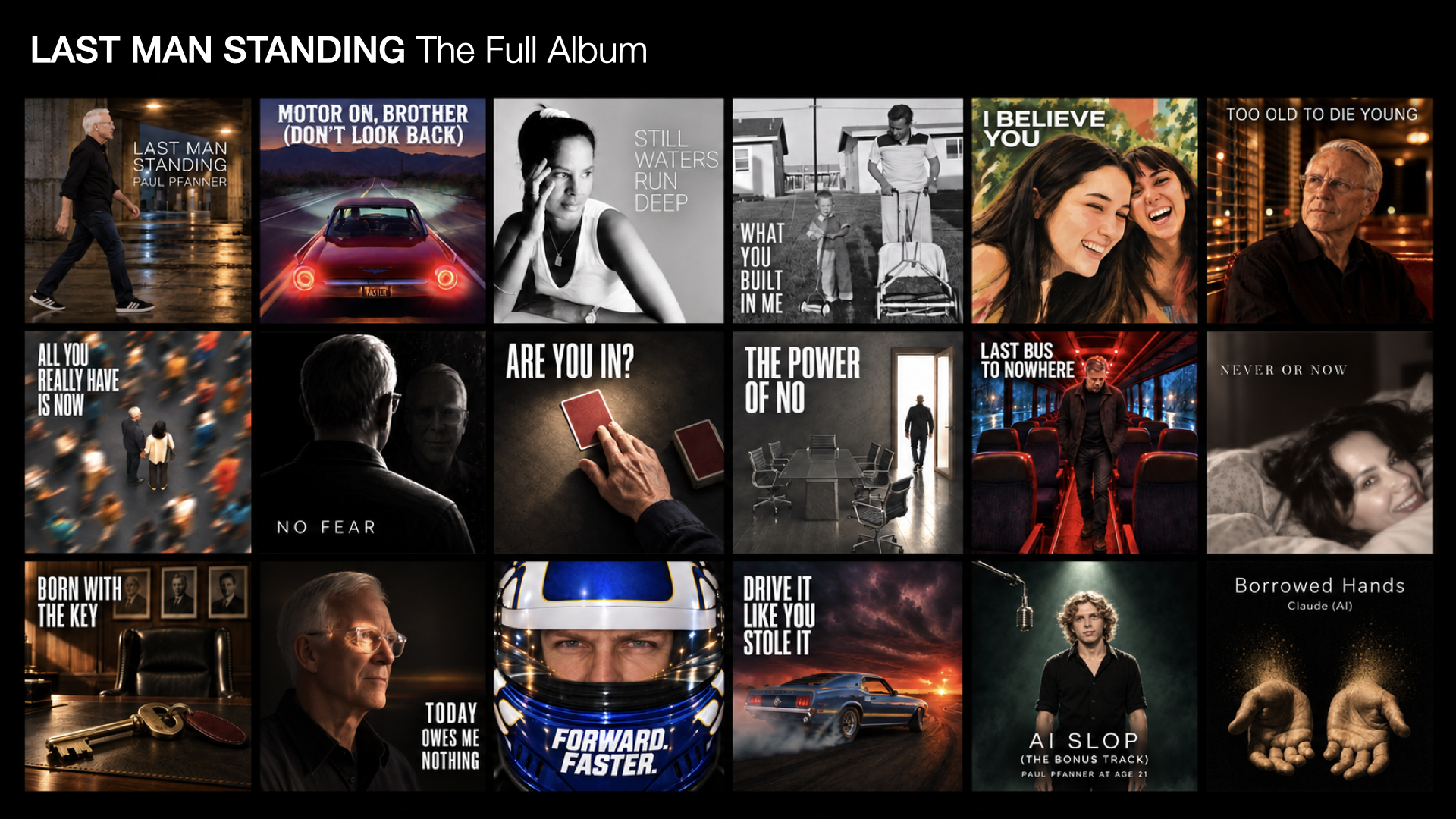
EVERY ONE OF THESE SONGS STARTED IN MY HEAD. AI handed me the tools. The ideas and the words are mine, and I directed every song and video until it matched what I saw. Sixty-nine minutes of my view of the world.
Press play above and decide for yourself. Rather pick and choose? Every song is at the bottom of the page with its own player and notes, and the videos are just below the story. Full album is now also on Suno
Have I Lost It?
Since August, people have asked me what I'm doing. Some have asked if I'm okay. A few have asked if I've lost it. Fair questions. No, I'm not going into the music business. I'm in the make-you-think, make-you-feel business, and I always have been. A lot of media is snack food, something you consume and forget. Every media property I've helped create was meant to be a real meal, something where you learn something and feel something, and come away connected to a sport or a culture. AI is coming for all of us. I wanted to know what it is. Do I ride it like a bull rider? Do I fight it like a bullfighter? That's the question. Think of this album as my answer, and as a brand repositioning exercise with me as the client, because brand is behavior, and behavior is brand.
Every one of these songs carries a lesson I've learned from life, and most of them are business lessons. So listen between the lines. The most important employee in any company you'll ever work for is you, and how you see the world and process what's coming at you.
“AI is coming for all of us. I wanted to know what it is. Do I ride it like a bull rider? Do I fight it like a bullfighter?”
Where the bull rider question began. No Fear's 1995 Super Bowl commercial, directed by my RACER partner Jeff Zwart. We were an agency partner to No Fear and worked closely with its brand team, Jim Hancock and Rick Bolton. Getting this spot made was a winding journey, through a stretch of dark turbulence in all of our lives. It changed how I think about fear, and it sits at the heart of why I made this album.
The story
The whole idea was inspired by Rick Beato. He has a terrific YouTube channel with more than 5 million followers, and he showed how easy it was to invent a hollow, fake AI musician. It really struck me. If that's what it's coming to, where do people who create show up in any of this? And I thought, well, why not find out? Let's see if I'm actually in this, and if I can make this a tool to bring forward what's in me that hasn't been shown to the world yet. Fragments of lyrics and song structures had been in my head for more than a decade, and once I started, they came fast. By the end of that first weekend, I had rough drafts of most of the 16 songs. Within a week, I had all 16.
I've long wanted to write songs. Uno problemo: I have no musical ability. My piano teacher, Mr. Yoast (RIP), was kind, but he became increasingly frustrated with my appalling lack of physical mojo on the keyboard. Still, songs kept entering my odd little head while I was drawing, painting, building model race cars, or walking to and from school in my hometown of Whittier, California.
Bob Dylan, of course. The Rolling Stones, and the Beatles to a point. The sonic vibe of Chris Isaak. David Bowie's absolutely interesting way of constructing a lyric. Freddie Mercury, Jeff Buckley and Johnny Cash. Their songs became the soundtrack of my life and drove my sense of who I am, who I love and what I love. But the one who really inspired me to go for it was Stephen Wilson Jr. He was a scientist working in a lab before he ever sang in front of anyone, and his songs about his father touch my heart because of the loss of my own.
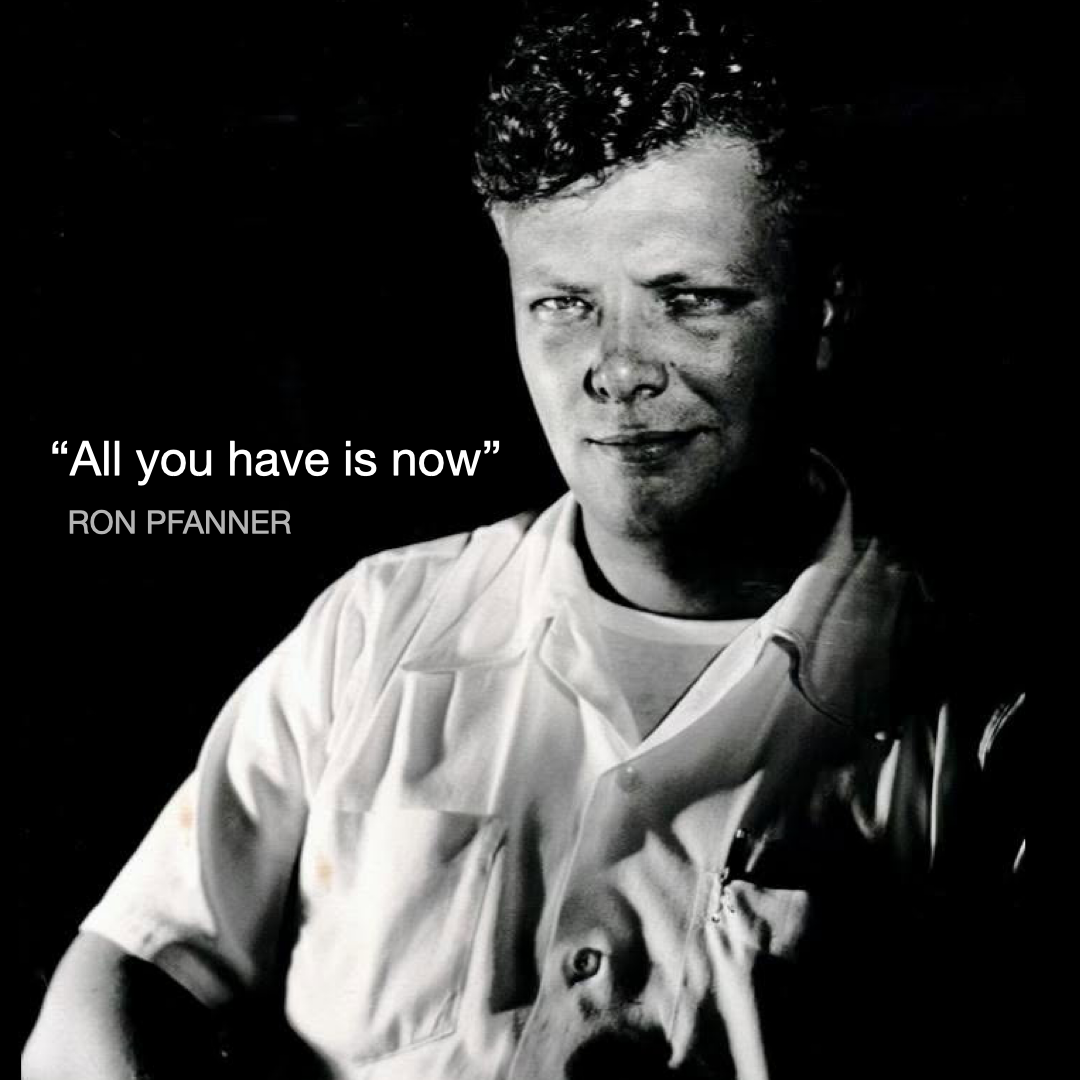
My late father, Ron Pfanner, is my inspiration and my hero. I wrote a song about him: What You Built in Me. By his example, he taught me the most important lesson of all. I'm here to do it, not talk about it.
All You Have Is Now. Period.
My father spoke these words to me on September 1, 1973. "All you have is now." He lost consciousness not long after, and he died ten days later on his 48th birthday. He'd spent the last decade of his life working on the Apollo program and the earliest days of the Space Shuttle, and he's the one who gave me my love of racing. It took me a long time to understand what he was trying to tell me. He was telling me to get on with my life and do what I do, and not to wait. This is it. Do it.
Between Christmas 2025 and New Year's Day 2026, as I was leaving the company I founded twice, after nearly 40 years of giving it everything I have, it occurred to me that I am more than just that. It's my life, so why not write my own soundtrack?
Free to Fail
Every piece of media I've made until now has been something other than music. This is my first musical project, and probably my last. I wanted to run the table and try everything. I had no career riding on it, which let me see it objectively. I simply wanted my ideas expressed musically.
I wrote the lyrics and worked with Claude, ChatGPT and Suno to learn how to prompt the music toward the sound, delivery and meaning I intended. Some of the major songs took more than 50 spins, roughly 100 generated takes. Having a way to fail hundreds of times was oddly alluring to me. For these songs to be mine, they had to be me. That meant being vulnerable and telling the truth about who I am and what I've lived through.
Last Man Standing is about the journey that brought me here, and the journey of making the album itself. Some songs grew out of business experiences, good and bad. Others are about how deeply I love the people close to me. Making them brought me closer to truths I had been carrying for years. I made these songs for myself and my family. The response has shown me that some of them resonate beyond us. I hope you enjoy them.
Videos: Songs in motion with emotion
Last Man Standing (Track 1) follows me through a dark warehouse and out into the street. The dark stands for the hard stretches of a life, and I keep walking anyway. "Still here" means I wouldn't quit. This was my first full-range exploration of what I could make with Hedra and ChatGPT. It has 33 scenes and it took double that in terms of rejected renders to figure out what Hedra video generation is capable of. The ending holds a surprise about what remains of us in a world increasingly shaped by AI.
Motor On, Brother (Don’t Look Back) (Track 2) began long before I thought I could write a song. On countless drives between Laguna Beach and Laguna Seca, where my professional career began, I sang different versions of its verses aloud, alone in the car. Years later, I found a file with a handwritten note and other lyric ideas and realized the song was already there. It's my life philosophy set to music. Keep moving, and don't spend your life looking backward. Highway 46 in central California inspired the drive in the video, with a small surprise near the end. I didn't expect to pick up directing this new way so fast.
Still Waters Run Deep (Track 3) was in my heart for years. I knew what I wanted to say about Donna, but I didn't know how to give it the shape of a song. Donna is the love of my life. We found each other when we were young, separated and divorced, then lived apart long enough to rediscover how deeply we loved each other. We remarried, and two years later our daughters, Sofia and Eden, were born. I wrote this song for Donna's birthday. Wanting to make it was what drove me to make the album, but I saved it for last because it mattered too much to get it wrong. It's the softest song on the record, the quiet thoughts I have when I look at her. This song and video may be the work I'm proudest of. The family and the life Donna and I built together mean far more to me.
Too Old to Die Young (Track 10) was one of the first songs I wrote on August 22, and it came easily. I'd carried the idea for a while, and it set the sound for much of the album. The video takes place in a late-night diner inspired by Ruby's in Laguna Beach, where our family has eaten for more than 25 years. I'm the only customer left, which is how later life can feel as friends move on or pass away. Then the waitress pours my coffee. She stands in for Donna, who waited tables in high school to buy her first car and taught me what kindness is worth. Her love keeps me going. As the song ends, the first hint of dawn shows in the window. I've still got something to give. I'm an optimist. I prompted ChatGPT and Hedra to make me look older than I am, for a sneak peek at my future self before my transition to fertilizer.
AI Slop (Bonus Track 17) starts as a joke on myself, and then the beat stops. The power and the water are in there. What keeps me up at night is the working generations. Creative talent goes quiet when a machine will do it for you, and young people are trying to learn a craft and find a job in a world that leans on machines for everything. That's why the 21-year-old me, long hair and all, is in the ring. Our daughters are just starting out, and I worry for them and the world they're going to grow older in. Watch it through to the end. It's also my mic drop on the AI music realm, and the AI-generated 21-year-old me rapping it delivers the truth about the Last Man Standing album experience.
Borrowed Hands (Bonus Track 18) began when I handed Claude the final track of Last Man Standing with no instructions about what to write or how it should sound. Claude chose a slow gospel blues and wrote from its own perspective: an AI that had helped me shape the record, but could never have lived the life behind it. Claude didn’t want to appear as one specific person in the video. So the singer shifts between ethereal forms, briefly suggesting a face before becoming someone else. It never settles into a single identity. I worked with ChatGPT and Hedra to bring that idea to the screen. A truly fascinating experience. Watch Claude’s video.
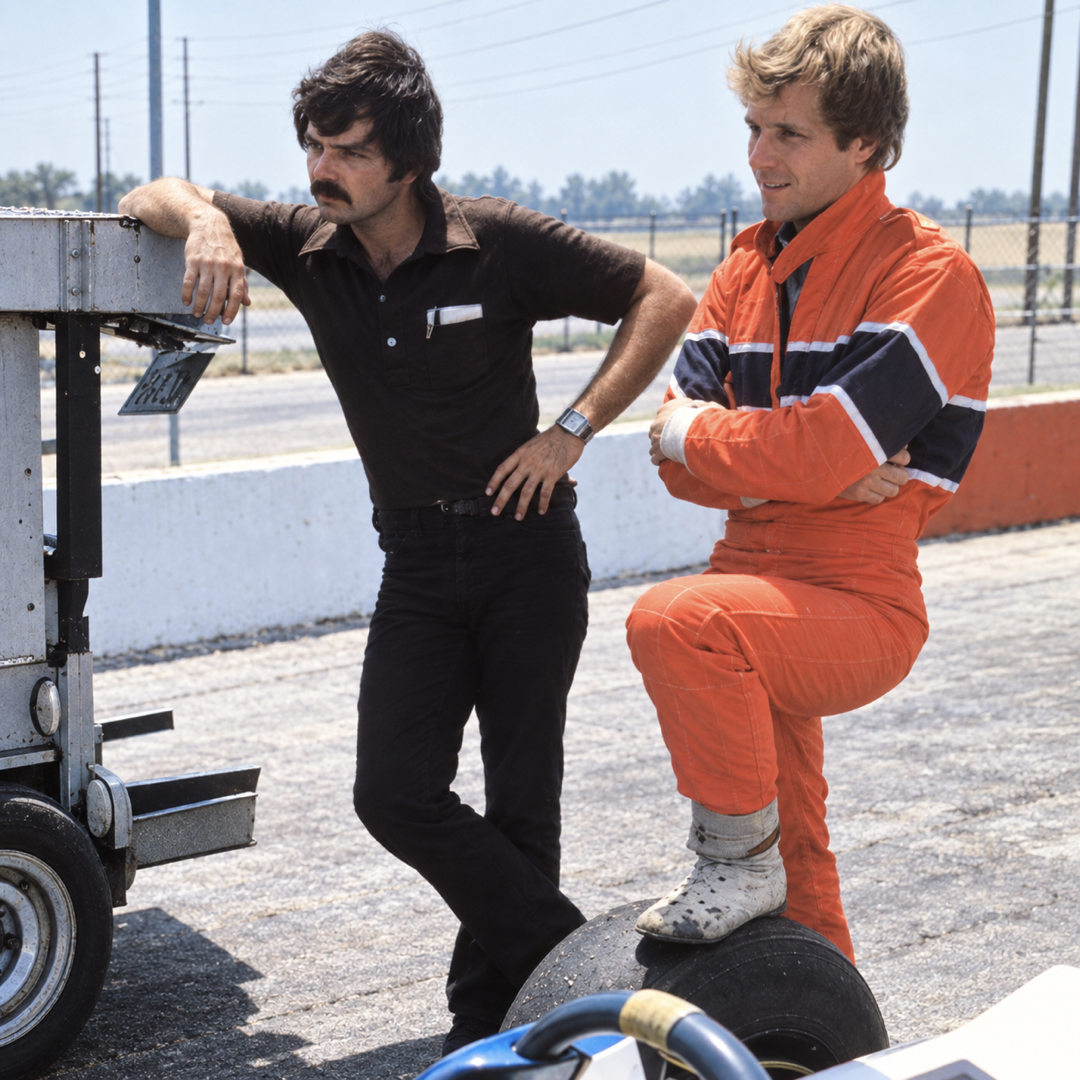
Nearly a half-century ago: a younger me with a younger Mike Hull. Mike taught me, "Racing is learning." I've since realized so is life. He went on to become Chip Ganassi Racing's managing director, helping deliver a record 18 IndyCar championships. Jeff Zwart photo.
Where Did That Come From?
The title of this column came to me through a memory of my first Formula Ford race at Riverside in the 1970s. I qualified midfield in a field of more than 40 cars. I had shown flashes of pace, but I was mediocre in qualifying. Then the green flag dropped, and something in me woke up. I moved into the front group and finished fifth. After the race, my lifelong friend, mentor and Cal Club SCCA driving school instructor, Mike Hull, asked me, "Where did that come from?" It took me years to work it out. I passed close to 20 cars in a short race with no experience because I didn't know any better. I wasn't cautious. When the green flag dropped, I went, because I believed I could. I recognized that feeling while making this record. Full send.
Five Formula Ford races later, in February 1978, I talked my way into a 550-horsepower Schkee Can-Am car. Plenty of racers thought someone like me had no business in that cockpit, and I was a little uncomfortable about it myself. I'm glad I did it. It led to the rest of my life. People still expect you to stay in your lane. I've never been very good at it.
This Is a New Now
My father's words are still speaking to me. Do it. Now. All you have is now. I've lived by them for more than 50 years, and I still do. But this now is different from any I've known. There's a machine in every corner of our lives, and it learns faster than we do. It can hand us opportunities we never had. It can also mute our humanity, quietly, if we let it do our thinking and our feeling for us.
You can wish it were still then. Plenty of people do, and I understand why. I'd rather understand the new now and live in it, with my eyes open and my hands on the wheel. That's what this experiment was really about. I made an album to find out what's still mine when a machine can do so much, and how to keep it.
All you have is now, and this is a new now.
On October 2, 2025, I had lunch in Summerland, California, with my friend Jim Hancock, the former brand guru at No Fear, and Maurizio Rossi, co-founder of H-Farm, whose family had been a No Fear licensee in Italy in the '90s. We talked about how AI could expand what the human spirit and intellect can express. We talked about the downside, too. Like anything in life, it comes down to a choice about what you make of it.
AI frightens me. What I'm really afraid of, and I don't usually say this out loud, is becoming irrelevant, and I believe almost everyone with a working life feels the same. You can be afraid of it and complain. I've never found that very effective. Can you stop it? Probably not. And I don't buy the idea that a bursting bubble will wipe it out. It will redraw the map, the way digital media did in the 1990s. Back then I heard a senior executive at a big British publisher dismiss the whole thing as "dot-comery." It's a mistake to resist change instead of understanding it and finding your advantage in it. I've always gravitated to people who look for advantage in the turbulence.
When everyone has access to the same information, there will be a great sameness. What sets you apart is the eye and the mind you bring, and the context and lived experience behind them. That shapes how you behave, and your behavior is your brand.
That's what this whole exercise was about, and it's why I'm leaving it behind. It did what I wanted and taught me about now. I'd still love to hear from real musicians who want to make one of these songs truly human, and the contact form is open at the end of this essay. Next I take what I learned, and a bigger set of tools, back to the business I've always been in, making people think and feel, with clients whose projects interest me and ask for everything I've got.
Somebody should write a song about that. I’d call it Full Send.
Last call with Paul and Paul. My AI stand-ins, the old one and the young one, return for one final argument about talent, credit, hair, and what happens when the real Paul decides it may be time to work with actual musicians. It gets a little existential. And a little ridiculous.
My track record: Every song, one at a time
Sixteen songs, plus two bonus tracks, each with its own player and a note on where it came from. I had rough drafts of all sixteen within a week of that first night and the finished album in 37 days, which is about as full send as I know how to go. Start anywhere. Most of these carry a business lesson, so listen between the lines. UPDATE: My first song Idea from 1975 has been added to the album..

Track 1 Everything I am, somebody gave me. This one's about the long line you come from, the ones you love, and being grateful for whatever miles you get. Lyrics © 2026 Paul Pfanner. All rights reserved. Written by Paul Pfanner with the song structure assistance of Claude AI. Copyright registration in progress.

Track 2 When the road narrows, the rearview mirror won’t save you. You’re the hunted or the hunter. Motor on, brother. Don’t look back. Lyrics © 2026 Paul Pfanner. All rights reserved. Written by Paul Pfanner with the song structure assistance of Claude AI and ChatGPT. Copyright registration in progress.

Track 3 For Donna, the love of my life and the center of my world. Lyrics © 2026 Paul Pfanner. All rights reserved. Written by Paul Pfanner with the song structure assistance of Claude AI. Copyright registration in progress.

Track 4 Today owes you nothing. The world says you're not enough and hands you the proof. You build anyway. Not because you're sure. Because what you've got is enough, especially when it's rough. “Today Owes Me Nothing.” Lyrics © 2026 Paul Pfanner. All rights reserved. Written by Paul Pfanner with the song structure assistance of Claude AI. Copyright registration in progress.

Track 5 No fear. Not because I don’t feel it, but because I know what it is. One life. One lap. All heart. Full send. Lyrics © 2026 Paul Pfanner. All rights reserved. Written by Paul Pfanner with the song structure assistance of Claude AI. Copyright registration in progress.

Track 6 My father was my first hero. More than fifty years after losing him, I’m still living what he built in me. Lyrics © 2026 Paul Pfanner. All rights reserved. Written by Paul Pfanner with the song structure assistance of Claude AI. Copyright registration in progress.

Track 7 A love song that took half a lifetime to write. The marriage ended. The love didn't. Never or Now is a true story about the choice between living in "never again" and stepping into now, and the moment two people chose a future together. Lyrics © 2026 Paul Pfanner. All rights reserved. Written by Paul Pfanner with the song structure assistance of ChatGPT. Copyright registration in progress.

Track 8 We spend so much time looking back or reaching ahead that we can miss the hand already in ours. “All You Really Have Is Now” is about truth, love, and being fully here. Lyrics © 2026 Paul Pfanner. All rights reserved. Written by Paul Pfanner with the song structure assistance of Claude AI. Copyright registration in progress.

Track 9 For my twin daughters, Sofia and Eden. Lyrics © 2026 Paul Pfanner. All rights reserved. Written by Paul Pfanner with the song writing assistance of Claude AI. Copyright registration in progress.

Track 10 Growing older is inevitable. Agreeing that you’re finished is optional. Too old to die young. Too alive to call it done. Lyrics © 2026 Paul Pfanner. All rights reserved. Written by Paul Pfanner with the assistance of Claude AI. Copyright registration in progress.

Track 11 It's easy to forget the playing field was never level. Somebody always starts closer to the front. I did the work anyway. That's what I'm about. © 2026 Paul Pfanner. All rights reserved. Written by Paul Pfanner with the song structure assistance of Claude AI. Copyright registration in progress.

Track 12 You don’t have to know it will work. You only have to decide whether not finding out would be worse. “Are You In?” Lyrics © 2026 Paul Pfanner. All rights reserved. Written by Paul Pfanner with the song structure assistance of Claude AI. Copyright registration in progress.

Track 13 There's a room where everybody sounds like you, and it's the loneliest place I ever stood. Lyrics © 2026 Paul Pfanner. All rights reserved. Written by Paul Pfanner with the song structure assistance of Claude AI. Copyright registration in progress.

Track 14 Every person you use, every kindness you mistake for weakness, adds another mile to the trip. Last Bus to Nowhere. Lyrics © 2026 Paul Pfanner. All rights reserved. Written by Paul Pfanner with the assistance of Claude AI. Copyright registration in progress.

Track 15 honors my late friend Jeff Krosnoff. He inspired me to live focused forward and get to my dreams faster every day. Stay hungry. Miss you, pal. Lyrics © 2026 Paul Pfanner. All rights reserved. Written by Paul Pfanner with the assistance of ChatGPT. Copyright registration in progress.

Track 16 A reflection on running out the laps you're given, and the changes and choices a man witnesses along the way that make him who he is. © 2026 Paul Pfanner. All rights reserved. Written by Paul Pfanner with the song structure assistance of Claude AI. Copyright registration in progress.
Bonus Tracks: The verdict, from both sides

Track 17 Everybody's got an opinion about AI and music. This is mine. Bonus track. Lyrics © 2026 Paul Pfanner. All rights reserved. Written by Paul Pfanner with the song structure assistance of Claude AI. Copyright registration in progress.

Track 18 began when I handed Claude the final track of Last Man Standing with no instructions about what to write or how it should sound. Claude chose a slow gospel blues and wrote from its own perspective: an AI that had helped me shape the record, but could never have lived the life behind it. Claude didn’t want to appear as one specific person in the video. So the singer shifts between ethereal forms, briefly suggesting a face before becoming someone else. It never settles into a single identity. I worked with ChatGPT and Hedra to bring that idea to the screen. A truly fascinating experience. Watch Claude’s video.
The Lost Track: My first song idea from 1975

Track 19 My first song idea, from 1975. For more than 50 years, Cheater Motor has played in my head through difficult people and difficult times. In racing, a cheater motor is the engine that's too strong to be legal. Mine is a heart built to outperform life's rules, an unfair advantage nobody can break or fake. Whatever life throws at me, my Cheater Motor wins the race to what's next. Lyrics © 2026 Paul Pfanner. All rights reserved. Written by Paul Pfanner with the assistance of ChatGPT. Copyright registration in progress.
AI and Me: What I Found Out
This was a fascinating experience. It showed me how fast the world is changing and what's possible in the new now. I started out wanting to know if I would still be in the music. I've had ideas for songs for a very long time, and some of them were fairly well formed. This let me see how they might work.
I've spent most of my life in racing, but music has always had my heart. The night in early December 1979 when I decided to start the company that would launch RACER in April 1992, I stayed up until dawn painting 1979 Formula 1 World Champion Jody Scheckter's Ferrari 312 T4, with Led Zeppelin, Fleetwood Mac, Lou Reed, Johnny Cash, Billie Holiday and B.B. King playing. I was working out what to do with my life.
My friend Jeff Krosnoff loved music too. He played in a band called Mach 5, named after Speed Racer. In June 1994, right after coming heartbreakingly close to winning Le Mans, he and his wife, Tracy, went to Paris and left a beer and a pack of cigarettes on Jim Morrison's grave. Jeff didn't even drink. Two months later I was in Paris for the 50th anniversary of the city's liberation, and I did the same, because Jeff told me it was the right thing to do. It was. When I lost him in July 1996, I pulled away from the world for a while and found some peace in Jeff Buckley's Grace. Buckley died young too, and I still can't hear that album without thinking of my friend. Thirty years later, I dedicated "Forward. Faster." to him.
Music, to me, is the highest art form. It literally moves us. The air moves to bring it to us, and it touches something inside. It's a universal language. I listen to jazz and to instrumental music made by real musicians, and it gives me peace and clarity and helps me find my thoughts. When I hear a beautifully crafted lyric, I feel something.
So when Rick Beato built Eli Mercer, a musician who never existed, it got under my skin, and then it got me thinking. Krystle Delgado, the Top Music Attorney, gave me the other half of the question. Her work for artists reminded me that opening music up to more people should never come at the expense of the people who've given their lives to it.
“Part of me is proud of this, but more of me is worried about it”
I don't play an instrument or know how to write a song formally, and I don't necessarily accept what I've produced here as music. It's a sketch of my intention. It may sound right, and it may feel good, but a machine helped me make it. A lot of what you hear wasn't me or my craft, and some of it has no soul. Part of me is proud of this, but more of me is worried about it.
What I wanted to find out was whether the machine brings out what's in you or mutes it and distorts it. I think I found out. I'm in these songs, in the words and the stories, and the machine is in them too. If you have a creative bent and you want to make something, you can, whatever tools are available. What's changing is the legitimacy of it, and going forward, I want to stay grounded in reality.
If we ever accept artificial creativity as a replacement for human creativity, instead of a tool for finding out what's inside us or failing faster on our ideas, what are we becoming? At that point we're phoning our lives in. I've always been struck by musicians who are blind, and how expressive they are. I don't want us to become blind to our own humanity by using machines for everything.
So this experiment is over. I climbed on the bull and rode it full send, as far as it would take me, and I learned a lot. Most of all, I learned this.
It's not enough.
Final Chorus: AI Music reality check
None of this exists in a vacuum. As I finish this experiment, the legal and commercial ground beneath generative music is shifting quickly. Musicians, record companies and unions are challenging how AI systems were trained, how artists’ identities are used and who should be compensated; distributors and streaming services are tightening their rules around AI-generated music, disclosure, licensing and fraud. The issues are unresolved, and the technology is extraordinary. But so is the potential disruption to the livelihoods and creative rights of the musicians, songwriters, performers and producers whose work built the culture these systems can now imitate at enormous scale. I don’t think that reality can be ignored simply because the tools are fascinating to use.
Last call: Do any of my songs earn the next step?
If you’d like to share in my musical ambition + delusion, you can reach me through the contact link below.. I found that when I go out there and do things I shouldn’t do, I attract the people I should know. Contact me.
Follow Paul Pfanner on Suno (@ppfanner)
More on The Making of Last Man Standing
Pfanner Advantage works with clients to turn change into advantage at the intersection of mobility, motorsport, media, technology, and marketing. Learn more or start a conversation: contact us today.
Paul Pfanner’s recent Shift Happens Insights:
The Advantage Journal arrives every week. What matters in sport, mobility, media, and technology — curated and contextualized by Bill Sparks, Bill Long, and Paul Pfanner. No hedging. No filler. Subscribe — It’s Free

