
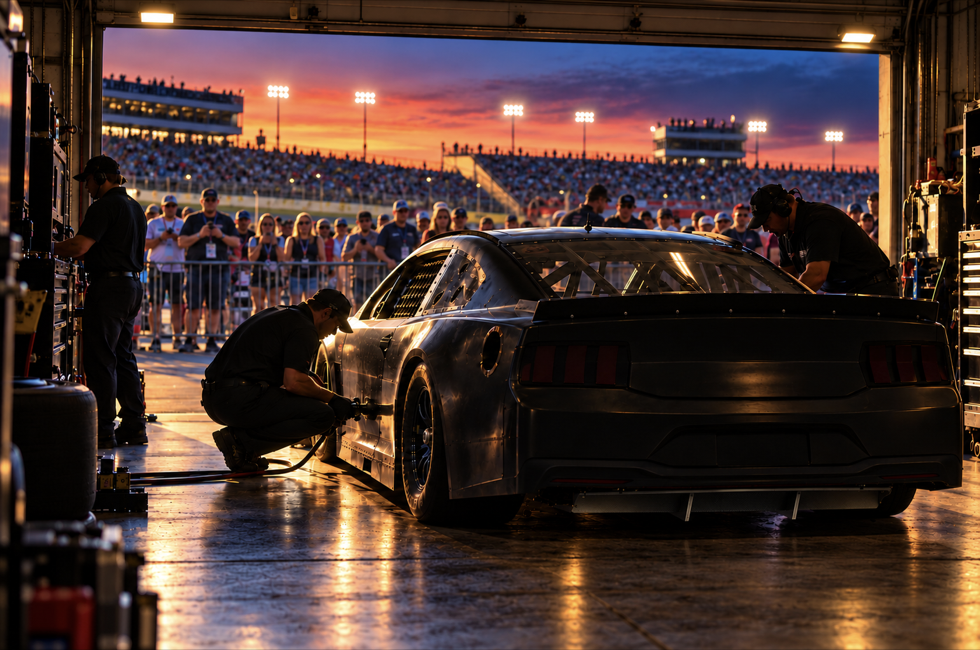
Built to last. With their place in the series more secure, teams can invest beyond the next race or next season. .
Paul Pfanner looks at what NASCAR stands to gain from teams built to outlast the people who founded them. Third in his series on NASCAR's Moment..
Les Richter shaped a lot of how I think about this sport. Les ran Riverside International Raceway when I was starting out, and later became one of NASCAR's senior executives. He played in eight Pro Bowls for the Los Angeles Rams, in a league governed by its teams.
Les believed the stability of the sanctioning body and the racetrack promoters came first. Teams come and go. The series and the tracks had to be there long after any particular owner had moved on, and you protected them. I heard that from him when I was young and it stayed with me.
I don't think he was wrong. For most of the years I've been around this sport, NASCAR's great strength was its stewardship. A team owner has to win next Sunday and make payroll on Friday. NASCAR has to make sure there's a championship worth racing in twenty years. Those jobs overlap, but they don't always point the same direction.
But times have changed. Teams are building content businesses of their own now, and several have attracted significant investment from outside the traditional racing world.
In September, Brad Keselowski, the K in RFK Racing, and the team announced they'd part ways after this season. He later confirmed he'd tried to buy the operation and the other owners turned him down. On October 31 he said he'll sell his 20 percent stake; he's now a passive investor with no management role. RFK carries on under Roush Enterprises and Fenway Sports Group. A champion who helped rebuild the team wanted to own all of it, and the team goes on either way. That tells you something about what a Cup team has become.
That's the change I want to look at in this third part of the series. If NASCAR's teams are becoming companies that outlast their founders, with outside investors and a longer view of their own, does NASCAR come out ahead?
I think it can. That principle was right for the sport he helped build, and it no longer describes a lot of the businesses in today's garage. Whether NASCAR comes out ahead depends on what both sides do with the years leading to 2032.
What changed last December
The charter system NASCAR created in 2016 gave 36 entries a guaranteed starting spot and more predictable revenue. It gave owners something they could sell, although the agreements ran for a fixed term.
That relationship was at the center of the lawsuit brought by 23XI Racing and Front Row Motorsports, settled last December. Financial terms stayed confidential. The joint statement said NASCAR would offer existing charter holders amendments including a form of evergreen charters, subject to mutual agreement.
The point is continuity. A team should be able to plan years ahead without wondering whether its place will survive the next renewal. A charter isn't a share of NASCAR, and the conditions of racing still apply. The announcement doesn't spell out every term. What I'd watch is how that security sits alongside NASCAR's authority over the sport.
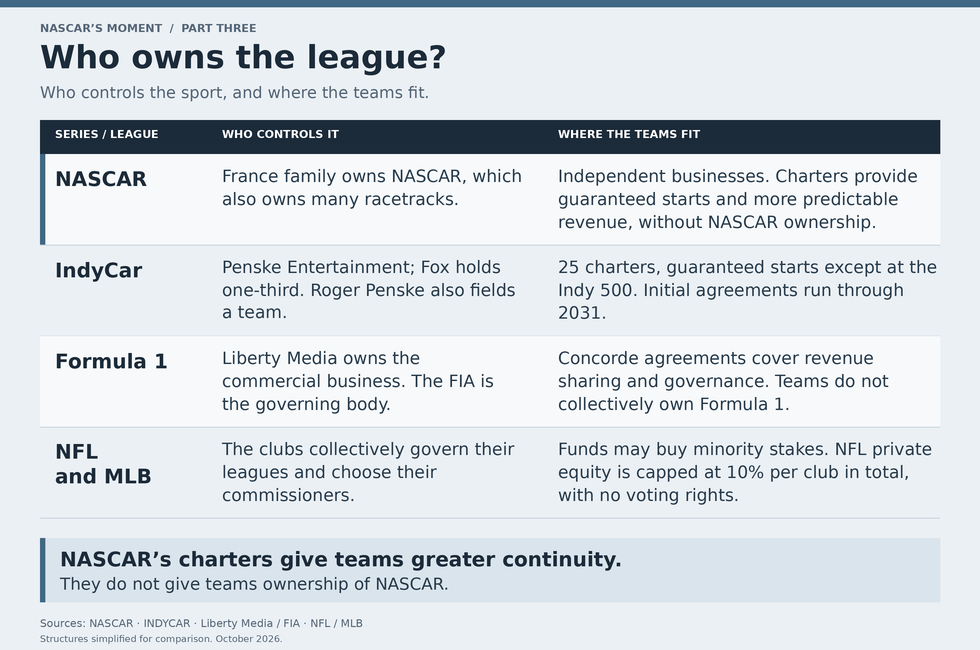
Who gets a say? A racing team can hold a guaranteed starting spot and a share of the revenue and still own no part of the series. In the NFL and baseball, the clubs run the league.
A higher price is not a stronger sport
Outside money arrived before the settlement. Fenway Sports Group is an owner of RFK. Harris Blitzer Sports & Entertainment and Arctos Partners took minority stakes in Joe Gibbs Racing in 2023, and Avenue Sports Fund bought a significant minority stake in Trackhouse's parent company the following year. Those groups bring experience from other leagues and relationships with brands NASCAR would love to reach.
But a rising charter price tells you somebody is willing to pay more for a place in NASCAR. It doesn't tell you the sport is healthier. Money that buys out an owner can help a team survive a succession. Money invested in facilities or commercial staff can build the business. An announcement often doesn't tell you how much goes where, and the difference matters.
I've spent my working life on the media and marketing side of this business, and I'd apply the same test I'd apply to any client. Brand is behavior. Show me what the new money does.
The tracks are in this too
Promoters carry the risk of putting on the show. Speedway Motorsports runs Charlotte, Bristol, Sonoma and others as an independent company, selling tickets and hospitality and paying for a race weekend whether it rains or not.
NASCAR negotiates the national media contracts, and tracks and teams are paid through their own agreements with NASCAR. Since it bought International Speedway Corporation in 2019, NASCAR also owns many of the tracks, so it sits on both sides of that table. A larger payment to teams affects the money available elsewhere. Growing the business gives everyone more room, although it won't settle every argument about the split.
The manufacturers are partners too
Chevrolet, Ford and Toyota put engineering and marketing money into this garage that teams depend on. NASCAR was built on American manufacturers, and Toyota, in Cup since 2007, has become an important player in its economy.
This year Ram returned to the Truck Series with a five-truck Kaulig Racing operation. Stellantis has discussed bringing Dodge back to Cup, though no return has been formally announced. A manufacturer brings money and marketing, and fans who follow a brand before they follow a driver. Stronger teams give that investment a more dependable home.
There's employment behind this too. Performance Racing Industry's 2025 study estimated that the wider U.S. racing industry supports more than 318,000 jobs. That reaches well beyond NASCAR. Keeping teams in business matters to the people they employ and the suppliers who depend on them.
What NASCAR gets back
So make the case in NASCAR's own terms.
A team with more confidence in its future has a better basis for signing a longer sponsorship deal. It can commit to a driver development program or a content operation that takes years to pay off. It can build a following for the organization itself, so fans have a reason to stay when a star retires or changes seats.
A team with real commercial strength can help a promoter sell a race. It can give broadcasters and streamers stories worth telling. If it brings a new sponsor into NASCAR, rather than moving an existing sponsor's money around the garage, that adds to the business. The sport benefits when those relationships reach people it wasn't reaching before.
Those are benefits NASCAR can reasonably expect. Teams that asked for greater security should invest in audience and brand as well as in the race car. NASCAR should be willing to listen to people putting long-term money into that work. Listening isn't handing over the keys. Both sides still have to show it works.
Everybody is a content company now
Teams use YouTube channels, podcasts and social accounts to give fans something to follow between races, including people who may never watch a whole one.
NASCAR is in that business too. It offers free race archives through NASCAR Classics. At San Diego this year, independent creators could apply for media credentials. Its chief digital officer has publicly encouraged NASCAR content from outside creators. Full Speed began on Netflix; this year's Daytona 500 film is on Prime Video, which also carries Cup races.
The more energy the sport collectively brings to telling its story across every touch point, the better.Reaching the younger audience is absolutely critical to its future. Owning the conversation about what racing in North America is, with people who have lived most of their lives in this century, is the whole enchilada.
What I'd watch
As I wrote in part two, the current media agreements run through 2031. The audience NASCAR and its teams build between now and then will help determine what they can offer for 2032. I'd watch whether people develop a lasting interest and keep coming back. That would tell me more about its future than any charter sale.
Most fans will never care how a charter deal was financed. They'll care whether they know who's driving and feel something for a team. And whether the race still fits into their Sunday.
A team built to outlast its founder can be a more dependable partner for NASCAR. Whether it turns out that way depends on whether all this security becomes investment that gives people more reasons to follow the sport. If it does, NASCAR gets a stronger business of its own out of an arrangement it resisted for a long time. That's what I'm hoping to see. In part four I'll take a closer look at the manufacturers, and at IMSA.
Pfanner Advantage works with clients to turn change into advantage at the intersection of mobility, motorsport, media, technology, and marketing. Learn more or start a conversation: contact us today.
Paul Pfanner’s recent Shift Happens Insights:
Other Than That, I Enjoyed the Film
Will NASCAR Play the TV Game or Redefine It?
The Advantage Journal arrives every week. What matters in sport, mobility, media, and technology — curated and contextualized by Bill Sparks, Bill Long, and Paul Pfanner. No hedging. No filler. Subscribe — It’s Free

