
I Saw What You Did There
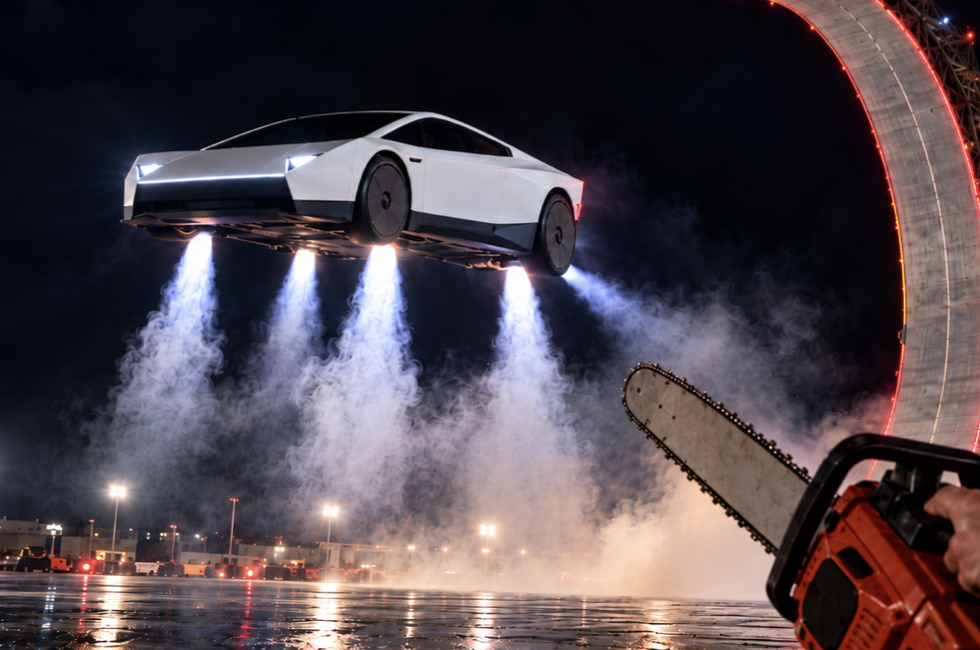
Ready for when it comes back down to earth.
Paul Pfanner's teammates at OnCars Studios made the films that introduced the Tesla Model S in 2009. Last night he watched Tesla make its new Roadster fly, and came away with a question the show didn't answer.
I watched Tesla unveil its long-awaited new Roadster last night, and I have to admit I was impressed.
Thrusters borrowed from SpaceX. Zero to sixty in under a second. A car that drove up a curved ramp until it was hanging upside down, let go, flipped in the air and came down on its wheels, then later hopped a row of parked Teslas like it was clearing a curb.
Quite a show.
Elon Musk knows how to work an audience, and Tesla’s engineers know how to make extraordinary things happen. I grew up with a father who worked on the Apollo program and I’ve spent my life around racing cars, so I can appreciate the science. Nobody broke the laws of physics in Waco. They exploited them, rather cleverly.
But somewhere between the cold-gas thrusters and the breathless celebration online, I had a thought.
Does anybody have a chainsaw? I’d like to cut through the bullshit.
Because once you get past the spectacle there’s an obvious question. What does any of this have to do with the automobile business? And what business is Tesla in now?
I Remember a Different Kind of Magic
I have some history here. In early 2009 our small team at OnCars Studios got the Model S prototype the day after it was finished, and we had a couple of weeks to make the films that introduced it. Tesla used them for years to collect the deposits that helped get the car built.
Which is why one date keeps bothering me. Tesla built its last Model S in May, and the Fremont line that built it is being turned over to Optimus robots. Five months later the company’s new showpiece is a two-seater that can fly a little, promised for 2028, more than ten years after it was first announced in November 2017. Back then Tesla said it would seat four and go 620 miles. Its website now says two seats and something over 300.
That’s a long time between the promise and the product, and the promise got smaller while we waited.
Physics Is Not a Business Model
Let’s give the engineers their due. Cold-gas thrusters are legitimate technology; push compressed gas out one way and the car goes the other. The fan-assisted suction has a racing pedigree I know well. Jim Hall’s Chaparral 2J sucked itself to the ground in Can-Am in 1970, and Brabham’s fan car won its only Formula 1 race in 1978 before it was withdrawn. Putting both ideas into a high-performance electric car is ambitious work.
But making something physically possible doesn’t make it useful. Supplemental thrust doesn’t automatically make a better sports car, and a car that can briefly drive upside down may just be a fascinating solution to a problem nobody has.
Racing taught me the difference. A great race car isn’t defined by one burst of performance under carefully controlled conditions. It’s defined by how its systems work together and whether it can do the same thing again, lap after lap. Driver, chassis, tires, brakes, aero and powertrain all have to talk to each other, and the performance has to be usable by the person in the seat.
So I have questions. How many times can the Roadster do its trick before the gas runs out? What does the hardware weigh, and what does it do to the handling? What happens when it fails, on a car Musk himself described as “not necessarily a safety optimized car”? Tesla has already answered the last question I would have asked. The flying version is invite-only, and Tesla’s own website says it isn’t approved for public road use.
None of that is an objection to innovation. Those are the questions that turn a demonstration into a product program. I’d love to see the Roadster run a proper road-course session, with consistent lap times, braking you can count on and handling that doesn’t change from one lap to the next. That would tell me something about the automobile. A choreographed aerial stunt tells me Tesla knows how to put on a show, and it was a very good show.
Meanwhile, Back on Earth
While Tesla was teaching a car to leave the ground, the rest of the electric car business kept moving.
In the third quarter BYD sold 762,478 battery-electric passenger cars, and that number leaves out its plug-in hybrids. Tesla delivered 486,532 vehicles worldwide. That’s a gap of roughly 276,000 cars in one quarter, and BYD is only one of several Chinese manufacturers coming hard on price, manufacturing efficiency, batteries, software and, more and more, design and perceived quality. China’s home market is rough right now, with brutal price wars and BYD’s own domestic sales falling, but its overseas sales have nearly doubled this year. They aren’t waiting for Tesla to finish its magic act. They’re building cars people can afford, for the jobs people need cars to do.
Will a Roadster with rocket hardware make Tesla’s factories more efficient, or take a dollar off the price of a Model Y? Will it help Tesla hold its ground as BYD pushes into Europe and beyond? I don’t see how, and Tesla hasn’t made the case.
That’s not to say Tesla can’t compete. It remains a formidable engineering and manufacturing company with real strengths in software, charging and energy storage. But you don’t win this race because the audience gasps. You win because customers choose your car over somebody else’s, and then choose it again.
The Business of Believing
Why do it, then?
Musk has never pretended the Roadster matters financially. Back in 2023 he called it “the cherry on the icing on the cake.” Fair enough. Automakers have always built halo cars that earn their keep by making the whole brand more desirable, and there’s nothing wrong with that.
But a halo is supposed to shine on something. What is this one shining on?
Tesla increasingly describes itself as an artificial intelligence, autonomy and robotics company. Maybe that bet pays off. Still, a midair rotation tells us nothing about the economics of robotaxis or whether humanoid robots can be built at scale. It tells us nothing about the next affordable Tesla either, a car Musk has said the company won’t build unless it drives itself.
What it does show is Tesla’s gift for attention, and attention has value, especially for a company whose market value rests on businesses that haven’t yet reached the scale promised for them. Was last night designed to juice the stock? I don’t know, and nobody outside Tesla’s inner circle can honestly say. The shares jumped about five percent before the market opened this morning and closed the day lower. Gene Munster, a longtime Tesla bull, called the event an engineering flex with no commercial value.
Did it win the internet? Mission accomplished. The clips were irresistible, and people who will never shop for a quarter-million-dollar electric sports car have spent today talking about one that flips. For a day nobody was talking about margins, Chinese competition, affordability, or how hard it is to make money from self-driving cars and robots. They were talking about a flying Tesla.
That’s what a good magician does. Nobody in the audience believes the woman is really sawn in half. The genius is in controlling where you look, so for a moment you stop thinking about everything else. Entertainment is a perfectly good business. I’m just not sure it’s the one Tesla was built to be in.
The Model S made an argument about personal transportation, that an electric car could be better than anything else in the showroom. The new Roadster makes a different argument, which boils down to look what we can do, and I’ve never seen that one change a market.
I saw what you did there.
Show Me the Business
I want Tesla to succeed. I have no obligation to defend its decisions, but I remember what it did when it forced the rest of the industry to face a future it had been dragging its feet on. That mattered.
The engineers who built this Roadster did something remarkable, and I hope some of what they learned turns up later in ways none of us can picture yet. But I don’t confuse admiring their work with trusting the strategy wrapped around it.
The real test for Tesla is whether it can keep developing, building and selling competitive cars in a world that has caught up with most of the advantages it once had. Next Wednesday Tesla reports its third quarter, and that’s where the car business shows up, in the numbers.
The Model S changed the industry because it was a product you could buy and drive. The Roadster may become one in 2028. Until then we’ve watched a spectacular piece of automotive theater from a company that spent two decades proving the future belongs to the people who build it.
Now show me the car business.
Pfanner Advantage works with clients to turn change into advantage at the intersection of mobility, motorsport, media, technology, and marketing. Learn more or start a conversation: contact us today.
Paul Pfanner’s recent Shift Happens Insights:
The Advantage Journal arrives every week. What matters in sport, mobility, media, and technology — curated and contextualized by Bill Sparks, Bill Long, and Paul Pfanner. No hedging. No filler. Subscribe — It’s Free

