
It Was Never Just the Car, It’s Who gets the Seat

The best thing about this car is the driver who isn't in it yet. The next one should show that even more clearly.
Fifth in a series about the new IR-28 Indy car. If you grew up reading about Indy car racing, chances are you held Paul Pfanner's work in your hands. He published RACER and RACER.com, IndyCar and Champ Car magazines, and the CART and IndyCar fan guides. Over the years he has worked with the sanctioning bodies, the manufacturers, the teams and the tracks that make up the sport. This piece began as a sidebar to his last column and outgrew it, because the story under the new car was never the car. It's the few with the courage and the gift to drive one at all, where every lap is a moment of truth, not a thrill show. The only question left is whether the sport still gives them a challenge worthy of what they risk.
The reveal of a new Indy car pulls every eye to the machine. That's natural. It's the thing you can see and argue about. But a car has only ever been half of a bigger question the sport keeps asking without saying it out loud. Who gets to drive one, and how did they get there. A formula answers that long before anyone takes the green. The car, the schedule, the ladder, the money and the open seats all settle who gets close enough to try. Change one piece and the field changes with it, until the sport is making a different kind of driver than it used to. And driving one of these has only ever been for the few, a rare and dangerous thing almost no one alive can do.
So the Indy Racing League was never really about a slower, cheaper car. The idea was bigger. It meant to bring back an American way of racing, more ovals, familiar engines, and a real road from midgets and sprint cars back to Indianapolis. Tony George, who started the league, laid out its purpose in a 1995 letter to the Indianapolis Star. The league existed, he wrote, to provide "growth, stability and opportunity for open-wheel, oval track racing," because he believed the long-term protection of the 500 depended on it. It was also an answer to CART, which had gotten fast and expensive and international, and had drifted far from the local tracks that used to feed it drivers. The short-track kids were already being pulled toward NASCAR, where the path was easier to see and the money was bigger.
A rule draws the line
The split came to a head on one afternoon I was standing in the middle of. For the 1996 Indianapolis 500, the 25/8 Rule set aside 25 of the 33 starting spots for the top IRL teams, as long as they ran a four-lap qualifying average of at least 220 mph. That left eight places for everyone else. CART wouldn't run under those terms, so it staged its own race the same day, the U.S. 500 at Michigan.
A lot of us went sure we were about to settle the argument for good. CART had the established teams, the name drivers, the field we believed was stronger. Then the cars crashed on the final pace lap, before the green ever flew. I found Dan Luginbuhl, Roger Penske's longtime PR man, up in the press box. He looked at me and said two words. "It's over." He was right, though not the way anyone meant it that day. What the wreck showed was a sport more interested in winning the argument than in protecting the thing both sides were fighting over. And underneath the engines and the politics, that thing was who gets to be a driver at Indianapolis.
The rule changed the field right away. In 1995, 14 of the 33 starters had been born in the United States. In 1996 it was 23. What that number doesn't tell you is whether the system that used to make those drivers had come back. All the rule really did was change who got into the race.
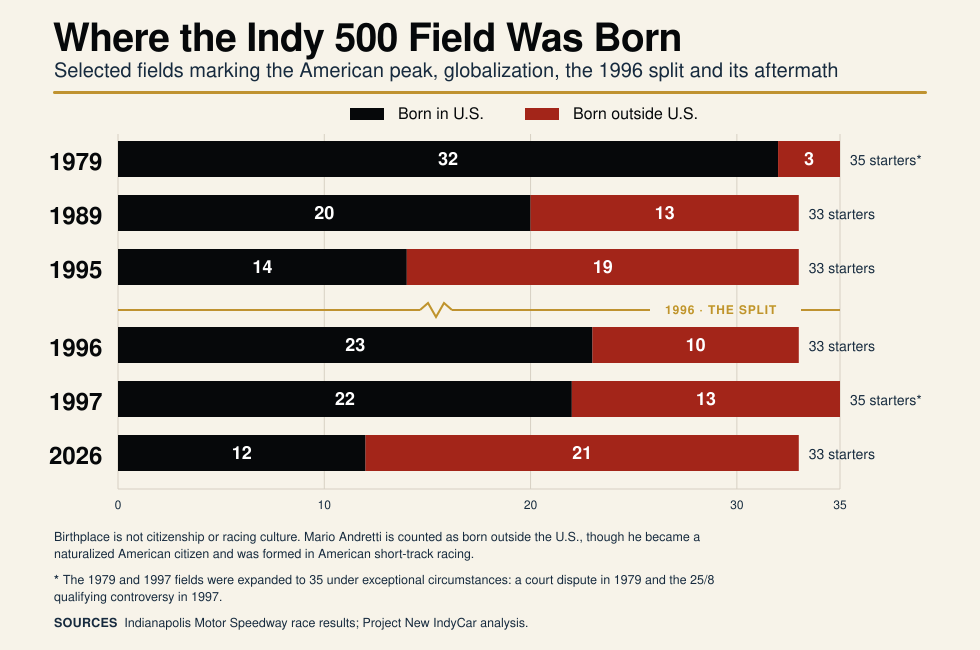
A year later it made a mess of its own. The 1997 field had to be opened to 35 after the rule bumped Lyn St. James and Johnny Unser, both quick enough to sit among the 33 fastest, and it was gone by 1998. Birthplace is easy to count and close to meaningless on its own. What shapes a driver is where and how they learned to race, and that is harder to put in a chart.
The road stayed closed
In 1979, 26 of the 35 cars at Indianapolis were driven by people who came up mainly through American oval racing, the midgets and sprint cars and dirt cars, the supermodifieds, the stock cars. By 1997 that was down to six. In 2026 it was one.
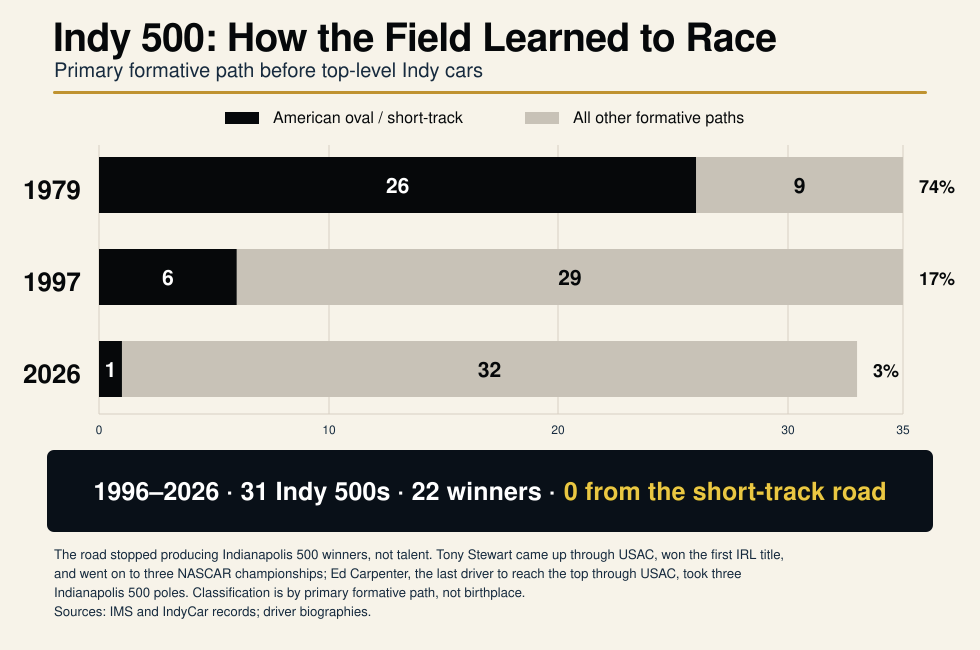
That's the part that stays with me. The IRL changed what the field looked like on paper. It never rebuilt the thing that used to make those drivers in the first place.
Years later, George admitted it himself. He said the old USAC feeder system that once carried dirt-track and sprint-car drivers to Indianapolis had long since disappeared, and that he built the league to give those drivers a way up again. Some advanced, he said, but for the most part the car owners wouldn't take the risk. He even named the one who got away, Jeff Gordon, who went to NASCAR instead.
Tony Stewart is the honest exception. He came up through USAC, won the Triple Crown, took the first IRL title, and then went out and won three NASCAR Cup championships, the only driver ever to hold titles in both. At Indianapolis his best was fifth, leading 64 laps in 1997. That is not a man who lacked the talent to win the 500. It's a man the system couldn't deliver to one, so his ability went and conquered NASCAR instead.
The larger number is harder to wave off. From 1996 through 2026 there were 31 Indianapolis 500s and 22 different winners. Not one came up mainly through the midget, sprint or Silver Crown ladder the IRL set out to save. The talent was there. What didn't survive was the ladder.
A Road Back That Led Away
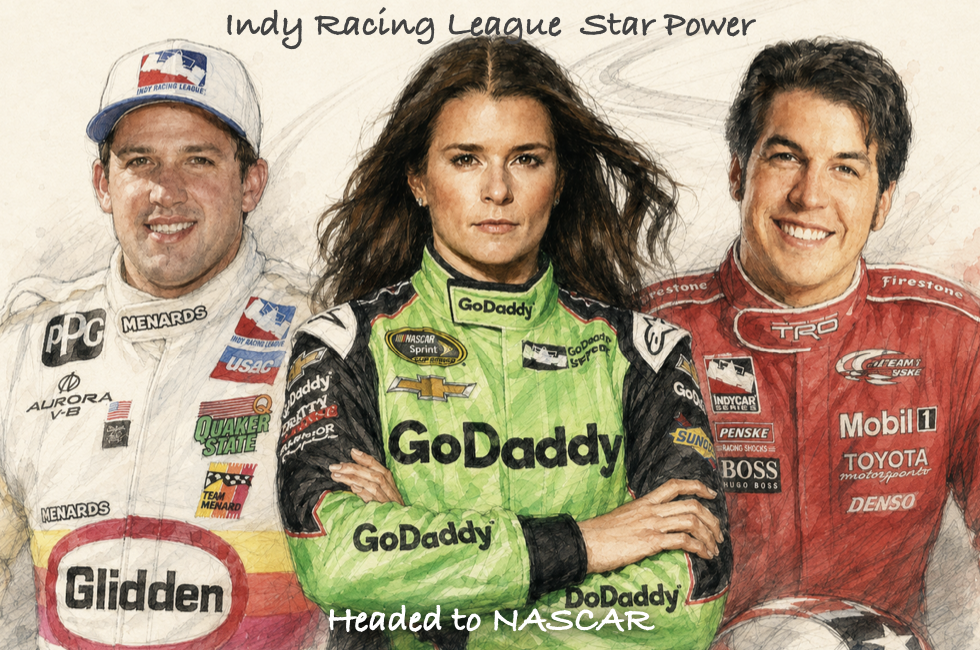
The league that bet on stars. The IRL wanted popular drivers as much as fast ones, and built a formula of lower-powered, closer cars that made the show the selling point. Tony Stewart, a USAC Triple Crown champion, won the 1996-97 title and left for NASCAR and three Cup crowns. Sam Hornish Jr. won three championships and the 2006 Indianapolis 500 for Penske. And Danica Patrick was the era's it girl, a mainstream celebrity more famous for being Danica than for her driving, though the driving was real: the first woman to lead the Indianapolis 500 and the only woman ever to win an IndyCar race. The star-first bet came before social media did, and it met the wall of reality when the talent poured back in, the cars got harder, and the road courses returned.
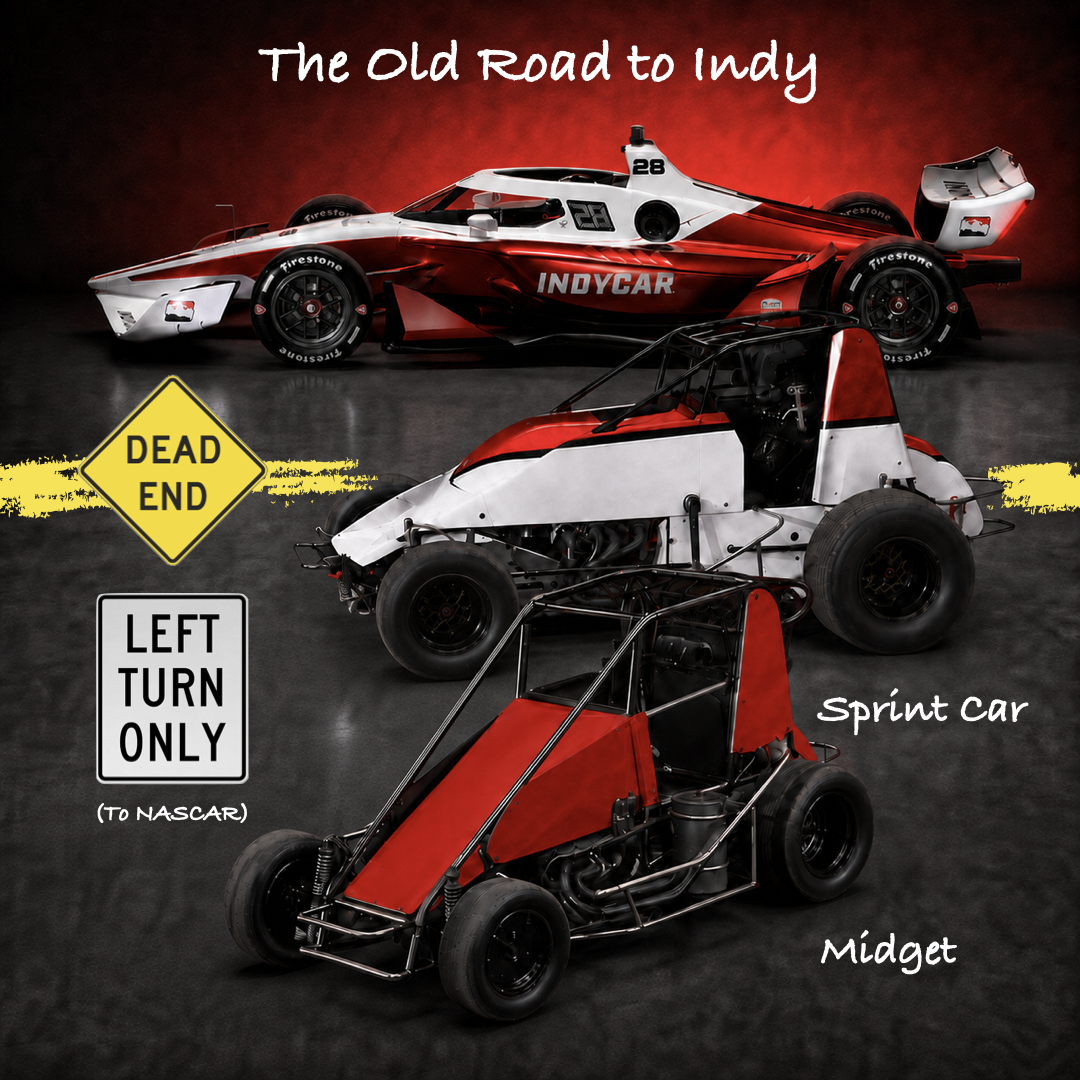
Road closed. Left turn only. Once the Indy car became a formula car, the midget and the sprint car stopped leading to Indianapolis. The ladder that had carried Americans to the Brickyard for fifty years turned into a dead end. The traffic didn't stop, though. It turned left, toward NASCAR, surging in the mid-1990s and glad to take them. Jeff Gordon kicked the door open, a USAC midget and Silver Crown champion who became a four-time NASCAR champion. In 1994 he won the first Brickyard 400, the first NASCAR race ever held at Indianapolis, conquering the Speedway in a stock car instead of an Indy car. The Speedway itself was changing too. It added NASCAR in 1994 and brought Formula One through its gates in 2000, a Grand Prix run the opposite way around a new infield road course, with garages built just for it. The home of the Indy 500 had become a venue with many tenants, its singular identity blurred. From then on the old road to Indy ran to NASCAR, and an Indy car driver looked like a formula car, not a front-engine sprint car hanging the tail out.
Someone built a way in
If you want to see what rebuilding a ladder really takes, it isn't a rule or a slogan. It's a person deciding to do it. In 1990 Jeremy Shaw started the Team USA Scholarship to find promising young Americans and get them in front of the sport before anyone was looking. Jeremy was the public face and the engine of it. I was the silent hand. Rather than repeat a Formula Ford Anniversary event we'd run the year before, we rolled its goodwill and sponsorship into sending one American a year overseas, into unfamiliar cars and competition, to see what he'd do.
The first was Jimmy Vasser, in 1990, and he won the CART championship in 1996. There was nearly another name alongside his that year. Jeff Gordon was a young USAC short-track racer then, and he wanted a way to Indianapolis. Jeremy talked to him about the ride, and we had Valvoline behind the scholarship, which we hoped would help pull him over. He was in the middle of changing teams and sponsors and couldn't make it go. He went to NASCAR and became a four-time champion. For a short-track kid, that was the road that was easier to see.
The second, in 1991, was Bryan Herta. I went over to watch him run the Formula Ford Festival, at Brands Hatch, and from then on he was inevitable to me, not because he was fastest but because of how he saw a race, the race going on inside the race. He made it to IndyCar, won races on merit, and then did the rarer thing and became a team owner. His team won the 2011 Indianapolis 500 with Dan Wheldon, and five years later his Andretti Herta car won the hundredth running with a rookie named Alexander Rossi, on a fuel call Bryan made from the timing stand that nobody else would touch.
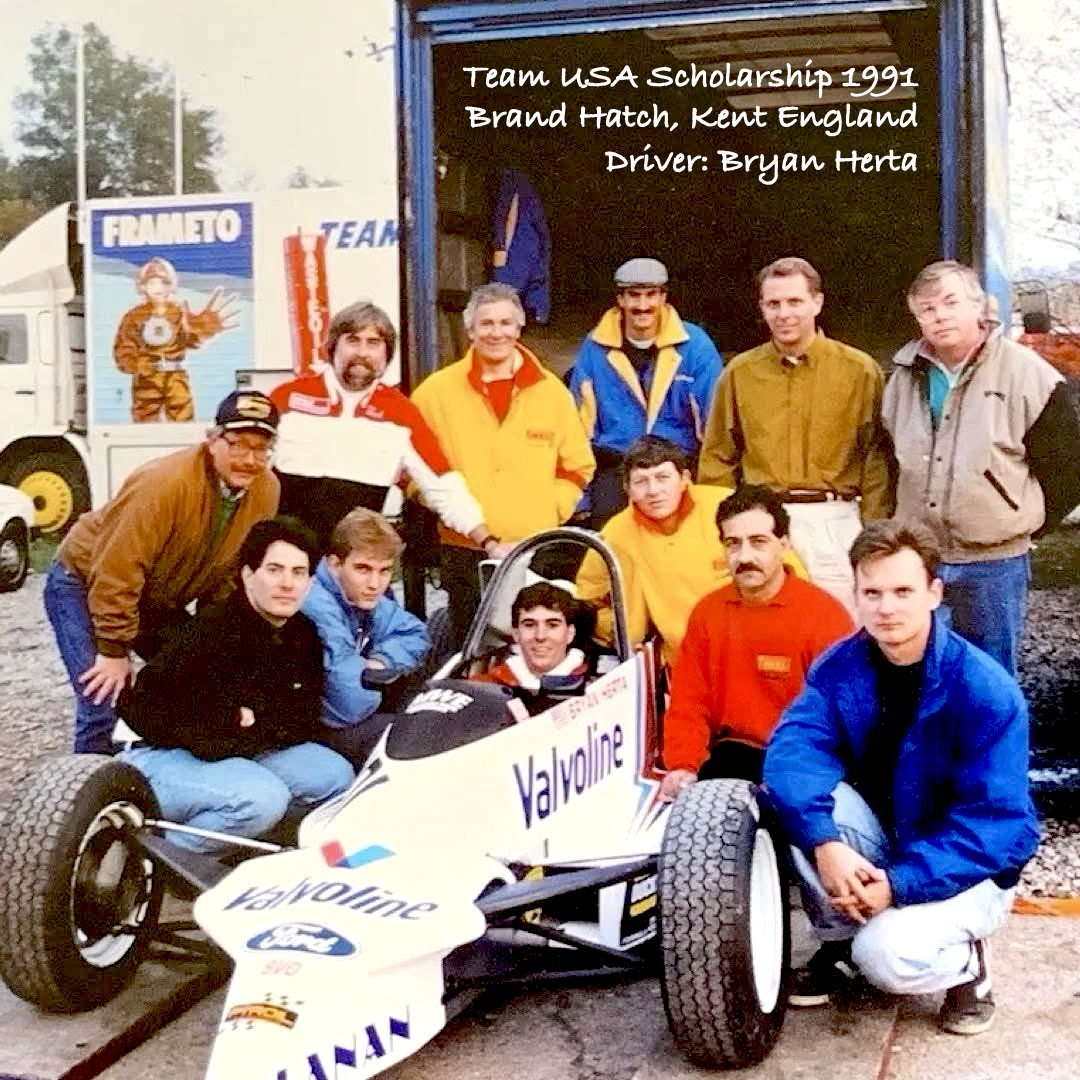
Brands Hatch, 1991. That's me in the brown shirt, next to Jeremy Shaw in the stylish blue and yellow jacket, at the British Formula Ford Festival at Brands Hatch. It was the second year of the Team USA Scholarship, the program Jeremy and I built to send one young American a year across the Atlantic to race the best. Jeremy ran it; I chased the sponsors, and Valvoline and Ford said yes. The young American we chose that year is in the frame, Bryan Herta, who ran strong in every heat and the final. He climbed to IndyCar on merit and won four races, for Bobby Rahal and for Andretti, though never the 500 as a driver. Then he did the rarer thing and became a team owner, guiding two of the most important Indianapolis 500 wins since the very first, with Dan Wheldon in 2011 and Alexander Rossi in 2016. He has since built a champion sports car team in IMSA, and his son Colton is one of the stars of the sport today. This is what building a way in looks like, years before anyone knew how the story would turn out.
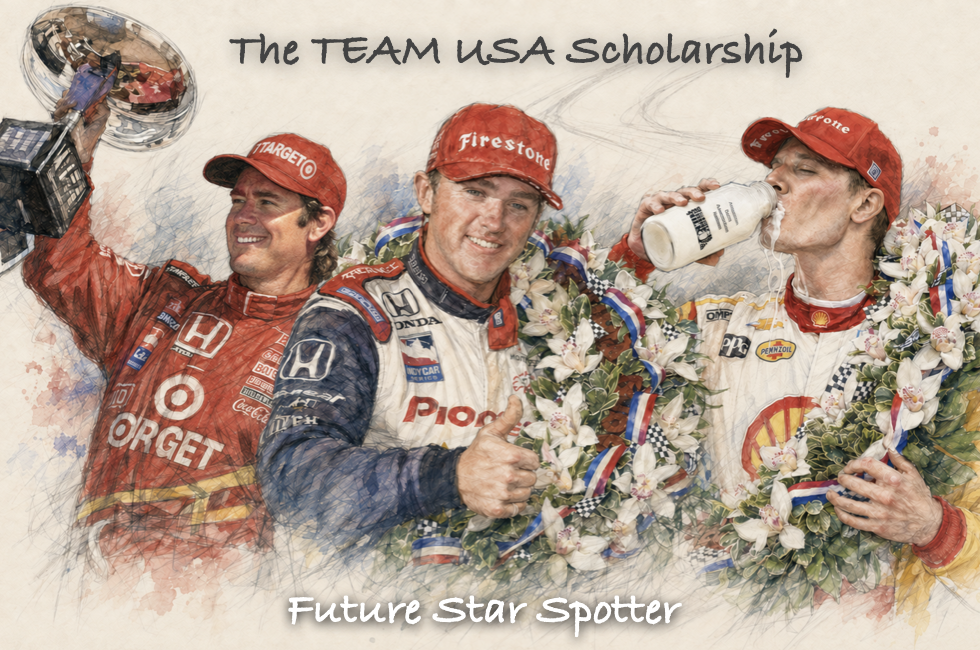
Where the road can lead. Three Team USA Scholarship drivers who reached the summit of the sport: Jimmy Vasser, the 1996 CART champion; Buddy Rice, the 2004 Indianapolis 500 winner; and Josef Newgarden, two-time IndyCar champion and back-to-back Indy 500 winner in 2023 and 2024.
By the scholarship's own count, something like fifteen of its drivers have started the Indianapolis 500, among them Conor Daly, J.R. Hildebrand, Charlie Kimball and Kyle Kirkwood. Buddy Rice won it in 2004, Josef Newgarden in 2023 and again in 2024, and Vasser, the first one, won it from the pit box as a co-owner with Tony Kanaan in 2013.
Here's the small version of the whole lesson. Nobody had to clear the field of foreigners for any of these drivers. They needed somebody to notice them early, take the money problem off the table, and open one door. They earned the next one on their own. Opportunity like that does not organize itself. And Team USA did its work through road racing, not the short-track world the IRL set out to save. It built Americans a way in. It just wasn't that way.
A Road Forward, for a Price
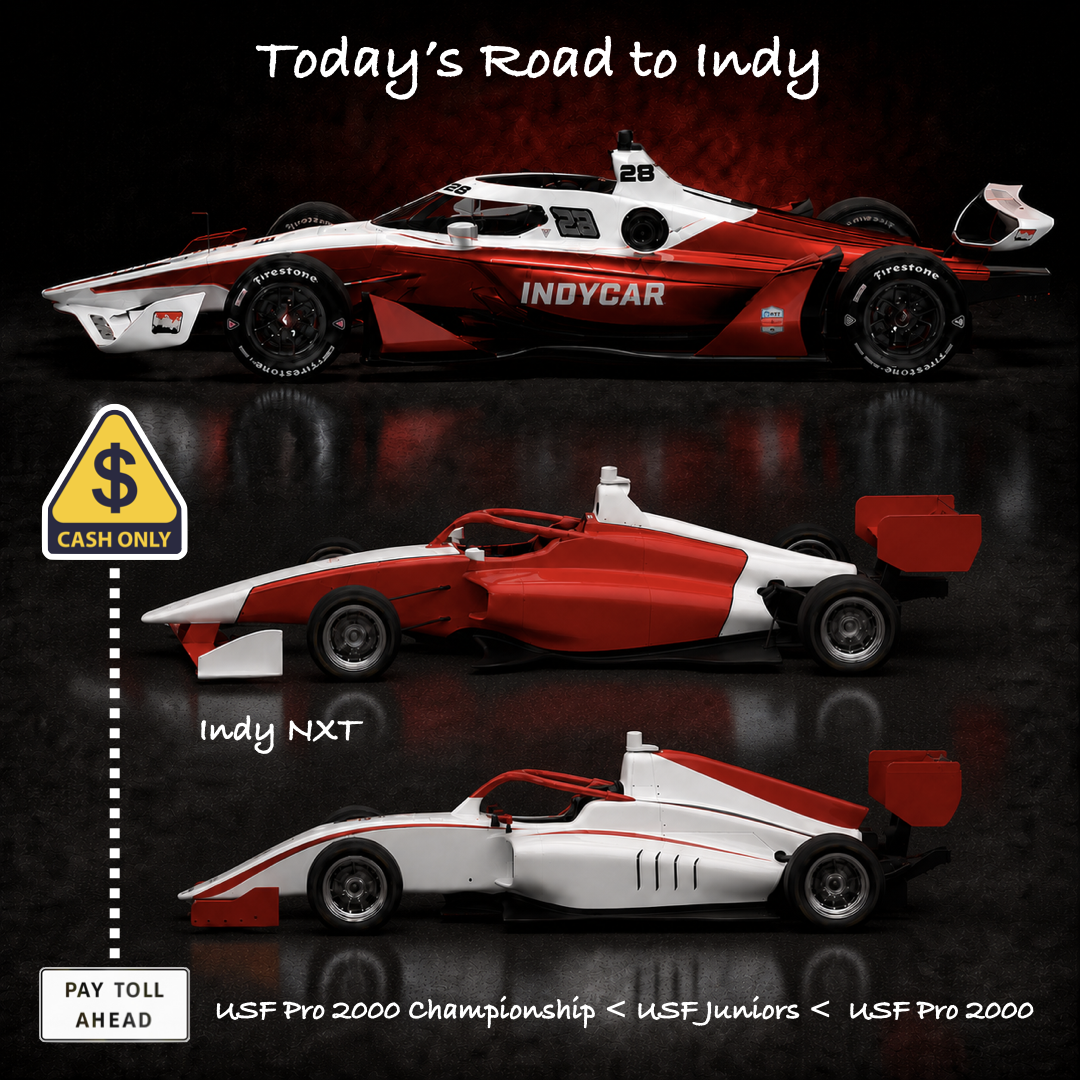
Pay toll ahead. A lot of dedicated people have spent years building the modern Road to Indy, and it works. USF2000 leads to USF Pro 2000 on a shared chassis stepped up in power, then to Indy NXT, whose Dallara is fast, sharp, and a real test of a driver. It has a television package, real promotion, and it graduates its winners. Pato O'Ward and Colton Herta came up it, and Kyle Kirkwood climbed every rung and now runs at the front. But it asks its two things in order. First you have to prove you can fund a season. Then you have to prove you belong, because only winning brings the exposure that returns value to a sponsor and earns you the next rung. Nobody moves up who hasn't already proven himself on the way. It is close to all or nothing, but so is racing most days, and this is preparation for a level where excuses don't pay the bills. The honest difference from the old oval road is the order of it. There, an owner paid you to drive and your results earned you in. Here you fund the chance first, then go prove you deserved it. It is the barrier Team USA was built to help good drivers clear.
The Road to a Revolution at the Brickyard
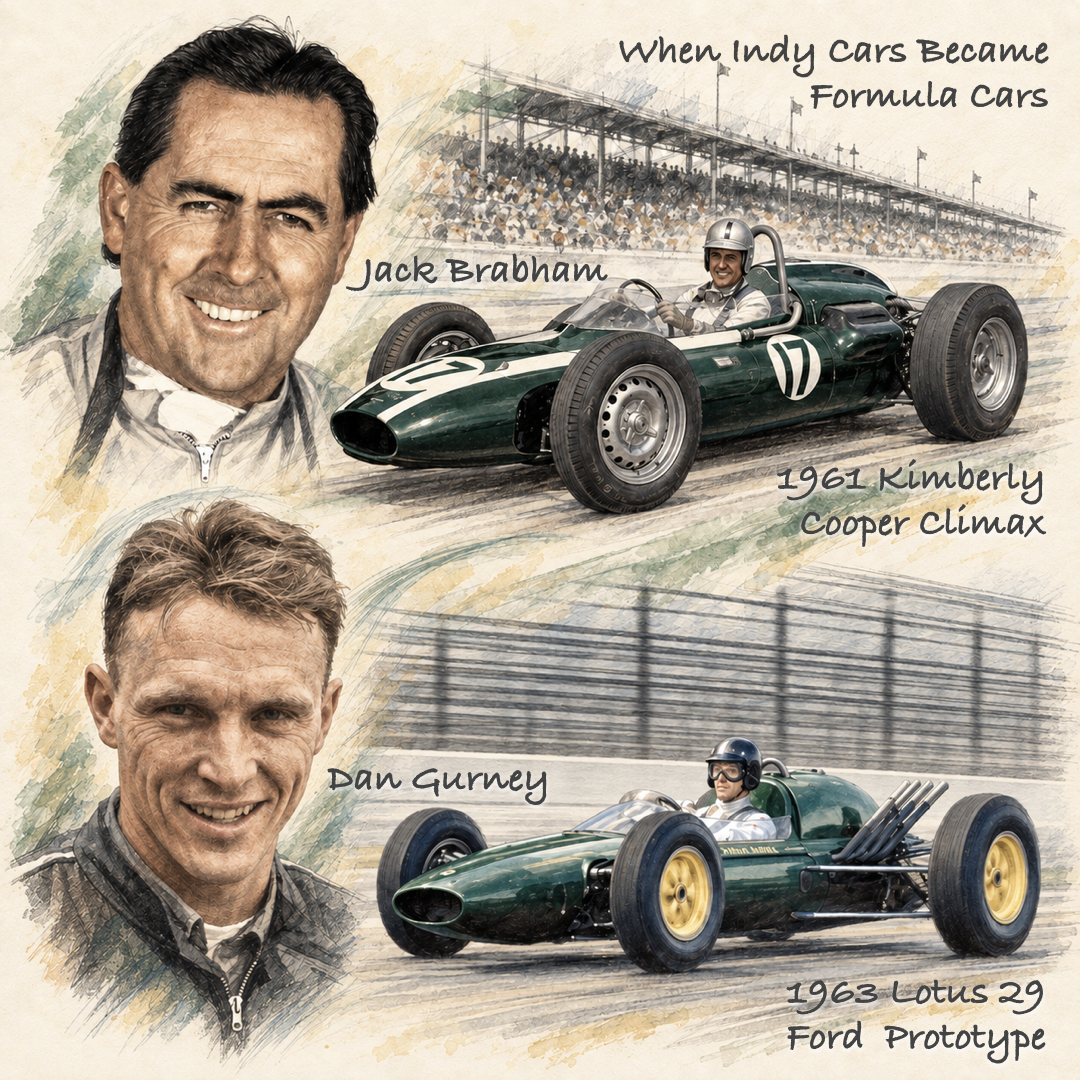
The moment everything changed. In 1961, Jack Brabham, the two-time reigning Formula One World Champion, ran a rear-engined Cooper-Climax at Indianapolis, its small engine no match on the straights but a knife in the corners. He finished ninth, and the roadster's days were numbered. A year later Dan Gurney, who won the 1962 French Grand Prix for Porsche, watched Colin Chapman's Lotus 25 and told him, "My god, if someone took a car like this to Indianapolis, they could win with it." Gurney brought Chapman to the Speedway and wired in Ford, and the modern era of IndyCar racing was born. Two men who could feel what a car could do sent the roadster to the museum and turned the Indy car into a formula car, the beginning of the end of the old road to Indy, and the gate swung wide open to the world.
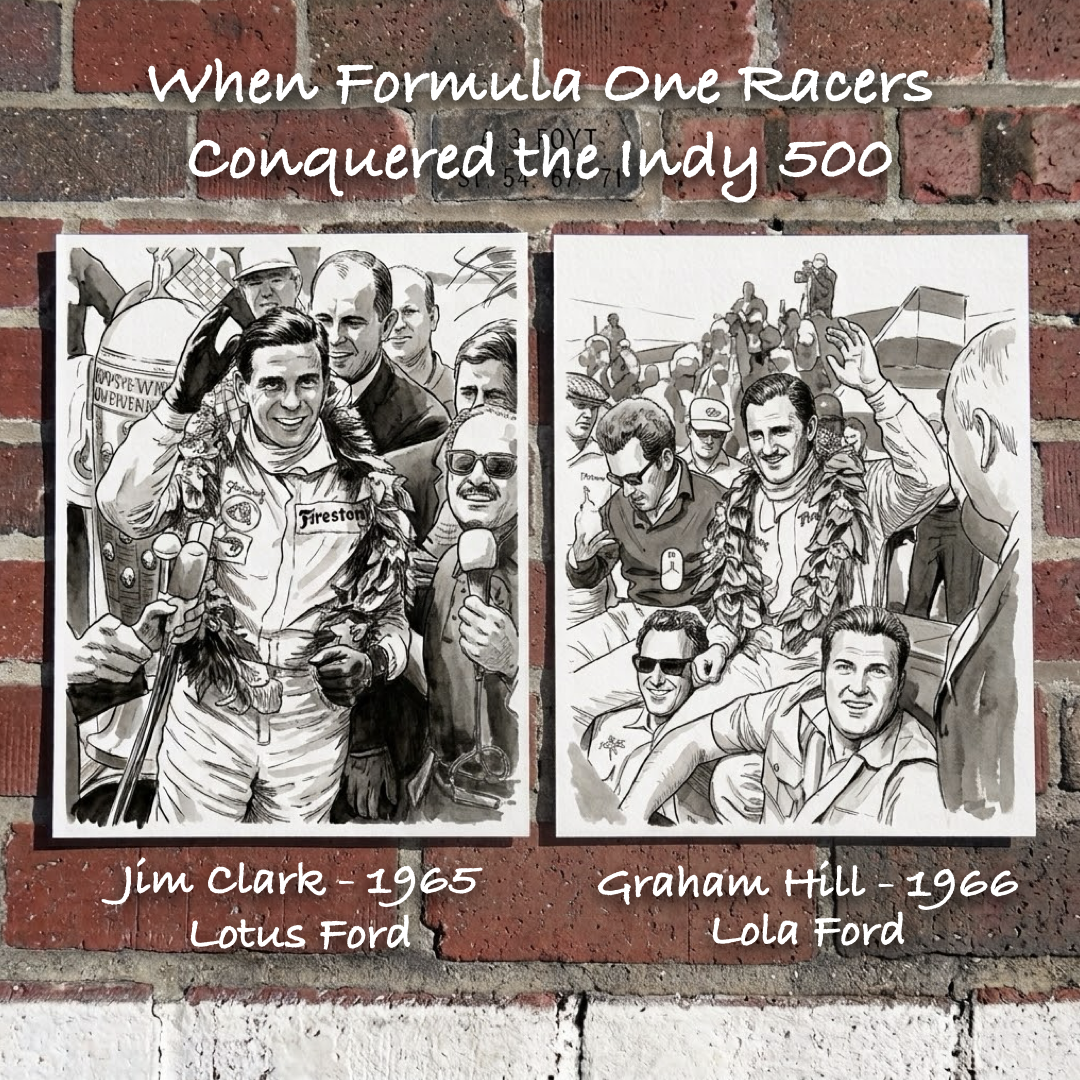
Two champions, two years, no turning back. Jim Clark won the 1965 Indianapolis 500 in the Ford-powered Lotus 38, the first rear-engined car to win it, and that same year he took the Formula One World Championship, the only man ever to do both in one season. A year later Graham Hill, the 1962 World Champion, won the 500 as a rookie in a Ford-powered Lola. Two Formula One champions in Victory Circle, back to back, and Formula One thinking had conquered Indianapolis with them. Road racing, and the drivers raised on it, were now part of what an Indy car driver would be. The old adage is divide and conquer. What Formula One did here was conquer and define.
Talent has always crossed borders
That was one bridge, built by hand. The wider way in re-formed on its own, around road racing. Americans reached Indy through Formula Ford, Super Vee, Atlantic, Indy Lights. The drivers from overseas came through Formula 3, Formula 2, Formula 3000, Formula One. Those were the ladders still standing, the ones with the seat time and the money and the contacts it takes to reach IndyCar.
None of that ever made Indianapolis smaller. If anything the foreign talent made it bigger. And you didn't have to look past the IRL's own garages to see how little nationality mattered once a race was on. A.J. Foyt, four-time winner, the most American name the Speedway has, hired a Swede named Kenny Bräck out of European Formula 3000 because, in Foyt's words, he was "a very smart racer." Bräck won him the 1998 championship and the 1999 Indianapolis 500. The man who made the case for American oval racing hired the best driver he could find and went to victory lane with him.
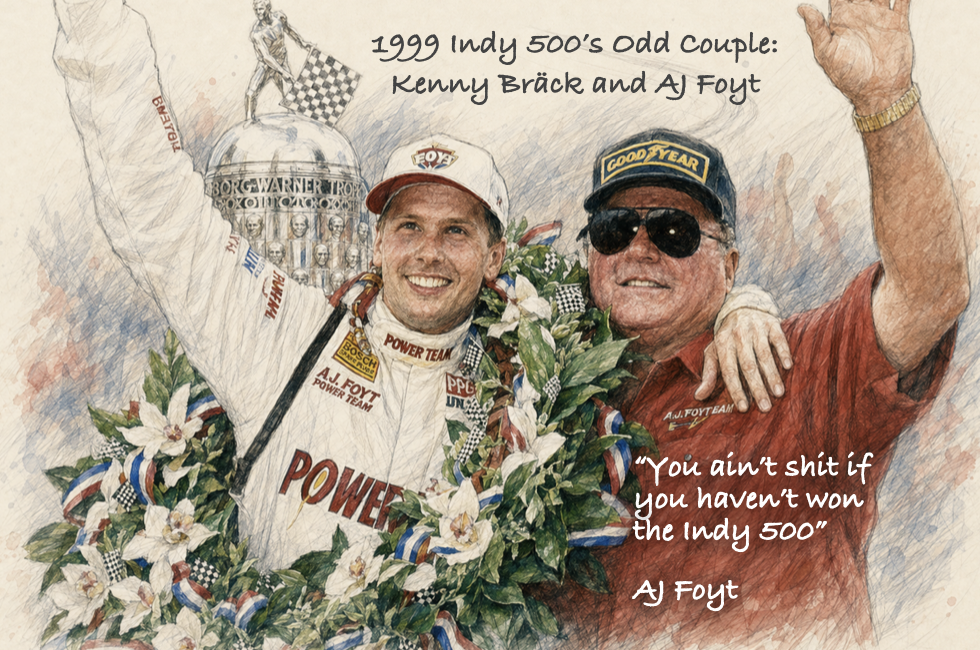
He argued for Americans, then won with a Swede. A.J. Foyt was the American bullring racer in the flesh, and no one pushed harder for American talent in the IRL. Then he won the 1998 title and the 1999 Indianapolis 500 with Kenny Bräck, a Swede out of European Formula 3000. They made the right calls and earned every bit of it. In the joy of the moment A.J. blurted, "I'm so wonderful." He is, and there's only one like him. The fiercest believer in the American driver won it all with the best man he could find.
Ten drivers who had already raced in Formula One went on to win the Indianapolis 500 or an Indy car title, among them Jim Clark and Graham Hill, Emerson Fittipaldi, Nigel Mansell, Alex Zanardi, Takuma Sato and Marcus Ericsson.
Where the Roads Cross
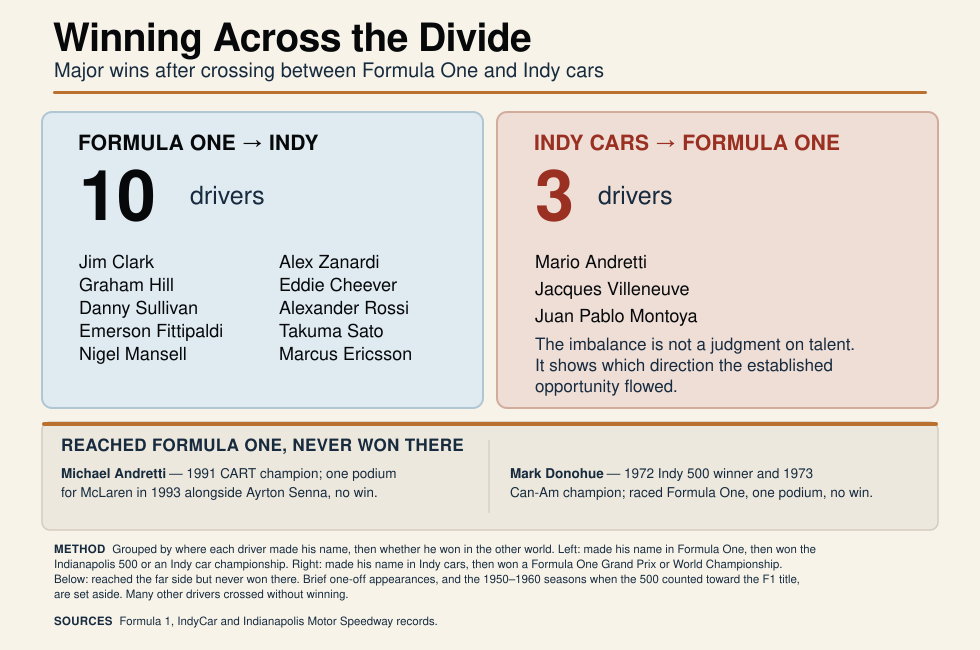
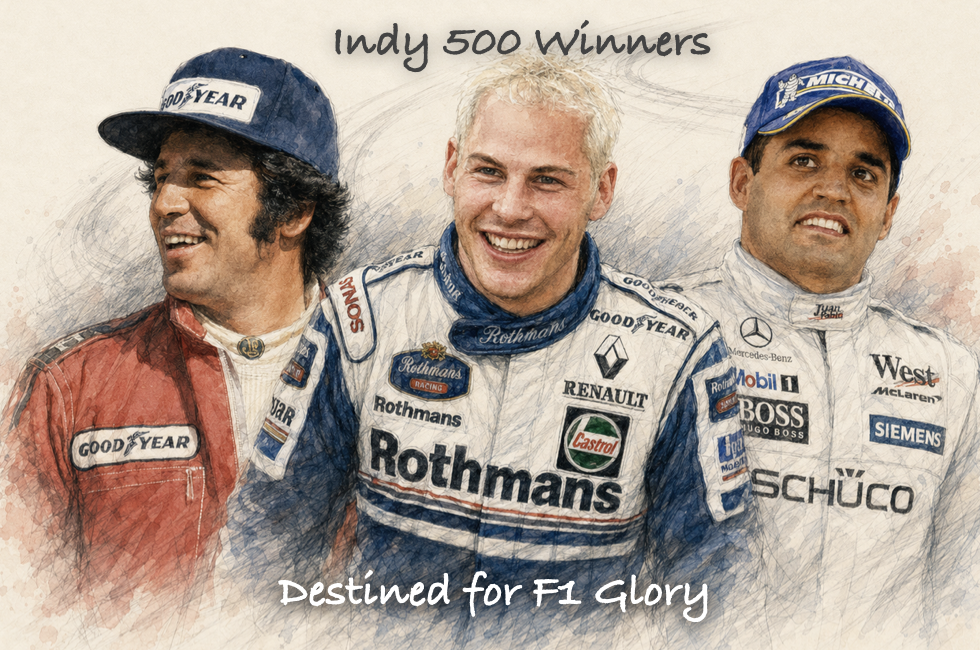
The three who won going the other way. Only three drivers built their names in Indy cars and then went to Formula One and won there, and not one was born in the United States. Mario Andretti, born in Italy, took the 1978 World Championship and 12 Grand Prix wins. Jacques Villeneuve of Canada won the 1995 Indianapolis 500 and the CART title in the last season before the split, then claimed the 1997 World Championship and 11 wins. Juan Pablo Montoya of Colombia won the 1999 CART title and the 2000 Indianapolis 500 for Chip Ganassi, then took seven Grands Prix for Williams and McLaren. Andretti and Villeneuve went further still. They sit among only three drivers in history to win the Indianapolis 500, an Indy car championship, and the Formula One World Championship. The only other is Emerson Fittipaldi of Brazil, who reached it from the opposite side, an F1 champion who crossed the Atlantic and conquered Indy.
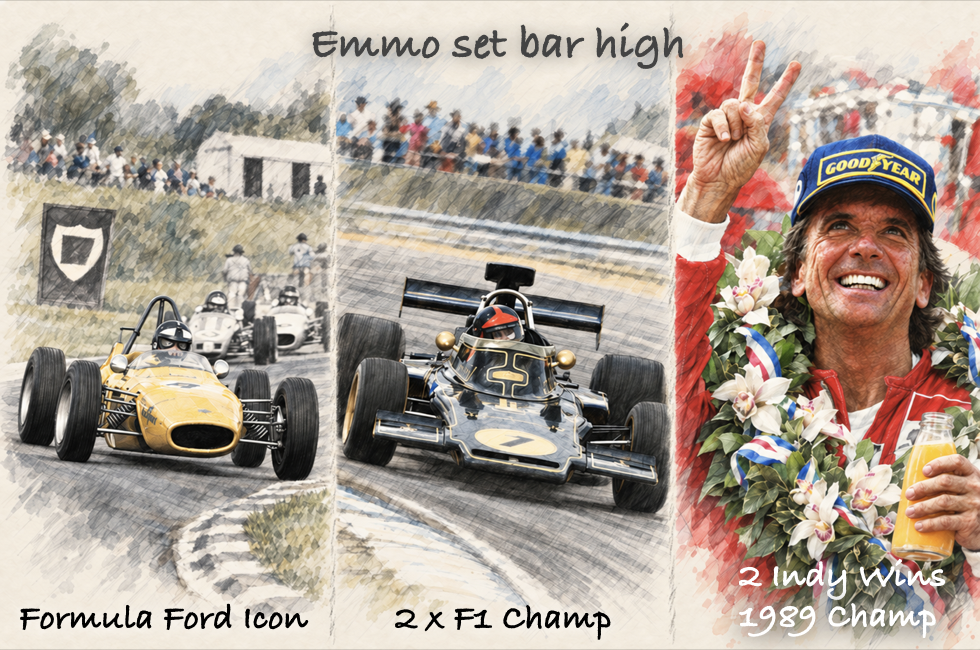
Where a Formula Ford can lead. In 1969 a young Brazilian stepped off a plane in England, bought a Formula Ford, and started winning at once. Emerson Fittipaldi took his first Grand Prix inside eighteen months and the Formula One World Championship within three years, and another two years later. He was the first driver off the Formula Ford ladder to win the title and the youngest champion in the sport's history at the time. Then he came the other way and won the Indianapolis 500 and the CART IndyCar Championship in 1989, and won the 500 again in 1993. Formula Ford to World Champion twice, to winning two at the Brickyard. The road runs in every direction, if the driver is good enough.
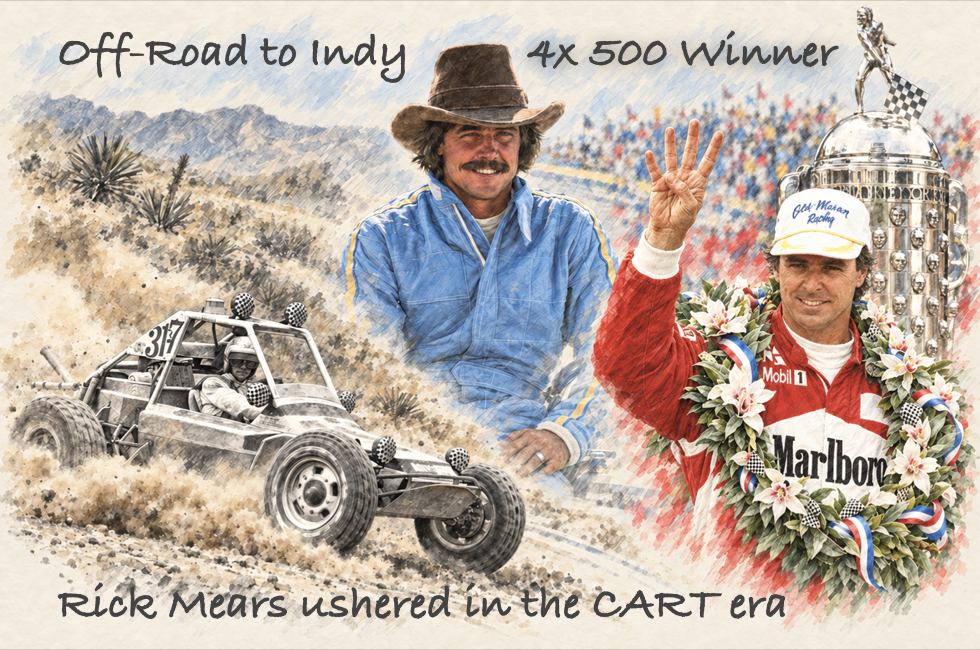
Rocket Man off-roaded his way to glory. The modern era began with the 1979 split, and its first Indianapolis 500 went to a desert off-road racer from Bakersfield, not a road racer or a short-track kid. Rick Mears caught Roger Penske's eye, won that 500 and the first CART title the same year, then won the 500 three more times and took three championships in all. He even tested a Brabham Formula One car and turned it down to stay on the ovals he loved. The road-racing era began with a man who learned to race in the desert.
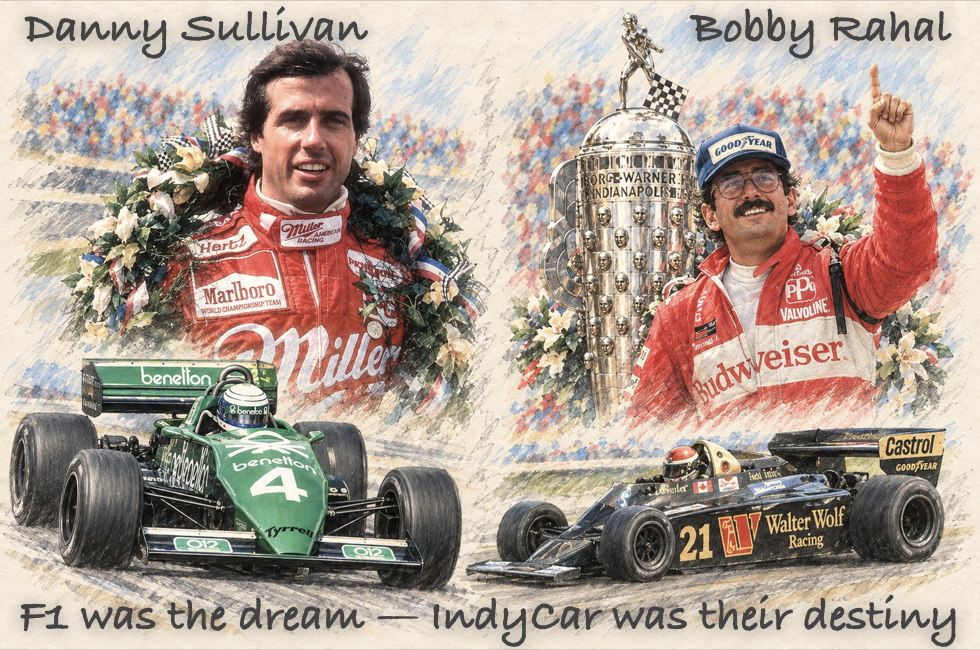
They aimed at Formula One and found Indianapolis. Danny Sullivan ran the full 1983 Formula One season in the Benetton Tyrrell; Bobby Rahal made his two Grand Prix starts in a Wolf. Neither stuck. Both came home as IndyCar rose, and both built the careers that made them: Sullivan, the 1985 Indianapolis 500 and the 1988 title; Rahal, the 1986 Indianapolis 500 and three championships, one as his own owner and driver. The road to Formula 1 closed behind them, and the American road opened wide to IndyCar. And I owe Bobby a debt, as President of the Road Racing Drivers Club, he’s been a fierce champion of Jeremy’s Shaw’s Team USA Scholarship at the heart of this story.
Going the other way the traffic is much thinner. Only three who made their name in Indy cars went on to win a Formula One Grand Prix or a World Championship, Mario Andretti, Jacques Villeneuve and Juan Pablo Montoya. That gap doesn't say which series had the better drivers. It says where the opportunity already sat.
Mario is also the best argument against reading a driver by his passport. Born in Italy, an American citizen, schooled on American short tracks, a winner at Indianapolis and a Formula One World Champion. "The day of parochialism in sports is over," he said. "Fans want the best, wherever they come from."
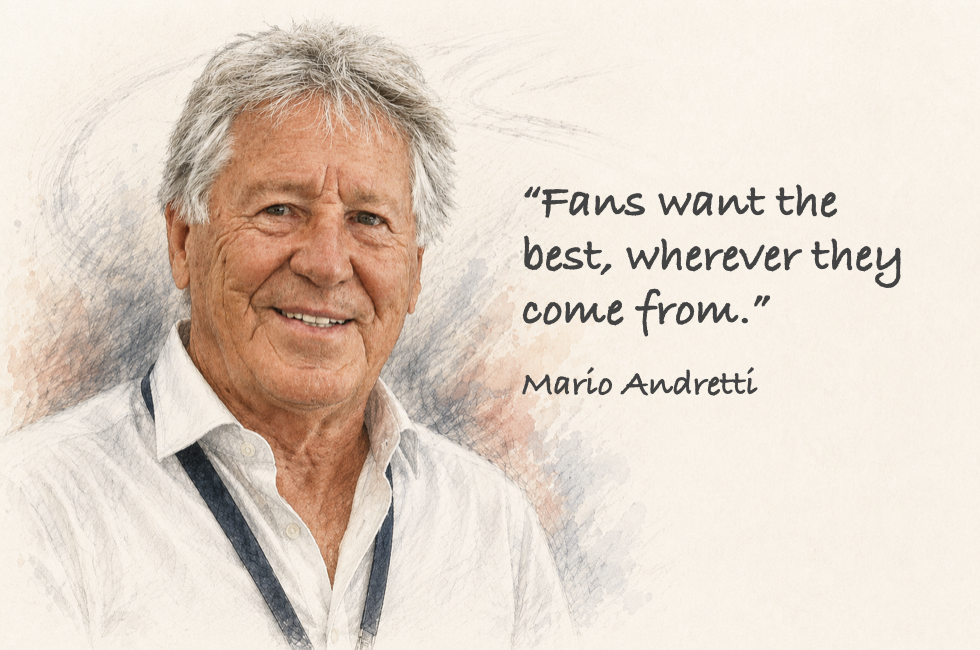
Born abroad, a winner everywhere. Mario Andretti may be the greatest driver America ever produced, and he was born in Italy. He won it all, the Indy 500, the Daytona 500, sports cars, and the Formula One World Championship. When he says talent has no borders, he's the living proof of it.
So the argument was never really about whether IndyCar's drivers are American enough. The audience stopped keeping that scorecard long ago. The question worth asking now is plainer and harder. Can a short-track kid, a road racer from North America, a formula car ace from overseas and a sports-car driver each look at IndyCar and see a real way in.
A better car helps, and the kind that helps most favors no one. Take the wings off, give it more power than grip, make the driver work the throttle as much as the wheel, and it stops asking where you came from. A Formula Ford graduate sees a big Formula Ford with a lot of power. A sprint car kid sees a big car with back end you steer with your right foot. It rewards the one thing all of them already own, the feel for a machine at the edge.
But this was never only about which drivers can reach the car. It is about what the car is for. A race car is not a ball or a bat, a neutral thing you hand to an athlete. It is a beast, and it is meant to be hard to tame. So hard that only a handful of people on earth can do it, and when one of them does, the rest of us get to watch a human being do something we never could. The more beastly the car, the more the person in it matters. Make every car the same tame, anonymous appliance, tuned to manufacture a close finish, and you have not made the sport fairer. You have taken the beast away and left the driver nothing to conquer.
I know what one of these asks, because I climbed into one, in the Fall of 1996, a Reynard 96i Mercedes CART car at the Chrysler Proving Grounds. My friends at PacWest had put my name on the cockpit side, PFANNER, and on the engine cover panel behind it, a second name: A WANKER. It still makes me smile. Steve Fusek, who managed the team’s commercial affairs put me in the car. He knew I was in a dark place and worried for me, and that crude joke was how he reached a grieving friend. It worked. And in nearly 900 horsepower, I proved the engine cover right. I floored it rolling onto the track, and the turbo hit so hard it spun the car while I was still pointed dead straight. Then I did it again. Fifteen minutes cured me of the boyhood fantasy that I could do what these people do. I can't. Almost no one can, and that is the whole point.
I needed to be in that cockpit. Four months earlier my friend Jeff Krosnoff had lost his life in a Reynard 96i at Toronto, a volunteer marshal, Gary Avrin, with him, and for the first time in my life I had fallen out of love with racing. Then, dropping into the seat, the reason I loved it came back. Years later I lost another friend, Tony Renna, one of our own Team USA drivers, testing at the Speedway. This is the part the highlight reels leave out. No matter what the sport does with safety, and it must never stop trying, a car running two hundred and thirty miles an hour can still take everything, and some of the finest people I have known paid that price. What moves me to my core is that racers climbed back into identical cars, sometimes the same weekend, and went to work. I don't think I could. I don't think most of the world could. From the first time I felt the dark beauty of this sport, it meant more to me because the people in it will risk everything to do it, and they do it so well they earn a place at the edge of what is possible, and past it. Racing is, and always was about celebrating the courage of the human spirt, while inspiring us to live our lives bravely.
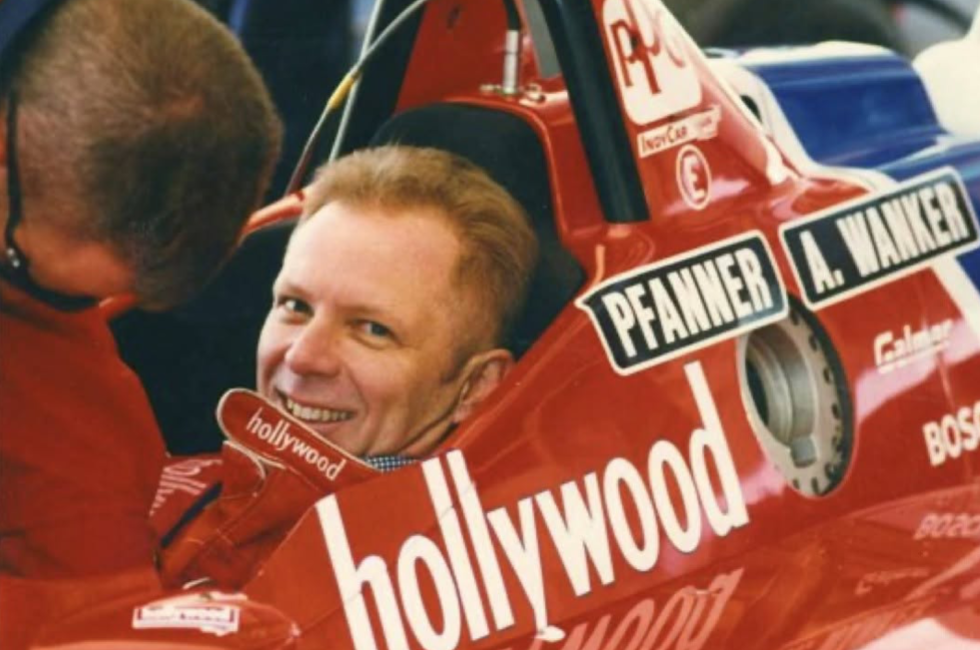
The engine cover told the truth. PFANNER on one panel, A WANKER on the next, and over the next fifteen minutes I proved the second one. But I needed to be in that seat more than I needed my dignity.
So let me be clear about what I want in the next Indy car after the IR-28, and what I don't. Not the danger. One thing is never negotiable: the safety of the driver, of the men and women who work the track, and above all the people who fill the stands to watch them. Difficulty and danger are not the same thing. A car can be savage monster to drive without being a lethal weapon, and that is the car I want. Not a softer parity appliance that does the hard part for the driver, but a harder beast that demands everything a great one has and puts it where we can all see it. Bring the danger down. Bring the difficulty back. Let the driver come forward again.
The young ones coming up now, men and women both, are full-send committed and brilliant, and they deserve better than to be the most gifted part of a machine that no longer needs them to be great. They should be the reason the machine exists. So build them a car worth the risk they take to master it, hard enough that only a few on earth can tame it, and give the rest of us the awe of watching them do it. That is what the sport is for. It always was.
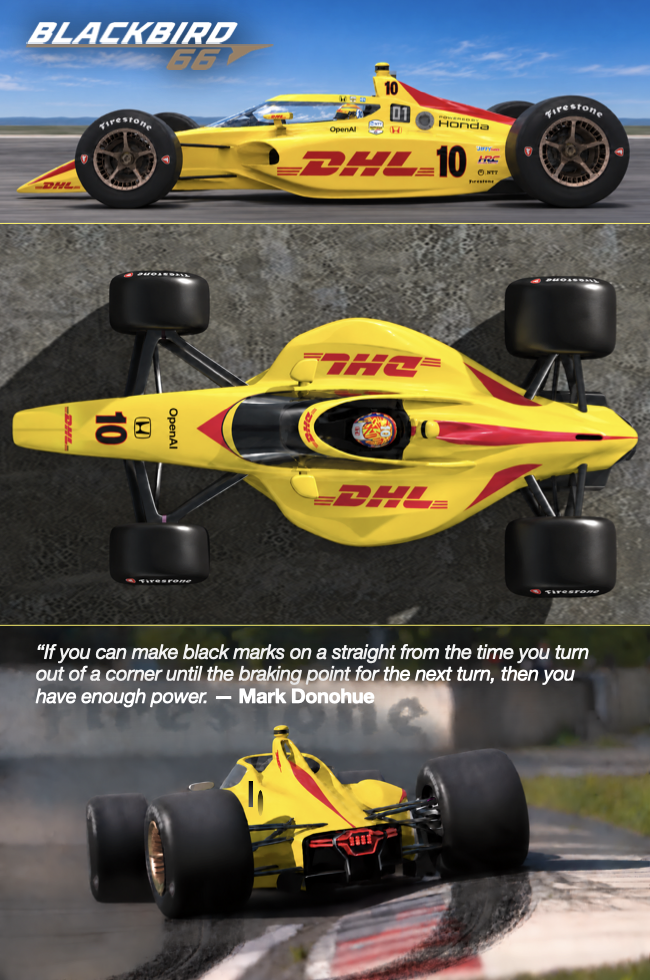
Imagine it in his hands. This is the Blackbird 66, J.R. Hildebrand's wingless concept, rendered here in the DHL colors of Álex Palou, who has just won his fifth IndyCar title in six years. Strip the wings, add power, widen the tires, and you get a car built to do the one thing this whole piece has argued for: reveal the driver fully. Hildebrand developed it with concept designer Patrick Faulwetter, and it traces back to the clean-sheet 2020 IndyCar study that Mark Miles commissioned in 2016, the year of the 100th Running, before Roger Penske bought the Speedway and the series. I was fortunate to be part of that study, alongside J.R., Clay Dean, Reilly Brennan and Diego Rodriguez. The spark came from Dan Gurney. In January 2017 he told us, "Take the wings off, and give them an engine that sings." It is only a proposal for now, renderings and a manifesto, the way the DeltaWing once was. But a machine like this, in the hands of a driver like that, is the sport worth building. See it at blackbird66.com.
Next up: The sixth and final piece in the series, on the circuits the NTT IndyCar Series races at, and the media, the business a great car and a great driver still can't live without.
Pfanner Advantage works with clients to turn change into advantage at the intersection of mobility, motorsport, media, technology, and marketing. Learn more or start a conversation: contact us today.
Other essays on the next Indy Car after the IR-28
The Fastest Thing off the Shelf
The New Indy car is No Accident
Paul Pfanner on the launch of the 2028 IR-28 Indy car
The Advantage Journal arrives every week. What matters in sport, mobility, media, and technology — curated and contextualized by Bill Sparks, Bill Long, and Paul Pfanner. No hedging. No filler. Subscribe — It’s Free

