
The Rule Nobody Writes Down
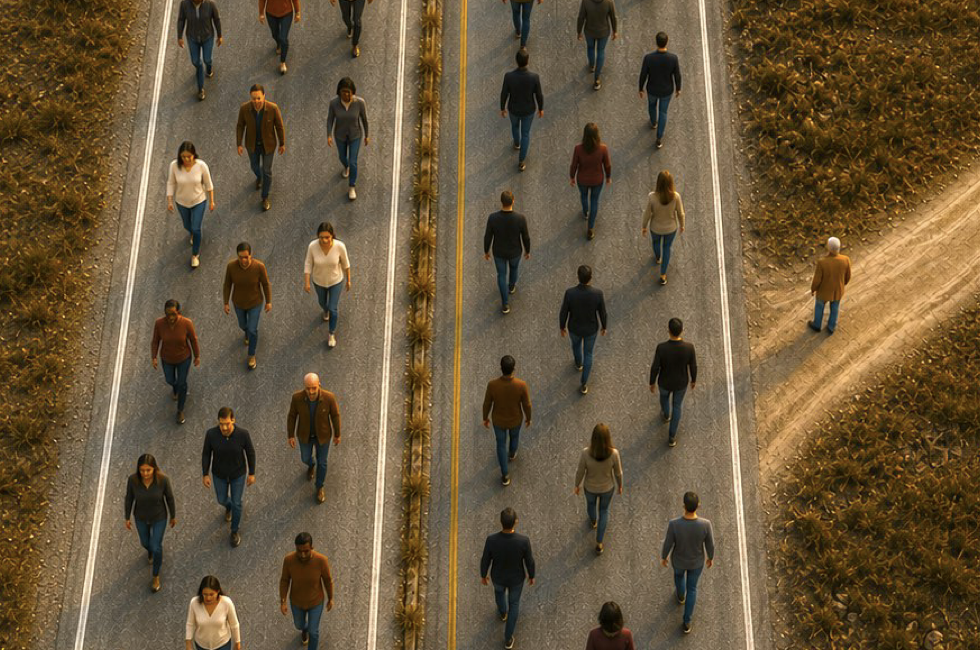
Lane departure warning. Once people decide which lane you belong in, stepping out of it can leave you standing alone while the rest of the world keeps moving. That doesn’t mean you took the wrong road.
Paul Pfanner on the unwritten rule everyone enforces and nobody admits to, and what a quiet experiment showed him about the cost, and the value of breaking it.
There's a rule nobody writes down and everybody enforces. Once people decide what you are, you're supposed to stay it. Keep doing the thing they know you for, and don't wander off. I've been ignoring that rule since I was a kid. In 1971 I forged a pit credential to get inside my first professional race.
A few weeks ago I did it again. I spent a week making an album, "Too Old to Die Young," with no business making one, my own lyrics and the Suno AI music platform. I don't sing, I'd never built a song, and I didn't even know the names for the parts of one. That was the point. The music was never really the thing I was after. I wanted to see what happens now that a person can make something that looks and sounds like art with none of the years that used to go into it. So I made it, and then I watched what came back. That turned out to be the part worth writing about.
I make my living reading patterns. It's the one thing I'd say I'm honestly pretty good at. When I put my first and final record out, I wasn't waiting for applause. I was watching the pattern. And the pattern broke.
People are comfortable with the shape they assigned you. Refuse to fit it, and watch how quickly they look away. Let them. What matters to me is to keep learning and stay who I am, and to own the choices that made my life mine. The mistakes and the failures and the losses have taught me more than the wins ever did, and you only get to those lessons by risking something you haven't tried before.
What came back
Mostly nothing came back, and the silence was the loudest thing in the whole experiment. My pieces usually pull a real reaction. The essay I wrote about making the album, titled “Real to Me, Synthetic in the Making” drew 63 reactions and 17 comments across Facebook, Instagram, LinkedIn and Substack, combined. I put more of myself into it than I do into most things, and most people looked away.
The ones who did say something sorted themselves into groups, and watching them sort was the education. Some were warm and weightless. "You never cease to amaze me." "Cool." A little animation of two hands clapping. The kind thing you say when you don't intend to sit and listen to all the songs. Then the ribbing. One old friend announced my imaginary second album, a list of joke titles about hotel vending machines and airport security lines, and I laughed, because that particular teasing tells you precisely who needs you to stay the one thing they filed you under years ago. A couple of people got quietly spooked. "Nice. Scary," one wrote. Another called the tool the "master impostor." And then there were the few who came all the way through the door. One friend told me flat out she thought I'd lost it, maybe just bored or tired. Then she sat with one song, "Still Waters Run Deep," and it stopped her where she stood, and she wrote to say so. Another took the racing comparison I'd made and pushed on it, that music has no fixed ground truth the way a laser-scanned racetrack does, so what's on the far side of the door is harder to judge. Five people reacted to that first friend's note. Not five hundred. Those five read the thing.
The first time I felt it
This wasn't the first time. It was the loudest. A while back I wrote a piece titled "Instrument Failure" built around the work of Mohamed El-Erian, the economist. I know him a little. His daughter played on my twin daughters' soccer team, and I've followed his thinking for years, because he's as sharp as they come and he earned every inch of the platform he stands on. I took something he'd written and set it against a question I live inside, whether the business of motorsport holds together in the years ahead. People bounced off it. Not because the thinking was wrong. Because they'd decided economics wasn't my lane, and who was I to stand next to a man like that. That was the first time I felt the disconnect hum, before I had a name for it. Stay in your lane. Stay where we put you.
Here's the contrast I can't shake. I wrote a piece about what the next IndyCar after the Dallara IR-28 ought to be, called "What Comes After Faster," and nearly 2,900 people reacted to it, 169 commented, and 74 shared it. I wrote a song for my wife, and just two people commented, and it has 70 plays on Suno. I don't read that as a wound to my ego. I read it the way I'd read a lap time off the timing screen. It's information I wanted to know. The only audience that matters is my wife Donna, and she was surprised and moved by the song. The audience beyond her looked away and went back to the thing it already agrees is in my lane. The audience for who I am when I take an unfamiliar creative and social risk thinned out the moment I stepped out of that lane.
The parallel universe
Say AI and plenty of people are out, sure it's coming for their work, or just sure they don't like it. I understand the feeling. I can't learn much standing outside the door, so I went in.
And I wasn't the only one. This is already one of the biggest things going on in the culture, bigger than most people realize.
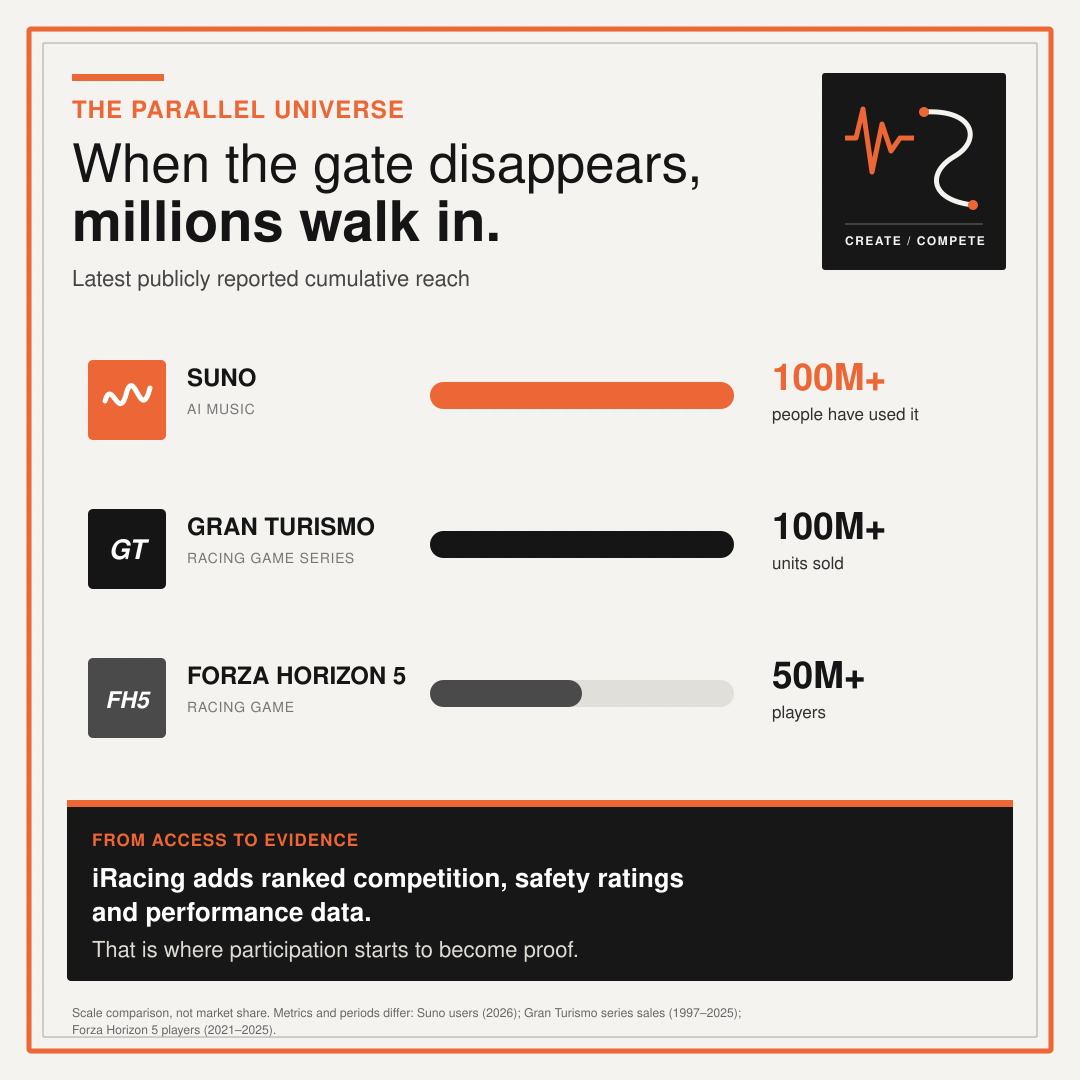
The same story in two worlds. Take away the gate and the equipment and the permission, and people show up by the millions to find out if the thing is in them. Suno did it for music. Sim racing did it for the track.
When the gate comes down, the crowd that walks through is far bigger than anyone guessed. Most of them will never own a race car or set foot in a studio, and now none of that is the price of trying. Music and racing were always about more than getting somewhere. They run on the need to find out whether something might be inside you. That's the door I walked through, the same as everyone else.
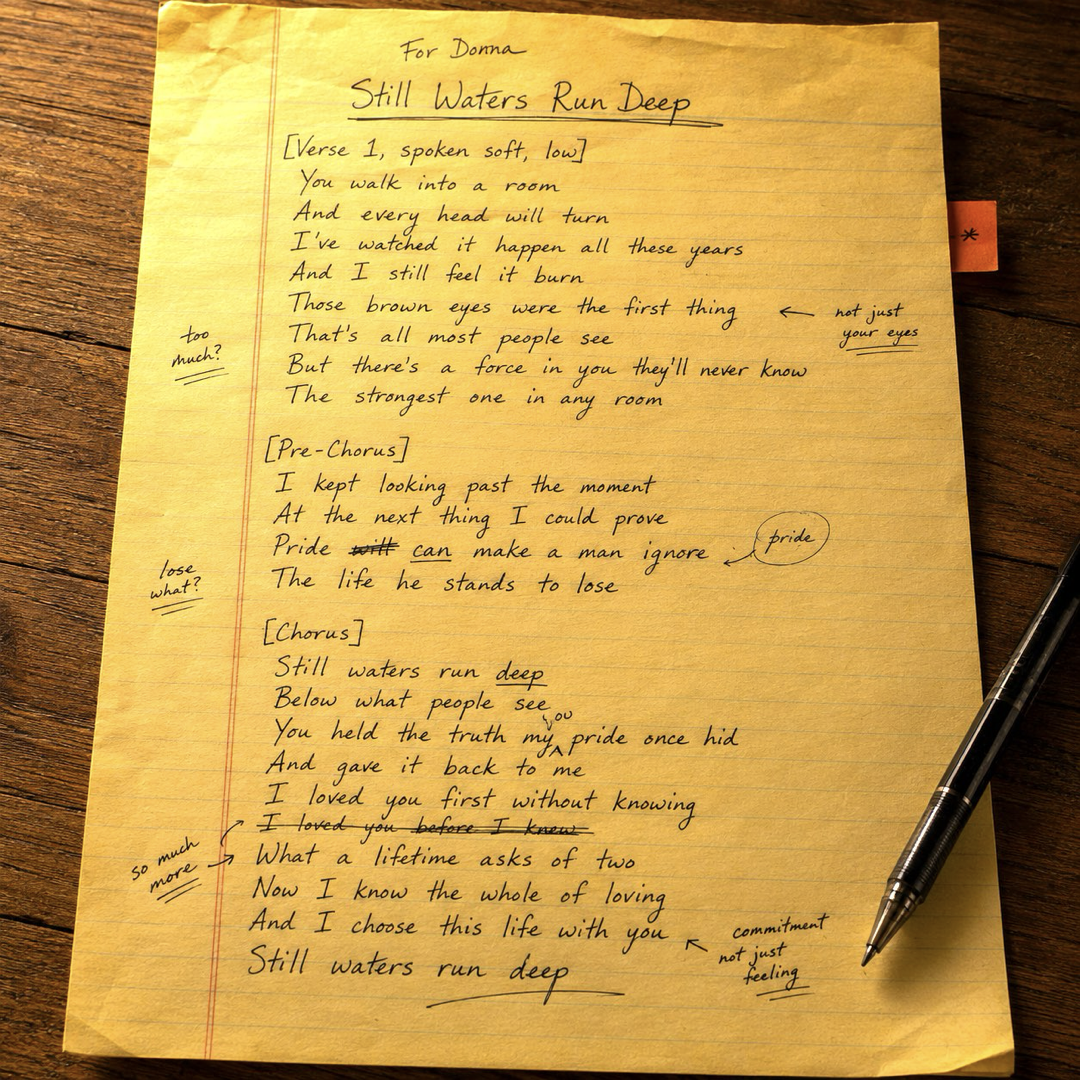
Nothing can replicate authentic human emotion. The point of this experiment was to find out whether that emotion could still come through, even using the new AI tools. “Still Waters Run Deep,” written for my wife, was the ultimate test. It passed with the only audience that really mattered: the love of my life.
I learn more from failing
I learn more from failing than I ever have from succeeding. Always have. So when I want to learn something fast, I go looking for a place I can fail cheap.
I brought music up alongside racing because the feeling was already familiar to me. I'd lived the same thing years ago, from the other side of my life. We were in early on iRacing, back in 2008, before it had really gone public, when the whole fight was convincing people it wasn't a toy. The company brought Pfanner Communications in to help figure out how to position it in those early days, and delivered a simulator to our office to evaluate. I became obsessed with the thing. It was built with such fidelity, tracks laser-scanned down to the texture of the pavement, that my laps in a Skip Barber Formula Ford came back nearly identical to my real times in the same type of car at the same track. And not just any track. Lime Rock Park, one of my favorite circuits on earth, fast and demanding, with a few corners that will genuinely hurt you.
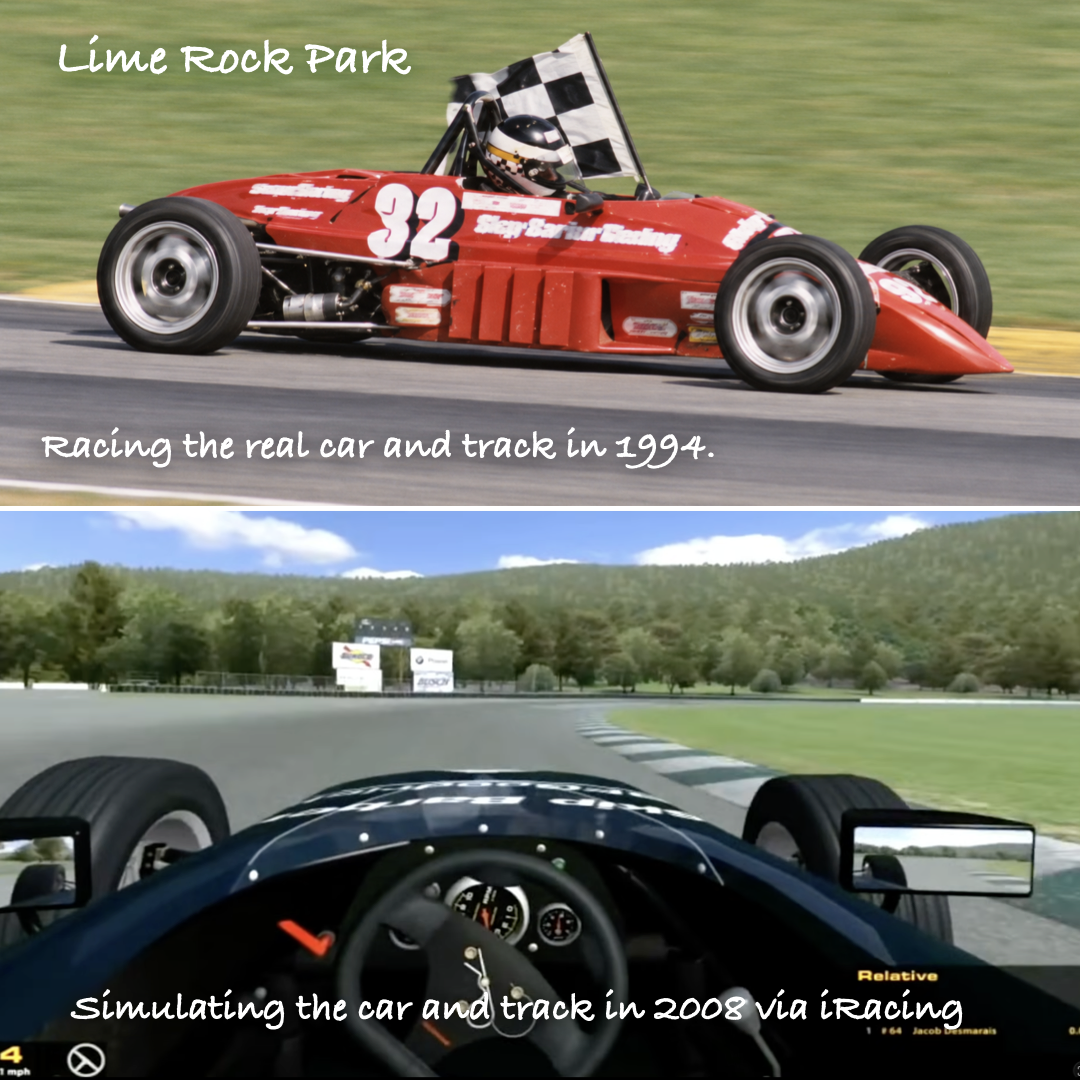
You still have to drive it, real or simulated. Top is the real one, me in a Skip Barber Mondial Formula Ford at Lime Rock in July 1994, holding the checkered from a media challenge race. I was leading, and my friend and Team USA Scholarship founder Jeremy Shaw likely beat himself by spinning behind me, which made my race easier (wink) thanks pal! Below it is the same car in the simulator, the early 2008 version of iRacing, blue instead of red. Lime Rock laser-scanned down to the texture of the pavement by the team there, and it changes nothing about the one thing that matters. Somebody still has to drive it.
The part I remember best is that I could put the car on a new line I'd never have risked for real, and if I got it wrong and put it into the tire wall and the Armco barriers, no harm done. Reset. Try it again. The simulation didn't cheapen the driving. It let me fail fast and cheap, and failing that way is how you get good.
That's the gift I didn't expect from the music, and it's the one worth telling you about. I failed at something close to sixty to one. Sixty tries in the tire wall for one that held. But the crash cost nothing, nobody was watching, and there was no bruise in the morning. So I kept trying lines I'd never have tried if every miss left a mark. And here's the part that matters most. Failing cheap meant I could go back to the wrecks and learn from them.
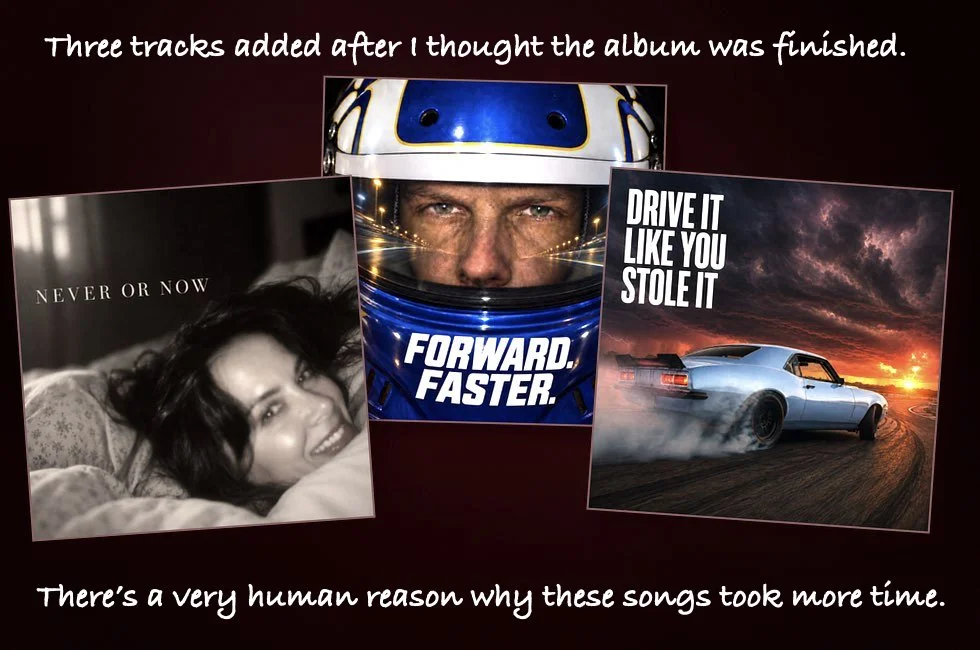
The machine couldn't make these. The words went through draft after draft, and none of it came easy. These three came last and came hardest, fought down through layers of feeling to reach the one true thing underneath. That fight is what a real songwriter does by instinct. It didn't come to me that way, and I had to learn the hard way that the struggle was the whole trick. Some of the album songs were the same, "Still Waters Run Deep" most of all. The words alone took everything I had to get the nuance right. Matching the music to them was harder. And the real grind, where most of the effort went, was bending the cloned copy of my voice until it phrased and inflected the way I hear myself. I don't take what the platform hands me. I prompt and re-prompt, changing the music, the structure, the style, the inflection, the feel, throwing out everything that doesn't fit, until the song matches the picture in my head instead of the machine's. You can hear it. These three, and the ones for Donna and the girls, don't sound like anything else on the record. That is because they aren’t. All the songs have my words, and a part of me in them, but these particular songs have all of me in them.
The ones I went back for
Three songs didn't make the first curation cut for the album because they were too hard initially, so I added them afterward. I'd started them early in the process, when I barely knew the tools, and they came out clumsy, so I left them by the road as wreckage. By the end of that first week I had sixteen in all, some I kept and some I threw aside. Later, once I understood more about how a song holds together, I went back to three of the wrecks and asked a different question. What happens if I bring what I've learned to the thing I gave up on? That was a lesson by itself. They got better because they'd failed first. The failing made me sit with what had been missing, and with the truth that hadn't come out the first time.
"Never or Now" began as "Now or Never," and in that version it was a trite little pop song about two people finding their way back to each other. Our love story wasn't that tidy. It's about our marriage (twice) and the truth in the space in between, and the choice that our life together really began in chosing the eternal now rather than the eternal never. Not a vow. A silent promise to see each other, to love each other without conditions, and to get past anything that could split us, because by then we both understood what splitting costs.
"Forward. Faster." went from "Fast Forward" to "Apex Predator" before it found its name. It's for my late friend Jeff Krosnoff, and it's about the instinct in him to push forward, bravely, in a race car and in his life. He was brilliant behind the wheel. I was in awe watching him carry a car that wasn't good enough and get everything out of it anyway. That was the lesson for me. No excuses, just get on with it, the way he always did. Jeff had no boundaries either. He could write, and play in a band, and drive at the front, and hold up his end of a conversation that ran deep. A complete human being, and I miss him. My lasting regret is that he isn't here now to make fun of me for doing this. It would be brutal… in the best way possible.
"Drive It Like You Stole It" was going to be the name of the album and the title track, right up until it wasn't. I went with "Too Old to Die Young" because it told a truth I needed out first. But I couldn't let this one go, because it carried something I had to work through, my own mortality. The song keeps reaching for the same picture, running out of laps, and that turned out to be harder to sit with than I expected.
Those three had lived in my head for years. I couldn't finish them at the start, because I didn't understand how a song goes together or what I had to work with. The words are mine. I didn't write the music. What I learned was how to prompt it, and the prompting turned out to be most of the “craft” (my apologies to real musical artists), hearing the influences and feeling how the parts sit together. I learned by doing, the only way anything has ever stuck for me. Can I make real music? No. But I hear it differently now, and I don't take any of it for granted. It also makes me want to learn more about making real music.
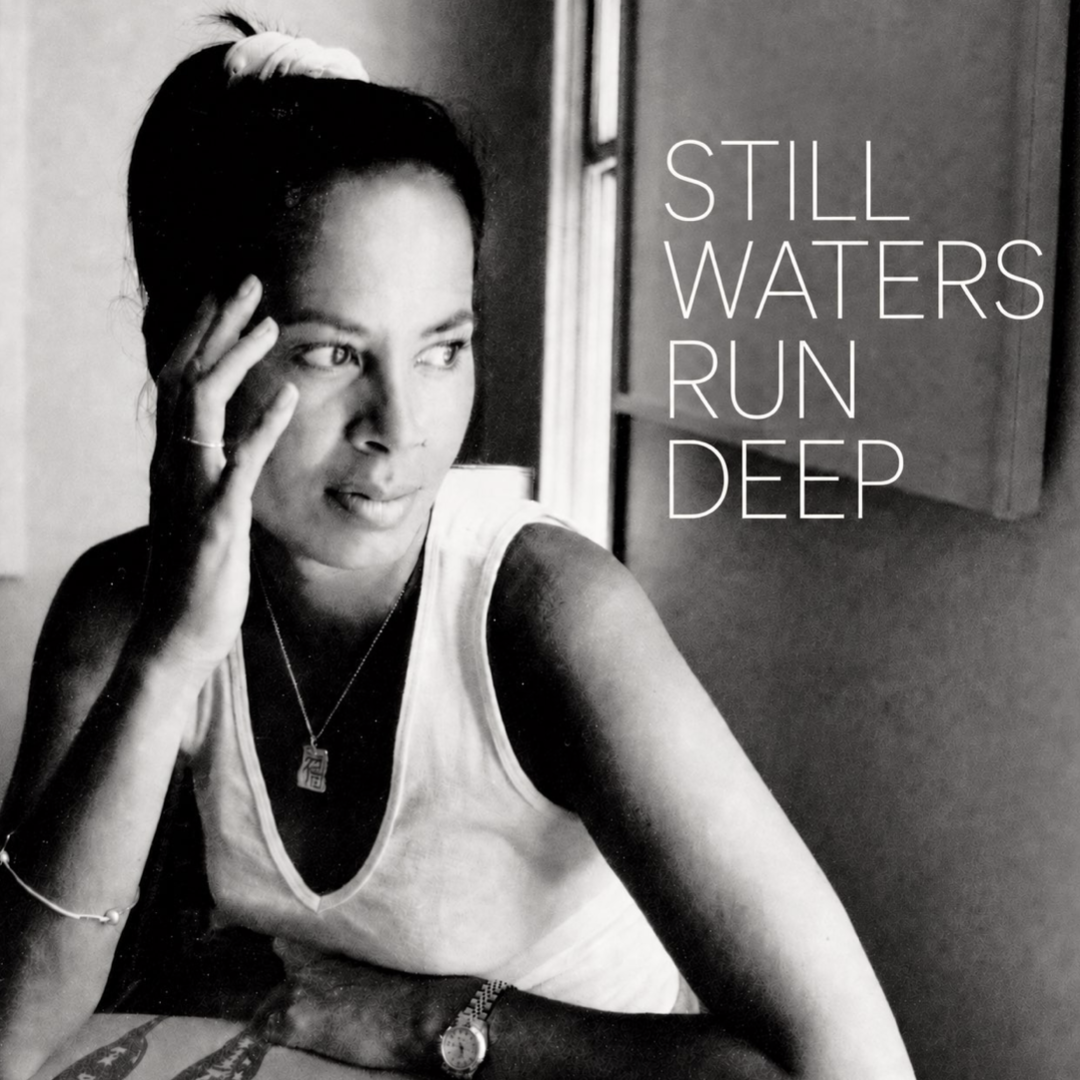
Nothing can replicate authentic human emotion. The whole point of the experiment was to find out whether that emotion could still come through, even with the new tools. "Still Waters Run Deep," written for Donna, was the test. It passed with the only audience that mattered, the love of my life.
The songs that meant something
The ones that cut deepest were about the people I love. "Still Waters Run Deep" was Donna's birthday song, and it's about her, her whole beauty, inside and out. It went through a stack of titles before it was right, and more than a hundred passes, because I wasn't going to hand my wife a rough draft of how I feel about her. There's another for our twin daughters that took just as long. The handful of people who sat with those songs felt what was in them and told me so, and I believe them, because those are the closest thing on the record to the truth. The machine couldn't invent what's in them. It could only carry what I already meant.
This is the part an AI button that does it all for you will never reach. The struggle is the art. What people connect to is the ache underneath the work, and the longing inside a thing is the frequency a stranger tunes into and hears as something of their own.
My daughters won't hear their song. They don't approve of the method, and I understand why, so I've left it where it is. That objection sits closer to the center of what worries me than any amount of praise could.
What I'm afraid of
The fear underneath all of it is plain and real. When a thing gets easy enough that anyone can do it, it stops being worth much. Make music by typing a sentence and you get a crowd convinced they're gifted because the machine did the lifting. Somewhere in that crowd, the person who carries something rare, the one built to make what no one else can, gets lost. That's the loss I care about. Not that the tools exist. I use them every day and I'm glad to have them. The loss is the few who carry the real thing, buried under everyone who can now produce a passable copy of it.
One of my twin daughters is who I have in mind when I say that. She's an omnicreative, the kind of person whose gift doesn't stay in one lane. She draws and paints, she designs, she works in digital art, video, and social platforms, and she writes beautifully, carrying every bit of it with the same passion and grace. None of it was handed to her. She finished top of her art school and turned the award that came with it into a certificate in post-production, and she left nothing on the table learning her craft. I taught myself everything I do, and what she can do already runs well past me. The question that keeps me up is whether any of that will matter, if the world decides it's fine with slop that has no soul in it. She's walking straight into that world. I'm probably past the worst of it. She isn't, and that's what I can't put down. She deserves a real shot, not displacement by a soulless chatbot.
Her sister is two minutes younger and every bit as sharp. They get that from their mother. She took a aerospace engineering master's in the Netherlands and works in human spaceflight now, with time in mission control, and she's earning her pilot's license because she means to fly up there herself. When the call comes down to whether someone lives, no one hands it to a machine to settle. The judgment stays human, and that's the ground AI has the hardest time taking from any of us.
And I'd be lying if I laid all of this on other people. I do it too. I've watched someone step outside the thing I knew them for and felt the same small tug, the one that wants them back in their lane where I can place them. Then I think of Helio Castroneves, who hit a challenging moment in his life and rose above it magnificently, brilliant in a lane nobody had assigned him. A great and fierce human. It's a reflex, and I'm not free of it. That's probably why I know it so fast when it comes for me.
Neither of my daughters is sold on any of this. It's likely neither will read a word I've put here, because the plain fact that I touched these tools sits wrong with them. I love them too much to argue the point, and they may be right.
THE AI FLOOD Faking It While You Make It
While I was building my album, the charts were filling up with acts that don't exist. Not the old kind of manufactured act. Singers with no body behind them and no bad night to live down, and a few of them are outrunning the humans.
Xania Monet reached a Billboard radio chart this fall, the first artificial act to get there on airplay, and the bidding to sign her climbed to three million dollars before a label closed the deal. The part I keep wondering about is who's underneath it. A Mississippi poet named Telisha Jones writes every word. The voice is generated, the lyrics are hers, and she means them. That's not so far from what I did.
Xania Monet is not a real person. A real human poet wrote the words and they are emotionally moving, The rest is AI generated., and the consequence is still being debated. What passes for “real” now that the AI music Genie is out of the bottle?
Breaking Rust, a gravel-voiced cowboy who doesn't exist, went to number one on Billboard's country sales chart. Read the small print and the number one took around three thousand purchases, because hardly anyone buys a download now. No one has turned up a human behind him either. The songs sound like every truck-and-flag record already on the radio, which might be the entire (cheap) trick. They suck, regardless. Perhaps a better name would have been Breaking Trust.
A group calling itself the Velvet Sundown drew more than a million monthly listeners on Spotify as a lost seventies rock band, until somebody finally admitted there was no band at all. People felt lied to, and they had every reason to. Let’s just call it what it is: Velvet Letdown.
They sound like music, and that comes with an asterisk. Nobody performed it. Then there's a second asterisk waiting, the one where no person wrote the words either, where nobody sat up at night deciding what the song was even about. When both asterisks are there, I don't know what you're listening to anymore. It moves air and fills a playlist. Whether that's music, I think, comes down to whether anybody meant any of it, or lived it.
I'm not the only one who went looking under the hood. Rick Beato is one of the most knowledgeable people exploring music on the internet, a musician and producer with millions of followers, and when I need a break from cars and media I love watching him take a song apart and explain why it works… or doesn’t. Nobody reads the craft, or the business behind it, more clearly. A brilliant and passionate guy who I can’t get enough of.
So it stuck with me when he built a fake artist on purpose, to show how little it now takes. He didn't even invent the guy. He fed ChatGPT a description and asked it for a square avatar image and a name, and it produced a handsome indie rocker dude named Eli Mercer, a fictional indie singer-songwriter. Rick prompted Claude AI to write the lyrics, and Suno made the music. Not one part of “Eli Mercer” came from a real person. That is both asterisks at once, the empty version, proven by The Man who knows exactly what real looks like. The difference between what he did and what I did is the whole argument. He used these tools to build an artist with nobody inside him, to warn you. I used the same tools to write my own life down, and I meant every word of it. I am also warning you, but it is about something far more important than the threat of AI slop.
How to create AI Slop music. Rick Beato builds a fake artist out of thin air and walks you through every step. Watch how little it takes.
Where I come out
My worry through all of this was simple. What happens to us if we lean on the machine so hard we forget how to make anything ourselves, and one day the music stops?
We've been handed more capability than any people who ever lived. The skill that counts now is taking whatever touches your life and making it yours, instead of guarding what you already know or sitting in the lane somebody handed you. I've lived that way my whole life, self-taught across a stack of trades that used to look like separate professions and don't anymore. Ignore the tools and you fall behind. Hand them the wheel and let them decide what you make, and you come out sounding like everybody else.
So what did I come away with? A soundtrack for my own life, which I didn't expect to care about the way I do. Songs for Donna that she loves. Those were the whole reason for the ones that mattered most. And a clearer sense of what I can still make, this far along.
I've always needed theme songs for my life. I made them up in my head for as long as I can remember, and now I can hear them. I play them on the long walks with my dog, and they remind me who I am and why I'm doing any of this, right down to walking the dog.
None of that is the part that stays with me. What stays with me is that I see what's opening up differently now. I can see what powers it, and it isn't the machine. It's us. These tools are here to let a person become the fullest version of what they already are. I'm not telling you that's what pours out of Suno today, because most of it isn't. I'm telling you it's coming, and more of it will be real every month.
The flood is real, and the danger riding in on it is real too. I haven't pretended otherwise. None of it lifts because I made a record I'm fond of. But the rising water does one more thing. It throws a hard light on the parts a machine can't reach, the part that was lived and meant, the reason any of it was worth making. That is the advantage, and it isn't the tool. It's the person behind it, reaching further than they ever could alone.
The predictions about all this run to both edges of fear and hope. One camp says it ends the human race. The other says it sets us free to become everything we could be. The truth is somewhere in the middle, and anybody certain they know where isn't paying attention.
What I do know is the part we've already covered. Stop learning and you get left behind, and that was true long before any of this showed up. My SCCA Cal Club driving-school instructor and racing mentor, Mike Hull, told me once, "Racing is learning." He left it there. I'm the one who added "and so is life," over the years, because it turned out to be true of everything. Mike and everyone he's worked with have lived it, and the titles are the proof. He just won his and Chip Ganassi Racing's 18th IndyCar Series title, the most any team has ever taken. I met Mike about six months before my father died, and his kindness, and the people around him, gave me the footing to get started, and keep going in this business and in the sport. I put what Mike told me into "Drive It Like You Stole It," because learning has been the whole shape of my life.
For the rest of us, it comes down to one thing. If there's nothing in you that only you can make, the kind of thing that comes out of one particular life lived one particular way, then a machine can stand in for you, and you'd have reason to worry. But if anything in here made you suspect there is such a thing in you, then it did its job, whatever you end up thinking of my little record.
I only noticed it after the fact. A handful of the songs keep circling this same choice, and I didn't plan a single one of them that way, "Drive It Like You Stole It," "Motor On Brother (Don't Look Back)," "Never or Now," "Last Man Standing," and "All You Really Have Is Now." That last title came from my late father, close to the last thing he ever said to me. It's just what surfaced in the songs, over and over, because it's what I've come to hold true.
Andy Dufresne says it best in "The Shawshank Redemption," and Red says it again at the end. "Get busy living, or get busy dying." It's your choice. It always has been.
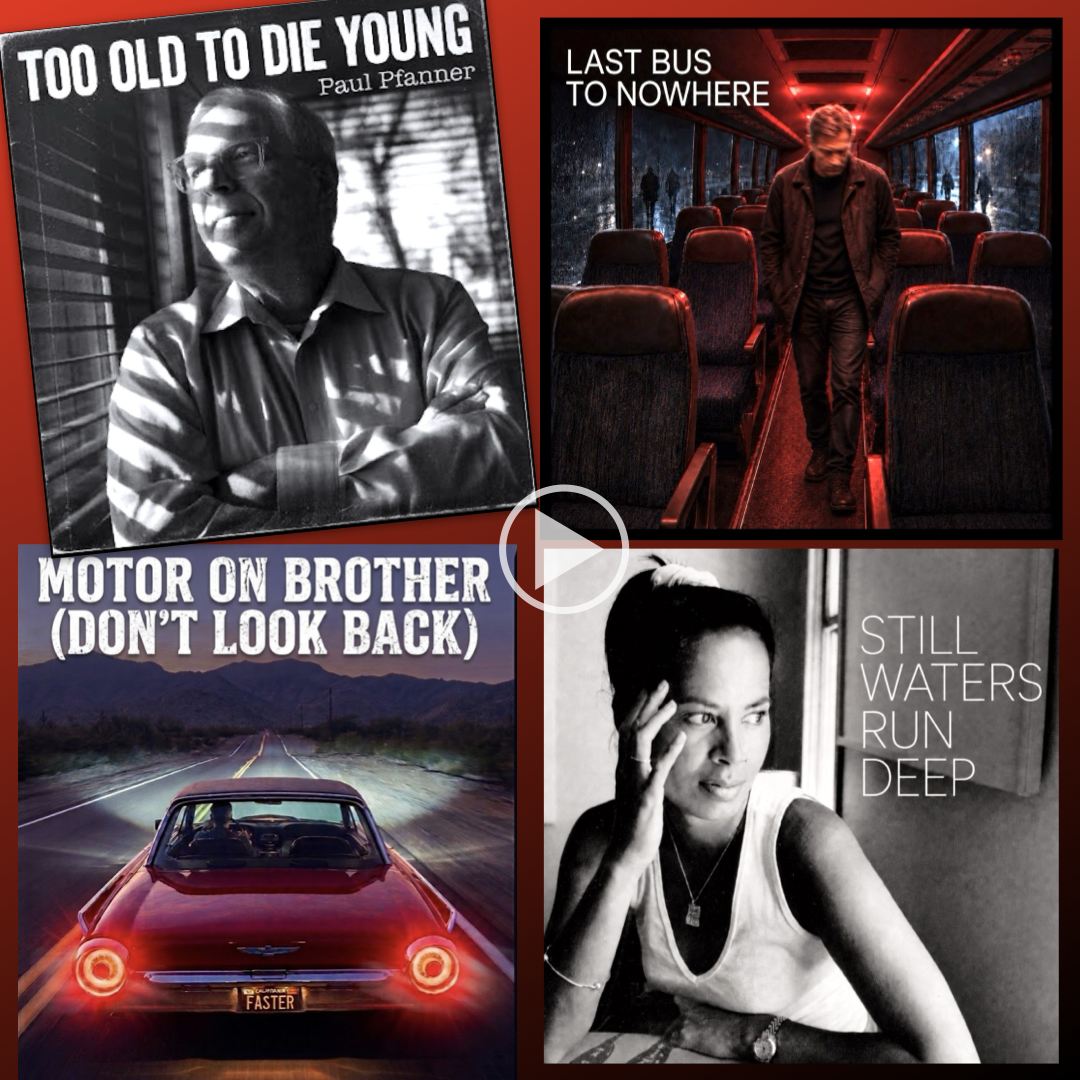
Too Old to Die Young: my first and final album. [Click the image above to listen]. The lyrics are mine. Claude and ChatGPT helped me find the structure, since I'd never built a song before, and Suno turned prompts I wrote with Claude into the music and the performances. The voice you hear is Suno's take on a clone of mine. I came out of the whole thing with far more respect for the songwriters and players who do this for a living. The tools get you close to the sound. The craft underneath it is still theirs, and I know the difference.
For Donna, our daughters, and my dad.
And for Jeff, still out front.
Paul Pfanner’s Shift Happens Essays on AI Music
Pfanner Advantage works with clients to turn change into advantage at the intersection of mobility, motorsport, media, technology, and marketing. Learn more or start a conversation: contact us today.
Paul Pfanner’s recent Shift Happens Insights:
The Advantage Journal arrives every week. What matters in sport, mobility, media, and technology — curated and contextualized by Bill Sparks, Bill Long, and Paul Pfanner. No hedging. No filler. Subscribe — It’s Free

