
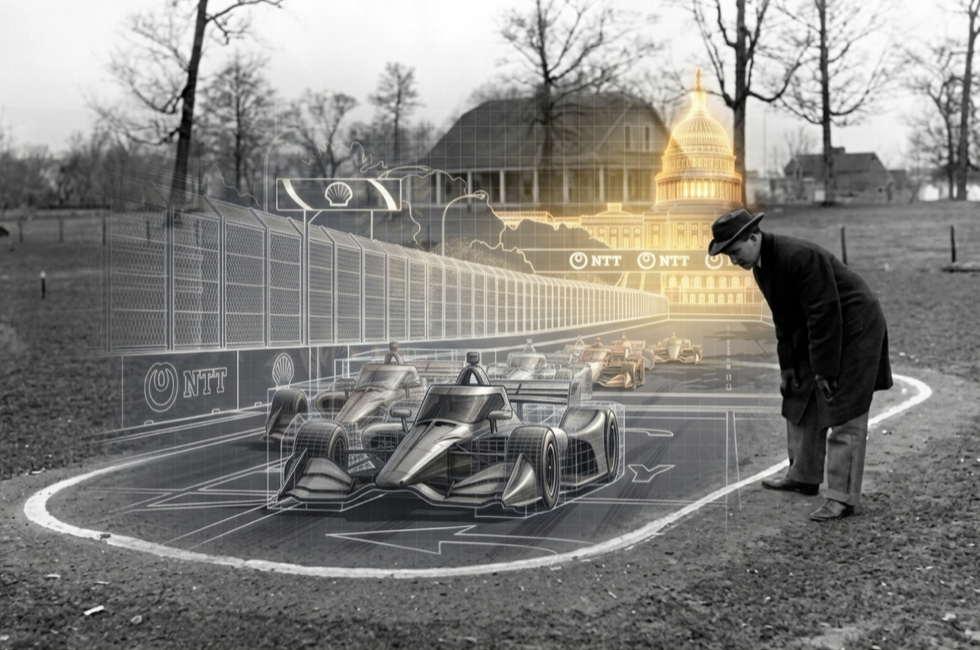
Carl Fisher chalks out the Indianapolis Motor Speedway in 1909, before the first brick was laid, as modern IndyCars run past the U.S. Capitol at the 2026 Freedom 250. Two Big Ideas separated by more than a century, driven by the same kind of ambition.
Bill Long has spent his career where the automotive business and motorsports meet, first as vice president of marketing for the IndyCar Series, then through fifteen years as president and CEO of the Motor & Equipment Manufacturers Association (MEMA), the vehicle suppliers association. He has watched big ideas get made and get killed. Here he lays out what separates the ones that change an industry from the ones that die in a conference room.
Big ideas are not incremental improvements. They are deliberate, organization-wide reinventions that create step-change value, the kind of ideas that fundamentally alter how a company creates value, competes, or is perceived. They reshape markets, business models, and customer expectations. And they always require the same ingredients: vision, leadership, perseverance, commitment, faith, and courage.
In motorsports and the automotive industry, big ideas have always been the engine of progress. I've seen them up close, the ones that changed everything and the ones that never made it past the conference room door.
An Original Big Idea: Building the Indianapolis Motor Speedway
Long before the Indianapolis 500 became a global icon, someone had a Big Idea: to build a 2½-mile rectangular racetrack in the middle of nowhere, paved with 3.2 million bricks, to serve as a proving ground for a fast-growing automobile industry. A place where innovation could be tested at full speed.
It was audacious and improbable, and it worked. It became one of the most important platforms for mobility innovation in history.
Big ideas usually look impossible at first. That's part of the job.
Big Ideas That Redefined Value
During my career in motorsports and the automotive sector, I've seen big ideas that didn't just improve a business. They redefined it.
George Hurst had one of those ideas.
He didn't just sell shifters. He built a brand. He did it by creating Miss Hurst, hiring Linda Vaughn (now a motorsports Hall of Famer) to become the face of Hurst Shifter. That move changed how the company created value. It wasn't a product strategy, it was a cultural one, and it turned the Hurst brand into an icon.
Another big idea followed. The Hurst/Olds Indy 500 Pace Car in 1972 was the first and only time an automotive supplier was included in the official title of the pace car. That partnership elevated Hurst, it rewrote the rules of brand collaboration in motorsports, and it literally saved the pace car program at Indianapolis.
The biggest ideas don't just change a company, they change the whole category it competes in.
The Freedom 250: A Modern Big Idea
The recent NTT IndyCar Series Freedom 250 was another example of transformative ambition.
As a former head of marketing for IndyCar, I've been in the room where big ideas were born, and in the room where a lot more of them died. Staging a race through the streets of Washington, D.C., during the 250th anniversary of our nation, with only seven months to prepare, was bold to the point of unbelievable. Think about everything that could go wrong: permission, politics, permits, logistics, weather, the racing surface, and the ever-present risk of a poor show on a big stage.
That's the difference between incremental thinking and transformative thinking. Big ideas carry big risk and, when they work, big reward.
IndyCar pulled it off, and they showed what step-change innovation looks like in real time.
Why Big Ideas Matter Now More Than Ever
For today's business leaders, especially in the automotive and mobility sectors, the headwinds are many:
Unprecedented uncertainty
Accelerated technology shifts
Supply chain disruption
New competitive pressures
Changing customer expectations
Tariffs and new business models
In moments like these, subscribing to a Big Idea can feel like a career-limiting move. The safer path leans toward incremental efficiencies.
I have watched this play out. Mobility and innovation keep changing fast, and that change brings a wide range of outcomes, possibilities, and opportunities. The future holds plenty of unknowns, but there is no debate that products, markets, and business models are going to be disrupted.
The risk of staying as you are is greater than the risk of change and the Big Idea.
Transformation is never comfortable, but standing still is worse.
The Lesson
Big ideas are not accidents. They are choices, made by leaders willing to imagine what doesn't exist yet and brave enough to build it.
Whether it's a brick-paved racetrack in 1909, a brand-defining partnership in 1972, or a street race in the nation's capital in 2026, the pattern is the same. It takes vision, courage, commitment, and perseverance, and the willingness to take a risk when the world says it's safer not to.
In business, as in motorsports, the future belongs to the people who bet on the Big Idea.
.Pfanner Advantage works with clients to turn change into advantage at the intersection of mobility, motorsport, media, technology, and marketing. Learn more or start a conversation: contact us today.
The Advantage Journal arrives every week. What matters in sport, mobility, media, and technology — curated and contextualized by Bill Sparks, Bill Long, and Paul Pfanner. No hedging. No filler. Subscribe — It’s Free