
The Race Beyond the Race
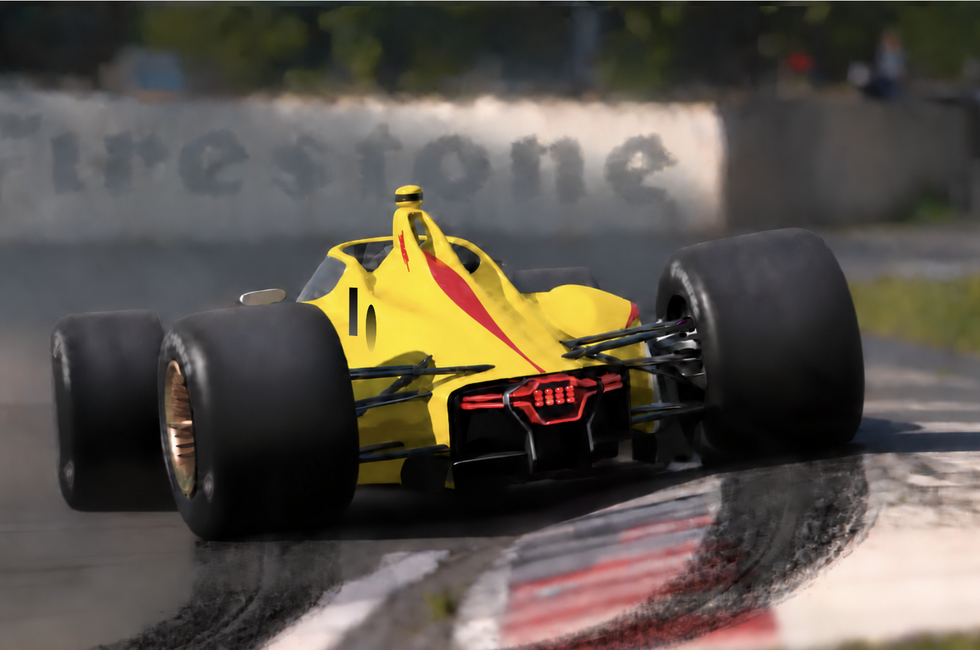
The Blackbird 66 concept driven beyond the edge, rendered in Alex Palou's DHL colors and sliding over a curb. A car you'd watch for the person driving it.
Sixth and final in a series. Last time out, Paul Pfanner asked who gets to drive the next IndyCar. Here he asks what that driver means to everyone watching, and why a car built to level talent and lock the idea of an Indy car in place would hold back a series that could become a global powerhouse. Then he shows what he means, in a make-believe TV spot for the 2033 season.
I started this series asking what the next Indy car should be. Five columns later my answer is clearer. The car should make us see the driver.
America already knows the Indianapolis 500. The grandstands sold out for a second year in a row, and 6.635 million people watched on FOX as Felix Rosenqvist won by 0.0233 seconds, the closest finish the race has ever had. I wrote about that day in May. The question now is what the 500 can do for the other seventeen races, and what they can give back to it.
The Puck Stops Here: Play at the Edge
I like putting my pixels where my mouth is. This isn't a real FOX Sports or IndyCar commercial. It's a make-believe spot for a 2033 season that I made with ChatGPT, Hedra and Suno, and the car coming out of the corner is J.R. Hildebrand and Patrick Faulwetter's Blackbird 66 concept. In an earlier column I treated the Indy car as a piece of sports equipment, like a ball or a bat, but it's much more than a prop. It can reveal the judgment, touch and courage of the person driving it, or it can hide them. IndyCar drivers are not interchangeable performers in a carnival thrill show, and they deserve a car that lets us see the difference between the best and the rest. I volunteered as the test pilot rather than ask one of my driver friends to lend their reputation to the experiment. The younger-looking, better-haired version of me is AI enhanced. The cloned voice is mine, and so are the words and the point of view.
More than wheel-to-wheel
IndyCar has spent too much of its modern life asking people to admire the racing. The old Indy Racing League promise of wheel-to-wheel excitement always struck me as incomplete. There's wheel-to-wheel excitement on the freeway, too. I'm joking, but the dad joke points at something serious, because describing the action doesn't give anybody a reason to care who wins. If we build another parity appliance on that premise, the drivers risk becoming a rotating cast in a thrill show. Their skill and courage are enormous. The audience just isn't given enough reason to notice when the cast changes. We’ve been there and done that with the IRL.
A sport reaching farther
The 2026 results give IndyCar an opening. FOX's 18 races averaged 1.681 million viewers, up 23 percent from 2025 and 57 percent from 2024, and nine of them passed a million. Washington averaged 3.282 million and Road America drew 1.803 million. IndyCar reports weekend attendance up roughly 20 percent, more than 250 million social and digital video views, and race-weekend merchandise sales up nearly 40 percent. Those are different measures and they all point the same way. The sport is reaching farther than it has in a long time.
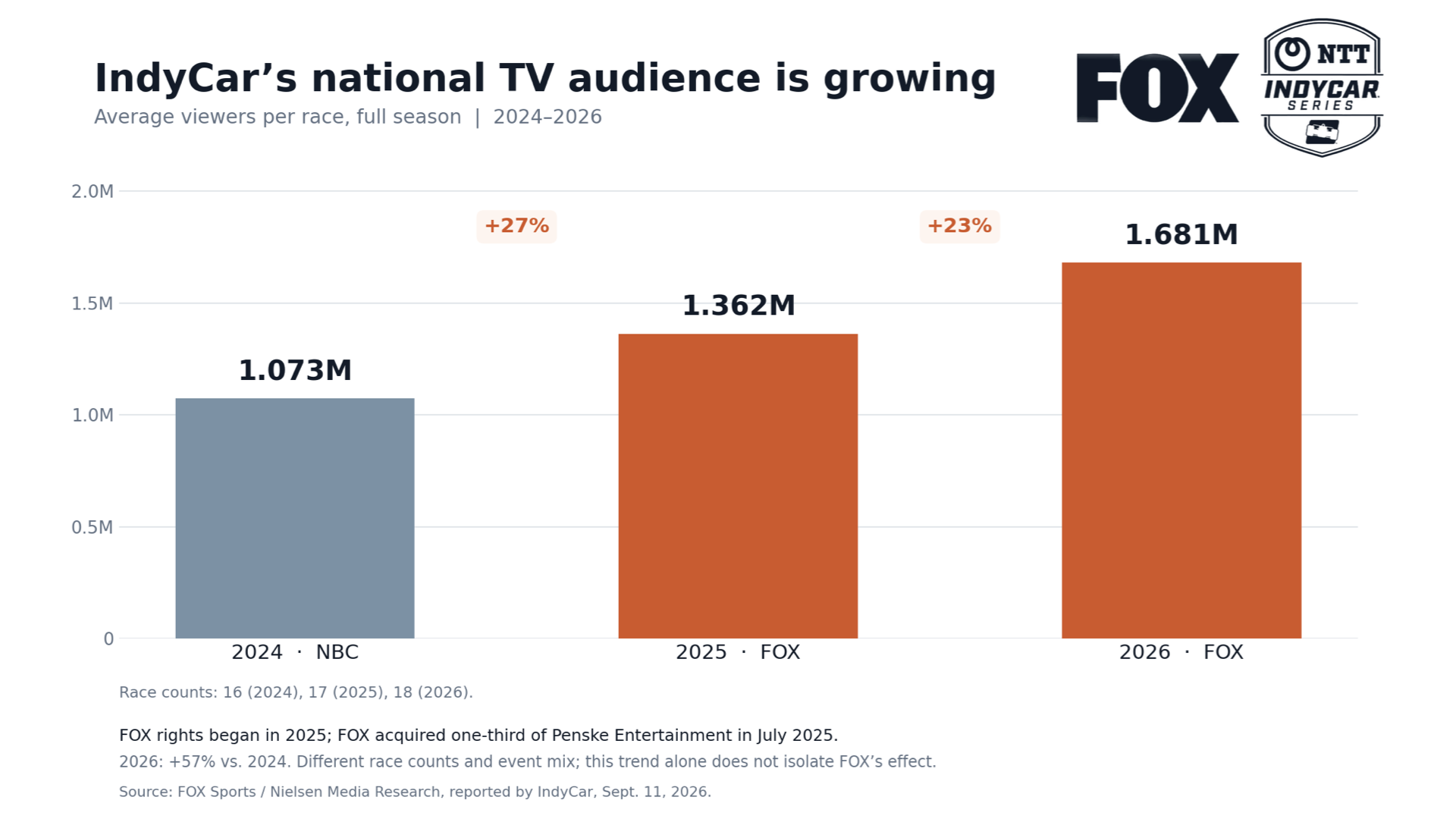
Two seasons, a lot more people watching. IndyCar's average audience per race went from 1.073 million in 2024 to 1.681 million this year, a 57 percent gain. The calendar changed along the way too, so the network doesn't get all the credit.
The calendar helped. Arlington brought in the events organization behind the Dallas Cowboys and Texas Rangers, and Washington turned the capital into a stage. Road America showed what a great circuit can still deliver. An event brings someone to the screen, and it takes a driver to bring them back.
FOX puts every race on the same broadcast network, promotes the sport and invests in programming well beyond the live telecast. It also owns a third of Penske Entertainment, which includes IndyCar and the Indianapolis Motor Speedway. That gives FOX a real stake in what the property becomes, and that's a competitive advantage if IndyCar uses it well.
Can you talk about Josef and Pato?
FOX Sports chief executive Eric Shanks, a lifelong 500 fan, put the ambition in human terms: “Ratings aside, can you walk down the street and talk to people about Josef and Pato?” He meant Josef Newgarden and Pato O'Ward. That's the test I'd use too. Recognition is what happens when a sport's stars travel beyond it.
FOX's 2026 spots with Josef Newgarden and Pato O'Ward are funny and hip, and they feel like right now. I think they're the best IndyCar spots I've ever seen, and I've made a few myself. They sell the drivers as people you'd want to know, which is the same test Shanks set.
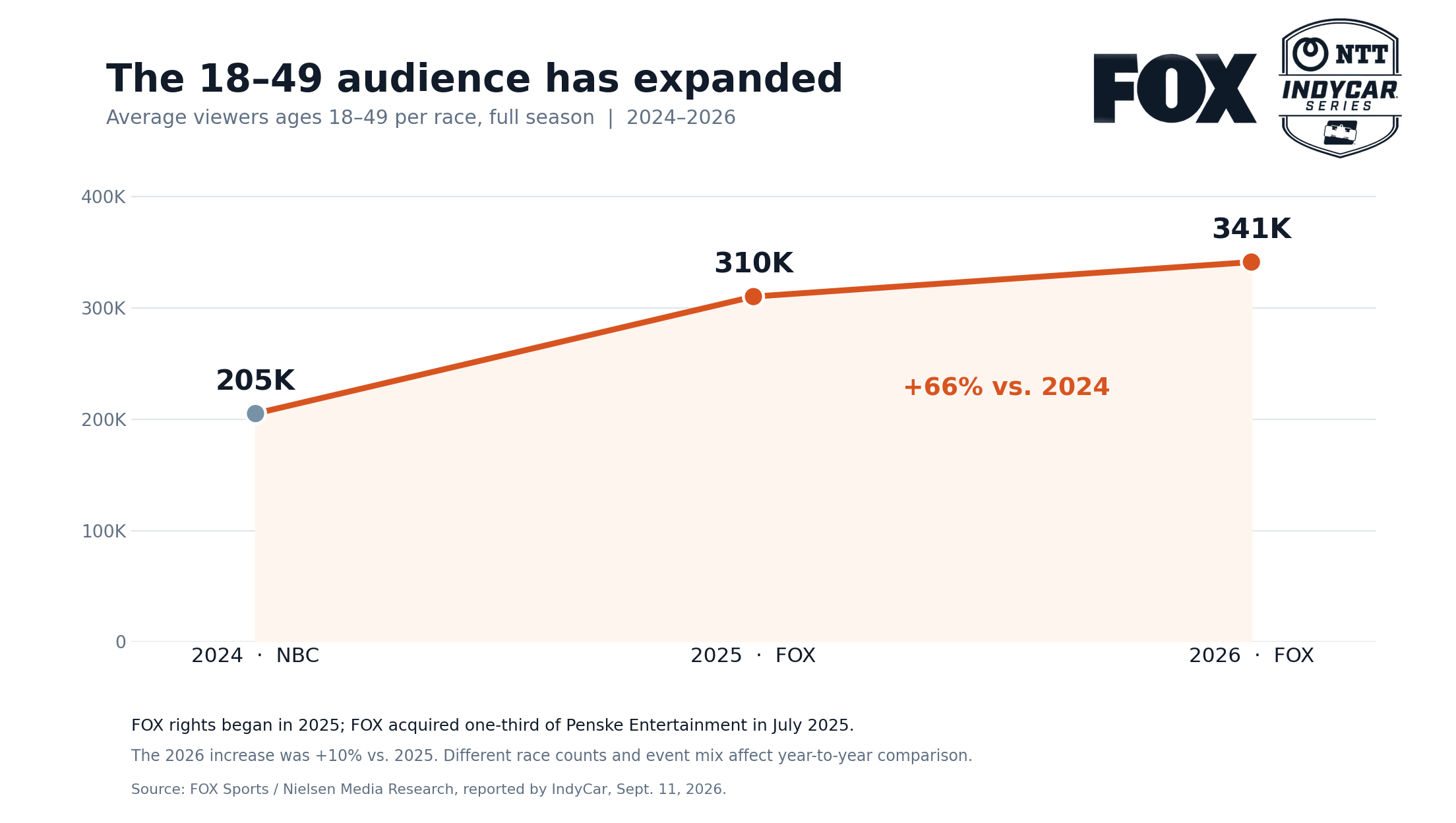
The people IndyCar most needs for that test are showing up. Viewers ages 18 to 49 went from 205,000 a race in 2024 to 341,000 this season
Formula 1's drivers and teams have moved into North American youth culture, and into fashion and entertainment along with it. In F1's 2025 survey of engaged U.S. fans, 40 percent said they followed a driver first. People meet a person and then discover the championship.
NASCAR once had that power. You could root for Dale Earnhardt or against him, and either way you knew him. Its racers are still compelling, but that broader recognition is harder to take for granted now. IndyCar should be asking itself the same question.
We've seen it in our own sport. Mario Andretti could race anywhere and still be Mario Andretti to people who'd never studied an entry list. Al Unser Jr. was recognizable, and Danica Patrick became a cultural figure well beyond the weekly audience. Each of them, in a different way, gave the public a door into racing.
IndyCar doesn't need a manufactured feud. Its field already has five-time champion Alex Palou, the magnetic O'Ward, the exacting Newgarden, a new Indianapolis 500 winner in Rosenqvist, and others worth following. The 2026 ALL IN: INDYCAR series pulled more than six million YouTube views. That's a good start, though a view isn't a relationship yet.
A car worth mastering
This is where the car comes back to the center of the story. Today's drivers produce astonishing moments in a chassis whose basic architecture dates to 2012, under a tightly controlled formula. Imagine a car that let us see more of their work, one that asked for more range and judgment across all four kinds of circuit without asking anyone to accept more danger. Imagine the best drivers in the world looking at it and thinking, I have to find out whether I can master that. The machine would pull them in, and I think watching them wrestle with it would bring the rest of us along.
The IR-28, due to race in 2028, is still in development. It promises a lighter car, a new engine formula and more performance within modern safety standards. I've only seen it in images from testing, and it's growing on me. The more I see it, the more I realize it's a completely new car, and that's a good thing. The bigger choice is what comes after it. Parity has kept the sport viable and given us magnificent finishes, and I don't take that lightly. But I want to be plain about what I'm pushing against. If the next car is a parity appliance with the challenge turned down so no driver's talent can stand too far apart from the rest, that defeats the whole purpose. You can't ask people to walk down the street talking about Josef and Pato and then hand them a car built to make Josef and Pato harder to tell apart.
IndyCar has to be something different from everybody else. Another winged formula car with a safety cell that happens to be faster is fine, as far as it goes. But a parity appliance where everybody runs the same thing, and it stays the same for a decade and a half, isn't what IndyCar was designed for. The world is moving faster than that. Everything is changing faster now than it ever has, and this sport was built to get to the future faster, not to sit in the same gear at a constant throttle for fifteen years. Difficulty and danger are not the same thing. Keep people safe, and let the car keep asking more of the driver, so we can see the difference between very good and great.
Formula 1 is wrestling with this in public. Before Monza, Lewis Hamilton described cars running out of power before the braking zone, with drivers downshifting on the straight. Oliver Bearman said energy-starved circuits had become less enjoyable to drive. At Hungary, Oscar Piastri said drivers had little control over how power was deployed in qualifying, and Fernando Alonso said the car didn't give him the same adrenaline anymore. None of that means F1 drivers have become passengers. It shows what happens when the machine starts to hide their command of it, and IndyCar can choose a different kind of technical ambition.
At its best, CART drew elite international talent without Formula 1's social distance. Nigel Mansell came here as the reigning F1 champion. Jacques Villeneuve won the Indianapolis 500 and the CART title here and went on to win the F1 championship. Drivers wanted the test. IndyCar can't recreate the 1990s and it shouldn't borrow F1's luxury brand costume either. It can be elite on the track and still feel open to the people watching, and the car is the first place anyone would see that.
The audience owns you
When I worked with IndyCar leadership on its brand and the 500, I told them the audience owns you, not the other way around. Fans lend a sport their time and their identity. What the sport represents, in the end, is a validation of what they believe, of their passion and their devotion. It represents them. Self-esteem is at the core of any sporting endeavor, ultimately. Align yourself with a team or a driver, or with a manufacturer whose brand is out there competing, and you see some of yourself in it. That's why the car matters to people who will never drive one. If it can't show them the difference a person makes, it can't carry that piece of them either. The split showed how an institution can leave its most devoted supporters uncomfortable defending it. A television partner can magnify a brand, but the sport still has to behave in ways worth following. Related column: The Split at 30.
IndyCar and FOX hold the megaphone now, and that means telling the difficult parts honestly too, like what teams are risking and why a decision went the way it did, and saying so when an event falls short. Access buys you attention for a while, but people only keep trusting you if you're straight with them when it would be easier not to be.
Everything Is Awesome: It wasn’t for a while
This is how the Indy Racing League sold itself in the late 1990s. Wheel-to-wheel excitement, the greatest racing on earth, and a lot of crashes cut together to prove it. It sells the action and stops there. Nobody tells you who these people are or why what they're doing is so hard to do.
I was on the other side of the split, doing marketing and branding for Champ Car, and we tried to sell something else. "Faster" was about the athlete taming the beast, on every kind of circuit and not just ovals. Champ Car didn't make it. I think the idea deserves another run.
And really, it could be a lot worse. If you want to know how far IndyCar has come, watch the late Robin Miller let loose on the state of the sport in June, 2015, after a race at the ironically now-shuttered Auto Club Speedway (built by Penske Motorsports, Inc.), in a video he did for RACER, the brand I co-founded. I wonder what Robin would think of today’s NTT IndyCar Series? I miss him.
A fair share of the value
The cultural ambition leads straight to a business question. Roger Penske joined Dan Gurney and Pat Patrick in forming CART to give team owners a bigger voice. Now he owns the series and the Indianapolis Motor Speedway, so he has sat on both sides of that table. As races become stronger businesses, teams need a more durable share of the value they create. Formula 1 teams have become valuable enterprises, and NASCAR has revised its charters to support team equity.
IndyCar's 25 charters offer grid protection outside the 500, Leaders Circle eligibility and a transferable right through 2031, with a possible extension. Rahal Letterman Lanigan Racing's sale of one to Dreyer & Reinbold Racing is the first public test of that right. RACER reported a rumored price around $13 million, and the teams disclosed no terms. One sale hints at an asset market, but it says nothing yet about whether teams across the field are making money running cars. The venues and promoters taking on local risk need value they can reinvest, too, and the cost of the car reaches all the way to them. Keep it where teams can afford to run it and a promoter isn't priced out of putting on a race. It's one economic engine. It fuels the venues and the teams, and now a network that holds an ownership position, so pull on any one of them and the others feel it.
The race beyond the race
Indianapolis is already a cultural institution, and FOX has given IndyCar a national stage. What's growing around the series now comes from the media alignment and from the quality of the racing, the teams, the drivers and the venues. That has put IndyCar up a gear. There's another gear coming that it will have to hit, and one after that, and it can be a global powerhouse if it thinks bigger. In racing you look for every advantage, and you rarely find one by becoming more like everyone else. We have more information than at any time in the sport's history, and more ability to model an idea and learn from it. I can't accept that this means the car has to be settled. The technology should help people invent and learn, and leave the driving to the driver.
Through all six of these columns I keep coming back to one simple thing. People care about people, not about things. A car matters when it carries people inside it, the ambition of the driver and the ambition of the people who dreamed it up and built it. That's why I keep calling it an instrument. The car should be an instrument of human expression, and it should let those humans be different from one another. Maybe that means moving past a pure spec car to something with more visible difference. I'm not going to write the rulebook here. The point of this series was to open the question, and I think it's open.
J.R. Hildebrand and Patrick Faulwetter's Blackbird 66, the car in the 2033 spot above, is one provocative answer to what might come after the IR-28. It's a concept, not a finished rulebook, and its value is in making us ask what kind of car the world's best drivers would feel they had to master.
The Speedway was built to find the future faster. The next Indy car should make the human being who gets there first impossible to miss. That is the race beyond the race.
Pfanner Advantage works with clients to turn change into advantage at the intersection of mobility, motorsport, media, technology, and marketing. Learn more or start a conversation: contact us today.
Essays on the next Indy Car after the IR-28
The Fastest Thing off the Shelf
The New Indy car is No Accident
It was never Just the Car, It’s Who Get’s the Seat
Paul Pfanner on the launch of the 2028 IR-28 Indy car
The Future Arrived Looking Familiar
Standing Still at 230 Miles Per Hour
Paul Pfanner’s recent Shift Happens Insights:
The Advantage Journal arrives every week. What matters in sport, mobility, media, and technology — curated and contextualized by Bill Sparks, Bill Long, and Paul Pfanner. No hedging. No filler. Subscribe — It’s Free

