
The New IndyCar is No Accident
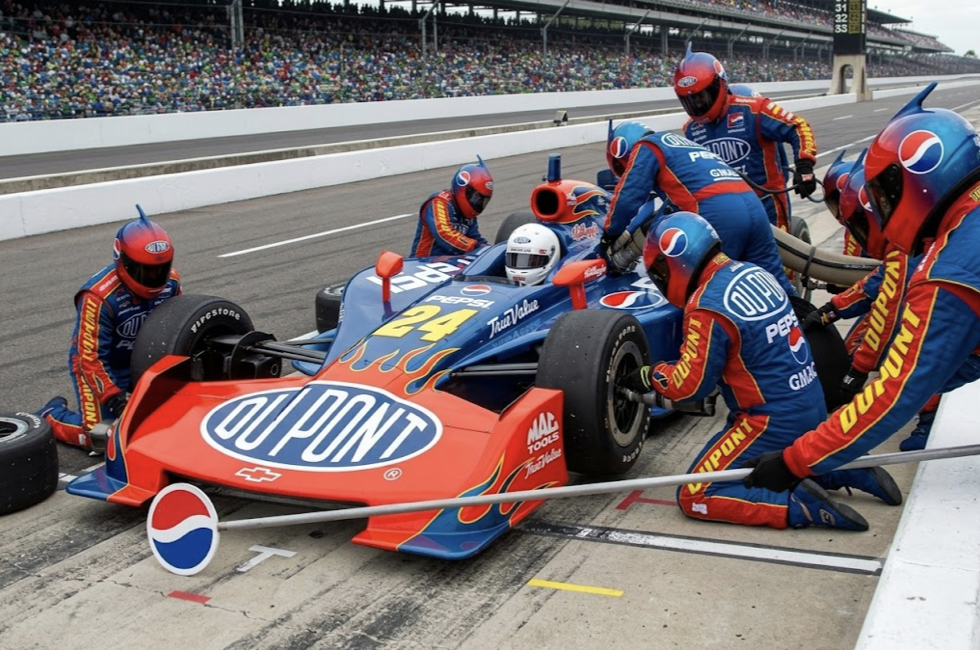
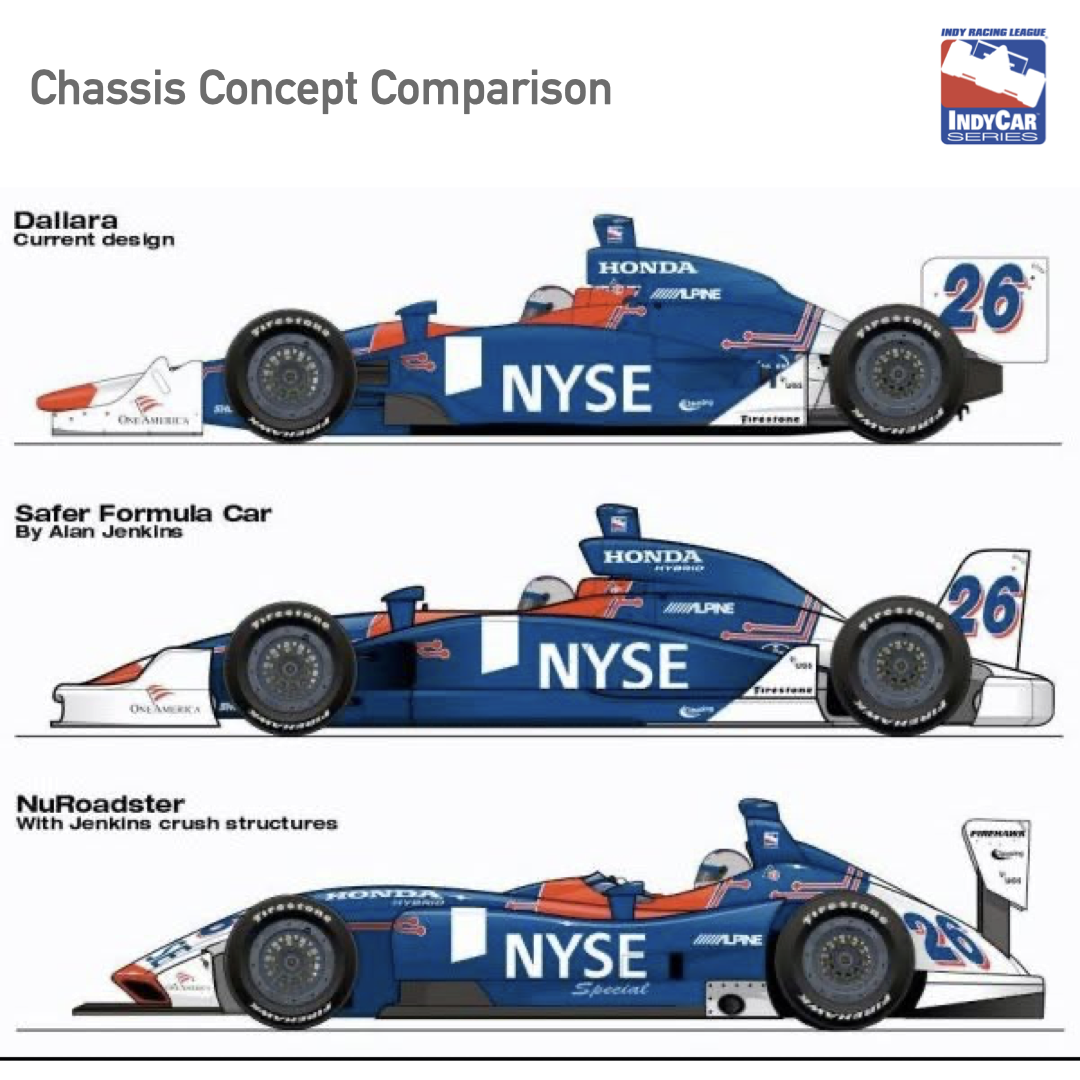
Designer Alan Jenkins had drawn a “Safer Formula Car”, and I wondered if his idea would make an Indy car safer, and worth more to sponsors. From our 2007 Indianapolis Motor Speedway Centennial Era presentation. Paul Laguette illustration, 2007, transformed by Gemini AI in 2026.
Fourth in a series IndyCar has a new car coming, and it didn't arrive by chance. To understand it, Paul Pfanner looks back at the forces that shaped it and the Indy cars that were drawn but never built, some explored by his firm, others proposed by rival constructors. Together they show how the sport got here, and the choice it now faces about what comes next.
I’ve spent some time going back through a collection of Indy cars that never existed and archive I’ve accumulated over decades of involvement in racing, media and marketing..
Some were concepts for possible Indy cars developed while Pfanner Communications was working with CART and Champ Car. The noted illustrator Paul Laguette and I explored others during our work for IndyCar and the Indianapolis Motor Speedway. Alan Jenkins' Safer Formula Car addressed interlocking wheels and driver protection. The Nu Roadster tried to reconnect Indianapolis with its history, production-car architecture and the American short-track racers being lost to NASCAR. We also considered a modern short-track formula car with wings and crush structures as a possible feeder.
They were not variations on one idea. Each was trying to solve a different problem.
That matters because much of IndyCar's modern history has been shaped by reactions to rising speed and horsepower, greater downforce and expense, fatal accidents, changes in the automotive industry, competing series, economic crises, shrinking fields and audiences moving somewhere else.
Reaction is not inherently a failure, because racing has always advanced by answering somebody else's faster idea. The difference is whether the response opens a future or simply closes a risk.
2006: What could an Indy car be next?
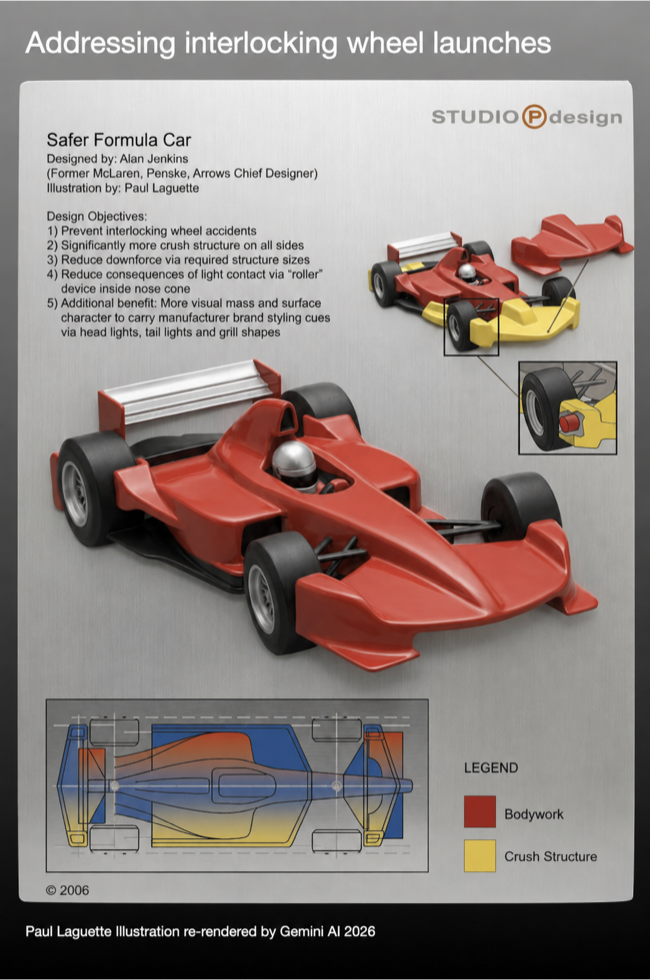
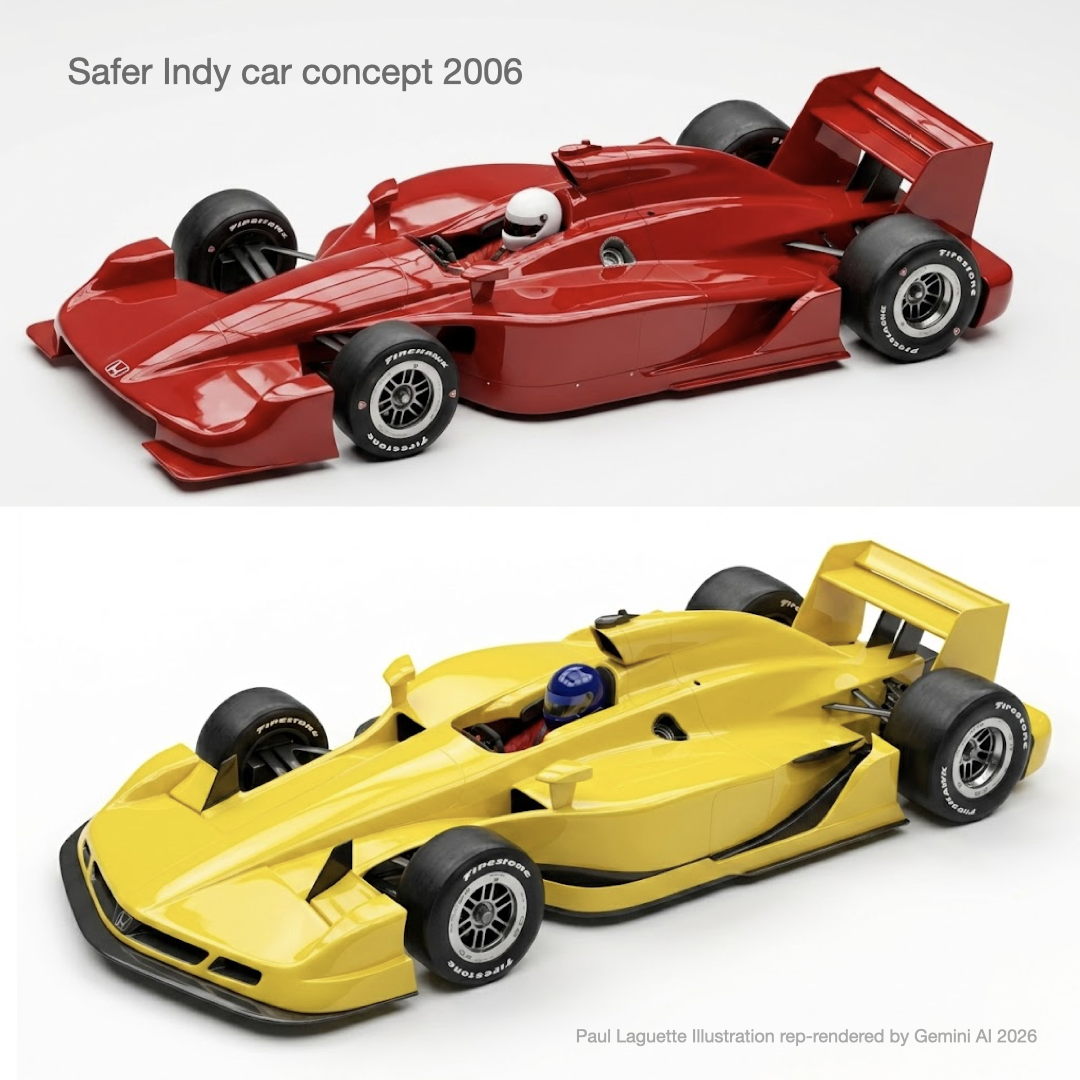
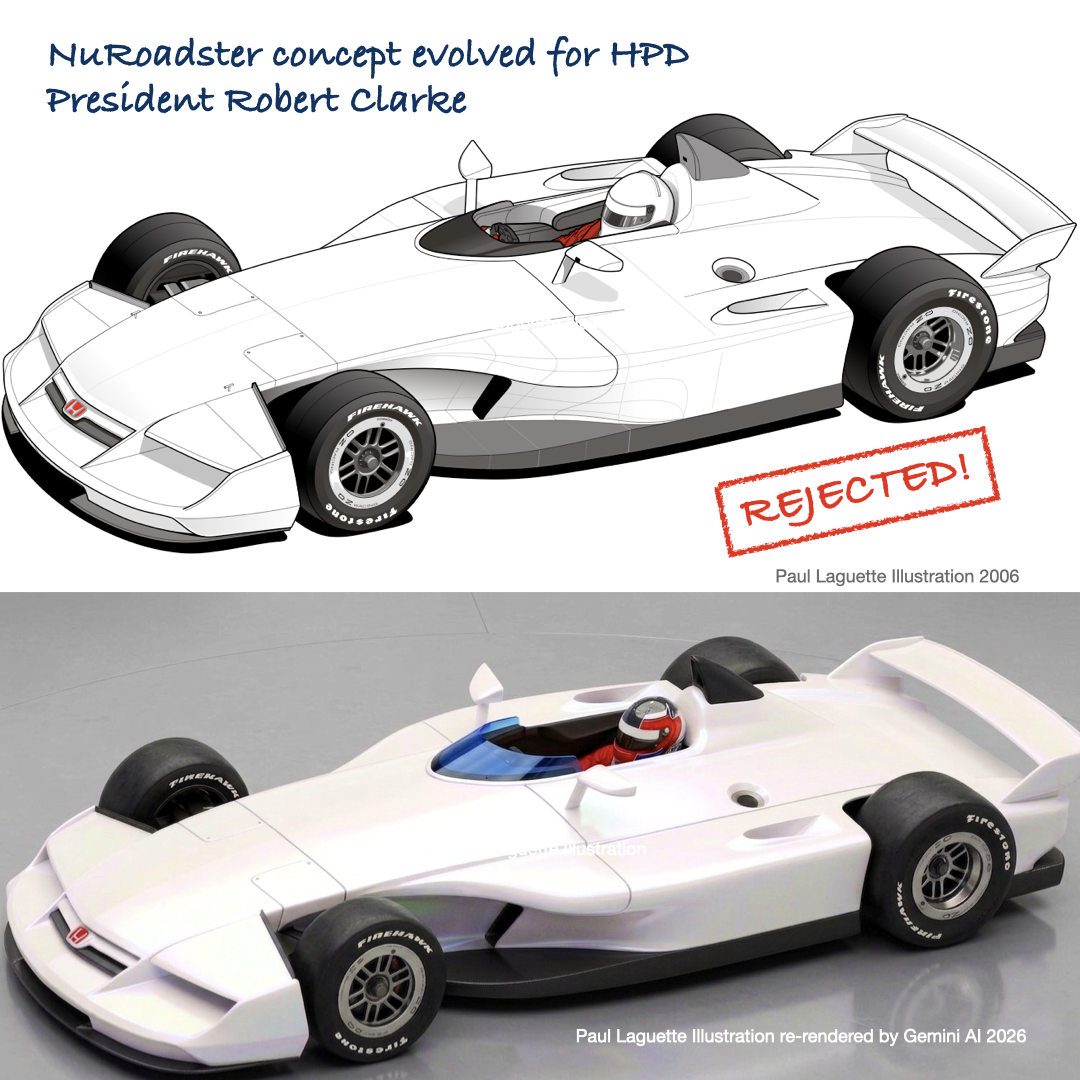
(Above) Paul Laguette and I built on Alan Jenkins' Safer Formula Car concept during our work for the IndyCar Series and American Honda's HPD, exploring whether an Indy car could be made safer and create more visual value for the people who sponsor it and watch it. (Below) One version stayed true to Jenkins. The other took on automotive styling and reached further. Honda was the series' only engine supplier then, and wanted a rival to race against.
Forward thinking?
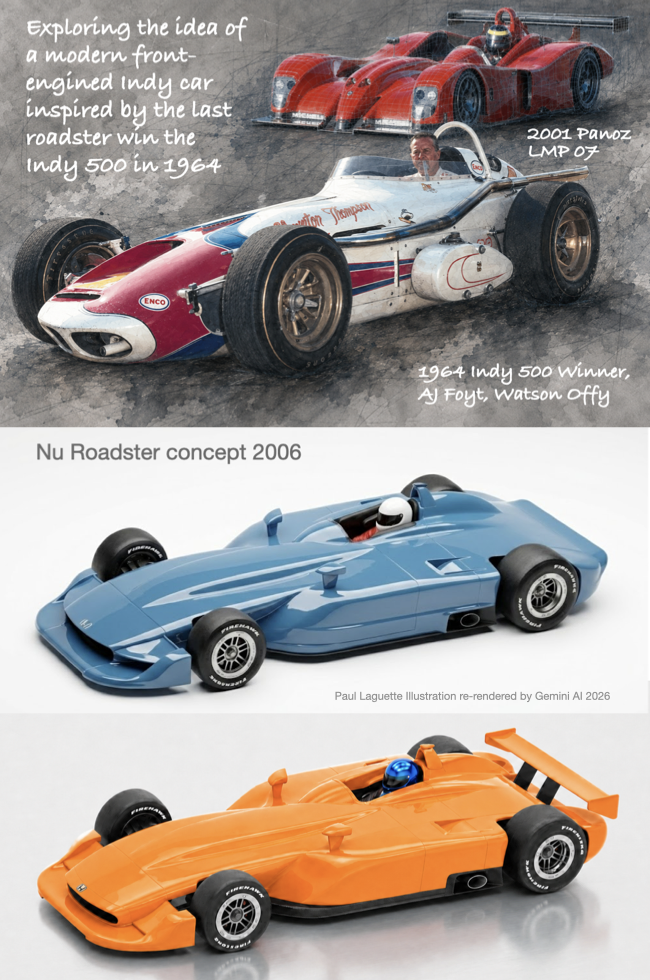
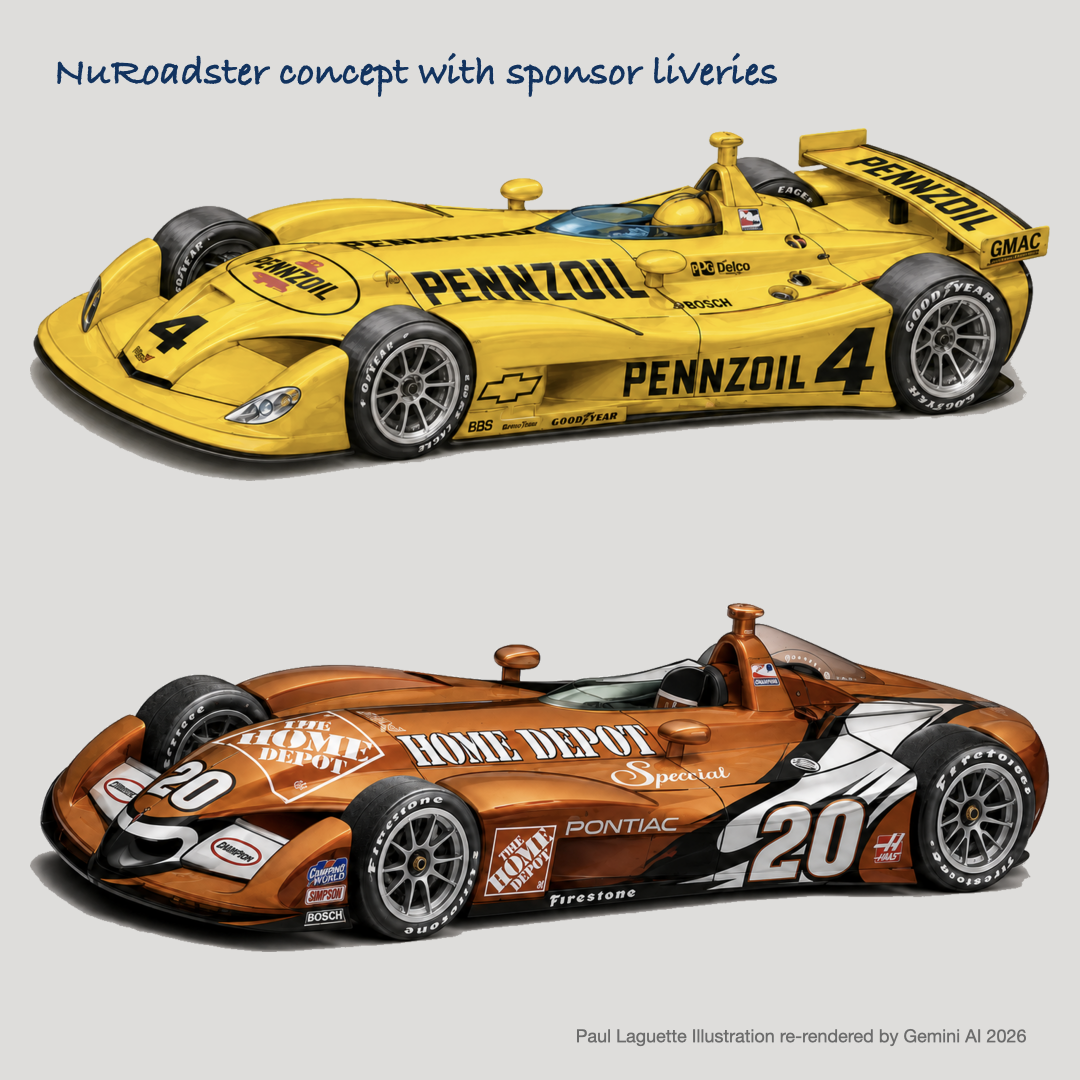
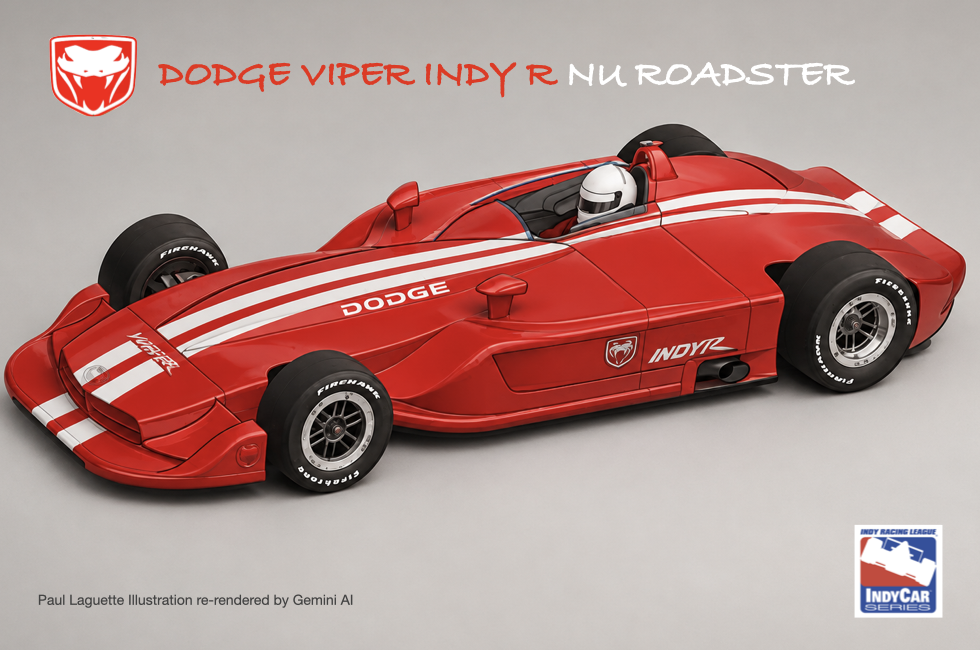
An idea rooted in Indy's roadster heritage: As part of our work for IndyCar, the Indianapolis Motor Speedway, and Robert Clarke at HPD, we looked at alternatives to the standard 21st Century Indy car, trying to find something distinctive that also reached back to the Indy 500's original vehicle format. The idea was a new roadster, rooted in the front-engine cars that ruled Indianapolis from 1911 until 1964. Don Panoz was campaigning front-engine prototypes in IMSA and at Le Mans right then, and it made us wonder what that architecture might look like brought back to the Speedway. We called it the Nu Roadster. This idea did not find traction, no pun intended.
The road to Indy could start closer to home
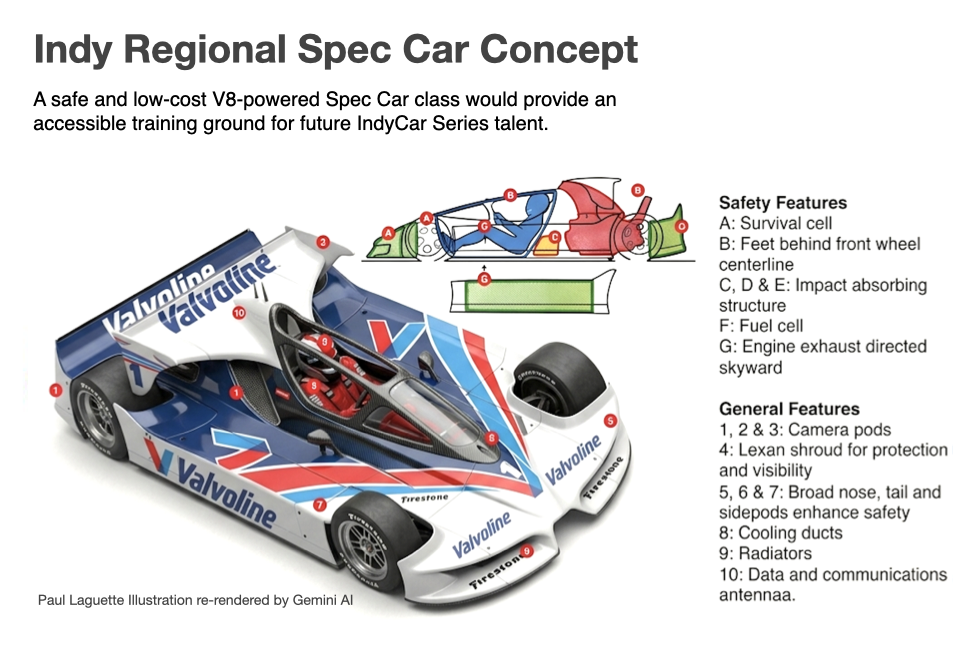
Let Them Prove It: In 2005 Paul Laguette and I wondered whether the next generation of IndyCar talent could be found at local tracks across North America by giving young drivers serious power much earlier. The car had to be safe, spectacular, affordable enough for a small local team, and versatile enough to race from bullrings to road courses. Rather than asking talent to spend years in small, underpowered formula cars, why not give them V8 power, with all the speed and responsibility that came with it, and create a path for drivers and their followings to grow all the way to Indianapolis?
How the Indy car became a formula car
Jack Brabham arrived at Indianapolis in 1961 with an underpowered rear-engine Cooper that was much faster through the corners than the traditional roadsters. Dan Gurney understood what it meant. After driving Mickey Thompson's rear-engine car in 1962, he brought Colin Chapman and Ford together. The Lotus-Ford program brought Formula One design thinking, a major American manufacturer and a different racing culture into Indianapolis.
Dan was reacting to what Brabham had demonstrated, but he was not merely adapting a car. He assembled the people and resources needed to change the direction of the sport.
A revolution at Indy powered by Ford
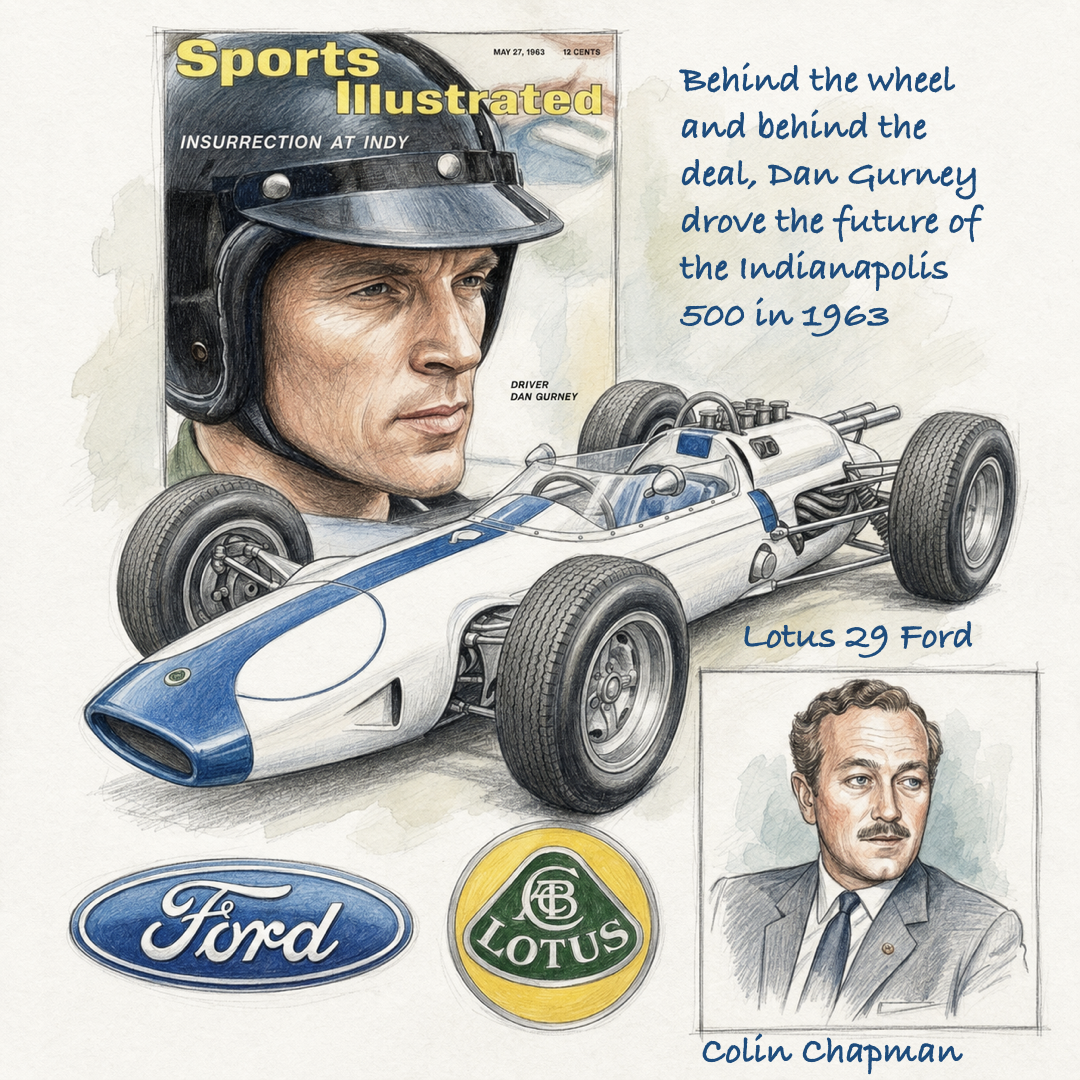
Dan Gurney saw it first. My hero could see where the sport was headed before the men he raced against, and he went after it. His actions remade Indy car racing. Not just a formula car in the image of Formula One, but a whole business model behind it, big money and big expectations, and an audience that devoured it. He poured accelerant on the culture and the presence of the Indianapolis 500. His one real regret was downforce, and how much of it the sport let in. He never had any use for a spec car that made everyone the same and left nothing to invent.
Ideas that ran both ways
Roger Penske and Vel's Parnelli Jones Racing carried that exchange further when both entered Formula One in 1974. Their programs ended in 1976, but the same organizations and designers applied what they had learned to Indy cars built around the Cosworth architecture.
Parnelli's Formula One program led into the VPJ6 Indy car and the privately developed turbocharged version of the Cosworth DFV that became the DFX. Cosworth took over its development and established its operation in Torrance. The engine won ten consecutive Indianapolis 500s from 1978 through 1987.
The Penske lineage is more complicated. The PC-4 was the final Penske Formula One car. Penske began 1977 with McLaren M24s before Geoff Ferris produced the one-off PC-5, essentially a Penske-built copy of the M24 and a test bed for what followed. The PC-6 of 1978 was the first fully realized Penske Indy car, combining knowledge from the PC-4 program with what the team had learned running the McLaren.
McLaren belongs at the center of the exchange. Its M16 Indy car helped shape the M23 Formula One car. McLaren then carried much of the M23 back into Indianapolis through the DFX-powered M24. The ideas were moving in both directions.
John Barnard moved from McLaren to Parnelli, designed around the DFX, then created Jim Hall's ground-effect Chaparral 2K before returning to McLaren. The Longhorn was adapted from the Williams FW07. March turned its Formula One design base into a successful customer Indy car. Lola and Reynard followed with increasingly sophisticated products drawn from a culture that moved among Formula One, Formula 3000, Formula 3, sports cars and IndyCar.
IndyCar’s identity and cultural transformation
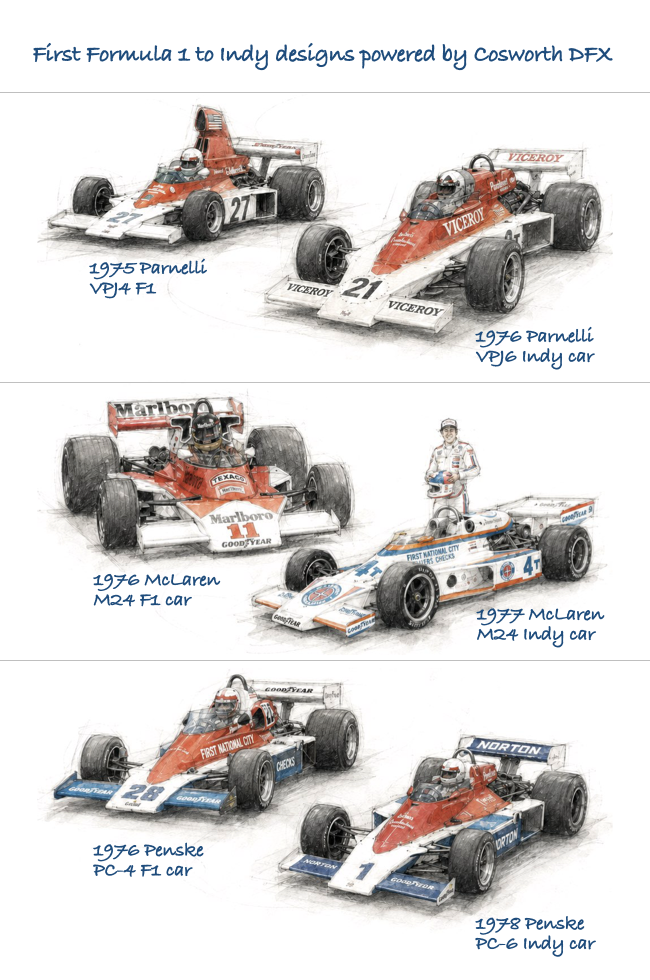
The Formula One accent grew stronger: By the mid-1970s the Formula One programs of Vel's Parnelli Jones, McLaren and Penske were feeding straight into Indy car design, and the cars looked the part. More like Formula One than ever, the difference down to turbocharging, far higher top speeds, and a series still built mostly for ovals. That last part would soon change too.
From builders to customers
By the 1980s, IndyCar was no longer importing the occasional idea. It was importing the constructor system that produced the ideas.
Teams could buy a highly developed car instead of maintaining the people and facilities required to create one. Fields became technically stronger, while constructors spread development expense across several customers.
It also changed the role of the team. The question gradually moved from who could build the best car to who could extract the most from the best available car.
There was still competition among March, Lola, Penske, Eagle and later Reynard and Swift. Choosing the wrong chassis could cost a team a season, while a constructor that fell behind could lose its customers. That produced visible change but also fed an expensive replacement cycle.
The best and the worst of times
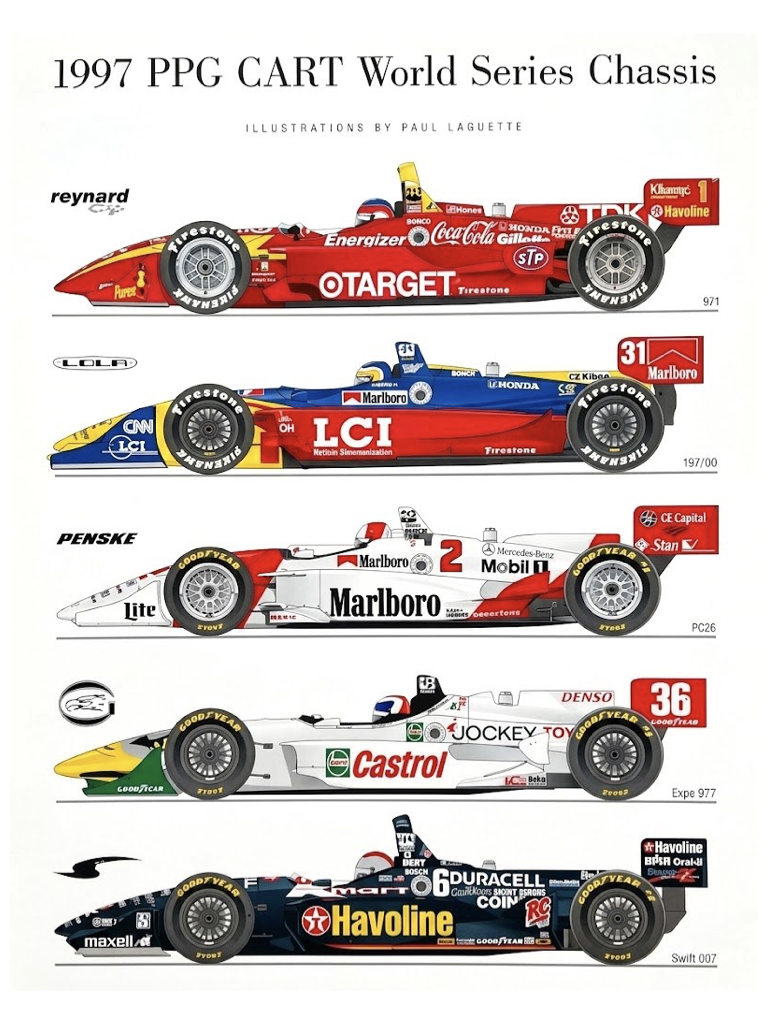
The peak, and the problem: Paul Laguette drew this poster for Pfanner Communications, in 1997, when we published the CART fan guide. The series had reached the high point of the modern era, five chassis makers and four engine suppliers on the grid. Today IndyCar runs on two engine manufacturers and a single chassis. In the CART era speeds were climbing toward numbers that scared people for a deadly reason. The costs were climbing just as fast. It was as good as it got, and it still couldn't last. Without the Indianapolis 500 it had no future.
The long and costly reaction
The CART and IRL split added another set of reactions. The IRL looked backward toward lower costs, American short-track drivers, production-based engines and oval racing. CART continued with international drivers, turbocharged engines and sophisticated road-racing cars. Both sides suffered serious safety problems and spent enormous sums defending their versions of what Indy car racing should be.
Chasing the wrong question
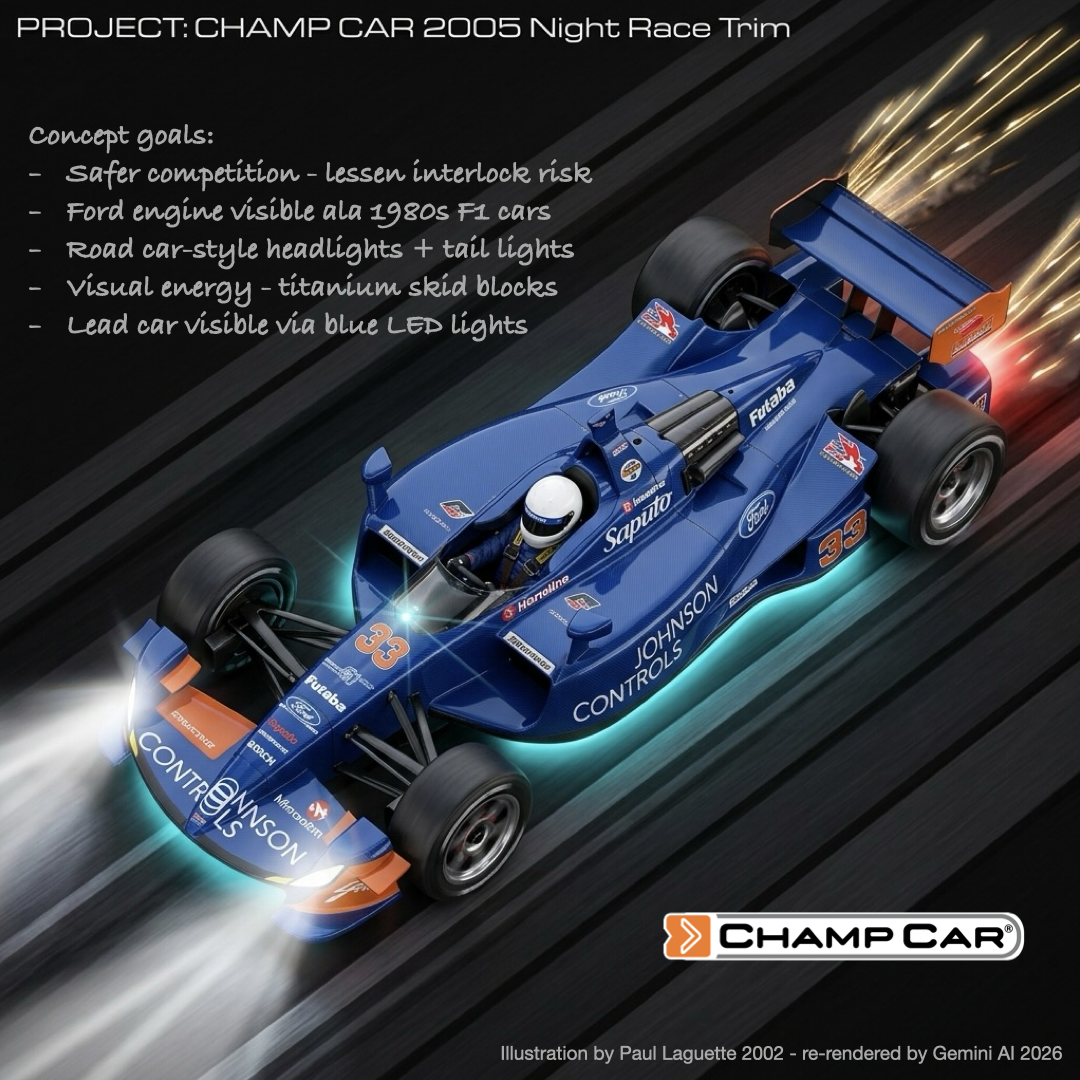
When the future became a Hail-Mary: During 2002 and 2003, CART CEO Chris Pook assigned the series branding and advertising work to our Pfanner Communications team, then operating under the Contact Agency name during Haymarket Publishing’s majority ownership of RACER Communications. Long Beach and other strong events remained, but leading CART teams were moving to the IRL alongside Honda and Toyota, while Mercedes-Benz was already gone. Survival increasingly pointed toward one car for everyone, the opposite of CART’s original premise. As the series tried to rebuild itself around Ford-Cosworth power and the Champ Car branding we had created, we also explored an “ownable” new identity through a car concept suitable for night racing on any type of circuit. Paul Laguette’s illustration was strong, but CART faced much larger challenges. The car went no further, but the series rebrand was introduced in January 2003.
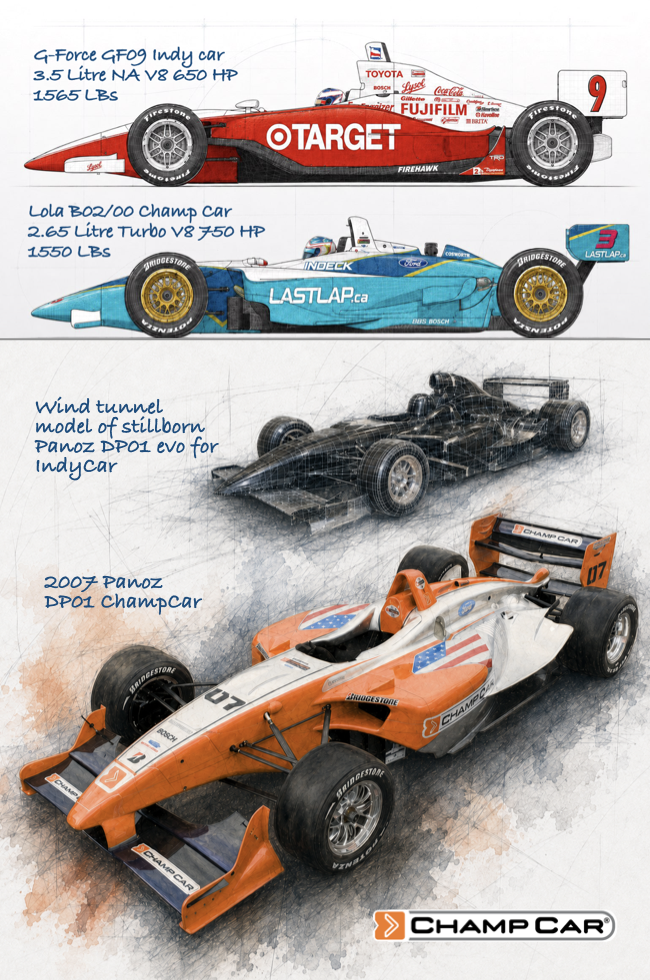
Proving the car wasn't the answer: On December 16, 2003, CART filed for bankruptcy. I was in the building. We had rebranded the series from CART to Champ Car with Chris Pook, and now the whole thing built on great cars and star drivers couldn't save itself. Standing there, I had to question a belief system I'd built around a sport I grew up loving. The Speedway never lost its value through any of it. That was where my faith went. Champ Car's last answer was still a car, the fine Panoz DP01, gone by 2008 when the series folded into IndyCar. By then both sides had become spec racing, and the car had become equipment.
Take the downforce away
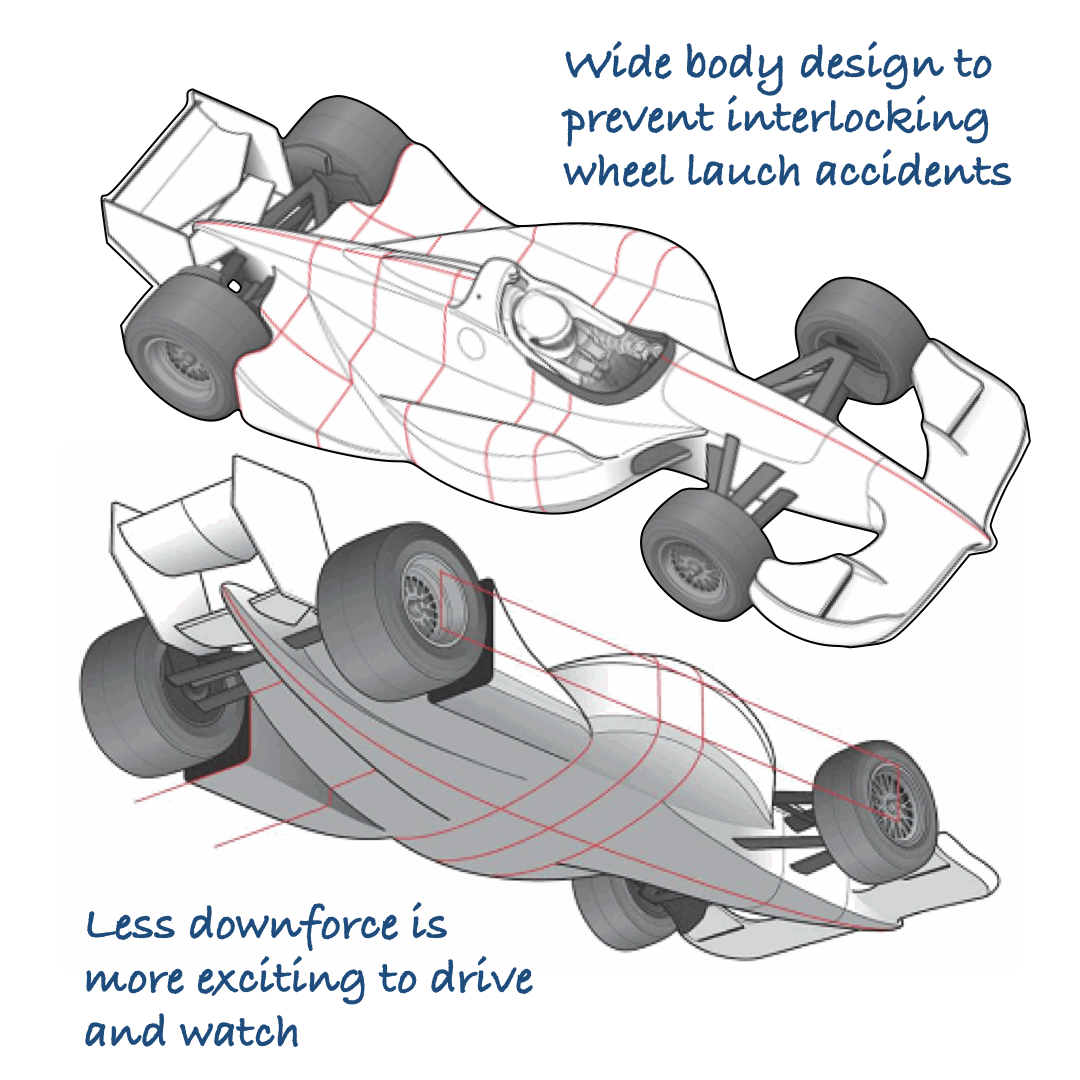
Bruce Ashmore's 2011 Indy car, drawn in 2008: Ashmore had been Lola's chief Indy car designer and later a Reynard development engineer, and he'd spent years on CART's rules committee. Two years before IndyCar went looking for its next car, Honda asked him to write a white paper on what the 2011 car should be. He turned against his own long faith in downforce. Cut it to a quarter of what it was, raise the power, and put the corners back in the driver's hands. Then close the bodywork out to the edge of the tires so wheels couldn't interlock and launch one car off another. By his own account he'd come around to what Andretti and Rahal had been arguing for years. Paul Laguette illustrated the concept independently. I wasn't involved in this one.
IndyCar’s post unification chassis reset
The 2010 selection process produced proposals from BAT, Dallara, DeltaWing, Lola and Swift. They were strikingly different because their creators were not answering the same question. DeltaWing focused on mass, drag and efficiency. Lola offered continuity. Swift produced a dramatic visual statement. Dallara presented the balance of safety, cost and practicality that IndyCar chose.
The DW12 was an understandable response to what the sport had endured. It improved safety, controlled capital expense and gave a reunified series a stable platform. Dallara has been an excellent partner and delivered what IndyCar asked it to deliver.
The search for a better way forward
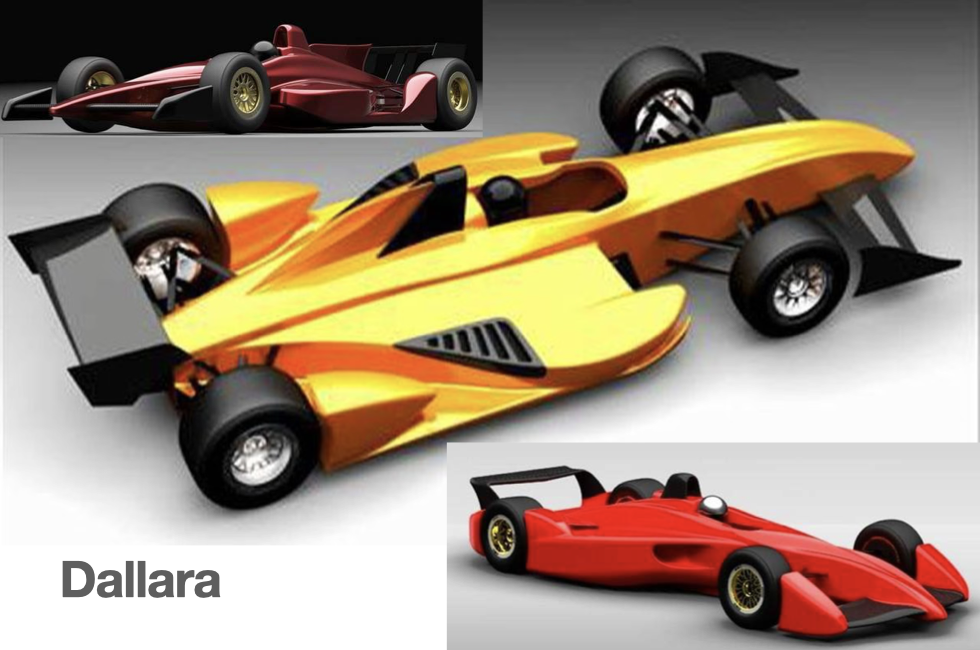
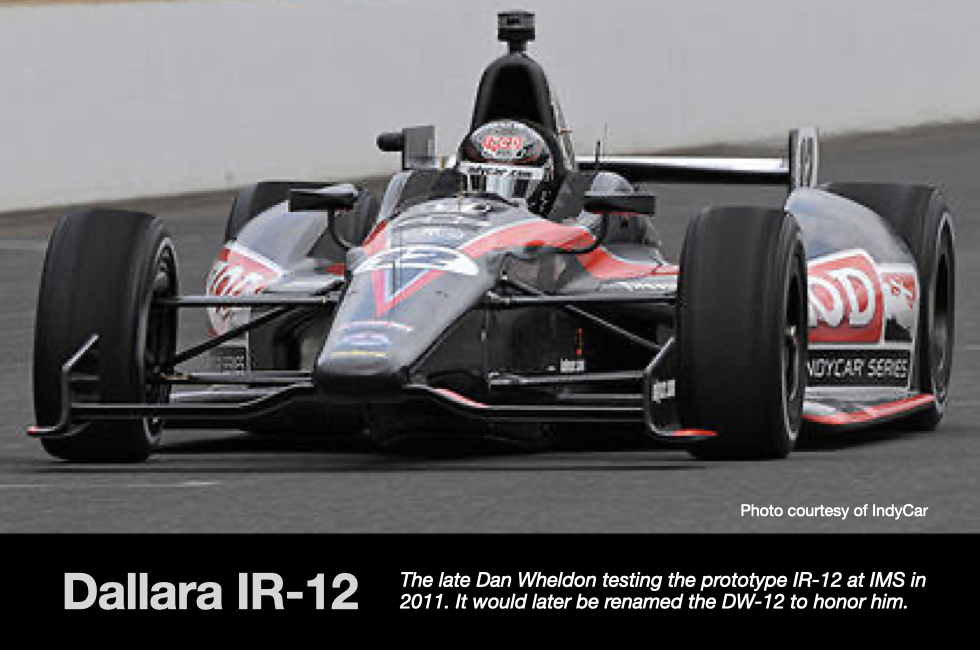
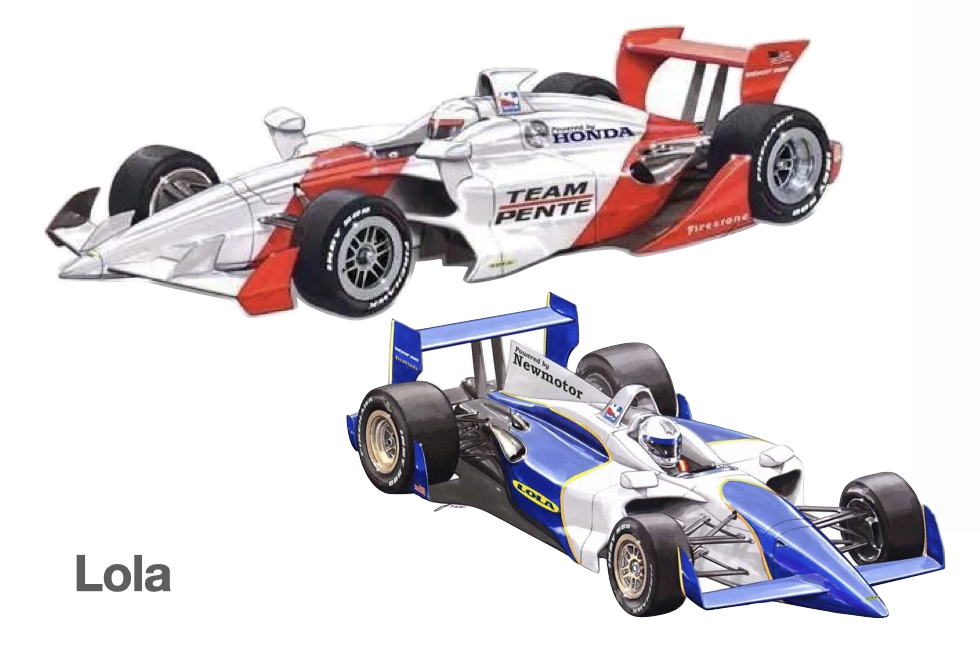
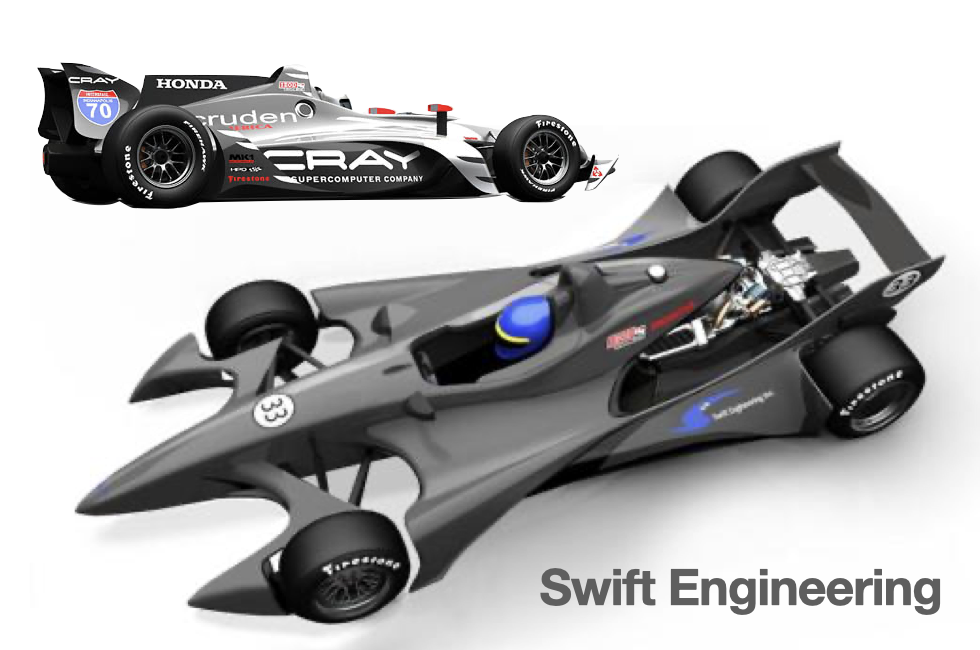
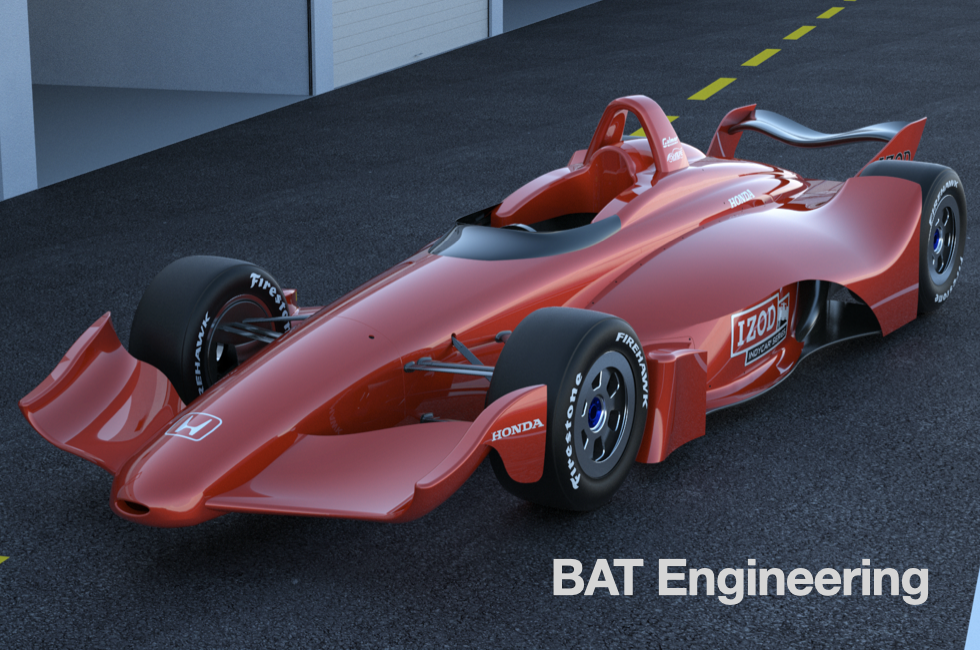
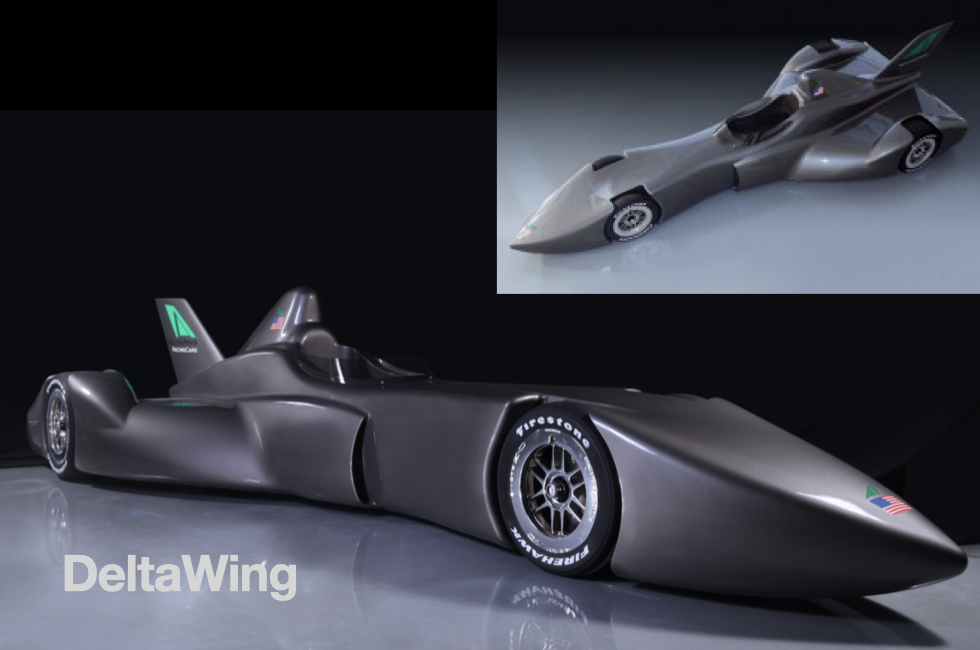
Options explored in making the right decision: In 2010 IndyCar solicited bids for its next chassis, and five companies answered. The image gallery shows: Dallara, the incumbent and the series' de facto spec provider. Lola, which had raced at Indianapolis until the CART/IRL split and had become the de facto chassis of choice for the Champ Car Series until the introduction of the Panoz DP01 in 2007, before that series merged with IndyCar in 2008. Swift Engineering, which built everything from Formula Fords to Indy cars. BAT Engineering, a newcomer. And the radical DeltaWing. So you can't say there weren't choices. In the end the decision leaned on stability, long-term commitment and experience with the category, and it went to the Dallara IR-12. It began testing in 2011 in the hands of the late Dan Wheldon, and when he was killed at the end of that season the car was renamed the DW12 in his honor. The DW12 raced far longer than anyone expected. When the checkered flag falls on the final race of the 2027 NTT IndyCar Series season, it will have been on track for 17 years, since testing began in the summer of 2011.
The long run: Marshall Pruett, my multi-talented omni-creative friend with a race car engineering background, recently put together an excellent video tracing the DW12's long life in competition and its many evolutions.
The car as equipment
Over time, that stability hardened into stasis. The team became an operator and developer of a prescribed tool. The manufacturer supplied an engine and, for a time, differentiated bodywork. The sanctioning body increasingly defined the boundaries of technical ambition. The car increasingly became equipment.
There is an irony in what happened elsewhere. Swift moved into aerospace, All American Racers applied its capabilities beyond race cars, and Dallara now has an aerospace business. Engineering talent tends to follow problems that remain open.
The equipment model makes sense to a sports entertainment company. A baseball league does not need competing baseballs, and a broadcaster would naturally rather build recognition around athletes than machinery. A parity appliance reduces the chance that equipment will overwhelm the human contest.
But an Indy car was never just the ball.
It carried the identity of the person who conceived it, the company that built it, the manufacturer that powered it and the team that developed it. People came to Indianapolis to see what was new because the machinery was part of the competition. When the car is reduced to equipment, IndyCar gives up one of the things that distinguishes it from almost every other sport.
I do not think there was one breakpoint. It was not simply wings, turbocharging, ground effects, European constructors or modern safety requirements. Those developments were often necessary and sometimes transformative.
The breakpoint arrived gradually, as the governing question changed. Instead of asking what racing could discover or prove, the sport increasingly asked how much it could control. How could it contain cost, equalize opportunity, improve safety, preserve the field and prevent another destructive technical contest?
Those were responsible questions whose cumulative answer was a car that is safer, closer, more stable and less meaningful.
A new beginning: IndyCar's own detailed video look at the new IR-28 that races in 2028, safer, faster and lighter, and no accident that it's built the way it is.
Discovery and Inspiration
A clean-sheet IndyCar cannot begin with another drawing. It has to identify a problem worth solving, but discovery alone is not enough. The competition also has to inspire something in the people watching it.
IndyCar once created awe around its machines and the people brave enough to drive them. It created curiosity about how the cars worked, devotion to drivers, teams and manufacturers, and a belief that progress was taking place in public.
Those are separate attractors. Not everyone enters a sport through the same door. One person may be drawn by the driver, another by engineering, speed, design, danger, history, community or a manufacturer. Formula One has done an exceptional job of adding fashion, celebrity, luxury and an aspirational lifestyle to its sporting and technical appeal. That is one successful model, but it is not the only one.
IndyCar can build its own layers of meaning around what Indianapolis was created to do. It can make the driver decisive without making the car anonymous. It can control destructive spending and still leave room for authorship. Close competition doesn't have to make everyone in it look interchangeable.
Before anyone draws the next Indy car, the sport needs to place three questions at the top of the page:
What are we trying to discover?
Who are we trying to attract and inspire?
Are we creating something relevant to people born in this century?
Other essays on the next Indy Car after the IR-28
The Fastest Thing off the Shelf
It Was Never Just the Car, It’s Who Gets the Seat
Paul Pfanner on the launch of the 2028 IR-28 Indy car
Pfanner Advantage works with clients to turn change into advantage at the intersection of mobility, motorsport, media, technology, and marketing. Learn more or start a conversation: contact us today.
Paul Pfanner’s recent Shift Happens Insights:
The Advantage Journal arrives every week. What matters in sport, mobility, media, and technology — curated and contextualized by Bill Sparks, Bill Long, and Paul Pfanner. No hedging. No filler. Subscribe — It’s Free

