
The Organizational Immune System
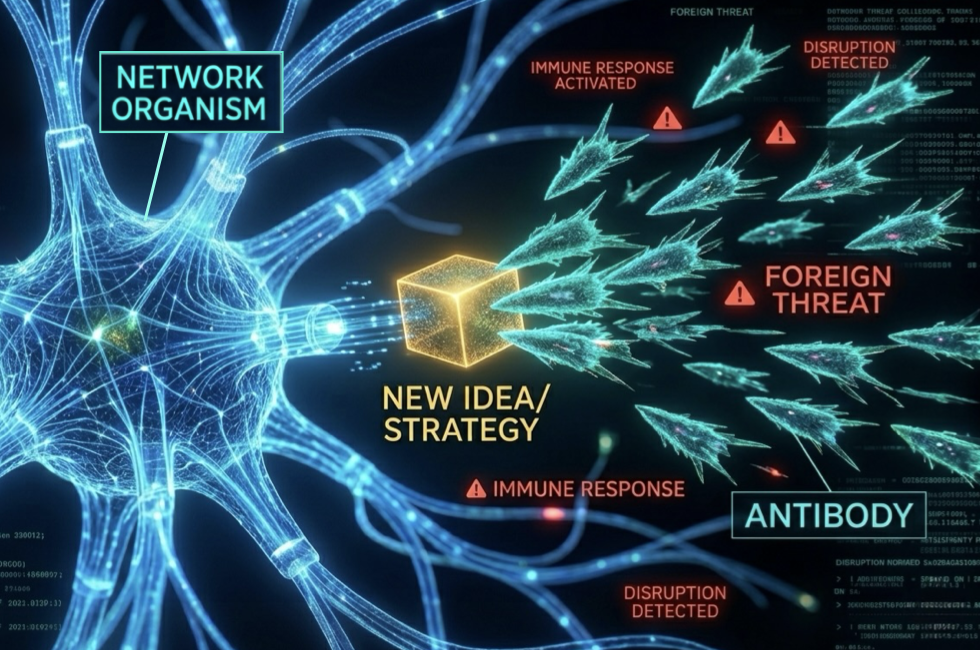
The organizational immune system doesn't ask whether your idea is good. It asks whether it's foreign.
Every organization has an immune system — a collection of cultural, political, and psychological forces designed to protect the status quo. In his latest Cold Read, Bill Sparks explores why it attacks your best ideas, and how the most effective change leaders learn to work with it.
How Companies Defeat Their Own Best Ideas
There is a moment in every transformation initiative when the organization turns on itself. It rarely comes with a warning. You won't find it on a risk register or in a stakeholder analysis. What happens is quieter: a Slack channel where people share "concerns" about the new direction. A senior engineer who quietly begins rebuilding the old system "for backup purposes." A VP who asks one too many clarifying questions in every meeting about the new strategy, each one more skeptical than the last. Within ninety days, the change that leadership championed with all-hands presentations and executive sponsorships has been gutted. Not by competitors, not by market conditions, but by the organization's own internal defenses.
This is the organizational immune system. And if you're leading change and you haven't accounted for it, you're already losing.
The Phenomenon: What It Looks Like
Every organization has an immune system. It's the collection of cultural, political, and psychological forces that converge to protect the status quo. And it is spectacularly effective.
Consider the company that decided to modernize its sales process. Leadership brought in a consultant, ran a pilot, rolled out new software, and trained the team. Within ninety days, the sales reps had figured out how to log activity in the new system while continuing to sell the old way. The CRM was a formality. The real work happened over dinner, on the phone, and through relationships built over years. The new system captured none of this, and none of the sales reps were willing to surrender to a digital process they didn't trust.
The leadership team saw this as a training problem. They were wrong. They were seeing the immune system at work.
The organizational immune system operates at every level. At the individual level, it shows up as the quiet anxiety people feel when their familiar ways of working are threatened. At the team level, it manifests as norms that punish people who adopt new behaviors before their peers — the "early adopter penalty." At the leadership level, it appears as political coalitions that form to protect existing budgets, territories, and decision-making authority. And at the cultural level, it is the gravitational pull toward "how we've always done things here" — a force so powerful that people enforce it on each other without being asked.
As Gilley, Godek, and Gilley documented in their foundational research on this phenomenon, organizations possess a powerful immune system that defends the status quo and actively resists change. Not because the change is bad, but because the immune system cannot distinguish between threats. It attacks everything foreign. (Gilley, A., Godek, M., & Gilley, J., 2009)
One important distinction: the organizational immune system doesn't only reject bad ideas. It rejects all foreign bodies, including the good ones. In fact, it is often most active against changes that are objectively correct, because correct changes carry a hidden threat: they imply that what came before was wrong. And "wrong" is personal when it touches people's identities, their professional self-conception, and their years of accumulated expertise.

When you change the order of things, you are implicitly telling people the expertise they've spent decades building is no longer the relevant expertise. No one accepts that gracefully.
The Root Causes: Why It Exists
The immune system isn't a sign of a sick organization. It's a sign of one that's functioning. In the same way that a fever is a sign that your body is fighting, not failing.
Psychological safety loss
Change threatens the mental maps that people have spent years constructing. When you tell a senior marketing manager that the entire demand generation model is shifting, you're not just changing a process. You're asking them to operate in a territory where their expertise no longer applies. Research from MIT Sloan Management Review confirms that "change is frequently destabilizing to employees and can result in low morale and reduced productivity." The antidote isn't accepting the change faster, but restoring a sense of agency and control. (Smallman, N. & Parry, D., MIT Sloan Management Review)
Political defense
Every organization has internal power structures that are maintained through control of information, relationships, and processes. Change threatens those power structures, and the immune response is often orchestrated — consciously or not — by people protecting their territory. This is the form of resistance that looks like genuine disagreement but is actually self-interest dressed in the language of organizational concern.
Identity threat
"The way we do things here" is tied to personal identity in ways that are hard to overstate. People have built careers, reputations, and relationships around the current order of things. When you change that order, you are not just changing workflows — you are implicitly telling people that the expertise they've spent decades building is no longer the relevant expertise. No one accepts that gracefully.
Loss aversion
Decades of research in behavioral economics confirm that people are motivated more strongly by the fear of loss than by the prospect of making the equivalent gain. (American Psychological Association, referencing Kahneman and Tversky's foundational Prospect Theory research) This asymmetry — the brain's tendency to weigh potential losses roughly twice as heavily as equivalent gains — means that as a leader, you are fighting biology when you push change without accounting for the fear you're generating. This isn't a character flaw in your workforce. It's hardwired. Which means your change initiative needs to be designed around that reality.
Cultural inertia
Finally, there is the accumulated weight of every decision, habit, and relationship that has built up over the life of the organization. All of it pulls toward what already exists. Change management that ignores this gravity is change management that will fail.
The Framework: How to Work With (Not Against) the Immune System
Principle 1: Name it
The organizational immune system is most dangerous when it's invisible. The moment you name it — in your own thinking, and eventually with your team — you gain the ability to see it at work and work around it. Framing resistance as "the immune system responding" rather than "people being difficult" changes how you respond to it.
Principle 2: Introduce change in stages
The immune system responds to sudden invasion. Gradual exposure allows tolerance to build. The difference between a six-month rollout and a pilot-and-expand approach isn't just risk management — it's immunology.
Principle 3: Build psychological safety first
Research from MIT Sloan Management Review makes this explicit: the leaders who best help employees cope with destabilizing change are the ones who restore agency and autonomy first. Change on top of fear triggers defensive rejection. Change on top of trust gets absorbed. Before you announce a major transformation, invest in the relational capital that will make the organization willing to follow you into uncertain territory. (Smallman, N. & Parry, D.)
Principle 4: Make it theirs
When the organization feels that a change is its own idea, adoption happens faster and more durably. This is not manipulation. It's good leadership. The best change leaders shape the process so that the people affected by the change feel a sense of authorship over it. David Sluss of ESADE Business School, writing in MIT Sloan Management Review, identifies this as a core failure point: leaders fall into a "hero complex" — a toxic mix of seeking overinflated credit for the change and experiencing extreme psychological ownership of it. This blinds them to the input of others and triggers exactly the immune response that destroys change initiatives. (Sluss, D., MIT Sloan Management Review, October 2025)
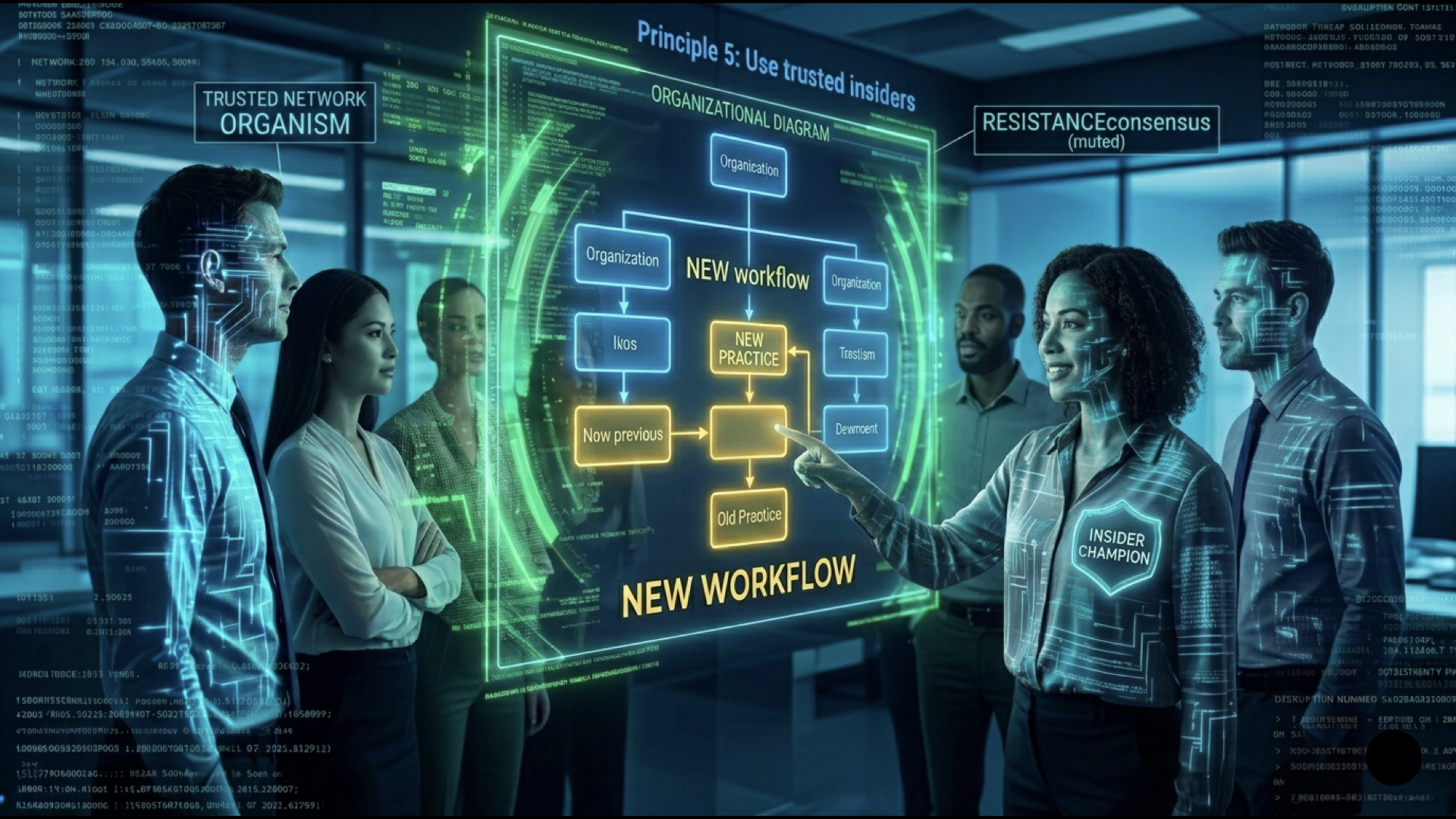
Outside advisors trigger immune responses by definition. The people the organization already trusts don't.
Principle 5: Use trusted insiders as change agents
Outside advisors trigger immune responses. They represent foreign bodies by definition. Insider champions — people the organization already trusts — don't trigger the same defensive reaction. Find the people who are already influential and make them the face of the change.
What Leaders Get Wrong
The "burn the ships" approach
Forcing change without exit routes triggers survival responses. You can't ask people to embrace uncertainty while simultaneously removing their sense of safety. A good example: technology migrations that force a hard cutover date often see a spike in "shadow IT" — people quietly maintaining spreadsheets, workarounds, and offline processes that replicate the old system. Leadership sees adoption metrics in the new platform and calls it a success. The real work is still happening somewhere else.
Messaging change as a solution to a problem
This one has a specific and under-appreciated consequence: it creates a cohort of defenders. The moment you imply that the old way was wrong, the people who built and championed the old way have a reputational stake in proving the new way is wrong. You've turned neutral bystanders into motivated opponents. Not because they're obstructionist, but because you've made it personal. A reframe that works: "We've grown beyond what this process was designed for" lands very differently than "This process isn't working."
Underestimating the grief cycle
Leaders who don't account for the grief cycle tend to move on to "implementation messaging" while large parts of the organization are still in anger or bargaining. The messages land in the wrong order: people are being told how to change before they've accepted that they're changing. A useful signal to watch for: when employees are asking the same foundational questions in month three that they were asking in month one, they haven't moved through denial yet. No matter what their calendar says.
Thinking a memo changes culture
The sharpest example here is the values statement. Almost every organization has one. Almost none of them match what actually gets rewarded, punished, or tolerated day to day. Employees learn culture by watching what happens when someone breaks a norm, not by reading what leadership says the norms are. If the memo announcing a new culture of "psychological safety" is followed by a manager who punishes a dissenting voice in a meeting, the memo is erased. The behavior is the message. Everything else is decoration.
The Paradox of Change Leadership
Here is the uncomfortable truth about leading transformation: the best change leaders are often indistinguishable from people who aren't doing anything.
They move slowly. They build consensus before announcing decisions. They introduce change in stages and then pause between stages to watch the immune response. They seem, from the outside, to be excessively cautious.
It seems contradictory, but the goal is never the speed of the change. It's the survival of the change. The ability to get it implemented well enough that it takes hold, delivers value, and becomes the new normal. Speed without absorption is just expensive disruption. As the old SEAL adage goes: slow is smooth, smooth is fast.
Before your next transformation initiative, do something simple: map your organization's immune system. Identify the antibodies. Understand what they'll attack and what they'll leave alone. Then design your change around that reality. Not around the optimistic assumption that a well-reasoned argument and executive sponsorship will be enough.
The immune system has been running your organization far longer than any individual leader has. It knows its terrain intimately: every fault line, every pressure point, every habit. The most effective change leaders aren't the ones who defeat it. They're the ones who learn to work with it.
The Advantage Journal arrives every week. What matters in sport, mobility, media, and technology — curated and contextualized by Bill Sparks, Bill Long, and Paul Pfanner. No hedging. No filler. Subscribe — It’s Free