
Now is Impatient

The pipe changed. The devotion didn't. The audience finds what moves them — wherever it runs.
The audience never bonded with the pipe. They bonded with what moved them — and they always found it, whatever it ran through. Paul Pfanner on what that means for every business that depends on being found, trusted, and chosen. Which is every business.
The Pipe Was Never the Point
In 1965, you didn't watch the Indianapolis 500 on television. You watched it in a theater.
Closed circuit. A screen. A crowd of strangers who had paid for the privilege of watching a race happen somewhere else in real time. It was a legitimate business model — sophisticated, profitable, built on the reasonable assumption that access was the product.
Within six years it was gone. ABC's same-day broadcast killed it completely. A better pipe replaced the old one, and the audience followed without hesitation.
The pipe that launched a devotion. The 1965 Indianapolis 500, brought to theaters across America on closed circuit television. The pipe is long gone. What it carried never left.
But here is what didn't change. The ten-year-old who watched Jim Clark win that race — and felt something lock into place that has never unlocked — didn't bond with the closed circuit model. He bonded with the race. With the driver. With the moment. With whatever speed and skill and consequence do to a human nervous system when witnessed at the right age.
The pipe changed. The devotion didn't.
That distinction is the most important thing happening in sports, media, and business right now. And most of the people running things haven't fully reckoned with it.
Intention Before the Revolution
The 1965 Indianapolis 500 was not just a race. It was a confirmation.
Dan Gurney had seen it coming three years earlier. After his qualifying run at Indianapolis in 1962, he flew directly to the Dutch Grand Prix, found Colin Chapman in the paddock, and made his case: a rear-engine Formula One car could win the Indianapolis 500. Chapman was skeptical. Gurney paid for his travel to come see it himself.
Then Gurney did something that separated him from every other driver of his generation. He connected Chapman to Ford. He saw the match — the premier Formula One chassis builder and the American industrial giant looking to make its mark in racing — and he made it happen. Not from the cockpit. From the mind.
The Lotus-Ford partnership put Jim Clark in Victory Lane in 1965 and ended the front-engine roadster era permanently. Twenty-seven of the thirty-three starters that day were rear-engine machines. The revolution Gurney had catalyzed three years earlier was complete.
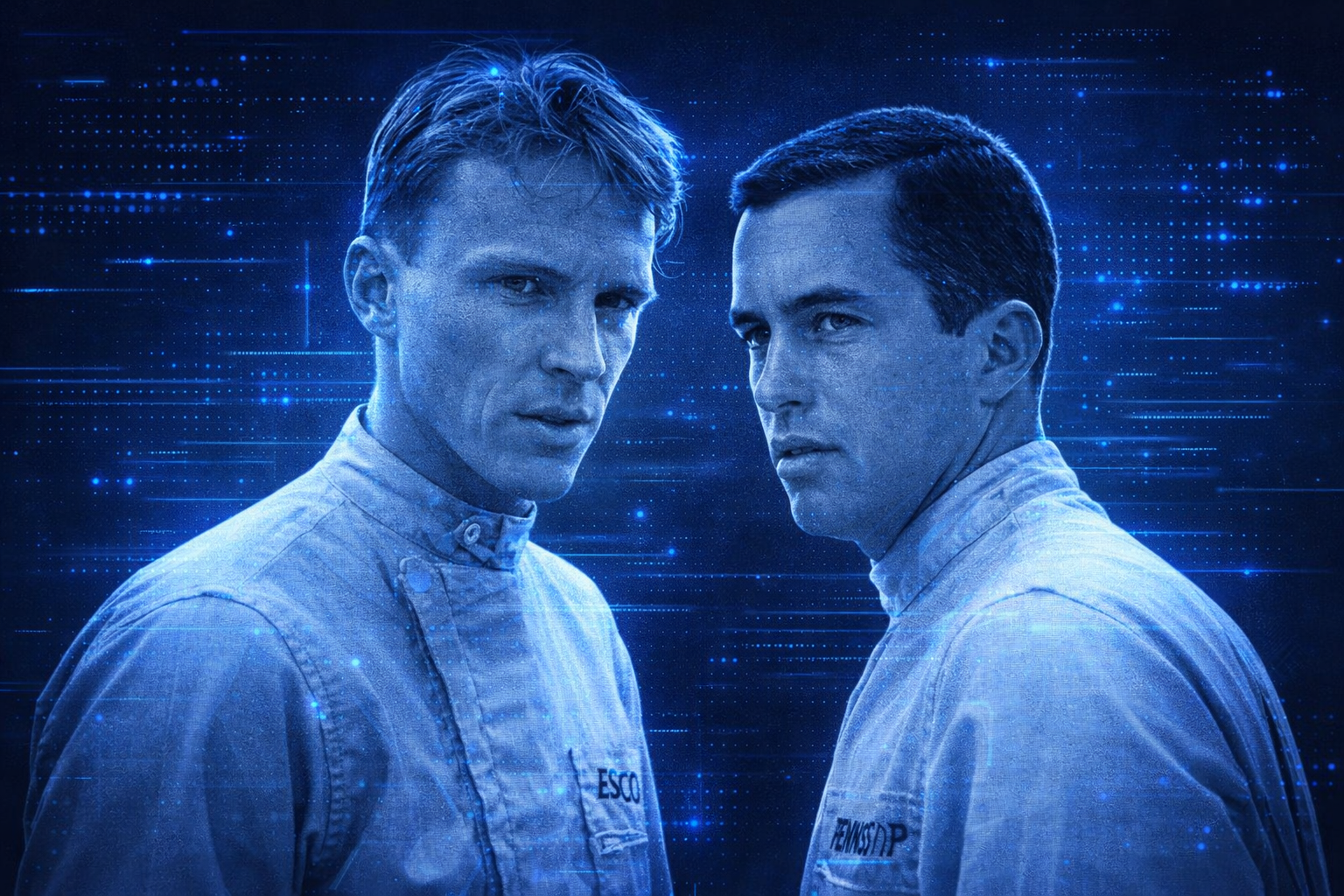
Dan Gurney and Roger Penske. Two drivers. Two minds. Both read the moment with intention. The race to Next has always belonged to the ones who decide what they're building before the field knows the race has changed.
That same year, Roger Penske read the same moment and made his own move. He retired as a driver and opened his first Chevrolet dealership in Philadelphia. He had decided what he intended to build and moved toward it without hesitation.
Neither man reacted to the future. Both intended it.
That is the distinction that matters. Not who learns faster — though that matters. Not who sees the shift coming — though that matters too. The people who create the future read Now with intention. They move toward what they have decided to build, not away from what they have decided to fear.
Next is fueled by intention. Not reaction.
A Letter Arrives
A letter crossed my Twitter/X feed recently — posted publicly by Sports Business Journal reporter Adam Stern. It was written by one of the most accomplished builders in the history of American motorsport, a man whose strategic instincts have won races, championships, and business empires across six decades. It was addressed to the Chairman of the Federal Communications Commission. It made an eloquent, data-grounded case for protecting the availability of professional sports on broadcast television.
The argument was sound. The data was real. The advocacy for fans was genuine. I read it with respect.
And then I sat with the question it didn't ask.
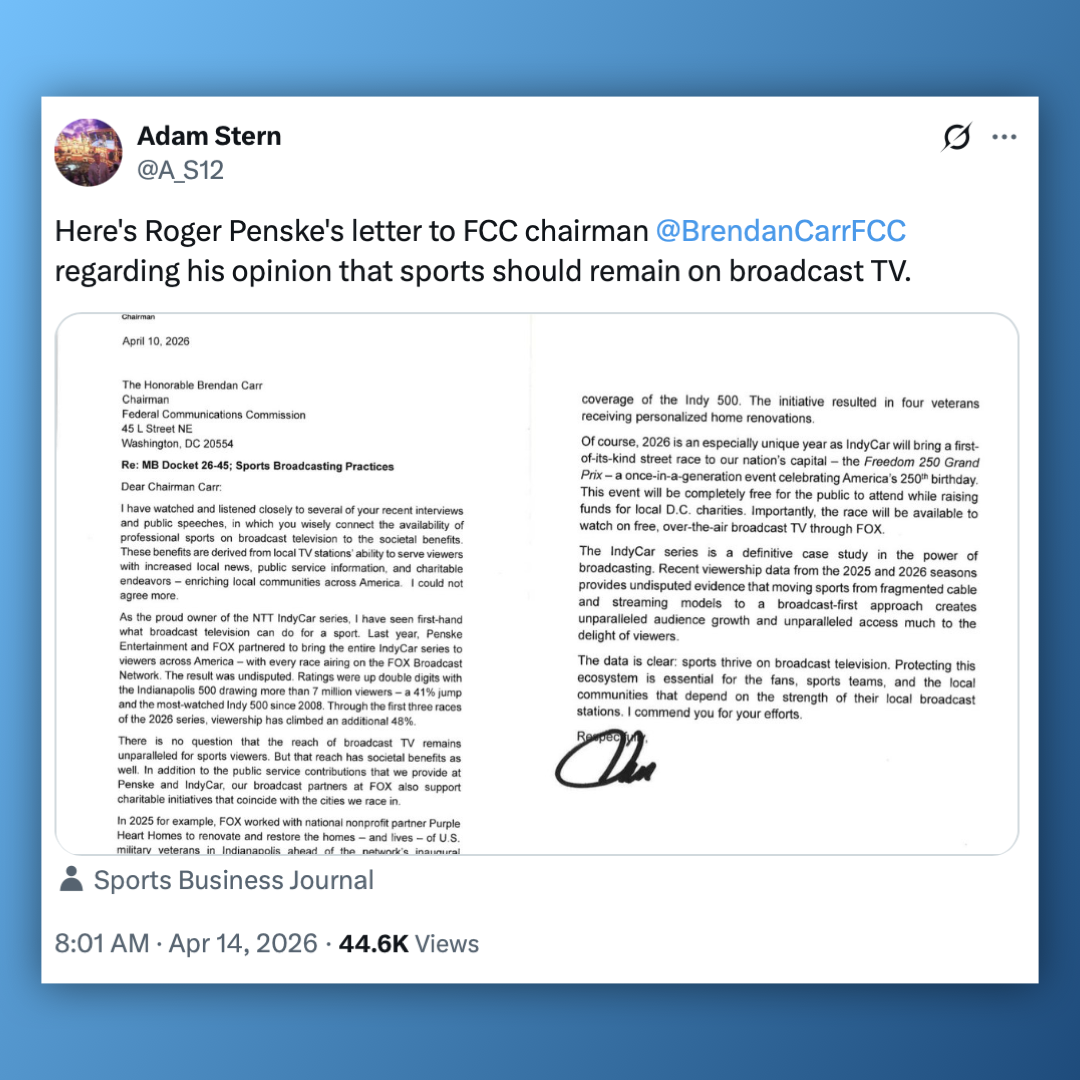
Roger Penske's April 10, 2026 letter to FCC Chairman Brendan Carr, shared publicly by Sports Business Journal reporter Adam Stern. The letter makes a compelling, data-grounded case for protecting sports on broadcast television — and surfaces the question this essay addresses: do you know what you actually own?
The letter was written to protect a pipe. A good pipe, a proven pipe, a pipe that has delivered real value to real audiences. But a pipe nonetheless. And pipes have a way of being replaced — regardless of how well they perform, regardless of the arguments made on their behalf, regardless of the letters written to the people who regulate them.
The closed circuit theater was a good pipe too.
What makes the letter worth examining carefully is its full context. Last July, Fox Corporation acquired a one-third equity stake in Penske Entertainment — the parent company of IndyCar and Indianapolis Motor Speedway — for approximately $135 million. Roger Penske and Fox Sports CEO Eric Shanks are now business partners in the fullest sense. The broadcast advocacy and the business partnership are aligned. That alignment is understandable. It is also instructive.
Roger Penske understands the race to Next better than almost anyone alive. His record in race strategy — the instinct for position, timing, when to push and when to manage — is without parallel in American motorsport. There is a legitimate race strategy called playing for the caution. You manage your position. You wait for the field to compress and the competition to reset. It works. It has won races.
But the race to Next doesn't have a safety car. The laps keep running. The field keeps spreading. And the question the letter doesn't ask is the one that changes everything:
Do you know what you actually own?
The Audience the Data Reveals
IndyCar knows the question better than most. For years, its TV audience has skewed older than any major American sport — 70 percent over 55 as recently as 2023, with 45 percent aged 65 or older. The series has been candid about it: the PGA Tour was the closest comparable. That is not where a sport looking toward the next fifty years wants to find itself on the demographic chart.
The FOX partnership has begun moving the needle. The 2025 season registered 81 percent growth in the 18-34 demographic. The first three races of 2026 each averaged more than one million viewers — the first time that has happened since open-wheel racing reunified in 2008. These are not small numbers.
But notice what actually happened. Fox didn't just buy the broadcast rights. They bought a piece of the content. A one-third stake in the series itself. In the Indianapolis Motor Speedway. In the story, the history, the relationship with the audience.
That is not a pipe strategy. That is a content strategy. And the audience growth followed.
The pipe is working because the content is right. Not the other way around.
When the Pipe Leaves You
In 1975, a Kodak engineer built the first digital camera. It was unmistakably the future.
Kodak locked it in a drawer.
Not because they were foolish. Because they were successful. Film was a two-billion-dollar annual business. And when you believe you have more to lose than you have to gain — as my friend Jim Hancock observed while building No Fear into a cultural force in the 1990s — you've already lost. Not because the threat is real. Because the posture has shifted from building to protecting. And protecting is not a strategy. It's a position.
Kodak filed for bankruptcy in 2012.
This past winter, the regional sports network model — the dominant local distribution infrastructure for professional baseball for four decades — collapsed. Not gradually. Not theoretically. Nine MLB teams left their RSN deals. Close to half the league now controls its own local television rights, producing and distributing its own content directly.
These teams did not do this because they are visionaries. They did it because the pipe left them.
And in that moment of forced clarity, something that has always been true became impossible to ignore: the game was never the pipe. The team was never the pipe. The relationship with the fan was never the pipe.
The asset was always the content.
Every Brand Is Now a Media Company
The sport. The team. The series. The manufacturer. The sponsor.
Every brand is now a media company. The ones who recognize it are building content businesses, distribution platforms, and direct relationships with their audiences. The ones who don't are writing letters asking someone else to protect the pipe they used to rent.
The audience has always known the difference. They don't bond with the distribution model. They bond with the story, the driver, the moment, the truth inside the experience. They found Jim Clark on a closed circuit screen in 1965 and they would have found him anywhere.
They always find what moves them.
The question is whether the people who own what moves them understand what they're actually holding.
Now Is Impatient
Pfanner Advantage works with clients to turn change into advantage at the intersection of mobility, motorsport, media, technology, and marketing. Learn more or start a conversation: contact us today.
The Advantage Journal arrives every week. What matters in sport, mobility, media, and technology — curated and contextualized by Bill Sparks, Bill Long, and Paul Pfanner. No hedging. No filler. Subscribe — It’s Free

